# Bob - A Package Builder
[](https://crates.io/crates/pkgbob)
[](https://docs.rs/pkgbob)
[](https://github.com/jperkin/bob)
Bob's goal is to become a simple but powerful, complete, and user-friendly
utility for building pkgsrc packages.
## Screencasts
- Example build session
[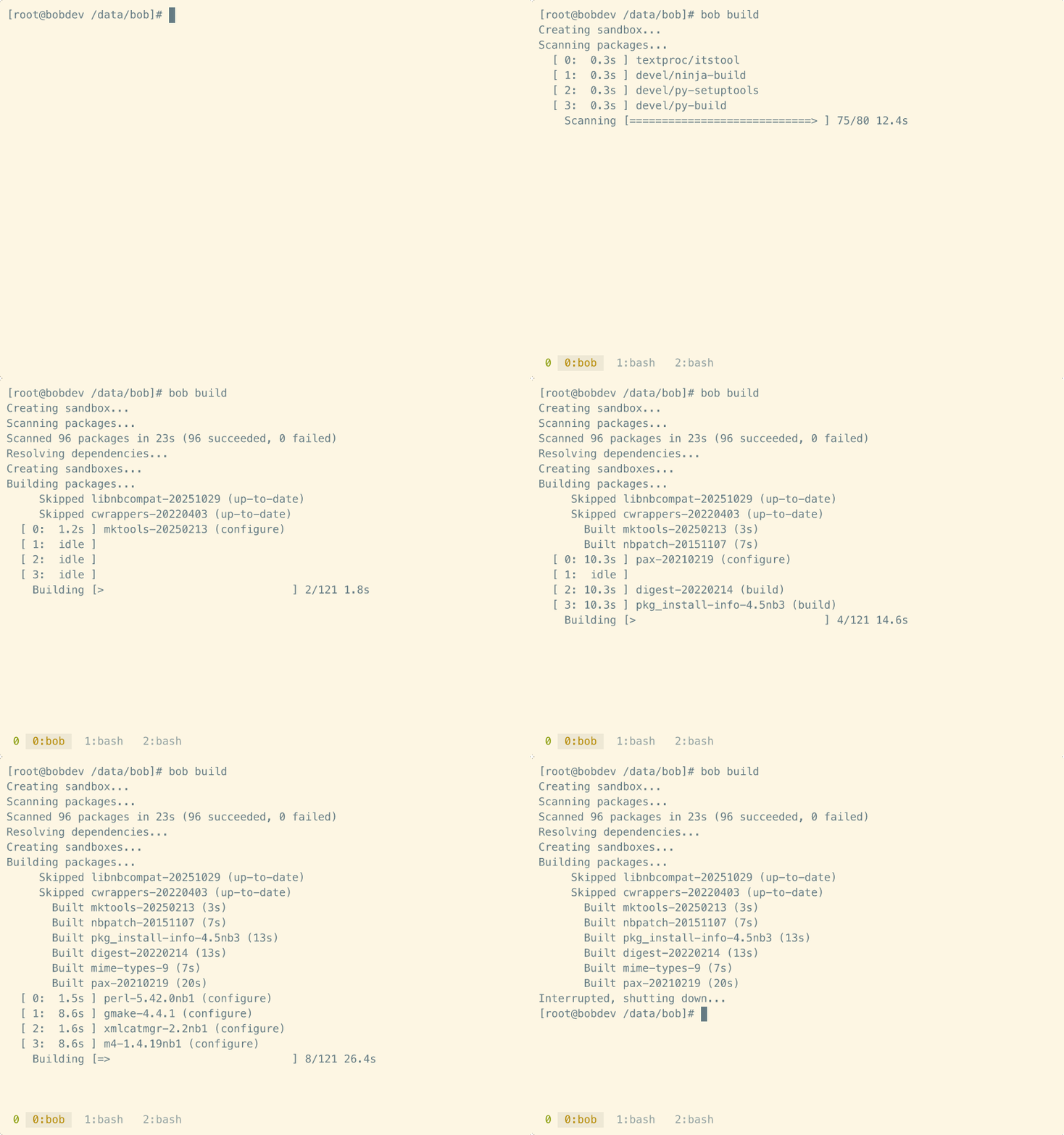](https://asciinema.org/a/763171)
- Live build log viewer
[](https://asciinema.org/a/763316)
## Features
- [x] Powerful and fast, but easy to use.
- [x] Native sandbox implementation for common operating systems.
- [x] Threaded scan and build processes inside concurrent sandboxes.
- [x] [Ratatui](https://ratatui.rs)-based user interface.
- [x] Simple, flexible, powerful Lua-based configuration.
- [x] Easily support multiple build configurations.
Bob should work pretty much out-of-the-box on NetBSD, Linux, and illumos.
Bob works on macOS, but due to Apple, there is a lot of additional sandbox work
to do before things work correctly (e.g. name resolution inside chroot). This
will be implemented in due course.
## Getting Started
Install bob, or upgrade an existing install to the latest release.
```
$ cargo install pkgbob
```
Generate directory containing the configuration file and build scripts. This
is also where by default all data will be generated. `/bob` here is used as
an example, but this can be any location. You may wish to put this directory
under version control to track changes.
You may wish to build multiple package sets (e.g. `netbsd-x86_64` and
`netbsd-i386`) in which case you can simply create a configuration directory
for each set.
```
$ bob init /bob
```
Customise the config. The defaults are designed to work mostly out of the
box, but you are likely to want to change some things, for example which
packages to build, or any additional mount points required.
```
$ cd /bob
$ vi config.lua
```
On non-NetBSD systems you will also need a pkgsrc bootstrap kit. By default
bob will look for `bootstrap.tar.gz` inside the init directory.
When you are happy with the configuration:
```
$ bob build
```
will proceed to build all of the packages you have requested.
During the build phase you can press 'v' to toggle between the default inline
progress bars and a full-screen paned layout that shows live build logs to
track progress.
Bob should handle interruptions gracefully, and automatically clean up
sandboxes, etc. If the build is interrupted, you can resume with `bob build,
and bob should continue from where it left off.
After a build has completed, and some time later you wish to update pkgsrc to
build updated packages, you will first need to run:
```
$ bob clean
```
to clear the previous database state, before running a new `bob build`.
## Design Goals
There are two main methods currently used to update a pkgsrc installation.
Update-in-place using tools such as `pkg_chk` or `pkg_rolling-replace`.
These tools operate directly on the target host, upgrading packages in
turn. These are the simplest to set up and use, and so are reasonable
popular amongst users, but have some major drawbacks:
* Upgrading in place means that if a build error is encountered, the
system may be left in a degraded state until the issue is fixed.
* Building directly on the system may end up finding tools and libraries on
the host system that wouldn't be found otherwise, which may mask issues that
would be exposed when building in a clean environment.
* Only one build can happen at a time, and dependency issues aren't discovered
until build time.
Bulk builds using `pbulk` allow packages to be built inside clean sandboxes,
and with the appropriate patches mean that builds can be performed in parallel.
These solve a number of the problems with update-in-place builds, but do have
their own drawbacks:
* Historically pbulk has been notoriously difficult to set up and configure,
and any runtime problems can be very hard to diagnose.
* A separate pkgsrc prefix (e.g. `/usr/pbulk`) is required to hold pbulk and
associated tools.
* Support for concurrent builds and sandbox configuration is left to external
patches and the user to configure manually, and it can be very easy to
accidentally trash your system.
Bob aims to combine these methods into a best-of-both approach:
* Automatically set up build sandboxes, hiding away all of the complexity
involved trying to support multiple operating systems.
* Perform a pbulk-style scan of the requested packages to ensure all of the
dependencies are correct.
* Build packages inside sandboxes, using a directed acyclic graph to perform
builds in the correct order, and take advantage of parallel builds where
possible.
* Provide a very flexible configuration interface for local customisation.
all with a user-friendly and easy to configure interface.