# PickFast : Lock-Free Weighted Load Balancer for Low-Latency Selection
High-performance weighted random selection library with atomic EMA weight updates. Designed for load balancing, A/B testing, resource scheduling, and scenarios requiring probability-based selection with dynamic weight adjustment.
## Navigation
- [Features](#features)
- [Usage Demonstration](#usage-demonstration)
- [Real DNS Resolution Example](#real-dns-resolution-example)
- [Custom Rank Strategy](#custom-rank-strategy)
- [Design Rationale](#design-rationale)
- [API Reference](#api-reference)
- [Tech Stack](#tech-stack)
- [Directory Structure](#directory-structure)
- [Historical Anecdote](#historical-anecdote)
## Features
- **Lock-Free Updates**: Uses `AtomicU32` and Compare-And-Swap (CAS) for thread-safe weight updates without locks
- **Adaptive Weighting**: Implements Exponential Moving Average (EMA) with 32-sample half-life to smooth latency fluctuations
- **Dynamic Base Value**: Auto-calculates `base` from node count, no node limit
- **Failure Handling**: Provides `failed()` method to quickly penalize underperforming nodes
- **Weight Floor Protection**: Ensures minimum weight of 1 to prevent nodes from being completely excluded
- **Cache Friendly**: Struct alignment prevents false sharing in multi-core environments
- **Flexible Strategies**: Supports custom ranking strategies via the `Rank` trait
- **Zero Allocation**: All operations are allocation-free after initialization
## Usage Demonstration
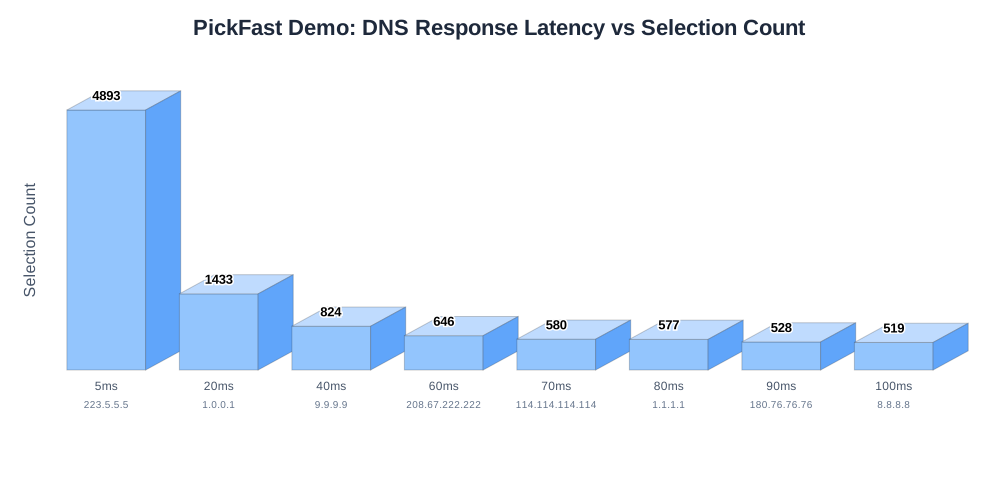
## Real DNS Resolution Example
Using `hickory-resolver` to perform actual DNS queries through specified DNS servers, combined with `race` crate for staggered resolution with automatic failover.
```rust
use std::{sync::Arc, time::Duration};
use futures::StreamExt;
use hickory_resolver::{
Resolver,
config::{NameServerConfig, ResolverConfig},
proto::xfer::Protocol,
};
use pick_fast::PickFast;
use race::Race;
use std::net::{IpAddr, Ipv4Addr};
#[derive(Debug, Clone, Copy)]
struct DnsServer { ip: IpAddr }
const fn ip(a: u8, b: u8, c: u8, d: u8) -> DnsServer {
DnsServer { ip: IpAddr::V4(Ipv4Addr::new(a, b, c, d)) }
}
const DNS_SERVER_LI: [DnsServer; 8] = [
ip(8, 8, 8, 8), // Google
ip(1, 1, 1, 1), // Cloudflare
ip(223, 5, 5, 5), // AliDNS
ip(208, 67, 222, 222), // OpenDNS
ip(9, 9, 9, 9), // Quad9
ip(1, 0, 0, 1), // Cloudflare
ip(114, 114, 114, 114), // 114DNS
ip(180, 76, 76, 76), // Baidu
];
/// Task struct for tracking DNS resolution
struct Task {
pub index: usize,
pub start: u64,
}
// Create resolver with specific DNS server
fn create_resolver(server: &DnsServer) -> Resolver<hickory_resolver::name_server::TokioConnectionProvider> {
let ns = NameServerConfig::new(
std::net::SocketAddr::new(server.ip, 53),
Protocol::Udp,
);
let mut config = ResolverConfig::new();
config.add_name_server(ns);
let provider = hickory_resolver::name_server::TokioConnectionProvider::default();
Resolver::builder_with_config(config, provider).build()
}
#[tokio::main]
async fn main() {
let lb = Arc::new(PickFast::<DnsServer>::new(DNS_SERVER_LI));
const HOST: &str = "example.com";
// Create Race with Task struct for latency tracking
let mut race = Race::new(
Duration::from_millis(500),
|task: &Task| {
let index = task.index;
let start = task.start;
let lb = lb.clone();
let resolver = create_resolver(&lb.li[index].data);
let server_ip = lb.li[index].data.ip;
async move {
match resolver.lookup_ip(HOST).await {
Ok(response) => {
if let Some(addr) = response.iter().next() {
let latency = (ts_::milli() - start) as u32;
// Successful: update latency weight
lb.set(index, latency);
println!("✅ {HOST} via {server_ip} -> {addr} ({latency}ms)");
Ok(addr)
} else {
lb.failed(index);
Err(std::io::Error::new(std::io::ErrorKind::NotFound, "No address"))
}
}
Err(e) => {
// Network error: reduce weight
lb.failed(index);
Err(std::io::Error::new(std::io::ErrorKind::Other, e.to_string()))
}
}
}
},
lb.iter().map(|i| Task {
index: i.0,
start: ts_::milli(),
}),
);
// Wait for first successful result
while let Some((_task, result)) = race.next().await {
match result {
Ok(addr) => {
println!("🎯 Resolved: {addr}");
// Mark remaining tasks as failed to reduce their weight
for (t, _) in race.ing {
lb.failed(t.index);
}
break;
}
Err(_) => {
// Already called lb.failed(index) in the async closure
}
}
}
}
```
## Custom Rank Strategy
The `Rank` trait defines how observed values (e.g., latency) convert to selection weights.
```rust
use pick_fast::Rank;
/// Priority-based ranking: higher priority = higher weight
pub struct Priority;
impl Rank for Priority {
fn calc(base: u32, priority: u32) -> u32 {
priority // Direct mapping: priority value becomes weight
}
}
// Usage
let lb = PickFast::<Task, Priority>::new(tasks);
lb.set(index, 100); // Set priority to 100
```
Built-in `Inverse` strategy suits latency-based selection:
```text
Weight = base / Latency
base = u32::MAX / NodeCount / 32
Initial Weight = base / NodeCount
```
Design choice: `base` is auto-calculated from node count. Division by 32 reserves headroom for EMA formula `old * 31` to prevent overflow, supporting any number of nodes.
## Design Rationale
Architecture focuses on minimizing synchronization overhead and maximizing throughput.
### Call Flow
```mermaid
graph TD
A[Client Request] --> B["pick()"]
B --> C[Atomic Load Total Weight]
C --> D[Random Target Selection]
D --> E["Linear Scan Nodes O(N)"]
E --> F[Return Handle]
G[Performance Feedback] --> H["set()"]
H --> I[Calculate Target Weight via Rank]
I --> J[CAS Update Node Weight with EMA]
J --> K[Atomic Update Total Weight]
```
### EMA Smoothing
```text
New Weight = (Old Weight * 31 + Target Weight) / 32
```
32-sample half-life smoothing makes weight changes more gradual, preventing drastic fluctuations from transient spikes.
## API Reference
### Core Types
| `PickFast<T, M>` | Main load balancer struct. `T`: node data, `M`: rank model (default: `Inverse`) |
| `PickFast.li` | `Vec<Node<T>>` - Node list |
| `PickFast.total` | `AtomicU32` - Cached total weight |
| `PickFast.base` | `u32` - Base value, auto-calculated from node count |
| `Node<T>` | Node struct containing data and weight |
| `Node.data` | `T` - Node data |
| `Node.weight` | `AtomicU32` - Node weight |
### Key Methods
| `new(data: impl IntoIterator<Item = T>) -> Self` | Create instance from iterator |
| `len(&self) -> usize` | Get node count |
| `is_empty(&self) -> bool` | Check if empty |
| `pick(&self) -> Handle<'_, T>` | Select node based on current weights. O(1) weight load + O(N) scan |
| `set(&self, index: usize, val: u32)` | Update node observation with EMA smoothing (minimum weight: 1) |
| `failed(&self, index: usize)` | Mark node as failed, halving its weight (minimum weight: 1) |
| `iter(&self) -> CIter<'_, Node<T>>` | Create circular iterator with weighted random start position (requires `iter` feature) |
### Other Types
| `Handle<'a, T>` | Smart pointer to selected node, contains `index` and `node` reference |
| `Rank` | Trait for custom weight calculation logic, `calc(base, val) -> weight` |
| `Inverse` | Default strategy: `weight = base / latency` |
## Tech Stack
| Language | Rust (Edition 2024) |
| Randomness | `fastrand` |
| Concurrency | `std::sync::atomic` |
| Testing/Visualization | `plotters`, `svg` |
## Directory Structure
```text
.
├── Cargo.toml # Project configuration
├── src/
│ └── lib.rs # Core implementation
├── tests/
│ ├── main.rs # Integration tests and chart generation
│ ├── dns.rs # Real DNS resolution test
│ └── dns_server.rs # DNS server definitions
└── readme/
├── en.md # English documentation
├── zh.md # Chinese documentation
├── rank-en.svg # English performance chart
└── rank-zh.svg # Chinese performance chart
```
## Historical Anecdote
Weighted load balancing has roots in network packet scheduling. The "Weighted Round Robin" (WRR) concept was formalized in 1991 for ATM (Asynchronous Transfer Mode) networks, where heterogeneous link speeds required differential treatment.
The evolution from WRR to modern weighted random selection represents a paradigm shift: instead of deterministic slot allocation, probabilistic approaches like `pick_fast` offer natural load distribution. Combined with EMA smoothing—a technique borrowed from stock market technical analysis dating back to the 1960s—the algorithm adapts gracefully to varying network conditions.
Interestingly, the Compare-And-Swap primitive used here traces back to IBM System/370 in 1970, making lock-free programming concepts over 50 years old—yet they remain the cornerstone of modern high-performance concurrent systems.

