# permission-flow
[](https://github.com/veecore/permission-flow/actions/workflows/ci.yml)
[](https://crates.io/crates/permission-flow)
[](https://docs.rs/permission-flow)
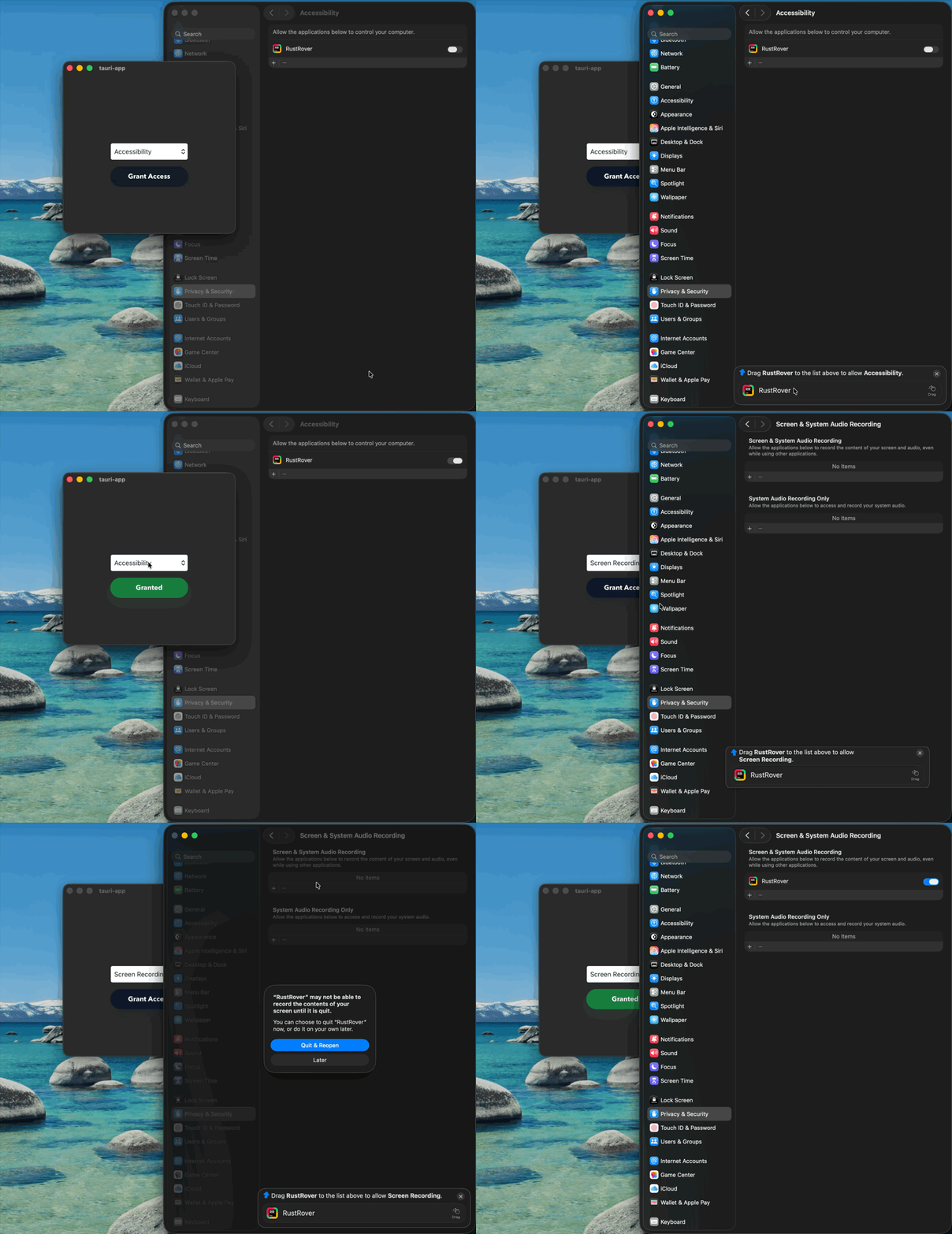
`permission-flow` provides a Rust-friendly API for presenting the macOS
permission guidance flow backed by the Swift/AppKit implementation in this
workspace.
## What it does
- Creates a `PermissionFlowController` on the macOS main thread
- Starts guided flows for supported privacy panes
- Infers a likely host app bundle with `AppPath::suggested_host_app()`
- Exposes host-app permission status checks through
`Permission::authorization_state()`
Supported permissions:
- Accessibility
- Input Monitoring
- Screen Recording
- App Management
- Bluetooth
- Developer Tools
- Full Disk Access
- Media & Apple Music
## Quick start
```rust
use permission_flow::{AppPath, Permission, PermissionFlowController, StartFlowOptions};
let controller = PermissionFlowController::new()?;
let app_path = AppPath::suggested_host_app()
.expect("expected a host app bundle in this launch context");
controller.start_flow(StartFlowOptions::new(Permission::ACCESSIBILITY, app_path))?;
# Ok::<(), Box<dyn std::error::Error>>(())
```
## Platform behavior
This crate is designed for macOS, but it now compiles on other operating
systems too.
Outside macOS:
- `PermissionFlowController::new()` succeeds with a no-op controller
- `start_flow()` and `stop_current_flow()` become no-ops
- `Permission::authorization_state()` returns `PermissionAuthorizationState::Unknown`
- `AppPath::suggested_host_app()` returns `None`
That keeps cross-platform Rust workspaces buildable without pretending the
actual macOS permission UI exists on those platforms.
## Important status warning
`Permission::authorization_state()` reports what the current host process or
host app can determine about its own permission state.
It does **not** authoritatively answer whether an arbitrary target `.app`
bundle already has the requested permission.
This means:
- if the target app is the current host app, the status is meaningful
- if the target app is some other app bundle, treat the status as host-app
information only
## Runtime note
Because the final macOS executable links Swift runtime libraries, downstream
binary crates currently need this in their `build.rs`:
```rust
fn main() {
if std::env::var("CARGO_CFG_TARGET_OS").as_deref() == Ok("macos") {
println!("cargo:rustc-link-arg=-Wl,-rpath,/usr/lib/swift");
}
}
```
## Acknowledgements
The Swift side of this crate builds on top of the excellent
[`PermissionFlow`](https://github.com/jaywcjlove/PermissionFlow) project and
uses [`swift-rs`](https://github.com/Brendonovich/swift-rs) for the bridge into
Rust.