<div align="center">
<img alt="Github" src="https://raw.githubusercontent.com/viktorlott/penum/main/penum-logo.png" height="103">
</div>
<div align="center">
<a href="https://github.com/viktorlott/penum">
<img alt="Github" src="https://img.shields.io/github/languages/code-size/viktorlott/penum?style=flat-square&logo=github" height="20">
<img alt="Download" src="https://img.shields.io/crates/d/penum.svg?style=flat-square&logo=rust" height="20">
<img alt="Tests" src="https://img.shields.io/github/actions/workflow/status/viktorlott/penum/test.yaml?branch=main&style=flat-square&logo=github">
</a>
<a href="https://crates.io/crates/penum">
<img alt="crates.io" src="https://img.shields.io/crates/v/penum.svg?style=flat-square&logo=rust" height="20">
</a>
<a href="https://docs.rs/penum/latest/penum/">
<img alt="docs.rs" src="https://img.shields.io/badge/docs.rs-penum-66c2a5?style=for-the-badge&labelColor=555555&logo=docs.rs" height="20">
</a>
</div>
`penum` is a procedural macro that is used for **enum conformity** and
**static dispatch**. This is done by specifying a declarative pattern
that expresses how we should interpret the enum. It's a tool for
asserting how enums should **look** and **behave** through simple
expressive rust grammar.
- **Patterns** — can be thought of as a *toy shape sorter* that sorts
through enum variants and makes sure they fit. So each variant has a
certain shape that must satisfy the patterns we've specified. There
are 3 shapes to choose from, *tuples* `()`, *structs* `{}` and
*units*.
- **Predicates** — are used in combination with *patterns* to assert
what the matched variants field types should implement. They can be
expressed like a regular where clause, e.g `where T: Trait<Type>`. The
*generic parameters* needs to be introduced inside a pattern fragment.
- **Smart dispatch** — lets us express how an enum should **behave** in
respect to its variants. The symbol that is used to express this is
`^` and should be put in front of the trait you wish to be dispatched.
## Installation
This crate is available on [crates.io](https://crates.io/crates/penum)
and can be used by adding the following to your project's Cargo.toml:
```toml
[dependencies]
penum = "0.1.30"
```
Or run this command in your cargo project:
```sh
$ cargo add penum
```
## Latest feature
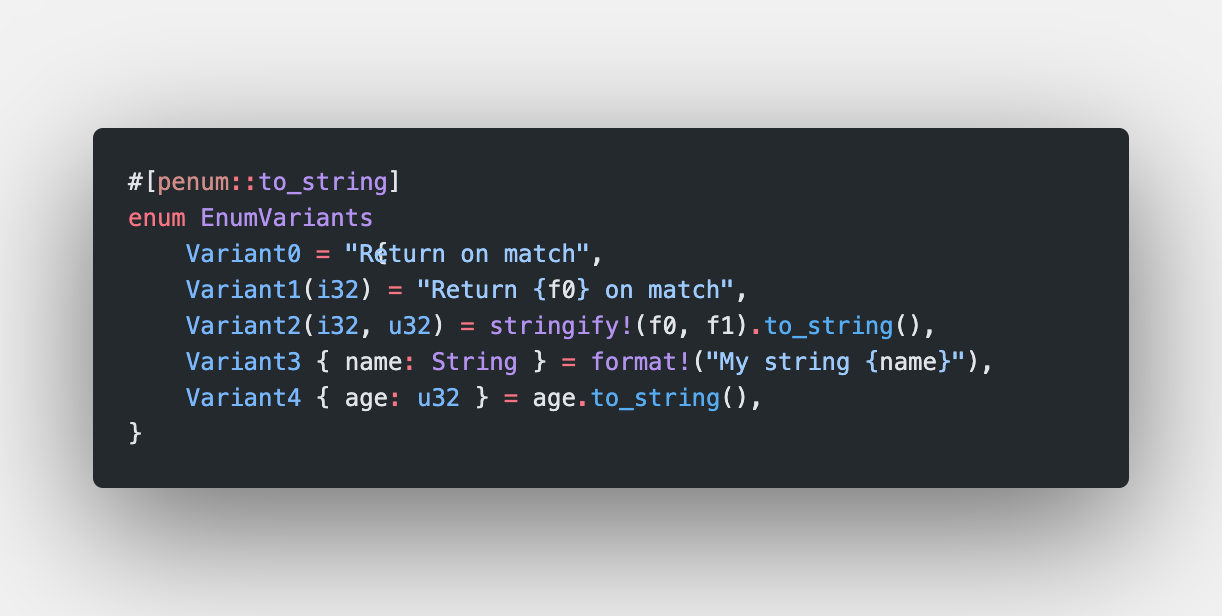
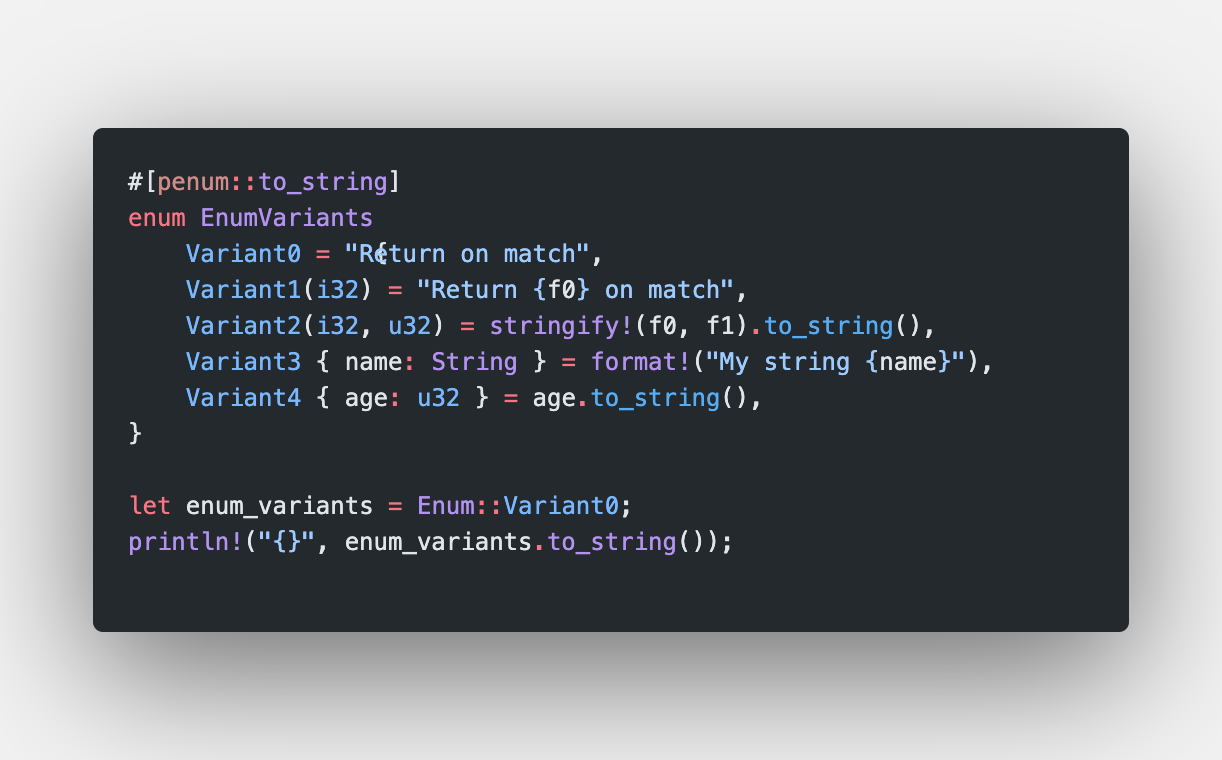
Expressions for enum discriminats are syntactically allowed, but is rejected at a semantic level.
So this feature unlocks this semantic lock for the developer such that `discriminants` can be writting as expression blocks. The current supported attributed proc macros are `ToString`, `Display`, `Into<T>` and `Deref<Target = T>`.
This could be useful as an alternative to const declarations, and also, to avoid inner attributes.
```rust
#[penum::to_string]
enum EnumVariants {
Variant0 = "Return on match",
Variant1(i32) = "Return {f0} on match",
Variant2(i32, u32) = stringify!(f0, f1).to_string(),
Variant3 { name: String } = format!("My string {name}"),
Variant4 { age: u32 } = age.to_string(),
Variant5 = EnumVariants::Variant0.to_string(),
Variant6 { list: Vec<u32> } = {
let string = list
.iter()
.map(ToString::to_string)
.collect::<String>();
format!("List: ({string})")
},
Variant7,
Variant8,
// Note that default will not appear in the Enum, i.e `EnumVariants::default` will not exist.
// Also, we might change this in the future, e.g. using `fallback` instead?
default = "Variant7 and Variant8 will return this default"
}
let enum_variants = Enum::Variant0;
println!("{}", enum_variants.to_string());
```
Add one of the following to your enum to enable enum descriminant expressions.
- `penum::to_string` — Useful when you only want to implement `ToString`.
- `penum::fmt` — Useful when you want to implement `ToString` and `Display`.
- `penum::into(T)` — Useful when you want to convert your variant `Into<T>`.
- `penum::deref(T)` — Useful when you want to utilize Rust auto dereferencer.
- `penum::static_str` — Will implement `Deref<Str>` and `AsRef<str>`, including helper methods
like: `.as_str()` and `.static_str()`.
Make sure to also try out `penum::penum` if you like this `feature`. Note that not interoperable
with `penum::penum`, and should be used separatly, because they are mutually exclusive.
Note that `penum::penum` might be changed into `penum::expr`, `penum::declare` or `pemum::express`.
------------------------------------------------------------------
## Overview
A `Penum` expression can look like this:
```console
Dispatch symbol.
|
#[penum( (T) where T: ^Trait )]
^^^ ^^^^^^^^^
| |
| Predicate bound.
|
Pattern fragment.
```
A `Penum` expression without specifying a pattern:
```console
#[penum( impl Trait for Type )]
^^^^^^^^^^^^^^^^^^^
```
*Shorthand syntax for `_ where Type: ^Trait`*
Important to include `^` for traits that you want to dispatch.
```rust
#[penum( impl Type: ^Trait )]
```
Note that in a penum impl for expression, no `^` is needed.
```rust
#[penum( impl Trait for Type )]
```
In Rust 1.68.0, `From<bool>` for `{f32,f64}` has stabilized.
That means you can do this.
```rust
#[penum( impl From<bool> for {f32,f64} )]
```
<br />
### Trivial example
Use `Penum` to automatically `implement` a trait for the enum.
```rust
#[penum(impl String: ^AsRef<str>)]
enum Store {
V0(),
V1(i32),
V2(String, i32),
V3(i32, usize, String),
V4(i32, String, usize),
V5 { age: usize, name: String },
V6,
}
```
- Will turn into this:
```rust
impl AsRef<str> for Store {
fn as_ref(&self) -> &str {
match self {
Store::V2(val, ..) => val.as_ref(),
Store::V3(_, _, val) => val.as_ref(),
Store::V4(_, val, ..) => val.as_ref(),
Store::V5 { name, .. } => name.as_ref(),
_ => "",
}
}
}
```
There is also support for user defined traits, but make sure that they
are tagged before the enum.
```rust
#[penum]
trait Trait {
fn method(&self, text: &str) -> &Option<&str>;
}
```
<br />
<details>
<summary>Supported std traits</summary>
`Any`, `Borrow`, `BorrowMut`, `Eq`, `AsMut`, `AsRef`, `From`, `Into`,
`TryFrom`, `TryInto`, `Default`, `Binary`, `Debug`, `Display`,
`LowerExp`, `LowerHex`, `Octal`, `Pointer`, `UpperExp`, `UpperHex`,
`Future`, `IntoFuture`, `FromIterator`, `FusedIterator`, `IntoIterator`,
`Product`, `Sum`, `Sized`, `ToSocketAddrs`, `Add`, `AddAssign`,
`BitAnd`, `BitAndAssign`, `BitOr`, `BitOrAssign`, `BitXor`,
`BitXorAssign`, `Deref`, `DerefMut`, `Div`, `DivAssign`, `Drop`,
`Index`, `IndexMut`, `Mul`, `MulAssign`, `MultiMethod`, `Neg`, `Not`,
`Rem`, `RemAssign`, `Shl`, `ShlAssign`, `Shr`, `ShrAssign`, `Sub`,
`SubAssign`, `Termination`, `SliceIndex`, `FromStr`, `ToString`
</details>
`Penum` is smart enough to infer certain return types for non-matching
variants. e.g `Option<T>`, `&Option<T>`, `String`, `&str`. It can even
handle `&String`, referenced non-const types. The goal is to support any
type, which we could potentially do by checking for types implementing
the `Default` trait.
Note, when dispatching traits with associated types, it's important to
declare them. e.g `Add<i32, Output = i32>`.
## Examples
Used penum to force every variant to be a tuple with one field that must
implement `Trait`.
```rust
#[penum( (T, ..) where T: Trait )]
enum Guard {
Bar(String),
^^^^^^
// ERROR: `String` doesn't implement `Trait`
Bor(Option<String>),
^^^^^^^^^^^^^^
// ERROR: `Option<String>` doesn't implement `Trait`
Bur(Vec<String>),
^^^^^^^^^^^
// ERROR: `Vec<String>` doesn't implement `Trait`
Byr(),
^^^^^
// ERROR: `Byr()` doesn't match pattern `(T)`
Bxr { name: usize },
^^^^^^^^^^^^^^^
// ERROR: `{ nname: usize }` doesn't match pattern `(T)`
Brr,
^^^
// ERROR: `Brr` doesn't match pattern `(T)`
Bir(i32, String), // Works!
Beer(i32) // Works!
}
```
If you don't care about the actual pattern matching, then you could use
`_` to automatically infer every shape and field. Combine this with
concrete dispatch types, and you got yourself a auto dispatcher.
<details>
<summary>Under development</summary>
For non-std types we rely on the `Default` trait, which means, if we can
prove that a type implements `Default` we can automatically add them as
return types for non-matching variants,
</details>
```rust
#[penum( _ where Ce: ^Special, Be: ^AsInner<i32> )]
enum Foo {
V1(Al),
V2(i32, Be),
V3(Ce),
V4 { name: String, age: Be },
}
// Will create these implementations
impl Special for Foo {
fn ret(&self) -> Option<&String> {
match self {
Foo::V3(val) => val.ret(),
_ => None,
}
}
}
impl AsInner<i32> for Foo {
fn as_inner(&self) -> &i32 {
match self {
Foo::V2(_, val) => val.as_inner(),
Foo::V4 { age, .. } => age.as_inner(),
_ => &0,
}
}
}
```
- It's identical to this:
```rust
#[penum(impl Ce: ^Special, Be: ^AsInner<i32>)]
```
#### More details
- **Impls** — can be seen as a shorthand for *a concrete type that
implements this trait*, and are primarily used as a substitute for
regular *generic trait bound expressions*. They look something like
this, `(impl Copy, impl Copy) | {name: impl Clone}`
- **Placeholders** — are single unbounded wildcards, or if you are
familiar with rust, it's the underscore `_` identifier and usually
means that something is ignored, which means that they will satisfy
any type `(_, _) | {num: _}`.
- **Variadic** — are similar to placeholders, but instead of only being
able to substitute one type, variadics can be substituted by 0 or more
types. Like placeholders, they are a way to express that we don't care
about the rest of the parameters in a pattern. The look something like
this`(T, U, ..) | {num: T, ..}`.
### Future ideas that might be useful
#### NOT SUPPORTED YET - WIP
The thing is, most of the time, you'd most likely want implement things the normal way, but when you
have a very tiny implementation planned, this might be good enough.
```rust
#[penum]
enum Enum {
Variant0(String) = implement! {
ToString => "My incoming string: {f0}",
Deref[Target = str] => &**f0,
AsRef[str] => f0,
},
default = {
ToString => "My custom fallback string",
_ => Default::default()
}
}
```
```rust
#[penum]
enum Enum {
Variant0(String) = implement! {
ToString => "My incoming string: {f0}",
},
Variant1(&'static str, i32) = implement! {
ToString => "My incoming string: {f0}",
},
default = {
ToString => "My custom fallback string",
_ => Default::default()
}
}
```
```rust
#[penum]
enum Enum {
Variant0(String) = implement! {
ToString {
format!("My incoming string: {f0}")
},
Deref<Target = str> {
&**f0
},
AsRef<str> { f0 },
},
default = implement! {
ToString { "My custom fallback string" },
_ { Default::default() }
}
}
```
```rust
#[penum]
enum Enum {
Variant0(String) = implement! {
ToString => {
format!("My incoming string: {f0}")
},
Deref<Target = str> => {
&**f0
},
AsRef<str> => { f0 },
},
default = implement! {
ToString { "My custom fallback string" },
_ { Default::default() }
}
}
```
```rust
#[penum]
enum Enum {
Variant0(String) = implement! {
ToString => {
format!("My incoming string: {f0}")
},
Deref<Target = str> => {
&**f0
},
AsRef<str> => { f0 },
},
default = implement! {
ToString => { "My custom fallback string" },
_ => { Default::default() }
}
}
```