# System Architecture
## Overview
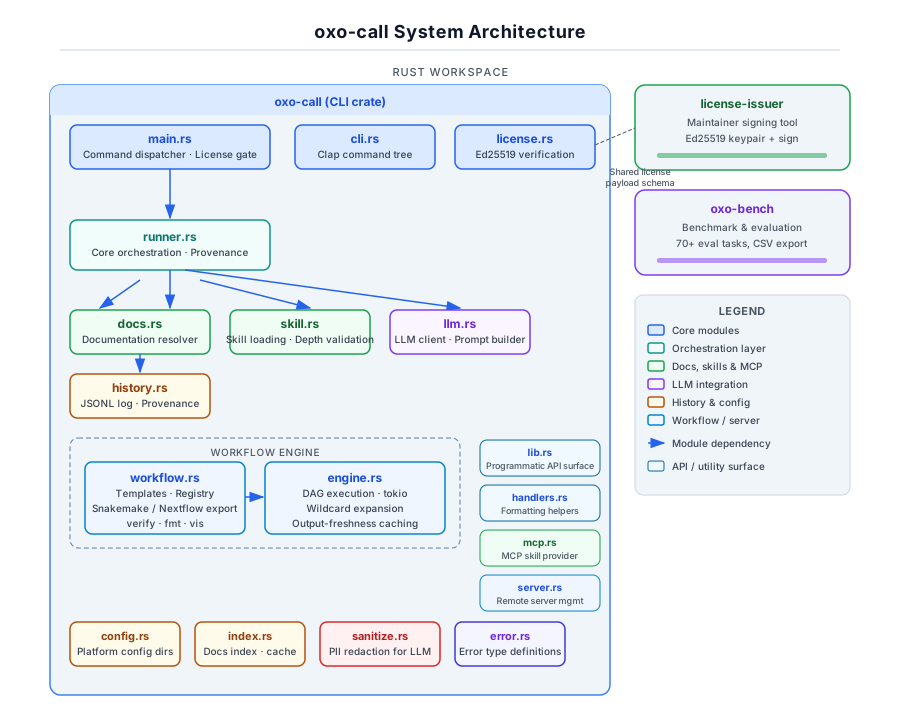
oxo-call is a Rust workspace with three crates:
| `oxo-call` (root) | End-user CLI | Yes (crates.io) |
| `crates/license-issuer` | Maintainer-only license signing tool | No |
| `crates/oxo-bench` | Benchmarking and evaluation suite | No |
The architecture is designed to make command generation usable in production science and engineering workflows, not just impressive in a demo. The key idea is that `oxo-call` reduces ambiguity before the model answers, then records enough provenance afterward for users to trust and reproduce the result.
## Module Structure
The main CLI crate contains the following modules with clear separation of concerns:
```text
main.rs — Command dispatcher & license gate
├─→ cli.rs — Command definitions (Clap)
├─→ handlers.rs — Extracted command-handler helpers (formatting, suggestions)
├─→ license.rs — Ed25519 offline verification
├─→ runner.rs — Core orchestration pipeline + provenance tracking
│ ├─→ docs.rs — Documentation resolver
│ ├─→ skill.rs — Skill loading system + depth validation
│ │ └─→ mcp.rs — MCP skill provider (JSON-RPC / HTTP)
│ ├─→ llm.rs — LLM client, prompt builder & provider trait
│ └─→ history.rs — Command history tracker with provenance
├─→ sanitize.rs — Data anonymization for LLM contexts
├─→ server.rs — Remote server management (SSH / HPC)
├─→ workflow.rs — Templates & registry
│ └─→ engine.rs — DAG execution engine
├─→ config.rs — Configuration management
├─→ index.rs — Documentation index
└─→ error.rs — Error type definitions
lib.rs — Programmatic API surface (re-exports all modules)
```
## Execution Flow
### Command Generation (run/dry-run)
```text
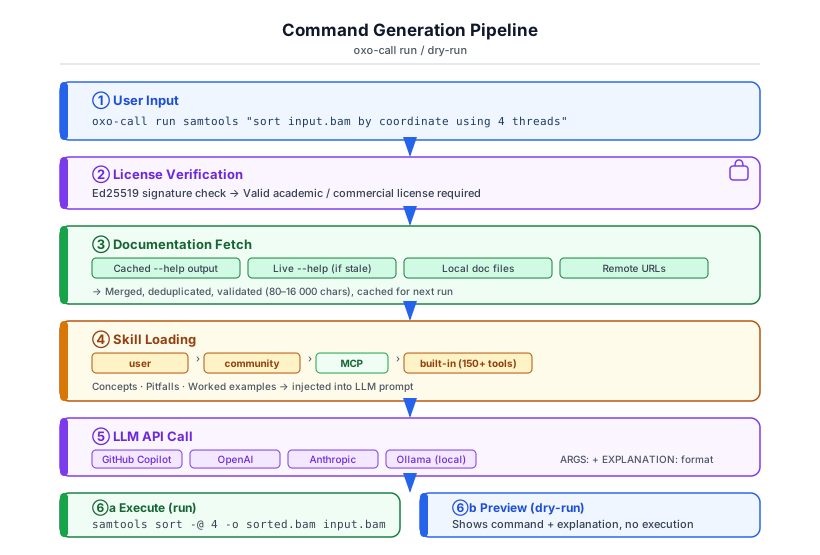
1. License verification (Ed25519 signature check)
2. Documentation fetch (cache → --help → local files → remote URLs)
3. Skill loading (user → community → MCP → built-in)
4. Prompt construction (docs + skill + task → system + user message)
5. LLM API call (GitHub Copilot / OpenAI / Anthropic / Ollama)
6. Response parsing (extract ARGS: and EXPLANATION: lines)
7. Command execution (run) or display (dry-run)
8. History recording (JSONL with UUID, exit code, timestamp)
```
### Workflow Execution
```text
1. Parse .oxo.toml workflow definition
2. Expand wildcards ({sample}, {params.*})
3. Build dependency DAG
4. Topological sort for execution order
5. Execute with tokio parallelism (JoinSet)
6. Skip steps with fresh outputs (output-freshness caching)
```
## Design Principles
1. **License-first**: Core commands require valid Ed25519 signature
2. **Docs-first grounding**: Documentation fetched before LLM call to prevent hallucination
3. **Offline-first**: Cached docs, no license server, optional remote fetching
4. **Skill-augmented prompting**: Domain knowledge injected without code changes
5. **Platform independence**: WASM conditional compilation, cross-platform config dirs
6. **Strict LLM contract**: ARGS:/EXPLANATION: format with retry on invalid response
## Why This Matters In Practice
- **Usability**: users can stay in natural language longer and only inspect flags when it matters
- **Reliability**: docs-first grounding and a strict response contract reduce free-form model drift
- **Scientific reproducibility**: provenance-rich history preserves the command, model, and context that produced each result
- **Engineering extensibility**: skills, MCP providers, and workflow export let teams expand capability without rewriting the core pipeline