
opi
Operations Interface — a project control center for your terminal.
Go into any repository, type opi, and get a usable interface for that
project — without configuring anything first.
Status:
0.11.0. Scripts are the main thing; health, security, updates, clean and the commit/push/release workflows are built on top of them. npm, pnpm, bun and Cargo projects are covered; yarn's scripts, health and security audit are too — its update listing is not read yet.
What it does
Its primary job is to be a better npm run. The start screen shows the
project's scripts — grouped by prefix, labelled from scripts-info, with the
package manager detected rather than typed:
astro-v7-workspace  pnpm
  12 entries · 4 groups

Development
› dev              Startet die Starter-App im Dev-Modus
  dev:blog         Startet die Blog-App im Dev-Modus
Build
  build            Baut Starter- und Blog-App
  build:blog       Baut die Blog-App
Preview
  preview          Vorschau des Starter-Builds
Quality
  check            Prüft das Repo mit Biome
  check:fix        Behebt Lint- und Formatfehler
Enter runs the highlighted script. That is the shortest path, and nothing is
placed in front of it. A list taller than the terminal scrolls, and / filters
it as you type — in a monorepo that is the difference between scrolling past
thirty entries and typing three letters.
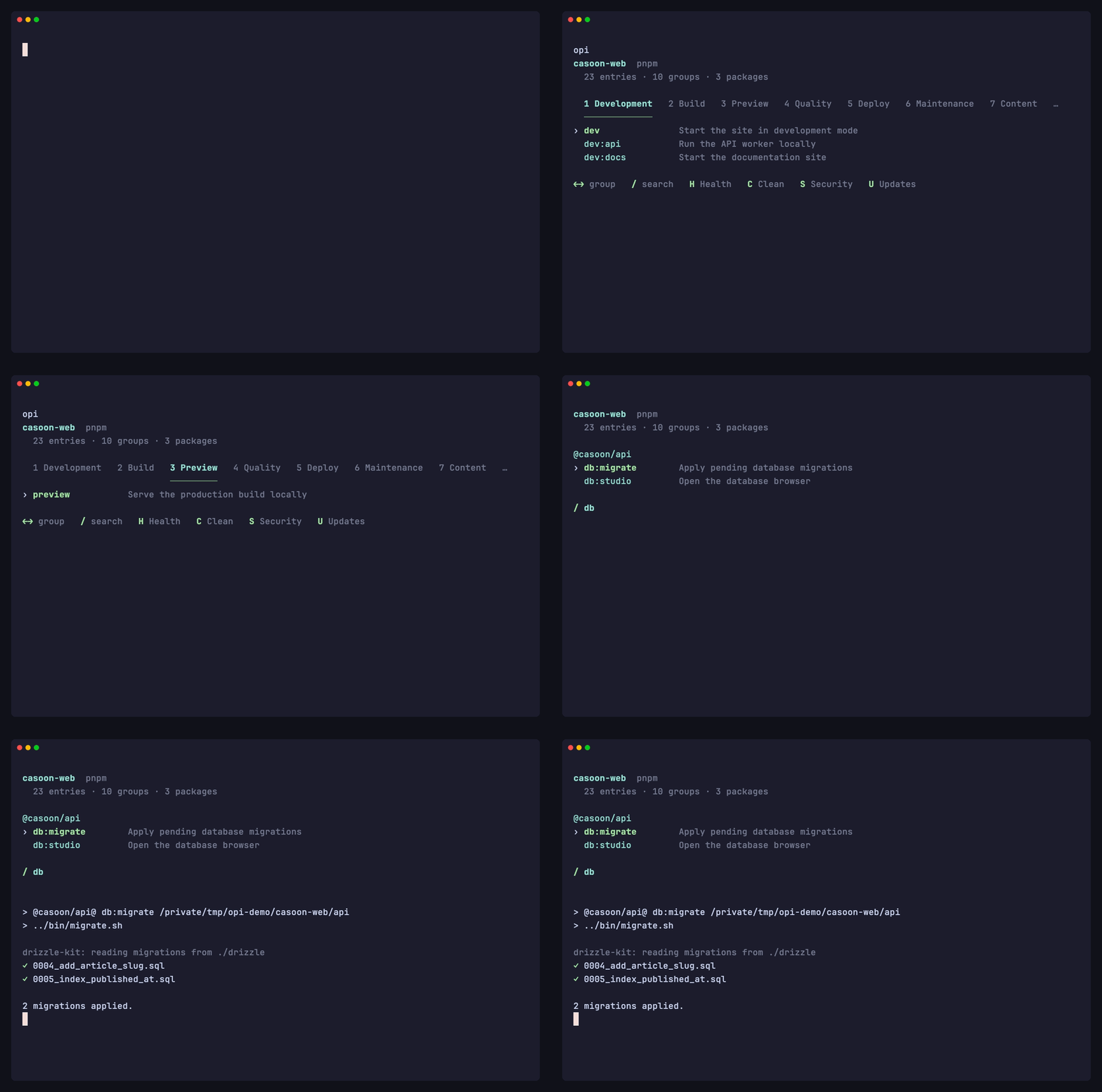
Past 15 entries or 5 groups the groups move into a row of tabs and only the active one's entries are listed, because a heading per group over thirty-odd scripts is taller than the terminal:
casoon-web  pnpm
  43 entries · 10 groups · 3 packages

  1 Development   2 Build   3 Preview   4 Quality   …   │   8 Packages
  ─────────────
› dev              Startet die Homepage
  dev:homepage     Startet die Homepage
  dev:insights     Startet Insights
  dev:webcheck     Startet Webcheck

←→ group   / search   H Health   C Clean   S Security   U Updates
A workspace's packages share the last tab rather than taking one each — 52 of them against 6 action groups is a tab row nobody can use — and a divider marks it, because the other tabs name what you are doing and that one names where.
The first group is preselected and the cursor is on its first entry, so opi ↵
still starts dev — the tabs hide what is not needed rather than asking for a
choice first. ← →, Tab and the digits switch groups; / searches all
of them, which is the case the tabs are worst at. opi | cat lists every group
as before: nothing on the other end of a pipe can press a key.
Three speeds, all backed by the same task model:
Arguments after the name go to the script: opi build --verbose.
In a monorepo each workspace member's scripts appear under the member's name —
only those the root does not already define, since the root's script usually
wraps them and wins the name anyway. Where both exist, a bare name runs the
root's and blog/dev runs the member's:
opi also works from anywhere inside a project, not only from the directory
holding package.json.
The script replaces the opi process, so Ctrl-C reaches your dev server
rather than killing a wrapper, and the script's exit code is what your shell
sees — opi build && … works.
More than one kind of project
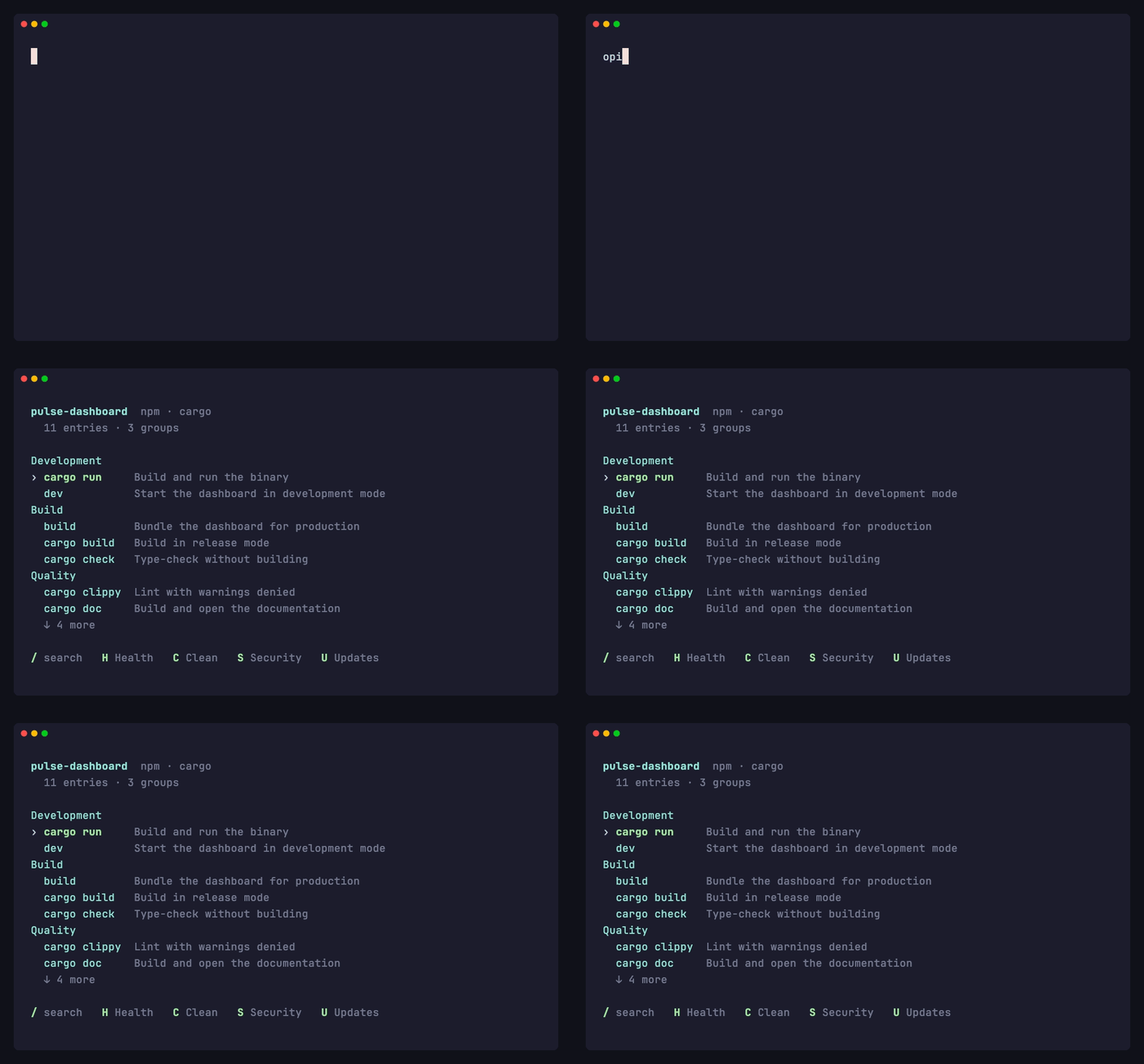
A repository can be several things at once, and opi does not make it choose.
package.json and Cargo.toml are both read, and their commands share one
list:
llmux-dashboard  npm · cargo

Development
  cargo run     Build and run the binary
  dev
Build
  build
  cargo build   Build in release mode
  cargo check   Type-check without building
Every area follows: cargo fmt --check, cargo clippy, cargo rustdoc and
cargo test run alongside the npm checks, cargo audit and cargo outdated
answer for the crates where they are installed, and target/ is listed with
the build artefacts. A repository carrying both manifests gets a section each
rather than one merged list — Dependencies and Dependencies (rust) —
because "safe to take" orders within an ecosystem and not across two.
Both are external cargo subcommands rather than part of the toolchain, so
where one is missing opi says so along with the cargo install that adds
it, instead of leaving a section that reads like "nothing found".
In a Cargo workspace opi works on the workspace even when started inside one
of its crates — that is where target/ lives and where the checks reach every
member. cargo run still follows you: it is offered in a binary crate, because
that is where cargo would start it.
Saying more about a script
Optional, and only ever refinement — a project with neither opi nor
scripts-info still gets a usable list, which is the whole point.
description |
Wins over scripts-info, which stays valid for nr |
group |
Replaces the group the script's name implies |
favorite |
Lifts it out of its group, to the top |
confirm |
Asks before running it; opi --yes <script> answers in advance |
A confirm script refuses to run without a terminal rather than assuming yes —
otherwise the protection would vanish in exactly the case it exists for.
The other areas
Each is a hotkey in the list and a flag on the command line. Never a bare word:
health, clean and release are script names in real projects, and the bare
word stays theirs.
H |
opi --health |
Runs every check the project's tools can answer, concurrently |
S |
opi --security |
Secret scan, a parsed dependency audit per ecosystem, signatures, release age and licenses |
U |
opi --updates |
What is outdated, split into safe and major — and the offer to take it |
C |
opi --clean |
Removable artefacts, with what each one costs |
opi --check commit |
The fast checks, before you commit | |
opi --check push |
Everything plus the build, on a clean tree that is not behind upstream | |
opi --check release |
Everything plus the build, a clean tree and an untagged version | |
opi --hooks |
Installs opi --check push as the pre-push hook |
astro-v7-workspace  health

✓ Lint & format                     0.2s  biome
✗ Secrets                           1.0s  nosecrets
✓ TypeScript (@astro-v7/starter)    5.2s  astro
✓ TypeScript (@astro-v7/blog)       5.4s  astro
opi reimplements none of this. It detects which tool a project depends on —
Biome, ESLint, Prettier, tsc, astro check, Vitest, Jest, fallow, Knip, a
secret scanner, cargo — runs it, and relays what came back. In a workspace the
checks run per member, in the member, because that is where the tools and their
config live.
Output is parsed only where the format is documented (audit --json,
outdated --json, audit signatures --json, licenses list --json). Everything else is relayed whole and capped at twenty lines,
with the command to see the rest: a parser that guesses at a tool's output
breaks on that tool's next release.
There is no health score. A composite number stops meaning anything within weeks; what a failing tool actually said does not.
Taking the updates
--updates can apply what it found, and then runs the commit checks on what
comes back — update, install, check, what is red now. That chain is the reason
the action exists; saving you from typing pnpm update would not have been.
The choice offered is not safe against major. That is how the list is
ordered, and it is the wrong question for an action: in a project whose ranges
are exact or ~, pnpm update moves none of what the list calls safe. The
real choice is staying inside the declared ranges against raising them, and
each line carries its own count and disappears when that count is zero.
opi writes nothing itself. It calls the package manager with a list of names
— no package.json, no lockfile, no pnpm-workspace.yaml. Majors are never in
that list. Raising ranges is offered for pnpm only, because npm has no command
that keeps the operator: npm install x@1.1.1 turns an exact 2.1.2 into
^2.1.3, and an exact pin is a statement. Where two lockfiles disagree and no
packageManager field settles it, the offer is withheld and the finding named
instead.
Design rules
- Zero configuration.
opimust be useful in an unmodified repository. A tool you have to configure first never gets started in someone else's project. - The project's own files are the only interface.
package.jsonandCargo.toml— noopi.toml, no second source of truth ofopi's own making.scripts, optionallyscripts-info, optionally anopikey for refinement. - No task system of its own.
opidoes not define tasks with their own commands — that would put it in competition with npm scripts,just,makeand Taskfile for no gain. - Orchestration, not reimplementation.
opiis a UX layer over proven tooling. opiwrites nothing. Clean removes what you pick, updates are applied by the package manager, andopi --hooksadds one line to the pre-push hook without touching the rest. No manifest or lockfile is ever rewritten byopiitself, and where a tool cannot do something cleanly it is not offered rather than offered badly.
Install
|
That downloads the release binary for your platform, checks it against the
published SHA-256 and puts it in ~/.local/bin — OPI_INSTALL_DIR picks
another directory, OPI_VERSION another version. Binaries exist for macOS on
Apple silicon and Intel, and for Linux on x86-64 and arm64; the Linux ones are
static musl builds, so the distribution does not matter.
From the registry instead, which builds it here:
Unix only. opi runs a script by replacing its own process with exec, so
Ctrl-C reaches the dev server rather than killing a wrapper, and its
interactive list drives termios directly. Windows offers neither, and a second
execution model that nothing exercises would be worse than an honest boundary.
Building on Windows fails with that message rather than producing a degraded
binary.
Documentation
casoon.github.io/opi — installation, a guide per area, the command line reference and the changelog, with the terminal output captured from the binary.
The files below are the same documentation as it sits in the repository:
- docs/project-state.md — what this is and where it stands
- docs/architecture.md — the modules and how they fit
- docs/constraints.md — the boundaries the implementation respects
- docs/conventions.md — the rules future changes follow
- docs/decisions.md — the decisions in force, and why
demo/ holds the fixtures and the scripted scenes the recordings above
are made from, and says what has to be true for a recording to show opi rather
than the repository it was recorded in.
Terminal presentation comes from runemark, the shared presentation layer for these CLI tools.
Name
opi is unrelated to OdradekAI/opi, which
owns the opi-* crate namespace on crates.io. Installing both puts two opi
binaries in ~/.cargo/bin.
License
MIT (LICENSE).