# OpenKoi
[](https://github.com/openkoi-ai/openkoi/actions/workflows/ci.yml)
[](https://crates.io/crates/openkoi)
[](https://crates.io/crates/openkoi)
[](https://github.com/openkoi-ai/openkoi/releases)
[](LICENSE)
[](https://openkoi.ai)
**Executive Function as a Service.** Stop babysitting your AI. OpenKoi thinks before it acts, deliberates internally, and iterates until the code is right.
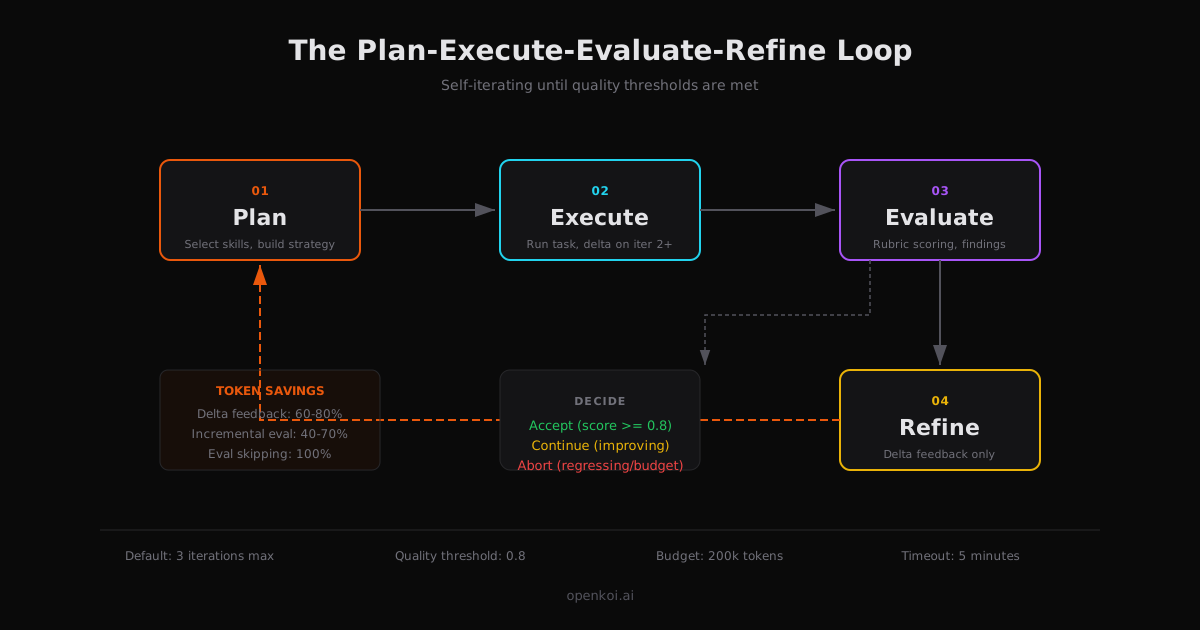
AI coding tools generate a first draft and leave you to fix it. You review, correct, re-prompt — and become the AI's QA department. OpenKoi is different. It follows a **Plan-Execute-Evaluate-Refine** loop, iterating on its own output until results meet your quality standards. The agent is its own reviewer.
Ships as a single static binary. Zero runtime dependencies. Works with any model.
## Three Steps
```bash
# 1. Install
cargo install openkoi
# or
# 2. Think — OpenKoi deliberates before it acts
openkoi think "Refactor the auth module to use JWT tokens"
# 3. Ship — it iterates until the code passes its own review
# [SOVEREIGN] "Direct, test-driven, security-conscious"
# [PARLIAMENT] Guardian=APPROVE Economist=APPROVE Scholar=APPROVE+
# [EXEC] Rewriting token.rs, middleware.rs, handlers.rs
# [EVAL] correctness=9.2 safety=9.5 style=8.8
# [REFN] Style below 9.0 — tightening error types
# [EVAL] correctness=9.4 safety=9.5 style=9.3
# [LEARNED] "JWT refresh tokens need constant-time comparison"
# ✓ Done. 3 iterations. 4 files changed.
```
No config file needed. No setup wizard. OpenKoi detects your API keys from environment variables, existing CLI tools, and local model servers — and picks the best available model.
## What Changes
| `agent run "do X"` → output | `openkoi think "do X"` → deliberation → parliament → output |
| You see the result | You see **how it decided**, not just what it decided |
| You manually review every AI output | The agent evaluates its own work against rubrics |
| You re-prompt corrections 3-5 times | Automatic iteration, stops when quality threshold is met |
| Learnings vanish between sessions | Patterns persist locally; skills improve over time |
| Memory is hidden | World model is inspectable: `openkoi world`, `openkoi mind` |
| Locked to one provider | Switch providers with a flag; different models per role |
| Data on someone else's cloud | Everything stays on your machine |
| 500ms startup, 100MB memory | <10ms startup, ~5MB idle, ~20MB binary |
## Features
- **Self-iteration** — Plan, execute, evaluate, refine. The agent is its own reviewer.
- **8+ providers** — Anthropic, OpenAI, Google, Ollama, AWS Bedrock, Groq, DeepSeek, Moonshot/Kimi, and any OpenAI-compatible endpoint.
- **Dynamic model discovery** — Probes provider APIs for available models, caches results locally. Fuzzy validation with "did you mean?" suggestions for typos.
- **Role-based models** — Assign different models to executor, evaluator, planner, and embedder roles. Auto-resolves a small/fast model for cost-sensitive internal tasks.
- **Automatic retry** — Rate limits, server errors, and timeouts are retried with exponential backoff and jitter. Context overflow is detected and handled separately.
- **Real-time progress** — Structured progress output on stderr showing plan, iterations, scores, tool calls, and costs. Suppress with `--quiet`.
- **Live task monitoring** — `openkoi status --live` polls the running task every second with a progress bar, score, cost, and recent history.
- **Task state persistence** — Current task state written to `~/.openkoi/state/current-task.json`; completed tasks appended to `task-history.jsonl` with auto-rotation.
- **HTTP API** — Localhost REST API (port 9742) for submitting tasks, querying status, and reading cost data. Optional Bearer token auth.
- **Webhooks** — Fire HTTP callbacks on `task.complete`, `task.failed`, and `budget.warning` events.
- **Smart truncation** — Tool outputs exceeding 2000 lines or 50KB are truncated with the full output saved to `~/.openkoi/tool-output/`.
- **Context overflow handling** — Detects overflow errors from all major providers and prunes context instead of failing.
- **Persistent memory** — SQLite + vector search. Learnings persist across sessions.
- **Pattern mining** — Observes your usage, proposes new skills to automate recurring workflows.
- **Skill system** — OpenClaw-compatible `.SKILL.md` format. Write once, use with any provider.
- **Rich messaging** — Slack, Discord, and Telegram integrations send structured task results with fields, colors, and thread support.
- **3-tier plugins** — MCP (external tools), WASM (sandboxed), Rhai (scripting).
- **10 integrations** — Slack, Discord, MS Teams, GitHub, Jira, Linear, Notion, Google Docs, Telegram, Email.
- **TUI dashboard** — Real-time view of tasks, costs, learnings, plugins, and config.
- **Soul system** — Optional personality that evolves with your interaction patterns.
- **Cognitive CLI** — `think` replaces `run`: deliberation before execution. Inspect the Parliament, World Map, Trust levels, and Reflection loops from the terminal.
- **Society of Mind** — Five agencies (Guardian, Economist, Empath, Scholar, Strategist) deliberate on every task. View verdicts with `openkoi mind`.
- **World model** — Tool Atlas tracks reliability and failure modes. Domain Atlas captures learned expertise. Human Atlas models your preferences.
- **Trust & delegation** — Grant autonomous action per domain, revoke anytime, audit every decision the agent made on its own.
- **Reflection loops** — Daily, weekly, and deep self-assessment. Epistemic honesty audit shows where the agent was wrong and what it learned.
## CLI
### Core
```bash
openkoi "task" # Run a task (default 3 iterations)
openkoi think "task" # EFaaS pipeline: Sovereign → Parliament → Execute → Learn
openkoi think "task" --simulate # Simulate futures without executing
openkoi think "task" --verbose # Show full parliamentary deliberation
openkoi chat # Interactive REPL
openkoi learn # Review proposed skills (interactive picker)
openkoi status # Show costs, memory, active models
openkoi status --live # Watch the running task in real-time
openkoi setup # First-time setup, diagnostics, provider connections
openkoi dashboard # TUI dashboard for tasks, costs, learnings, plugins
openkoi disconnect # Interactive picker: choose from connected providers
openkoi update # Self-update
```
### Cognitive Commands
Introspect the agent's mind. Every command works with no arguments (shows overview) or with a subcommand for detail.
```bash
# Soul — Sovereign identity
openkoi soul show # Display current SOUL.md + Value Model + Trajectory
openkoi soul evolve # Trigger soul evolution check from accumulated learnings
openkoi soul diff # Show proposed changes with evidence
openkoi soul history # Show evolution timeline
# Mind — Society of Mind introspection
openkoi mind parliament # Show last parliamentary deliberation
openkoi mind agencies # List active agencies + recent verdicts
openkoi mind dissent # Show cases where agencies disagreed
openkoi mind calibrate # Review agency prediction accuracy vs. outcomes
# World — World model inspection
openkoi world tools # Tool Atlas: reliability, failure modes, call history
openkoi world tools <name> # Drill into a specific tool
openkoi world domains # Domain Atlas: learned domain knowledge
openkoi world human # Human Atlas: what the agent knows about you
openkoi world map # Full World Map overview
# Reflect — Feedback loops & self-assessment
openkoi reflect today # Tight loop: today's tasks, decisions, outcomes
openkoi reflect week # Medium loop: weekly patterns and behavioral trends
openkoi reflect growth # Deep loop: maturity stage and unlock progress
openkoi reflect honest # Epistemic audit: where was I wrong? what did I learn?
# Trust — Trust & delegation management
openkoi trust show # Current trust level per domain
openkoi trust grant <domain> <level> # Delegate a domain (levels: ask, suggest, act, autonomous)
openkoi trust revoke <domain> # Revoke delegation
openkoi trust audit [domain] # Audit autonomous actions taken
```
### Task flags
```bash
openkoi "task" -i 5 # Set max iterations (default 3)
openkoi "task" --quality 0.9 # Set quality threshold (default 0.8)
openkoi "task" --quiet # Suppress progress output; only emit final result
openkoi "task" -m claude-sonnet-4 # Use a specific model
```
All commands that accept an argument also work without one — omitting the argument shows an interactive selection menu. Explicit arguments still work exactly as before.
## Providers
### Subscription-based (OAuth login, free with your existing plan)
Use `openkoi connect` to authenticate via device-code flow. No API key needed.
| GitHub Copilot | `openkoi connect copilot` | Device code (GitHub login) |
| ChatGPT Plus/Pro | `openkoi connect chatgpt` | Device code (OpenAI login) |
Tokens are stored in `~/.openkoi/auth.json` and refreshed automatically.
### API key providers
Set an environment variable or paste a key when prompted during `openkoi init`.
| Anthropic | `ANTHROPIC_API_KEY` |
| OpenAI | `OPENAI_API_KEY` |
| Google | `GOOGLE_API_KEY` |
| AWS Bedrock | `AWS_ACCESS_KEY_ID` + `AWS_SECRET_ACCESS_KEY` |
| Groq | `GROQ_API_KEY` |
| OpenRouter | `OPENROUTER_API_KEY` |
| Together | `TOGETHER_API_KEY` |
| DeepSeek | `DEEPSEEK_API_KEY` |
| Moonshot/Kimi | `MOONSHOT_API_KEY` |
| xAI | `XAI_API_KEY` |
| Qwen | `QWEN_API_KEY` |
API keys are saved to `~/.openkoi/credentials/<provider>.key` (owner-only permissions).
### Local
| Ollama | Auto-detected at `localhost:11434` |
| Custom (OpenAI-compatible) | `openkoi connect` picker or `config.toml` |
## Credential Discovery
OpenKoi auto-discovers credentials in this order:
1. **Environment variables** — `ANTHROPIC_API_KEY`, `OPENAI_API_KEY`, `GOOGLE_API_KEY`, etc.
2. **OAuth store** — GitHub Copilot, ChatGPT tokens from `openkoi connect`
3. **External CLIs** — Claude CLI (`~/.claude/.credentials.json`), Qwen CLI
4. **macOS Keychain** — Claude Code credentials (macOS only)
5. **Saved credentials** — `~/.openkoi/credentials/*.key`
6. **Local probes** — Ollama at `localhost:11434`
### Connect and Disconnect
```bash
# Interactive picker (shows all providers and integrations)
openkoi connect
# Or specify directly
openkoi connect copilot # GitHub Copilot
openkoi connect chatgpt # ChatGPT Plus/Pro
# Interactive disconnect (shows only currently connected providers)
openkoi disconnect
# Or specify directly
openkoi disconnect copilot
openkoi disconnect chatgpt
openkoi disconnect anthropic # Remove saved API key
openkoi disconnect all # Remove all OAuth tokens
# Show connection status
openkoi connect status
```
## HTTP API
The daemon exposes a localhost REST API on port 9742 for external tools, scripts, and web UIs.
| `POST` | `/api/v1/tasks` | Submit a new task |
| `GET` | `/api/v1/tasks` | List recent tasks |
| `GET` | `/api/v1/tasks/{id}` | Get task details |
| `POST` | `/api/v1/tasks/{id}/cancel` | Cancel a running task |
| `GET` | `/api/v1/status` | System status (version, daemon state, active task) |
| `GET` | `/api/v1/cost` | Cost summary for last 24 hours |
| `GET` | `/api/v1/health` | Health check |
```bash
# Submit a task
curl -X POST http://localhost:9742/api/v1/tasks \
-H "Content-Type: application/json" \
-d '{"description": "Fix the login bug", "max_iterations": 5}'
# Check status
curl http://localhost:9742/api/v1/status
```
Configure in `config.toml`:
```toml
[api]
enabled = true
port = 9742
token = "your-secret-token" # Optional Bearer auth
[api.webhooks]
on_task_complete = "https://example.com/hooks/complete"
on_task_failed = "https://example.com/hooks/failed"
on_budget_warning = "https://example.com/hooks/budget"
```
## Architecture
```
┌─────────────────┐
│ Sovereign │ ← Soul (SOUL.md + Value Model + Trajectory)
│ Directive │
└────────┬────────┘
│
┌────────▼────────┐
│ Parliament │ ← Mind (Guardian, Economist, Empath, Scholar, Strategist)
└────────┬────────┘
│
┌────────▼────────┐
│ Orchestrator │
└────────┬────────┘
┌───────┬───────┼───────┬──────────┐
▼ ▼ ▼ ▼ ▼
Executor Evaluator Learner Pattern Integrations
│ Miner
▼
Tools (MCP / WASM / Rhai)
│
▼
World Model ← World (Tool Atlas + Domain Atlas + Human Atlas)
```
Supported platforms: **Linux** (x86_64, ARM64) and **macOS** (Intel, Apple Silicon). Built with Rust + Tokio. < 10ms startup, ~5MB idle memory, ~20MB binary.
## Skills
Skills are markdown files (`SKILL.md`) with YAML frontmatter that teach OpenKoi how to handle specific tasks. They use the same format as OpenClaw, so skills are portable between tools.
### How skills work
OpenKoi loads skills from multiple sources in precedence order:
| Bundled | Embedded in binary | Lowest |
| Managed | `~/.openkoi/skills/managed/` | |
| Workspace | `.agents/skills/` in your project | |
| User global | `~/.openkoi/skills/user/` | |
| Pattern-proposed | `~/.openkoi/skills/proposed/` | Highest |
When you run a task, the skill selector ranks eligible skills by semantic similarity and historical effectiveness, then injects the most relevant ones into the prompt. You don't need to specify which skill to use — OpenKoi picks automatically.
### Bundled skills
These ship with the binary and are always available:
| `self-iterate` | task | Guides OpenKoi when modifying its own codebase |
| `general` | evaluator | Fallback evaluator for any task |
| `code-review` | evaluator | Evaluates code for correctness, safety, style |
| `prose-quality` | evaluator | Evaluates writing for clarity, accuracy, tone |
| `sql-safety` | evaluator | Evaluates SQL for correctness, safety, performance |
| `api-design` | evaluator | Evaluates APIs for consistency, error handling |
| `test-quality` | evaluator | Evaluates tests for coverage, assertions, isolation |
### Writing a custom skill
Create a directory with a `SKILL.md` file:
```bash
mkdir -p .agents/skills/my-skill
```
```markdown
---
name: my-skill
description: Enforces our team's API conventions.
metadata:
categories: ["api", "code"]
---
# My Skill
When building API endpoints for this project:
- Use snake_case for all field names
- Return 404 with `{"error": "not_found"}` for missing resources
- Always include `X-Request-Id` header in responses
- Validate all path parameters before database queries
```
Place it in `.agents/skills/` for project-specific skills, or `~/.openkoi/skills/user/` for global skills. OpenKoi picks it up automatically on the next run.
### Example: self-iterate
The `self-iterate` skill is how OpenKoi works on its own codebase. When a task targets the OpenKoi source tree, the skill selector activates it automatically based on category matching (`self-improvement`, `rust`, `code`, `refactor`).
It enforces architectural invariants that must never be violated:
- **Single binary** — everything embeds via `include_str!`, no runtime file dependencies
- **Zero-dependency crypto** — SHA-256 and base64 are hand-rolled, only `getrandom` for CSPRNG
- **Provider parity** — all providers implement the same `ModelProvider` trait
- **Iteration safety** — circuit breakers (token budget, time budget, max iterations) cannot be weakened
- **Atomic writes** — all credential/config files use write-to-temp-then-rename
It also defines hard boundaries on recursive self-improvement: OpenKoi can improve its own skills, providers, and memory system, but cannot disable its own safety circuit breakers or bypass evaluation.
### Evaluator skills
Evaluator skills define **how OpenKoi judges its own output**. They specify scoring dimensions and rubrics:
```markdown
---
name: my-evaluator
kind: evaluator
description: Evaluates database migrations for safety.
metadata:
categories: ["database", "migration"]
dimensions:
- { name: reversibility, weight: 0.4 }
- { name: data_safety, weight: 0.35 }
- { name: performance, weight: 0.25 }
---
# Database Migration Evaluator
## Reversibility (40%)
- Is there a matching down migration?
- Can the migration be rolled back without data loss?
...
```
Place evaluator skills in `.agents/evaluators/` (project) or `~/.openkoi/evaluators/user/` (global).
### Managing skills
```bash
openkoi learn # Review pattern-proposed skills
openkoi learn --install # Install a managed skill
openkoi status # See active skills and effectiveness scores
```
OpenKoi's pattern miner watches your usage and proposes new skills when it detects recurring workflows. Run `openkoi learn` to review and approve them.
## Environment
All paths default to `~/.openkoi/` (config) and `~/.local/share/openkoi/` (data). Set `OPENKOI_HOME` to relocate everything under a single directory:
```bash
export OPENKOI_HOME=/tmp/openkoi-test
openkoi status # config at /tmp/openkoi-test/, data at /tmp/openkoi-test/data/
```
| `OPENKOI_HOME` | Override all config and data paths. Config lives at `$OPENKOI_HOME/`, data at `$OPENKOI_HOME/data/`. |
| `OPENKOI_CONFIG` | Override the config file path only. Default: `~/.openkoi/config.toml`. |
| `OPENKOI_DATA` | Override the data directory only. Default: `~/.local/share/openkoi`. |
| `OPENKOI_MODEL` | Default model in `provider/model` format. |
| `OPENKOI_LOG_LEVEL` | Log verbosity: `error`, `warn`, `info`, `debug`, `trace`. |
## Install
```bash
# Via Cargo
cargo install openkoi
# Via shell installer
Full documentation at [openkoi.ai](https://openkoi.ai).
## License
[MIT](LICENSE)
