//! # Binary descriptors for lines extracted from an image
//!
//! Introduction
//! ------------
//!
//! One of the most challenging activities in computer vision is the extraction of useful information
//! from a given image. Such information, usually comes in the form of points that preserve some kind of
//! property (for instance, they are scale-invariant) and are actually representative of input image.
//!
//! The goal of this module is seeking a new kind of representative information inside an image and
//! providing the functionalities for its extraction and representation. In particular, differently from
//! previous methods for detection of relevant elements inside an image, lines are extracted in place of
//! points; a new class is defined ad hoc to summarize a line's properties, for reuse and plotting
//! purposes.
//!
//! Computation of binary descriptors
//! ---------------------------------
//!
//! To obtatin a binary descriptor representing a certain line detected from a certain octave of an
//! image, we first compute a non-binary descriptor as described in [LBD](https://docs.opencv.org/4.1.1/d0/de3/citelist.html#CITEREF_LBD) . Such algorithm works on
//! lines extracted using EDLine detector, as explained in [EDL](https://docs.opencv.org/4.1.1/d0/de3/citelist.html#CITEREF_EDL) . Given a line, we consider a
//! rectangular region centered at it and called *line support region (LSR)*. Such region is divided
//! into a set of bands , whose length equals the one of line.
//!
//! If we indicate with  the direction of line, the orthogonal and clockwise direction to line
//!  can be determined; these two directions, are used to construct a reference frame
//! centered in the middle point of line. The gradients of pixels  inside LSR can be projected
//! to the newly determined frame, obtaining their local equivalent
//! .
//!
//! Later on, a Gaussian function is applied to all LSR's pixels along  direction; first,
//! we assign a global weighting coefficient  to
//! *i*-th row in LSR, where  is the distance of *i*-th row from the center row in LSR,
//!  and  is the width of bands (the same for every band). Secondly,
//! considering a band  and its neighbor bands , we assign a local weighting
//! , where  is the distance of *k*-th
//! row from the center row in  and . Using the global and local weights, we obtain,
//! at the same time, the reduction of role played by gradients far from line and of boundary effect,
//! respectively.
//!
//! Each band  in LSR has an associated *band descriptor(BD)* which is computed considering
//! previous and next band (top and bottom bands are ignored when computing descriptor for first and
//! last band). Once each band has been assignen its BD, the LBD descriptor of line is simply given by
//!
//! 
//!
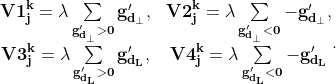
//! To compute a band descriptor , each *k*-th row in it is considered and the gradients in such
//! row are accumulated:
//!
//! 
//!
//! with .
//!
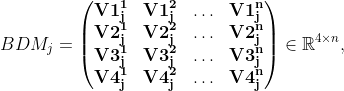
//! By stacking previous results, we obtain the *band description matrix (BDM)*
//!
//! 
//!
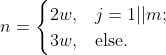
//! with  the number of rows in band :
//!
//! 
//!
//! Each  can be obtained using the standard deviation vector  and mean vector  of
//! . Thus, finally:
//!
//! 
//!
//! Once the LBD has been obtained, it must be converted into a binary form. For such purpose, we
//! consider 32 possible pairs of BD inside it; each couple of BD is compared bit by bit and comparison
//! generates an 8 bit string. Concatenating 32 comparison strings, we get the 256-bit final binary
//! representation of a single LBD.
use std::os::raw::{c_char, c_void};
use libc::{ptrdiff_t, size_t};
use crate::{Error, Result, core, sys, types};
use crate::core::{_InputArray, _OutputArray};
/// A class to represent a line
///
/// As aformentioned, it is been necessary to design a class that fully stores the information needed to
/// characterize completely a line and plot it on image it was extracted from, when required.
///
/// *KeyLine* class has been created for such goal; it is mainly inspired to Feature2d's KeyPoint class,
/// since KeyLine shares some of *KeyPoint*'s fields, even if a part of them assumes a different
/// meaning, when speaking about lines. In particular:
///
/// * the *class_id* field is used to gather lines extracted from different octaves which refer to
/// same line inside original image (such lines and the one they represent in original image share
/// the same *class_id* value)
/// * the *angle* field represents line's slope with respect to (positive) X axis
/// * the *pt* field represents line's midpoint
/// * the *response* field is computed as the ratio between the line's length and maximum between
/// image's width and height
/// * the *size* field is the area of the smallest rectangle containing line
///
/// Apart from fields inspired to KeyPoint class, KeyLines stores information about extremes of line in
/// original image and in octave it was extracted from, about line's length and number of pixels it
/// covers.
#[repr(C)]
#[derive(Copy,Clone,Debug,PartialEq)]
pub struct KeyLine {
pub angle: f32,
pub class_id: i32,
pub octave: i32,
pub pt: core::Point2f,
pub response: f32,
pub size: f32,
pub start_point_x: f32,
pub start_point_y: f32,
pub end_point_x: f32,
pub end_point_y: f32,
pub s_point_in_octave_x: f32,
pub s_point_in_octave_y: f32,
pub e_point_in_octave_x: f32,
pub e_point_in_octave_y: f32,
pub line_length: f32,
pub num_of_pixels: i32,
}
/// Lines extraction methodology
/// ----------------------------
///
/// The lines extraction methodology described in the following is mainly based on [EDL](https://docs.opencv.org/4.1.1/d0/de3/citelist.html#CITEREF_EDL) . The
/// extraction starts with a Gaussian pyramid generated from an original image, downsampled N-1 times,
/// blurred N times, to obtain N layers (one for each octave), with layer 0 corresponding to input
/// image. Then, from each layer (octave) in the pyramid, lines are extracted using LSD algorithm.
///
/// Differently from EDLine lines extractor used in original article, LSD furnishes information only
/// about lines extremes; thus, additional information regarding slope and equation of line are computed
/// via analytic methods. The number of pixels is obtained using *LineIterator*. Extracted lines are
/// returned in the form of KeyLine objects, but since extraction is based on a method different from
/// the one used in *BinaryDescriptor* class, data associated to a line's extremes in original image and
/// in octave it was extracted from, coincide. KeyLine's field *class_id* is used as an index to
/// indicate the order of extraction of a line inside a single octave.
#[repr(C)]
#[derive(Copy,Clone,Debug,PartialEq)]
pub struct LSDParam {
pub scale: f64,
pub sigma_scale: f64,
pub quant: f64,
pub ang_th: f64,
pub log_eps: f64,
pub density_th: f64,
pub n_bins: i32,
}
/// struct for drawing options
#[repr(C)]
#[derive(Copy,Clone,Debug,PartialEq)]
pub struct DrawLinesMatchesFlags {
__rust_private: [u8; 0],
}
/// Draws keylines.
///
/// ## Parameters
/// * image: input image
/// * keylines: keylines to be drawn
/// * outImage: output image to draw on
/// * color: color of lines to be drawn (if set to defaul value, color is chosen randomly)
/// * flags: drawing flags
///
/// ## C++ default parameters
/// * color: Scalar::all( -1 )
/// * flags: DrawLinesMatchesFlags::DEFAULT
pub fn draw_keylines(image: &core::Mat, keylines: &types::VectorOfKeyLine, out_image: &mut core::Mat, color: core::Scalar, flags: i32) -> Result<()> {
unsafe { sys::cv_line_descriptor_drawKeylines_Mat_VectorOfKeyLine_Mat_Scalar_int(image.as_raw_Mat(), keylines.as_raw_VectorOfKeyLine(), out_image.as_raw_Mat(), color, flags) }.into_result()
}
/// Draws the found matches of keylines from two images.
///
/// ## Parameters
/// * img1: first image
/// * keylines1: keylines extracted from first image
/// * img2: second image
/// * keylines2: keylines extracted from second image
/// * matches1to2: vector of matches
/// * outImg: output matrix to draw on
/// * matchColor: drawing color for matches (chosen randomly in case of default value)
/// * singleLineColor: drawing color for keylines (chosen randomly in case of default value)
/// * matchesMask: mask to indicate which matches must be drawn
/// * flags: drawing flags, see DrawLinesMatchesFlags
///
///
/// Note: If both *matchColor* and *singleLineColor* are set to their default values, function draws
/// matched lines and line connecting them with same color
///
/// ## C++ default parameters
/// * match_color: Scalar::all( -1 )
/// * single_line_color: Scalar::all( -1 )
/// * matches_mask: std::vector<char>()
/// * flags: DrawLinesMatchesFlags::DEFAULT
pub fn draw_line_matches(img1: &core::Mat, keylines1: &types::VectorOfKeyLine, img2: &core::Mat, keylines2: &types::VectorOfKeyLine, matches1to2: &types::VectorOfDMatch, out_img: &mut core::Mat, match_color: core::Scalar, single_line_color: core::Scalar, matches_mask: &types::VectorOfchar, flags: i32) -> Result<()> {
unsafe { sys::cv_line_descriptor_drawLineMatches_Mat_VectorOfKeyLine_Mat_VectorOfKeyLine_VectorOfDMatch_Mat_Scalar_Scalar_VectorOfchar_int(img1.as_raw_Mat(), keylines1.as_raw_VectorOfKeyLine(), img2.as_raw_Mat(), keylines2.as_raw_VectorOfKeyLine(), matches1to2.as_raw_VectorOfDMatch(), out_img.as_raw_Mat(), match_color, single_line_color, matches_mask.as_raw_VectorOfchar(), flags) }.into_result()
}
// boxed class cv::line_descriptor::BinaryDescriptor
/// Class implements both functionalities for detection of lines and computation of their
/// binary descriptor.
///
/// Class' interface is mainly based on the ones of classical detectors and extractors, such as
/// Feature2d's @ref features2d_main and @ref features2d_match. Retrieved information about lines is
/// stored in line_descriptor::KeyLine objects.
pub struct BinaryDescriptor {
#[doc(hidden)] pub(crate) ptr: *mut c_void
}
impl Drop for crate::line_descriptor::BinaryDescriptor {
fn drop(&mut self) {
unsafe { sys::cv_BinaryDescriptor_delete(self.ptr) };
}
}
impl crate::line_descriptor::BinaryDescriptor {
#[inline(always)] pub fn as_raw_BinaryDescriptor(&self) -> *mut c_void { self.ptr }
pub unsafe fn from_raw_ptr(ptr: *mut c_void) -> Self {
Self { ptr }
}
}
unsafe impl Send for BinaryDescriptor {}
impl core::Algorithm for BinaryDescriptor {
#[inline(always)] fn as_raw_Algorithm(&self) -> *mut c_void { self.ptr }
}
impl BinaryDescriptor {
/// Constructor
///
/// ## Parameters
/// * parameters: configuration parameters BinaryDescriptor::Params
///
/// If no argument is provided, constructor sets default values (see comments in the code snippet in
/// previous section). Default values are strongly reccomended.
///
/// ## C++ default parameters
/// * parameters: BinaryDescriptor::Params()
pub fn new(parameters: &crate::line_descriptor::BinaryDescriptor_Params) -> Result<crate::line_descriptor::BinaryDescriptor> {
unsafe { sys::cv_line_descriptor_BinaryDescriptor_BinaryDescriptor_Params(parameters.as_raw_BinaryDescriptor_Params()) }.into_result().map(|ptr| crate::line_descriptor::BinaryDescriptor { ptr })
}
/// Create a BinaryDescriptor object with default parameters (or with the ones provided)
/// and return a smart pointer to it
pub fn create_binary_descriptor() -> Result<types::PtrOfBinaryDescriptor> {
unsafe { sys::cv_line_descriptor_BinaryDescriptor_createBinaryDescriptor() }.into_result().map(|ptr| types::PtrOfBinaryDescriptor { ptr })
}
pub fn create_binary_descriptor_1(parameters: &crate::line_descriptor::BinaryDescriptor_Params) -> Result<types::PtrOfBinaryDescriptor> {
unsafe { sys::cv_line_descriptor_BinaryDescriptor_createBinaryDescriptor_Params(parameters.as_raw_BinaryDescriptor_Params()) }.into_result().map(|ptr| types::PtrOfBinaryDescriptor { ptr })
}
/// Get current number of octaves
pub fn get_num_of_octaves(&mut self) -> Result<i32> {
unsafe { sys::cv_line_descriptor_BinaryDescriptor_getNumOfOctaves(self.as_raw_BinaryDescriptor()) }.into_result()
}
/// Set number of octaves
/// ## Parameters
/// * octaves: number of octaves
pub fn set_num_of_octaves(&mut self, octaves: i32) -> Result<()> {
unsafe { sys::cv_line_descriptor_BinaryDescriptor_setNumOfOctaves_int(self.as_raw_BinaryDescriptor(), octaves) }.into_result()
}
/// Get current width of bands
pub fn get_width_of_band(&mut self) -> Result<i32> {
unsafe { sys::cv_line_descriptor_BinaryDescriptor_getWidthOfBand(self.as_raw_BinaryDescriptor()) }.into_result()
}
/// Set width of bands
/// ## Parameters
/// * width: width of bands
pub fn set_width_of_band(&mut self, width: i32) -> Result<()> {
unsafe { sys::cv_line_descriptor_BinaryDescriptor_setWidthOfBand_int(self.as_raw_BinaryDescriptor(), width) }.into_result()
}
/// Get current reduction ratio (used in Gaussian pyramids)
pub fn get_reduction_ratio(&mut self) -> Result<i32> {
unsafe { sys::cv_line_descriptor_BinaryDescriptor_getReductionRatio(self.as_raw_BinaryDescriptor()) }.into_result()
}
/// Set reduction ratio (used in Gaussian pyramids)
/// ## Parameters
/// * rRatio: reduction ratio
pub fn set_reduction_ratio(&mut self, r_ratio: i32) -> Result<()> {
unsafe { sys::cv_line_descriptor_BinaryDescriptor_setReductionRatio_int(self.as_raw_BinaryDescriptor(), r_ratio) }.into_result()
}
/// Read parameters from a FileNode object and store them
///
/// ## Parameters
/// * fn: source FileNode file
pub fn read(&mut self, _fn: &core::FileNode) -> Result<()> {
unsafe { sys::cv_line_descriptor_BinaryDescriptor_read_FileNode(self.as_raw_BinaryDescriptor(), _fn.as_raw_FileNode()) }.into_result()
}
/// Store parameters to a FileStorage object
///
/// ## Parameters
/// * fs: output FileStorage file
pub fn write(&self, fs: &mut core::FileStorage) -> Result<()> {
unsafe { sys::cv_line_descriptor_BinaryDescriptor_write_const_FileStorage(self.as_raw_BinaryDescriptor(), fs.as_raw_FileStorage()) }.into_result()
}
/// Requires line detection
///
/// ## Parameters
/// * image: input image
/// * keypoints: vector that will store extracted lines for one or more images
/// * mask: mask matrix to detect only KeyLines of interest
///
/// ## C++ default parameters
/// * mask: Mat()
pub fn detect(&mut self, image: &core::Mat, keypoints: &mut types::VectorOfKeyLine, mask: &core::Mat) -> Result<()> {
unsafe { sys::cv_line_descriptor_BinaryDescriptor_detect_Mat_VectorOfKeyLine_Mat(self.as_raw_BinaryDescriptor(), image.as_raw_Mat(), keypoints.as_raw_VectorOfKeyLine(), mask.as_raw_Mat()) }.into_result()
}
/// ## Parameters
/// * images: input images
/// * keylines: set of vectors that will store extracted lines for one or more images
/// * masks: vector of mask matrices to detect only KeyLines of interest from each input image
///
/// ## C++ default parameters
/// * masks: std::vector<Mat>()
pub fn detect_1(&self, images: &types::VectorOfMat, keylines: &mut types::VectorOfVectorOfKeyLine, masks: &types::VectorOfMat) -> Result<()> {
unsafe { sys::cv_line_descriptor_BinaryDescriptor_detect_const_VectorOfMat_VectorOfVectorOfKeyLine_VectorOfMat(self.as_raw_BinaryDescriptor(), images.as_raw_VectorOfMat(), keylines.as_raw_VectorOfVectorOfKeyLine(), masks.as_raw_VectorOfMat()) }.into_result()
}
/// Requires descriptors computation
///
/// ## Parameters
/// * image: input image
/// * keylines: vector containing lines for which descriptors must be computed
/// * descriptors:
/// * returnFloatDescr: flag (when set to true, original non-binary descriptors are returned)
///
/// ## C++ default parameters
/// * return_float_descr: false
pub fn compute(&self, image: &core::Mat, keylines: &mut types::VectorOfKeyLine, descriptors: &mut core::Mat, return_float_descr: bool) -> Result<()> {
unsafe { sys::cv_line_descriptor_BinaryDescriptor_compute_const_Mat_VectorOfKeyLine_Mat_bool(self.as_raw_BinaryDescriptor(), image.as_raw_Mat(), keylines.as_raw_VectorOfKeyLine(), descriptors.as_raw_Mat(), return_float_descr) }.into_result()
}
/// ## Parameters
/// * images: input images
/// * keylines: set of vectors containing lines for which descriptors must be computed
/// * descriptors:
/// * returnFloatDescr: flag (when set to true, original non-binary descriptors are returned)
///
/// ## C++ default parameters
/// * return_float_descr: false
pub fn compute_1(&self, images: &types::VectorOfMat, keylines: &mut types::VectorOfVectorOfKeyLine, descriptors: &mut types::VectorOfMat, return_float_descr: bool) -> Result<()> {
unsafe { sys::cv_line_descriptor_BinaryDescriptor_compute_const_VectorOfMat_VectorOfVectorOfKeyLine_VectorOfMat_bool(self.as_raw_BinaryDescriptor(), images.as_raw_VectorOfMat(), keylines.as_raw_VectorOfVectorOfKeyLine(), descriptors.as_raw_VectorOfMat(), return_float_descr) }.into_result()
}
/// Return descriptor size
pub fn descriptor_size(&self) -> Result<i32> {
unsafe { sys::cv_line_descriptor_BinaryDescriptor_descriptorSize_const(self.as_raw_BinaryDescriptor()) }.into_result()
}
/// Return data type
pub fn descriptor_type(&self) -> Result<i32> {
unsafe { sys::cv_line_descriptor_BinaryDescriptor_descriptorType_const(self.as_raw_BinaryDescriptor()) }.into_result()
}
/// returns norm mode
pub fn default_norm(&self) -> Result<i32> {
unsafe { sys::cv_line_descriptor_BinaryDescriptor_defaultNorm_const(self.as_raw_BinaryDescriptor()) }.into_result()
}
}
// boxed class cv::line_descriptor::BinaryDescriptor::Params
/// List of BinaryDescriptor parameters:
pub struct BinaryDescriptor_Params {
#[doc(hidden)] pub(crate) ptr: *mut c_void
}
impl Drop for crate::line_descriptor::BinaryDescriptor_Params {
fn drop(&mut self) {
unsafe { sys::cv_BinaryDescriptor_Params_delete(self.ptr) };
}
}
impl crate::line_descriptor::BinaryDescriptor_Params {
#[inline(always)] pub fn as_raw_BinaryDescriptor_Params(&self) -> *mut c_void { self.ptr }
pub unsafe fn from_raw_ptr(ptr: *mut c_void) -> Self {
Self { ptr }
}
}
unsafe impl Send for BinaryDescriptor_Params {}
impl BinaryDescriptor_Params {
pub fn default() -> Result<crate::line_descriptor::BinaryDescriptor_Params> {
unsafe { sys::cv_line_descriptor_BinaryDescriptor_Params_Params() }.into_result().map(|ptr| crate::line_descriptor::BinaryDescriptor_Params { ptr })
}
/// read parameters from a FileNode object and store them (struct function)
pub fn read(&mut self, _fn: &core::FileNode) -> Result<()> {
unsafe { sys::cv_line_descriptor_BinaryDescriptor_Params_read_FileNode(self.as_raw_BinaryDescriptor_Params(), _fn.as_raw_FileNode()) }.into_result()
}
/// store parameters to a FileStorage object (struct function)
pub fn write(&self, fs: &mut core::FileStorage) -> Result<()> {
unsafe { sys::cv_line_descriptor_BinaryDescriptor_Params_write_const_FileStorage(self.as_raw_BinaryDescriptor_Params(), fs.as_raw_FileStorage()) }.into_result()
}
}
// boxed class cv::line_descriptor::BinaryDescriptorMatcher
/// furnishes all functionalities for querying a dataset provided by user or internal to
/// class (that user must, anyway, populate) on the model of @ref features2d_match
///
///
/// Once descriptors have been extracted from an image (both they represent lines and points), it
/// becomes interesting to be able to match a descriptor with another one extracted from a different
/// image and representing the same line or point, seen from a differente perspective or on a different
/// scale. In reaching such goal, the main headache is designing an efficient search algorithm to
/// associate a query descriptor to one extracted from a dataset. In the following, a matching modality
/// based on *Multi-Index Hashing (MiHashing)* will be described.
///
/// Multi-Index Hashing
/// -------------------
///
/// The theory described in this section is based on [MIH](https://docs.opencv.org/4.1.1/d0/de3/citelist.html#CITEREF_MIH) . Given a dataset populated with binary
/// codes, each code is indexed *m* times into *m* different hash tables, according to *m* substrings it
/// has been divided into. Thus, given a query code, all the entries close to it at least in one
/// substring are returned by search as *neighbor candidates*. Returned entries are then checked for
/// validity by verifying that their full codes are not distant (in Hamming space) more than *r* bits
/// from query code. In details, each binary code **h** composed of *b* bits is divided into *m*
/// disjoint substrings , each with length
///  or  bits. Formally, when two codes **h** and **g** differ
/// by at the most *r* bits, in at the least one of their *m* substrings they differ by at the most
///  bits. In particular, when  (where 
/// is the Hamming norm), there must exist a substring *k* (with ) such that
///
/// 
///
/// That means that if Hamming distance between each of the *m* substring is strictly greater than
/// , then  must be larger that *r* and that is a
/// contradiction. If the codes in dataset are divided into *m* substrings, then *m* tables will be
/// built. Given a query **q** with substrings , *i*-th hash table is
/// searched for entries distant at the most  from  and a set of
/// candidates  is obtained. The union of sets
/// 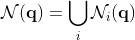 is a superset of the *r*-neighbors
/// of **q**. Then, last step of algorithm is computing the Hamming distance between **q** and each
/// element in , deleting the codes that are distant more that *r* from **q**.
pub struct BinaryDescriptorMatcher {
#[doc(hidden)] pub(crate) ptr: *mut c_void
}
impl Drop for crate::line_descriptor::BinaryDescriptorMatcher {
fn drop(&mut self) {
unsafe { sys::cv_BinaryDescriptorMatcher_delete(self.ptr) };
}
}
impl crate::line_descriptor::BinaryDescriptorMatcher {
#[inline(always)] pub fn as_raw_BinaryDescriptorMatcher(&self) -> *mut c_void { self.ptr }
pub unsafe fn from_raw_ptr(ptr: *mut c_void) -> Self {
Self { ptr }
}
}
unsafe impl Send for BinaryDescriptorMatcher {}
impl core::Algorithm for BinaryDescriptorMatcher {
#[inline(always)] fn as_raw_Algorithm(&self) -> *mut c_void { self.ptr }
}
impl BinaryDescriptorMatcher {
/// For every input query descriptor, retrieve the best matching one from a dataset provided from user
/// or from the one internal to class
///
/// ## Parameters
/// * queryDescriptors: query descriptors
/// * trainDescriptors: dataset of descriptors furnished by user
/// * matches: vector to host retrieved matches
/// * mask: mask to select which input descriptors must be matched to one in dataset
///
/// ## C++ default parameters
/// * mask: Mat()
pub fn _match(&self, query_descriptors: &core::Mat, train_descriptors: &core::Mat, matches: &mut types::VectorOfDMatch, mask: &core::Mat) -> Result<()> {
unsafe { sys::cv_line_descriptor_BinaryDescriptorMatcher_match_const_Mat_Mat_VectorOfDMatch_Mat(self.as_raw_BinaryDescriptorMatcher(), query_descriptors.as_raw_Mat(), train_descriptors.as_raw_Mat(), matches.as_raw_VectorOfDMatch(), mask.as_raw_Mat()) }.into_result()
}
/// ## Parameters
/// * queryDescriptors: query descriptors
/// * matches: vector to host retrieved matches
/// * masks: vector of masks to select which input descriptors must be matched to one in dataset
/// (the *i*-th mask in vector indicates whether each input query can be matched with descriptors in
/// dataset relative to *i*-th image)
///
/// ## C++ default parameters
/// * masks: std::vector<Mat>()
pub fn _match_1(&mut self, query_descriptors: &core::Mat, matches: &mut types::VectorOfDMatch, masks: &types::VectorOfMat) -> Result<()> {
unsafe { sys::cv_line_descriptor_BinaryDescriptorMatcher_match_Mat_VectorOfDMatch_VectorOfMat(self.as_raw_BinaryDescriptorMatcher(), query_descriptors.as_raw_Mat(), matches.as_raw_VectorOfDMatch(), masks.as_raw_VectorOfMat()) }.into_result()
}
/// For every input query descriptor, retrieve the best *k* matching ones from a dataset provided from
/// user or from the one internal to class
///
/// ## Parameters
/// * queryDescriptors: query descriptors
/// * trainDescriptors: dataset of descriptors furnished by user
/// * matches: vector to host retrieved matches
/// * k: number of the closest descriptors to be returned for every input query
/// * mask: mask to select which input descriptors must be matched to ones in dataset
/// * compactResult: flag to obtain a compact result (if true, a vector that doesn't contain any
/// matches for a given query is not inserted in final result)
///
/// ## C++ default parameters
/// * mask: Mat()
/// * compact_result: false
pub fn knn_match(&self, query_descriptors: &core::Mat, train_descriptors: &core::Mat, matches: &mut types::VectorOfVectorOfDMatch, k: i32, mask: &core::Mat, compact_result: bool) -> Result<()> {
unsafe { sys::cv_line_descriptor_BinaryDescriptorMatcher_knnMatch_const_Mat_Mat_VectorOfVectorOfDMatch_int_Mat_bool(self.as_raw_BinaryDescriptorMatcher(), query_descriptors.as_raw_Mat(), train_descriptors.as_raw_Mat(), matches.as_raw_VectorOfVectorOfDMatch(), k, mask.as_raw_Mat(), compact_result) }.into_result()
}
/// ## Parameters
/// * queryDescriptors: query descriptors
/// * matches: vector to host retrieved matches
/// * k: number of the closest descriptors to be returned for every input query
/// * masks: vector of masks to select which input descriptors must be matched to ones in dataset
/// (the *i*-th mask in vector indicates whether each input query can be matched with descriptors in
/// dataset relative to *i*-th image)
/// * compactResult: flag to obtain a compact result (if true, a vector that doesn't contain any
/// matches for a given query is not inserted in final result)
///
/// ## C++ default parameters
/// * masks: std::vector<Mat>()
/// * compact_result: false
pub fn knn_match_1(&mut self, query_descriptors: &core::Mat, matches: &mut types::VectorOfVectorOfDMatch, k: i32, masks: &types::VectorOfMat, compact_result: bool) -> Result<()> {
unsafe { sys::cv_line_descriptor_BinaryDescriptorMatcher_knnMatch_Mat_VectorOfVectorOfDMatch_int_VectorOfMat_bool(self.as_raw_BinaryDescriptorMatcher(), query_descriptors.as_raw_Mat(), matches.as_raw_VectorOfVectorOfDMatch(), k, masks.as_raw_VectorOfMat(), compact_result) }.into_result()
}
/// For every input query descriptor, retrieve, from a dataset provided from user or from the one
/// internal to class, all the descriptors that are not further than *maxDist* from input query
///
/// ## Parameters
/// * queryDescriptors: query descriptors
/// * trainDescriptors: dataset of descriptors furnished by user
/// * matches: vector to host retrieved matches
/// * maxDistance: search radius
/// * mask: mask to select which input descriptors must be matched to ones in dataset
/// * compactResult: flag to obtain a compact result (if true, a vector that doesn't contain any
/// matches for a given query is not inserted in final result)
///
/// ## C++ default parameters
/// * mask: Mat()
/// * compact_result: false
pub fn radius_match(&self, query_descriptors: &core::Mat, train_descriptors: &core::Mat, matches: &mut types::VectorOfVectorOfDMatch, max_distance: f32, mask: &core::Mat, compact_result: bool) -> Result<()> {
unsafe { sys::cv_line_descriptor_BinaryDescriptorMatcher_radiusMatch_const_Mat_Mat_VectorOfVectorOfDMatch_float_Mat_bool(self.as_raw_BinaryDescriptorMatcher(), query_descriptors.as_raw_Mat(), train_descriptors.as_raw_Mat(), matches.as_raw_VectorOfVectorOfDMatch(), max_distance, mask.as_raw_Mat(), compact_result) }.into_result()
}
/// ## Parameters
/// * queryDescriptors: query descriptors
/// * matches: vector to host retrieved matches
/// * maxDistance: search radius
/// * masks: vector of masks to select which input descriptors must be matched to ones in dataset
/// (the *i*-th mask in vector indicates whether each input query can be matched with descriptors in
/// dataset relative to *i*-th image)
/// * compactResult: flag to obtain a compact result (if true, a vector that doesn't contain any
/// matches for a given query is not inserted in final result)
///
/// ## C++ default parameters
/// * masks: std::vector<Mat>()
/// * compact_result: false
pub fn radius_match_1(&mut self, query_descriptors: &core::Mat, matches: &mut types::VectorOfVectorOfDMatch, max_distance: f32, masks: &types::VectorOfMat, compact_result: bool) -> Result<()> {
unsafe { sys::cv_line_descriptor_BinaryDescriptorMatcher_radiusMatch_Mat_VectorOfVectorOfDMatch_float_VectorOfMat_bool(self.as_raw_BinaryDescriptorMatcher(), query_descriptors.as_raw_Mat(), matches.as_raw_VectorOfVectorOfDMatch(), max_distance, masks.as_raw_VectorOfMat(), compact_result) }.into_result()
}
/// Store locally new descriptors to be inserted in dataset, without updating dataset.
///
/// ## Parameters
/// * descriptors: matrices containing descriptors to be inserted into dataset
///
///
/// Note: Each matrix *i* in **descriptors** should contain descriptors relative to lines extracted from
/// *i*-th image.
pub fn add(&mut self, descriptors: &types::VectorOfMat) -> Result<()> {
unsafe { sys::cv_line_descriptor_BinaryDescriptorMatcher_add_VectorOfMat(self.as_raw_BinaryDescriptorMatcher(), descriptors.as_raw_VectorOfMat()) }.into_result()
}
/// Update dataset by inserting into it all descriptors that were stored locally by *add* function.
///
///
/// Note: Every time this function is invoked, current dataset is deleted and locally stored descriptors
/// are inserted into dataset. The locally stored copy of just inserted descriptors is then removed.
pub fn train(&mut self) -> Result<()> {
unsafe { sys::cv_line_descriptor_BinaryDescriptorMatcher_train(self.as_raw_BinaryDescriptorMatcher()) }.into_result()
}
/// Create a BinaryDescriptorMatcher object and return a smart pointer to it.
pub fn create_binary_descriptor_matcher() -> Result<types::PtrOfBinaryDescriptorMatcher> {
unsafe { sys::cv_line_descriptor_BinaryDescriptorMatcher_createBinaryDescriptorMatcher() }.into_result().map(|ptr| types::PtrOfBinaryDescriptorMatcher { ptr })
}
/// Clear dataset and internal data
pub fn clear(&mut self) -> Result<()> {
unsafe { sys::cv_line_descriptor_BinaryDescriptorMatcher_clear(self.as_raw_BinaryDescriptorMatcher()) }.into_result()
}
/// Constructor.
///
/// The BinaryDescriptorMatcher constructed is able to store and manage 256-bits long entries.
pub fn default() -> Result<crate::line_descriptor::BinaryDescriptorMatcher> {
unsafe { sys::cv_line_descriptor_BinaryDescriptorMatcher_BinaryDescriptorMatcher() }.into_result().map(|ptr| crate::line_descriptor::BinaryDescriptorMatcher { ptr })
}
}
impl KeyLine {
/// Returns the start point of the line in the original image
pub fn get_start_point(self) -> Result<core::Point2f> {
unsafe { sys::cv_line_descriptor_KeyLine_getStartPoint_const(self) }.into_result()
}
/// Returns the end point of the line in the original image
pub fn get_end_point(self) -> Result<core::Point2f> {
unsafe { sys::cv_line_descriptor_KeyLine_getEndPoint_const(self) }.into_result()
}
/// Returns the start point of the line in the octave it was extracted from
pub fn get_start_point_in_octave(self) -> Result<core::Point2f> {
unsafe { sys::cv_line_descriptor_KeyLine_getStartPointInOctave_const(self) }.into_result()
}
/// Returns the end point of the line in the octave it was extracted from
pub fn get_end_point_in_octave(self) -> Result<core::Point2f> {
unsafe { sys::cv_line_descriptor_KeyLine_getEndPointInOctave_const(self) }.into_result()
}
/// constructor
pub fn default() -> Result<crate::line_descriptor::KeyLine> {
unsafe { sys::cv_line_descriptor_KeyLine_KeyLine() }.into_result()
}
}
// boxed class cv::line_descriptor::LSDDetector
pub struct LSDDetector {
#[doc(hidden)] pub(crate) ptr: *mut c_void
}
impl Drop for crate::line_descriptor::LSDDetector {
fn drop(&mut self) {
unsafe { sys::cv_LSDDetector_delete(self.ptr) };
}
}
impl crate::line_descriptor::LSDDetector {
#[inline(always)] pub fn as_raw_LSDDetector(&self) -> *mut c_void { self.ptr }
pub unsafe fn from_raw_ptr(ptr: *mut c_void) -> Self {
Self { ptr }
}
}
unsafe impl Send for LSDDetector {}
impl core::Algorithm for LSDDetector {
#[inline(always)] fn as_raw_Algorithm(&self) -> *mut c_void { self.ptr }
}
impl LSDDetector {
pub fn default() -> Result<crate::line_descriptor::LSDDetector> {
unsafe { sys::cv_line_descriptor_LSDDetector_LSDDetector() }.into_result().map(|ptr| crate::line_descriptor::LSDDetector { ptr })
}
pub fn new(_params: crate::line_descriptor::LSDParam) -> Result<crate::line_descriptor::LSDDetector> {
unsafe { sys::cv_line_descriptor_LSDDetector_LSDDetector_LSDParam(_params) }.into_result().map(|ptr| crate::line_descriptor::LSDDetector { ptr })
}
/// Creates ad LSDDetector object, using smart pointers.
pub fn create_lsd_detector() -> Result<types::PtrOfLSDDetector> {
unsafe { sys::cv_line_descriptor_LSDDetector_createLSDDetector() }.into_result().map(|ptr| types::PtrOfLSDDetector { ptr })
}
pub fn create_lsd_detector_1(params: crate::line_descriptor::LSDParam) -> Result<types::PtrOfLSDDetector> {
unsafe { sys::cv_line_descriptor_LSDDetector_createLSDDetector_LSDParam(params) }.into_result().map(|ptr| types::PtrOfLSDDetector { ptr })
}
/// Detect lines inside an image.
///
/// ## Parameters
/// * image: input image
/// * keypoints: vector that will store extracted lines for one or more images
/// * scale: scale factor used in pyramids generation
/// * numOctaves: number of octaves inside pyramid
/// * mask: mask matrix to detect only KeyLines of interest
///
/// ## C++ default parameters
/// * mask: Mat()
pub fn detect(&mut self, image: &core::Mat, keypoints: &mut types::VectorOfKeyLine, scale: i32, num_octaves: i32, mask: &core::Mat) -> Result<()> {
unsafe { sys::cv_line_descriptor_LSDDetector_detect_Mat_VectorOfKeyLine_int_int_Mat(self.as_raw_LSDDetector(), image.as_raw_Mat(), keypoints.as_raw_VectorOfKeyLine(), scale, num_octaves, mask.as_raw_Mat()) }.into_result()
}
/// ## Parameters
/// * images: input images
/// * keylines: set of vectors that will store extracted lines for one or more images
/// * scale: scale factor used in pyramids generation
/// * numOctaves: number of octaves inside pyramid
/// * masks: vector of mask matrices to detect only KeyLines of interest from each input image
///
/// ## C++ default parameters
/// * masks: std::vector<Mat>()
pub fn detect_multiple(&self, images: &types::VectorOfMat, keylines: &mut types::VectorOfVectorOfKeyLine, scale: i32, num_octaves: i32, masks: &types::VectorOfMat) -> Result<()> {
unsafe { sys::cv_line_descriptor_LSDDetector_detect_const_VectorOfMat_VectorOfVectorOfKeyLine_int_int_VectorOfMat(self.as_raw_LSDDetector(), images.as_raw_VectorOfMat(), keylines.as_raw_VectorOfVectorOfKeyLine(), scale, num_octaves, masks.as_raw_VectorOfMat()) }.into_result()
}
}
impl LSDParam {
pub fn default() -> Result<crate::line_descriptor::LSDParam> {
unsafe { sys::cv_line_descriptor_LSDParam_LSDParam() }.into_result()
}
}
pub const MLN10: f64 = 2.302585;
pub const RELATIVE_ERROR_FACTOR: f64 = 100.000000;
pub const UINT32_1: i32 = 0x1; // 1