# obfuse-rs
Compile-time string encryption for Rust with runtime decryption and secure memory wiping.
**🔒 Now with polymorphic decryption by default** - Each string gets unique inline decryption code combining AES-256-GCM with random transformations for maximum anti-reversing protection.
## Demo
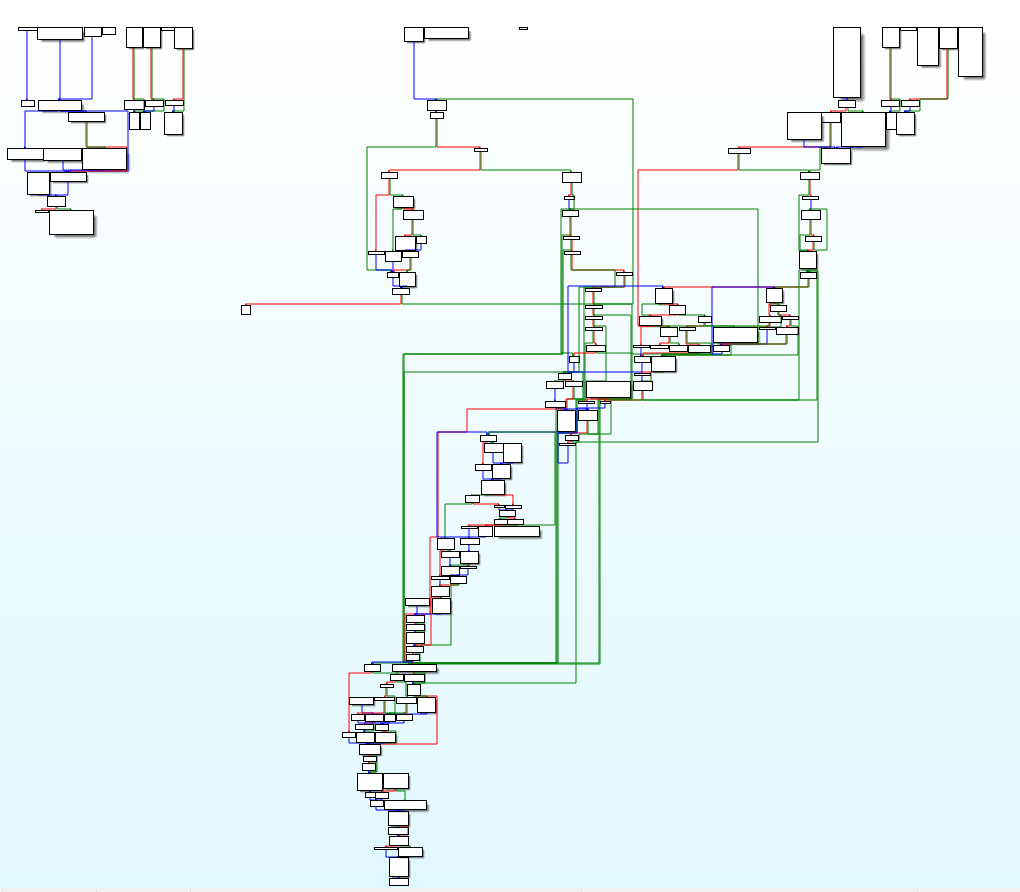
### Control Flow Obfuscation in IDA Pro
Obfuscated binaries produce complex control flow graphs that resist static analysis:
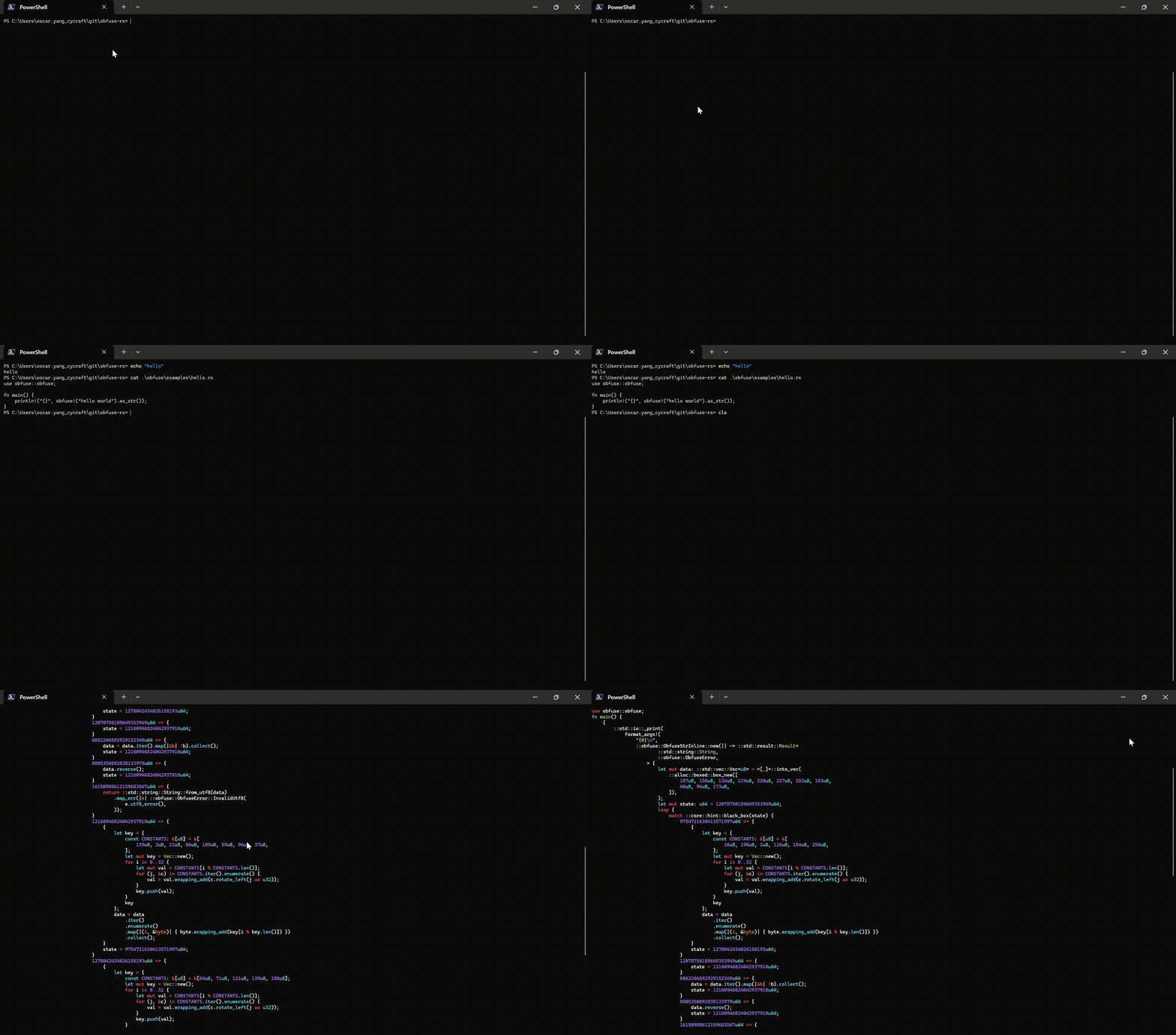
### Macro Expansion
The `obfuse!` macro generates unique inline decryption code for each string at compile time:
## Quick Start
```toml
[dependencies]
obfuse = "1.0"
```
```rust
use obfuse::obfuse;
fn main() {
// String encrypted at compile time with AES-256-GCM + unique polymorphic layers
let license = obfuse!("Licensed to ACME Corp - Internal Use Only");
// Decrypted only when accessed
println!("{}", license.as_str());
// Memory securely wiped on drop
}
```
> **Security Notice**: This library provides **string obfuscation**, not military-grade encryption. The encryption key is embedded in the binary alongside the ciphertext. A determined attacker with access to your binary can extract both.
>
> **Appropriate uses:**
> - Hiding license/copyright strings from casual inspection
> - Obfuscating internal configuration or feature flags
> - Making reverse engineering more time-consuming
> - Protecting proprietary algorithms or logic identifiers
>
> **NOT appropriate for:**
> - Storing API keys, passwords, or credentials (use proper secrets management)
> - Compliance requirements (PCI-DSS, HIPAA, SOC2, etc.)
> - Any data where extraction would be catastrophic
## Features
- **Compile-time encryption**: Strings are encrypted during compilation, never stored in plaintext in binaries
- **Polymorphic decryption** (default): Each string gets unique inline decryption code with combined encryption
- **Control flow flattening** (default): Decryption logic is transformed into state machines with opaque predicates and fake blocks, making static analysis extremely difficult
- **Combined encryption layers** (polymorphic mode):
- **Layer 1**: Strong AEAD encryption (AES-256-GCM by default)
- **Layer 2**: Unique polymorphic transformations per string (XOR, ADD/SUB, bit rotations)
- **Layer 3**: Runtime key derivation (keys computed from constants, not stored statically)
- **Multiple encryption algorithms**: Choose via Cargo features
- `aes-256-gcm` (default) - AES-256 in GCM mode with polymorphic layers
- `aes-128-gcm` - AES-128 in GCM mode with polymorphic layers
- `chacha20-poly1305` - ChaCha20-Poly1305 AEAD with polymorphic layers
- `xor` - Simple XOR with MBA obfuscation (fast, less secure)
- **MBA (Mixed Boolean-Arithmetic) transformations**: XOR decryption uses mathematically equivalent but complex expressions to resist decompiler simplification (e.g., IDA's Hex-Rays)
- **Proper error handling**: No panics unless you use `.as_str()` - use `try_as_str()` for Result-based error handling
- **Secure memory handling**: Volatile zeroing of data on drop
- **Zero-copy decryption**: Decrypt only when accessed
- **No runtime dependencies**: Encryption happens at compile time
## Encryption Modes
### Default Mode: AES-256-GCM + Polymorphic + Control Flow Flattening
The default configuration provides **maximum obfuscation** through combined techniques:
```toml
[dependencies]
obfuse = "1.0" # Uses aes-256-gcm + polymorphic + control-flow-flatten by default
```
**Returns:** `ObfuseStrInline` - each string has unique inline decryption code
**Obfuscation layers:**
1. **AES-256-GCM encryption**: Industry-standard authenticated encryption
2. **Polymorphic transformations**: 2-4 random layers per string (XOR, ADD/SUB, rotations)
3. **Control flow flattening**: Decryption converted to state machines with opaque predicates
4. **Runtime key derivation**: Keys computed from constants, not stored statically
5. **No central decrypt function**: Each string has unique inline decryption code
**Benefits:**
- ✅ Maximum anti-reversing protection
- ✅ Defense in depth (multiple independent obfuscation layers)
- ✅ Unique code per string prevents pattern analysis
- ✅ Control flow graphs become extremely complex (see IDA screenshot above)
- ✅ Proper error propagation (no unwrap/expect in generated code)
**Trade-offs:**
- Slightly larger binary (~150 bytes per string vs ~68 bytes traditional)
- Minimal runtime overhead (key computation is fast)
### Traditional Mode: AES-256-GCM Only
For projects that prioritize smaller binary size:
```toml
[dependencies]
obfuse = { version = "1.0", default-features = false, features = ["aes-256-gcm"] }
```
**Returns:** `ObfuseStr` - traditional centralized decryption
**When to use:**
- Binary size is critical
- Basic obfuscation is sufficient
- Not targeting experienced reverse engineers
### Other Encryption Options
```toml
# AES-128-GCM with polymorphic (smaller key, still very secure)
obfuse = { version = "1.0", default-features = false, features = ["aes-128-gcm", "polymorphic"] }
# ChaCha20-Poly1305 with polymorphic (best for ARM/mobile)
obfuse = { version = "1.0", default-features = false, features = ["chacha20-poly1305", "polymorphic"] }
# XOR with MBA (fastest, suitable for obfuscation only)
obfuse = { version = "1.0", default-features = false, features = ["xor"] }
```
## Recommendations by Use Case
| **Production software** | Default (`aes-256-gcm` + `polymorphic`) | `ObfuseStrInline` | Maximum protection, worth the small size increase |
| **Mobile/embedded** | `chacha20-poly1305` + `polymorphic` | `ObfuseStrInline` | ChaCha20 is faster on ARM processors |
| **Size-critical** | `aes-256-gcm` only (no polymorphic) | `ObfuseStr` | Smallest per-string overhead |
| **High-performance** | `xor` with MBA | `ObfuseStr` | Fastest encryption/decryption |
| **Maximum security** | Default + deterministic seed for CI | `ObfuseStrInline` | Reproducible builds with strong protection |
## Binary Size Impact
Adding `obfuse` to your project has minimal overhead:
| Default (AES-256 + polymorphic) | ~27 KB | ~150 bytes | **Recommended** - Maximum security |
| Traditional (AES-256 only) | ~27 KB | ~68 bytes | Smaller, but less secure |
| XOR with MBA | ~5 KB | ~40 bytes | Fastest, obfuscation only |
**Breakdown (default mode):**
- **Library overhead**: ~27 KB (one-time cost for crypto + zeroize)
- **Per-string overhead**: ~150 bytes (inline decryption code + encrypted data)
**For 100 strings:**
- Traditional: 27 KB + (100 × 68 bytes) = ~34 KB
- Polymorphic (default): 27 KB + (100 × 150 bytes) = ~42 KB
- **Extra cost**: 8 KB for significantly stronger protection
### Performance
| First access (decryption) | ~500 ns |
| Cached access | ~10 ns |
| Plain string access | ~1 ns |
Decryption is lazy and cached - subsequent accesses are nearly free.
## Installation
**Requires Rust 1.85+** (edition 2024)
Add to your `Cargo.toml`:
```toml
[dependencies]
obfuse = "1.0" # Default: aes-256-gcm + polymorphic + control-flow-flatten
```
This gives you **maximum obfuscation** with:
- AES-256-GCM authenticated encryption
- Unique polymorphic transformations per string
- Control flow flattening (state machines + opaque predicates)
- Runtime key derivation
- No central decryption point
### Customizing Encryption Options
If you need different configurations:
```toml
# Traditional mode (smaller binary, less secure)
[dependencies]
obfuse = { version = "1.0", default-features = false, features = ["aes-256-gcm"] }
# AES-128 with polymorphic (good balance)
[dependencies]
obfuse = { version = "1.0", default-features = false, features = ["aes-128-gcm", "polymorphic"] }
# ChaCha20 with polymorphic (best for ARM/mobile)
[dependencies]
obfuse = { version = "1.0", default-features = false, features = ["chacha20-poly1305", "polymorphic"] }
# XOR only (fastest, obfuscation only)
[dependencies]
obfuse = { version = "1.0", default-features = false, features = ["xor"] }
```
### Understanding Polymorphic Mode (Enabled by Default)
Polymorphic mode generates **unique inline decryption code** for each string, eliminating central decryption functions that aid reverse engineering.
**What it does:**
1. **Layer 1**: Encrypts with AES-256-GCM (industry-standard AEAD)
2. **Layer 2**: Adds 2-4 random transformation layers per string
3. **Layer 3**: Derives keys at runtime from constants
**Why it's effective:**
- Each string has **unique decryption code** (not a shared function)
- Reverse engineers must analyze **each string individually**
- **Defense in depth**: Multiple independent obfuscation layers
- **No panics in generated code**: Errors propagate properly via `Result`
**To disable polymorphic and use traditional mode only:**
```toml
[dependencies]
obfuse = { version = "1.0", default-features = false, features = ["aes-256-gcm"] }
```
### Understanding Control Flow Flattening (Enabled by Default)
Control flow flattening transforms the decryption logic into **state machines** that are extremely difficult to analyze statically.
**What it does:**
1. Converts sequential decryption steps into a dispatcher loop
2. Inserts **opaque predicates** (conditions that always evaluate one way but are hard to prove statically)
3. Adds **fake blocks** that are never executed but appear valid
4. Uses randomized state transitions
**Why it's effective:**
- IDA Pro and other disassemblers show **complex control flow graphs** (see demo above)
- Decompilers produce **convoluted pseudo-code** instead of clean logic
- Symbolic execution tools struggle with opaque predicates
- Each string has different state machine structure
**To disable control flow flattening:**
```toml
[dependencies]
obfuse = { version = "1.0", default-features = false, features = ["aes-256-gcm", "polymorphic"] }
```
**Debug mode** (`cff-debug` feature): Prints state machine structure during compilation for debugging.
## Usage
### Basic Usage (Polymorphic Mode - Default)
```rust
use obfuse::obfuse;
fn main() {
// Returns ObfuseStrInline with unique inline decryption code
let build_info = obfuse!("Build: 2024.1.0-internal");
// Decrypted only when accessed (may panic on error)
println!("{}", build_info.as_str());
// Memory is securely wiped when `build_info` goes out of scope
}
```
### Error Handling (Recommended)
```rust
use obfuse::{obfuse, ObfuseError};
fn main() -> Result<(), ObfuseError> {
let license = obfuse!("Pro Edition - Licensed to Example Inc");
// Use try_as_str() for proper error handling - no panics!
match license.try_as_str() {
Ok(s) => println!("{s}"),
Err(ObfuseError::InvalidUtf8(e)) => {
eprintln!("Invalid UTF-8: {e}");
}
Err(e) => {
eprintln!("Decryption error: {e}");
}
}
Ok(())
}
```
Or with `?` operator:
```rust
use obfuse::{obfuse, ObfuseError};
fn get_license() -> Result<String, ObfuseError> {
let license = obfuse!("Pro Edition");
Ok(license.try_as_str()?.to_string())
}
```
### Traditional Mode Usage
```rust
use obfuse::{obfuse, ObfuseStr};
fn main() {
// Returns ObfuseStr when polymorphic is disabled
let endpoint: ObfuseStr = obfuse!("https://internal.example.com/api/v2");
// Use the decrypted string
connect_to_service(endpoint.as_str());
// `endpoint` is automatically zeroed on drop
}
```
### With Explicit Type Annotation
```rust
use obfuse::obfuse;
fn main() {
// Type inference works for both modes
let version = obfuse!("v2.1.0-beta");
// Explicit type if needed (default mode returns ObfuseStrInline)
let copyright: _ = obfuse!("Copyright 2024 Example Corp");
println!("{}", version.as_str());
println!("{}", copyright.as_str());
}
```
### Lazy Decryption
Both `ObfuseStrInline` and `ObfuseStr` decrypt lazily:
```rust
use obfuse::obfuse;
fn main() {
let config = obfuse!("feature_flags=premium,analytics");
// String remains encrypted until first access
if should_load_config() {
// Decryption happens here
parse_config(config.as_str());
}
// If condition is false, string is never decrypted
}
```
## How It Works
1. **Compile Time**: The `obfuse!` macro:
- Generates a random encryption key and nonce
- Encrypts the string literal using the selected algorithm
- Embeds encrypted bytes, key, and nonce in the binary
2. **Runtime**: The `ObfuseStr` type:
- Stores encrypted data until accessed
- Decrypts on first call to `as_str()` or `Deref`
- Caches decrypted value for subsequent accesses
3. **Drop**: When `ObfuseStr` is dropped:
- Uses `std::ptr::write_volatile` to zero all sensitive memory
- Zeros: encryption key, nonce, and decrypted plaintext
- Prevents compiler from optimizing away the zeroing
## MBA (Mixed Boolean-Arithmetic) Transformations
When using the `xor` feature, decryption logic is obfuscated using MBA transformations to resist decompiler simplification.
### What are MBA Transformations?
MBA transformations replace simple operations with mathematically equivalent but complex expressions. For example:
```text
Simple XOR: a ^ b
```
### Why Use MBA?
Decompilers like IDA's Hex-Rays are excellent at recognizing and simplifying straightforward operations. MBA transformations:
- **Resist pattern matching**: The complex expressions don't match known simplification patterns
- **Expand simple operations**: A single XOR becomes many lines of arithmetic/logic
- **Include noise operations**: Dummy constants that cancel out add visual complexity
- **Combine Boolean and arithmetic**: Mixing `AND`, `OR`, `XOR` with `+`, `-`, `*` prevents easy reduction
### Example Decompiler Output
Without MBA, a simple decryption loop might decompile as:
```c
for (i = 0; i < len; i++)
plaintext[i] = ciphertext[i] ^ key[i % 32];
```
With MBA transformations, the same logic becomes dozens of lines of convoluted operations, making reverse engineering significantly more time-consuming.
## Build Modes: Random vs Deterministic
This library supports two build modes for different use cases:
### Default: Random Key (Recommended for Production)
```rust
// Random key generated each compile - different binary every build
let license = obfuse!("Licensed to ACME Corp");
println!("{}", license.as_str()); // Auto-decrypts
```
```
Build 1: key = [0xab, 0xcd, ...] (random)
Build 2: key = [0x12, 0x34, ...] (different random)
Build 3: key = [0x9f, 0xe2, ...] (different random)
```
**Benefits**:
- Each build produces unique encryption
- Harder for attackers to create universal decryption tools
- Best obfuscation for production binaries
### With Seed: Deterministic Key (For Testing/CI)
```rust
// Same seed = same key = reproducible output
let license = obfuse!("Licensed to ACME Corp", seed = "test_seed_123");
println!("{}", license.as_str()); // Auto-decrypts (same as random mode)
```
```
Build 1 (seed="test"): key = [0xaa, 0xbb, ...] (deterministic)
Build 2 (seed="test"): key = [0xaa, 0xbb, ...] (same!)
Build 3 (seed="prod"): key = [0xcc, 0xdd, ...] (different seed = different key)
```
**Benefits**:
- Reproducible builds for CI/CD pipelines
- Testable encrypted output
- Debugging with known encryption state
### Which Mode Should You Use?
| Production builds | `obfuse!("...")` (random) |
| Unit tests | `obfuse!("...", seed = "test")` |
| CI/CD pipelines | `obfuse!("...", seed = "ci")` |
| Debugging encryption issues | `obfuse!("...", seed = "debug")` |
### Important: Both Modes Are Obfuscation
```
┌─────────────────────────────────────────────────────┐
│ Your Binary (Both Modes) │
├─────────────────────────────────────────────────────┤
│ Encrypted Data: [0x4a, 0x7f, 0x2c, ...] │
│ Encryption Key: [0xab, 0xcd, 0xef, ...] ← HERE │
│ Nonce: [0x11, 0x22, 0x33, ...] │
└─────────────────────────────────────────────────────┘
Key is ALWAYS embedded in binary
This is OBFUSCATION, not real encryption
```
For actual secrets (API keys, passwords, credentials), use runtime secrets management (environment variables, Vault, AWS Secrets Manager).
## Security Considerations
### What This Protects Against
- Static binary analysis (strings command, hex editors)
- Simple memory dumps of unaccessed strings
- Casual reverse engineering attempts
### What This Does NOT Protect Against
- Runtime memory inspection while string is in use
- Sophisticated reverse engineering
- Side-channel attacks
- Compromised systems with debugging access
### Best Practices
1. **Use error handling**: Prefer `try_as_str()` over `as_str()` to avoid panics
2. **Minimize lifetime**: Keep obfuscated strings in scope only while needed
3. **Avoid cloning**: Don't clone decrypted strings unnecessarily
4. **Use strong algorithms**: Default (`aes-256-gcm` + `polymorphic`) is recommended
5. **Defense in depth**: Use as one layer of protection, not the only one
## API Reference
### `obfuse!` Macro
```rust
// Random key (production) - Default returns ObfuseStrInline
obfuse!("string literal") -> ObfuseStrInline // with polymorphic (default)
obfuse!("string literal") -> ObfuseStr // without polymorphic
// Deterministic key (testing/CI) - Same return types
obfuse!("string literal", seed = "your_seed") -> ObfuseStrInline // or ObfuseStr
```
Encrypts a string literal at compile time.
- **Without seed**: Random key each compile (non-reproducible)
- **With seed**: Deterministic key derived from seed (reproducible)
- **Return type**: `ObfuseStrInline` (default with polymorphic) or `ObfuseStr` (traditional mode)
### `ObfuseStrInline` Type (Polymorphic Mode - Default)
```rust
impl ObfuseStrInline {
/// Returns the decrypted string, decrypting on first access.
/// Panics on error - use try_as_str() for error handling.
pub fn as_str(&self) -> &str;
/// Fallible version - returns Result instead of panicking.
/// RECOMMENDED for all production code.
pub fn try_as_str(&self) -> Result<&str, ObfuseError>;
/// Returns the decrypted string as bytes.
/// Panics on error - use try_as_bytes() for error handling.
pub fn as_bytes(&self) -> &[u8];
/// Fallible version of as_bytes().
/// RECOMMENDED for all production code.
pub fn try_as_bytes(&self) -> Result<&[u8], ObfuseError>;
/// Returns true if the string has been decrypted.
pub fn is_decrypted(&self) -> bool;
/// Pre-decrypt without returning the value.
pub fn try_decrypt(&self) -> Result<(), ObfuseError>;
/// Manually zeros the decrypted plaintext memory.
pub fn zeroize(&mut self);
}
impl Deref for ObfuseStrInline {
type Target = str;
fn deref(&self) -> &str; // Triggers decryption, panics on error
}
impl Drop for ObfuseStrInline {
fn drop(&mut self); // Zeros decrypted plaintext
}
```
### `ObfuseStr` Type (Traditional Mode)
```rust
impl ObfuseStr {
/// Returns the decrypted string, decrypting on first access.
/// Panics with detailed message on error.
pub fn as_str(&self) -> &str;
/// Fallible version - returns Result instead of panicking.
/// Recommended for critical code paths.
pub fn try_as_str(&self) -> Result<&str, ObfuseError>;
/// Returns the decrypted string as bytes.
pub fn as_bytes(&self) -> &[u8];
/// Fallible version of as_bytes().
pub fn try_as_bytes(&self) -> Result<&[u8], ObfuseError>;
/// Returns true if the string has been decrypted.
pub fn is_decrypted(&self) -> bool;
/// Pre-decrypt without returning the value.
pub fn try_decrypt(&self) -> Result<(), ObfuseError>;
/// Manually zero memory (also happens automatically on drop).
pub fn zeroize(&mut self);
}
impl Deref for ObfuseStr {
type Target = str;
fn deref(&self) -> &str; // Triggers decryption, panics on error
}
impl Drop for ObfuseStr {
fn drop(&mut self); // Volatile zeroing of all sensitive data
}
```
### `ObfuseError` Type
```rust
/// Errors that can occur during decryption
#[derive(Debug)]
pub enum ObfuseError {
/// Memory allocation failed during decryption (OOM)
AllocationFailed,
/// AEAD authentication tag verification failed.
/// Indicates ciphertext tampering or algorithm mismatch.
AuthenticationFailed,
/// Decrypted bytes are not valid UTF-8
InvalidUtf8(std::str::Utf8Error),
}
impl std::fmt::Display for ObfuseError { /* ... */ }
impl std::error::Error for ObfuseError { /* ... */ }
```
## Project Structure
```
obfuse-rs/
├── Cargo.toml # Workspace configuration
├── README.md
├── LICENSE
├── docs/
│ └── images/ # Documentation images (IDA screenshots, etc.)
├── scripts/ # Verification scripts
│ ├── verify_cff_obfuscation.sh
│ ├── verify_mba_obfuscation.sh
│ └── verify_polymorphic.sh
├── .github/
│ └── workflows/
│ ├── ci.yml # CI pipeline
│ └── publish.yml # Crates.io publishing
├── obfuse/ # Main library crate (re-exports)
│ ├── Cargo.toml
│ ├── src/
│ │ └── lib.rs
│ ├── examples/
│ │ ├── basic.rs
│ │ ├── deterministic.rs
│ │ ├── error_handling.rs
│ │ ├── hello.rs
│ │ └── polymorphic.rs
│ └── tests/
│ ├── binary_verification.rs
│ ├── cff_integration.rs
│ ├── integration.rs
│ └── polymorphic.rs
├── obfuse-macros/ # Procedural macro crate
│ ├── Cargo.toml
│ └── src/
│ ├── lib.rs
│ ├── encrypt.rs # Encryption code generation
│ ├── polymorphic.rs # Polymorphic transformation generation
│ └── control_flow_flatten/
│ ├── mod.rs
│ ├── block_scheduler.rs
│ ├── state_machine.rs
│ └── opaque_predicates.rs
└── obfuse-core/ # Core encryption/decryption logic
├── Cargo.toml
└── src/
├── lib.rs
├── error.rs # Error types (ObfuseError)
├── obfuse_str.rs # ObfuseStr type (traditional mode)
├── obfuse_str_inline.rs # ObfuseStrInline type (polymorphic mode)
├── mba.rs # MBA transformations
├── aes.rs # AES-128/256-GCM encryption
├── chacha.rs # ChaCha20-Poly1305 encryption
└── xor.rs # XOR encryption with MBA
```
## Building
```bash
# Build with default features (AES-256-GCM)
cargo build
# Build with specific algorithm
cargo build --no-default-features --features chacha20-poly1305
# Run tests
cargo test
# Run tests for specific algorithm
cargo test --no-default-features --features aes-128-gcm
```
## License
MIT License - see [LICENSE](LICENSE) for details.
## Contributing
Contributions welcome! Please read the contributing guidelines first.
## Acknowledgments
- [aes-gcm](https://crates.io/crates/aes-gcm) - AES-GCM implementation
- [chacha20poly1305](https://crates.io/crates/chacha20poly1305) - ChaCha20-Poly1305 implementation
- [zeroize](https://crates.io/crates/zeroize) - Secure memory zeroing patterns