#LyX 2.3 created this file. For more info see http://www.lyx.org/
\lyxformat 544
\begin_document
\begin_header
\save_transient_properties true
\origin unavailable
\textclass article
\begin_preamble
\usepackage{fullpage}
\end_preamble
\use_default_options true
\maintain_unincluded_children false
\language english
\language_package default
\inputencoding auto
\fontencoding global
\font_roman "default" "default"
\font_sans "default" "default"
\font_typewriter "default" "default"
\font_math "auto" "auto"
\font_default_family default
\use_non_tex_fonts false
\font_sc false
\font_osf false
\font_sf_scale 100 100
\font_tt_scale 100 100
\use_microtype false
\use_dash_ligatures true
\graphics default
\default_output_format default
\output_sync 0
\bibtex_command default
\index_command default
\paperfontsize default
\spacing single
\use_hyperref false
\papersize default
\use_geometry false
\use_package amsmath 1
\use_package amssymb 1
\use_package cancel 1
\use_package esint 1
\use_package mathdots 1
\use_package mathtools 1
\use_package mhchem 1
\use_package stackrel 1
\use_package stmaryrd 1
\use_package undertilde 1
\cite_engine basic
\cite_engine_type default
\biblio_style plain
\use_bibtopic false
\use_indices false
\paperorientation portrait
\suppress_date false
\justification true
\use_refstyle 1
\use_minted 0
\index Index
\shortcut idx
\color #008000
\end_index
\secnumdepth 3
\tocdepth 3
\paragraph_separation indent
\paragraph_indentation default
\is_math_indent 0
\math_numbering_side default
\quotes_style english
\dynamic_quotes 0
\papercolumns 1
\papersides 1
\paperpagestyle default
\tracking_changes false
\output_changes false
\html_math_output 0
\html_css_as_file 0
\html_be_strict false
\end_header

\begin_body

\begin_layout Title
Eclipse computations in nyx
\end_layout

\begin_layout Author
Christopher Rabotin
\end_layout

\begin_layout Standard
This computation assumes that all objects are spherical.
\end_layout

\begin_layout Standard
\begin_inset CommandInset toc
LatexCommand tableofcontents

\end_inset


\end_layout

\begin_layout Section
Summary
\end_layout

\begin_layout Standard
In short, we project the light source onto a plane which crosses the eclipsing
 body perpendicularly to the direction between the spacecraft and the (potential
ly) eclipsing body.
 We then find whether the disks representing the eclipsing body and the
 light source on that plane overlap.
 If they do not, then we're in full illumination.
 If they do, we compute the overlapping area of both disks, and compute
 the nominal apparent disk.
 The ratio of these areas is used to compute the percentage of penumbra.
\end_layout

\begin_layout Section
Derivation
\end_layout

\begin_layout Subsection
Umbra or visibilis computation
\end_layout

\begin_layout Standard
\begin_inset Float figure
placement h
wide false
sideways false
status collapsed

\begin_layout Plain Layout
\align center
\begin_inset Graphics
	filename eclipse_computation.jpg
	width 25col%

\end_inset


\end_layout

\begin_layout Plain Layout
\begin_inset Caption Standard

\begin_layout Plain Layout
Top-view of eclipsing problem
\end_layout

\end_inset


\end_layout

\end_inset


\end_layout

\begin_layout Standard
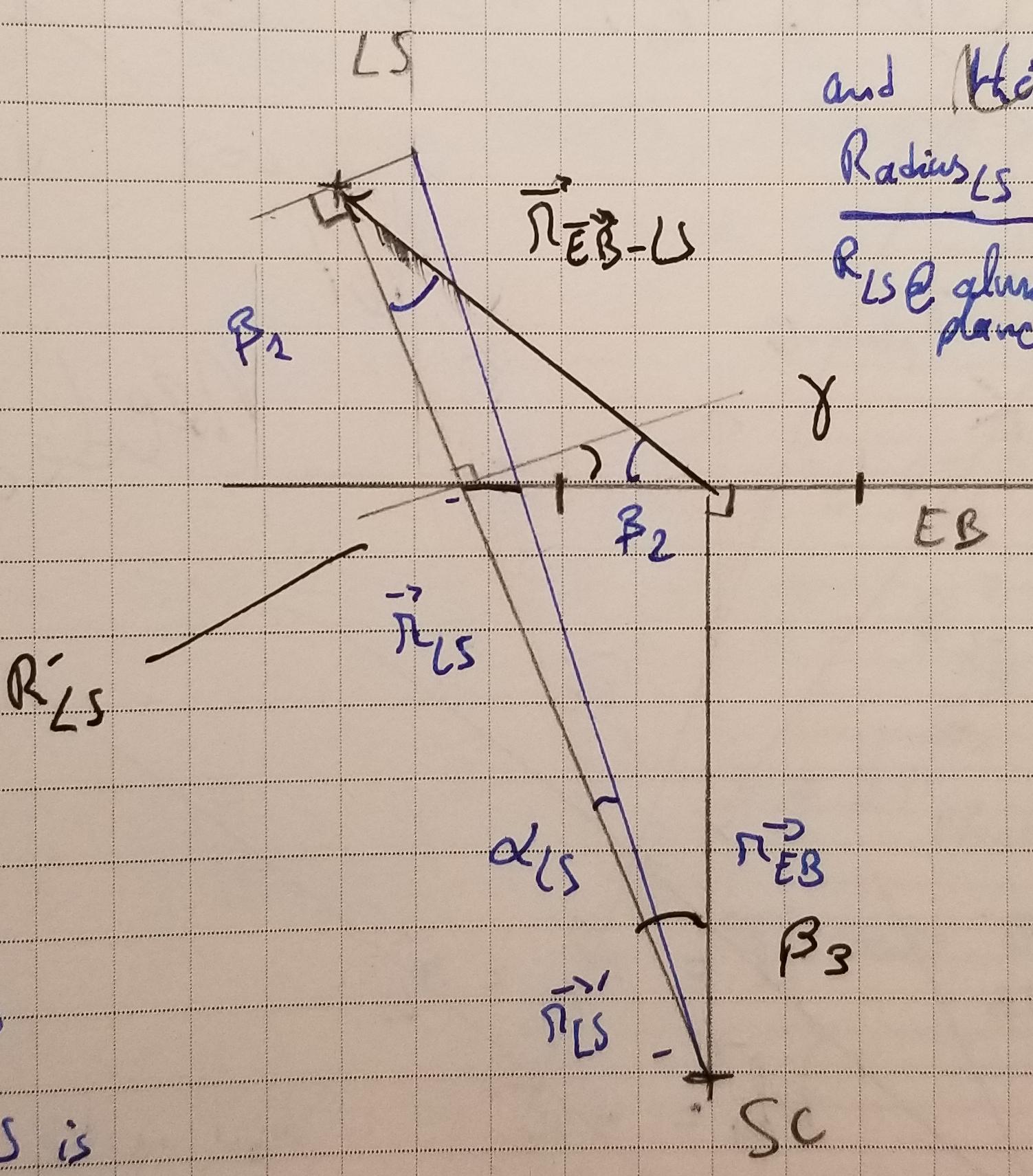
First, let's compute
\begin_inset Formula $\beta_{2}$
\end_inset

 the angle between
\begin_inset Formula $\vec{r}_{\text{EB-LS}}$
\end_inset

 and
\begin_inset Formula $\vec{r}_{\text{LS}}$
\end_inset

, respectively the vector from the eclipsing body to the light source and
 the vector from the spacecraft to the light source.
 If that angle is less than a right angle, then the light source is not
 behind the eclipsing body, so we're in full illumination:
\emph on
visibilis
\emph default
.
\end_layout

\begin_layout Standard
Then, we compute
\begin_inset Formula $\beta_{3}$
\end_inset

 the angle between the spacecraft and the eclipsing body, and between the
 spacecraft and the light source.
 We need this to project the radius of the light source onto the plane centered
 at the eclipsing geoid, and normal to the direction to the spacecraft.
\end_layout

\begin_layout Standard
Using the triangle formed between the spacecraft, the center of the eclipsing
 body, and the projection plane, we can compute
\begin_inset Formula $\vec{r^{\prime}}_{\text{LS}}$
\end_inset

, the vector from the spacecraft to the intersection point on the plane
 in the direction of
\begin_inset Formula $\hat{\boldsymbol{r}}_{\text{LS}}$
\end_inset

.
 We use
\begin_inset Formula $\beta_{3}$
\end_inset

 for this computation as we know the length of that hypotenuse is
\begin_inset Formula
\[
|\vec{r}_{\text{EB-LS}}|=|\vec{r^{\prime}}_{\text{LS}}|\cos\beta_{3}
\]

\end_inset


\end_layout

\begin_layout Standard
Using Thales' theorem, we can compute the
\begin_inset Quotes eld
\end_inset

pseudo light source radius
\begin_inset Quotes erd
\end_inset

, that is the radius of the light source as seen from an angle
\begin_inset Formula $\gamma$
\end_inset

 from the plane.
 Forming a triangle between the intersection point, the center of the eclipsing
 body, and the orthogonal projection of that intersection point onto
\begin_inset Formula $\vec{r}_{\text{EB-LS}}$
\end_inset

, we can compute the actual radius of the light source on the projection
 plane.
\end_layout

\begin_layout Standard
Let
\begin_inset Formula $\vec{r}_{\text{Plane-LS}}$
\end_inset

 be the vector from the center of the eclipsing body to the projected center
 of the light source on the plane.
 We now check for any overlap.
 If the norm of
\begin_inset Formula $\vec{r}_{\text{Plane-LS}}$
\end_inset

 minus the project radius is greater than the radius of the eclipsing body,
 it means that, no matter what the direction is, the shaddow of the eclipsing
 body
\emph on
ends
\emph default
 before the closest point of the light source: the light source is fully
 visible.
 If the norm of
\begin_inset Formula $\vec{r}_{\text{Plane-LS}}$
\end_inset

 plus the projected radius of the light source is less than the radius of
 the eclipsing body, then the light source is fully behind the eclipsing
 body, so we're in total eclipse (
\emph on
umbra
\emph default
).
 Note that we have ruled out the light source being in front of the eclipsing
 body by computing the angle
\begin_inset Formula $\beta_{2}$
\end_inset

 at the start.
\end_layout

\begin_layout Subsection
Penumbra percentage
\end_layout

\begin_layout Standard
\begin_inset Float figure
placement h
wide false
sideways false
status collapsed

\begin_layout Plain Layout
\align center
\begin_inset Graphics
	filename eclipse_penumbra.jpg
	width 25col%

\end_inset


\end_layout

\begin_layout Plain Layout
\begin_inset Caption Standard

\begin_layout Plain Layout
In plane view
\end_layout

\end_inset


\end_layout

\begin_layout Plain Layout

\end_layout

\end_inset


\end_layout

\begin_layout Standard
Both circles represent the light source and the eclipsing body.
 We then use the
\begin_inset CommandInset href
LatexCommand href
name "Circle-Circle intersection"
target "http://mathworld.wolfram.com/Circle-CircleIntersection.html"
literal "false"

\end_inset

 computation to compute the area of the asymmetric lens corresponding to
 the overlap of both circles,
\begin_inset Formula $A_{\text{shadow}}$
\end_inset

.
 Then, we compute the full area of the light source,
\begin_inset Formula $\mathcal{A_{\text{LS}}}$
\end_inset

.
\end_layout

\begin_layout Standard
The penumbra value,
\begin_inset Formula $P$
\end_inset

, is such that a number close to one means that the light source is almost
 in full visibility.
 Conversely, if the number is close to zero, then we are near total umbra.
\end_layout

\begin_layout Standard
\begin_inset Formula
\[
P=\frac{\mathcal{A_{\text{LS}}}-\mathcal{A_{\text{shadow}}}}{\mathcal{A_{\text{LS}}}}
\]

\end_inset


\end_layout

\end_body
\end_document