---
title: 594 KB to orbit: a browser for AI agents with no Chromium attached
description: Houston, we deleted Chromium: your agent's browser is 594 KB and ships with your OS. Full WebKit, MCP-native, resident at 24 ms.
published: false
tags: showdev, rust, ai, webdev
---
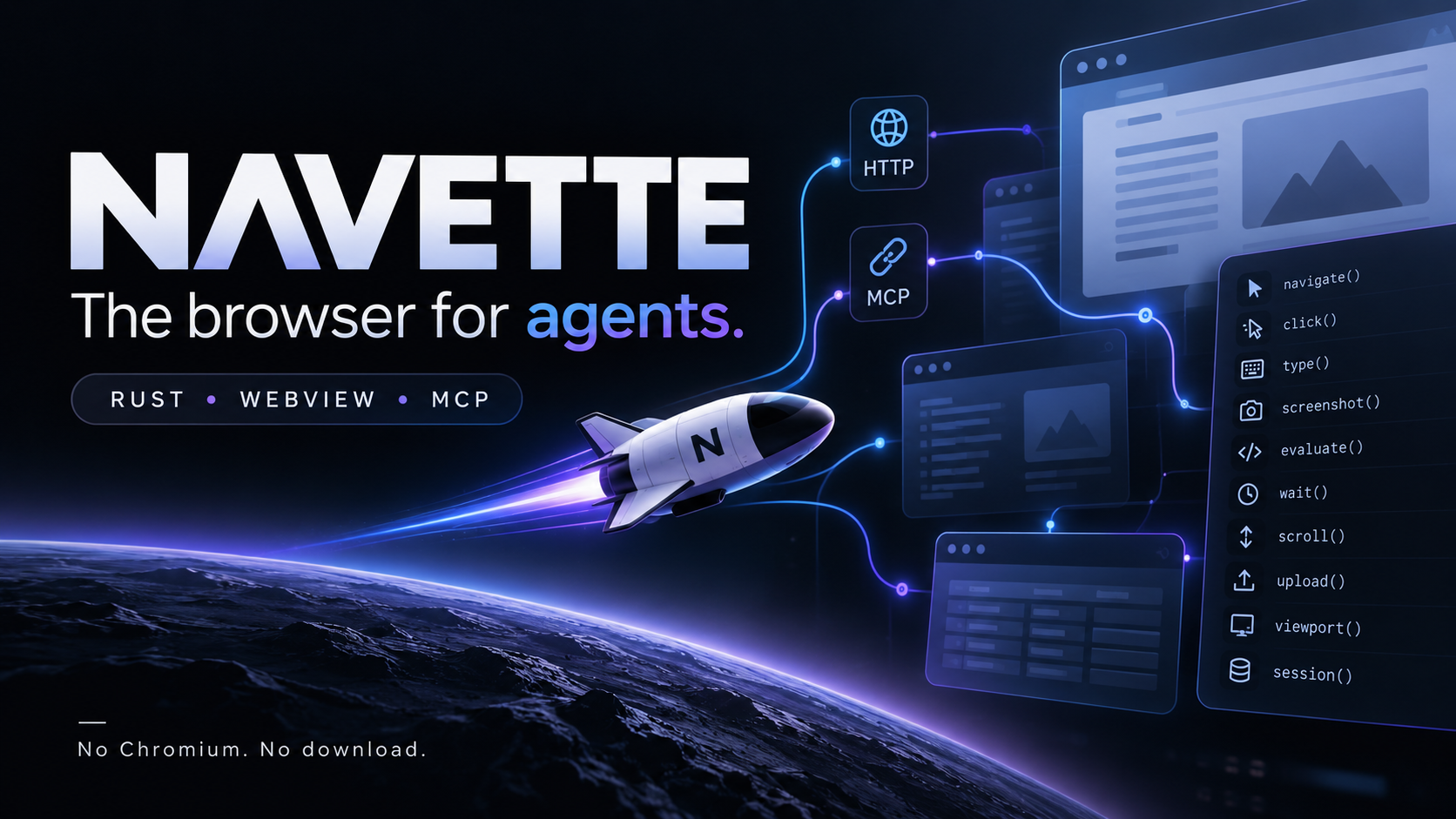
**Houston, we deleted Chromium.**
Every AI agent that touches the web today drags the same luggage: **headless Chromium**.
Playwright downloads ~400 MB of browser on every machine your agent touches. Cloud browser APIs (Browserbase, Steel, Hyperbrowser) rent you Chrome by the subscription — and your pages leave your machine. And all of this to do what an agent actually needs: *open a page, read it, take a screenshot, click a button, fill a form.*
Meanwhile, your computer **already ships a full browser engine**. macOS has WebKit. Windows has WebView2 — which is Chromium, preinstalled. Linux has WebKitGTK.
So I built **navette** (French for *shuttle*): a single Rust binary that drives the WebView your OS already ships, and speaks MCP — the protocol agents already speak.
**594 KB installed. No Chromium. No download.**
## What it is
One binary, three modes:
```sh
navette serve --port 8765 # HTTP API on loopback
navette mcp # MCP stdio server for agent hosts
navette install-daemon # resident: warm from login
```
Nine MCP tools: `navigate`, `read`, `screenshot`, `click`, `type`, `evaluate`, `wait`, `sessions`, `session_close`. The screenshot comes back as MCP image content — your agent literally **sees** the page.
Under the hood: a WKWebView per session living in a **ghost window** (real pixels, parked off-screen so it renders but nobody sees it). Navigation completion is event-driven — I implemented `WKNavigationDelegate` in Rust with raw `objc2` message sends, and the content extraction runs *inside* the `didFinish` callback, so a warm navigate + full markdown read costs **8 ms**.
## The numbers
Same machine (M1, 8 GB), same corpus (100 local pages + 20 real URLs), reproducible with one command (`python3 navbench.py`):
| Install size | **0.6 MB** | 216 MB | 80 MB |
| Cold start (resident daemon) | **24–37 ms** | n/a | ~320 ms boot / launch |
| Cold start (fresh process) | 531–984 ms | 934–1539 ms | ~320 ms |
| Navigate → readable content | **8–11 ms** | 12–33 ms | 3–16 ms |
| Act (type + click) | **1–2 ms** | 33 ms | 18–204 ms |
| Peak RAM (process tree) | 79 MB | 536 MB | 41 MB |
| Crawl 100 pages | **0.9–2.8 s** | 1.8–4.0 s | 0.9–2.6 s |
| Real-web success (20 URLs) | **95–100%** | — | 85% |
Two honest disclosures, because benchmark posts die without them:
1. **Lightpanda is the fastest page-*reader*** (3.3 ms through a zero-bias raw-CDP probe — I measured it through a fair minimal client, not just through Playwright). It parses a partial DOM and cannot render, screenshot, or act. If your agent only reads static pages, use it — or plain fetch + readability.
2. **The two rows Lightpanda wins (fresh boot, peak RAM) are the price of rendering.** Three WebKit helper processes and a backing store are what buy screenshots and full fidelity. That tax *is* the product.
The claim I'll defend: **nobody else combines 0.6 MB + 1 ms actions + a 0.9 s hundred-page crawl + full WebKit rendering + a resident 24 ms mode.**
## The demo that sold me on it
I pointed the resident daemon at a login form and a research loop and let an agent drive through MCP only:
- **Act 1 — authenticate**: type credentials, click, verify the session (`"You logged into a secure area!"`), screenshot the authenticated page.
- **Act 2 — research**: DuckDuckGo → extract results → open one (it was dead — moved on) → read the article → screenshot.
Full walkthrough with the verbatim tool calls and screenshots is in [`demo/JOURNEY.md`](https://github.com/slabbdev/navette/blob/main/demo/JOURNEY.md).
## Try it
```sh
cargo build --release
./target/release/navette serve --port 8765
# or let your agent host own the lifecycle:
./target/release/navette mcp
```
Register it in any MCP client (ZCode example):
```json
{ "mcp": { "servers": { "navette": {
"command": "/path/to/navette", "args": ["mcp"] } } } }
```
Then just talk to your agent: *"open this dashboard, check if the deploy banner is there, screenshot it for me."*
## The honest limits
- **macOS today.** Windows (WebView2) and Linux (WebKitGTK/WPE) are the next backends — the 8 primitives are engine-agnostic by design, and the engine strategy is written down: system-first, official embed (WebView2 Fixed Version) or distro packages as fallback. Never vendor a browser the way Playwright does.
- **The automation long tail is missing.** Network interception, file uploads, hover, dialogs — Playwright has twenty years of API surface. The core agent loop (navigate, read, see, act, wait, sessions) is complete; the tail is the roadmap.
- **Fresh-process cold start can't beat a blind engine.** A full WebKit spawns three helper processes; Lightpanda spawns none because it renders nothing. That's why navette ships a resident mode: warm from login, 24 ms forever.
## Why this matters
Headless Chromium is the Postgres of web automation. navette is trying to be the embedded SQLite — the browser agents *bring with them*, for the fastest-growing half of the agent world: agents that run **locally**, on machines that already have an engine.
Apple shipped a Safari MCP server for coding agents this year. The thesis is being validated from above. navette is it from below: tiny, open, cross-platform-bound.
##Update — v1.2.0 (Oct 2):
Two new MCP tools shipped: state_export / state_import — cookies and storage out of the browser and back in, the Playwright storageState equivalent. Your agent can now save an authenticated session and resume it tomorrow. 11 tools total.
The Windows (WebView2) and Linux (WebKitGTK) backends are aboard and in the v1.2.0 tag — same HTTP/MCP surface, same 8 primitives, +32 KB of binary. macOS remains the fully hardened, benchmark-carrying backend: Windows passed its first end-to-end runtime smoke on GitHub's runners; Linux works under headless X and is hardening.
Honest sizing update: the macOS binary is now 626 KB (the title's 594 KB was v1.0.0) — still ~350× smaller than Playwright's browser download.
##Update — v1.2.1 (Oct 3):
- CI is green on all three OSes: the Windows (WebView2) and Linux (WebKitGTK) backends pass the same navigate→read smoke on GitHub's runners — same binary, same MCP surface, +32 KB. Getting there surfaced five real root causes (fold-result routing, URL-matched completion, a missing D-Bus session bus in headless Linux, WebView2's file:// stall) — all fixed, each proven with a breadcrumb or a backtrace. macOS remains the benchmark-carrying backend; screenshots and cookie state on wry land next.
- Two new MCP tools: state_export / state_import — cookies and storage out of the browser and back in, the Playwright storageState equivalent. Your agent can now save an authenticated session and resume it tomorrow. 11 tools total.
Boot-time session pre-warm reached parity with macOS: first navigate on a cold CI VM went 38 s → 83 ms.
- Honest sizing update: the macOS binary is now 626 KB (the title's 594 KB was v1.0.0) — still ~350× smaller than Playwright's browser download. Release notes: https://github.com/slabbdev/navette/releases/tag/v1.2.1
##Updates — v1.3.0 & v1.4.0 (Oct 4):
- **Full platform parity**: screenshots (native capture per engine), cookie state export/import, viewport control, and the resident daemon now work on Windows and Linux too. CI verifies a valid PNG screenshot and a cookie round-trip on all three OSes. JS dialogs are auto-handled in-page — agents can no longer deadlock on a hidden modal.
- **The agent loop is complete**: file upload (in-memory content through a page-side DataTransfer — no OS dialog, identical JS on all three engines) and scroll joined. **16 MCP tools** now. One bug worth mentioning: the eval wrapper on Windows/Linux silently discarded its value — every /evaluate and /read outside the fold path returned `undefined`; fixed, and CI tests it explicitly.
- **Install it in one command**: `cargo install navette-browser` — or grab the release binaries (macOS arm64 658 KB, Windows x64 / Linux x64 ~1.2 MB — still ~180× smaller than Playwright's download): https://github.com/slabbdev/navette/releases/tag/v1.4.0
- A bench workflow now measures navigate/read/screenshot on all three engines (median/p95, in the run summary). Still missing, stated plainly: OS-level keyboard/mouse input, request/response network interception, OS file-dialog automation.
Repo, benchmarks and the reproducible harness: **https://github.com/slabbdev/navette**
If you run agents locally, I'd genuinely love your feedback — especially the failure cases.