
monatq
Monakhov Tensor Quantiles - approximate quantile tracking for tensors using T-Digest.
monatq maintains one T-Digest per element position across many tensor samples, enabling fast approximate quantile queries (median, percentiles, etc.) over the observed value distribution at each position. Updates are parallelised element-wise via Rayon.
Use Cases
- Model interpretability - feed activation or weight tensors through a forward pass and query per-position quantiles to understand how individual neurons or channels behave across inputs.
- Quantization & pruning - characterise the value distribution at each position to inform bit-width selection, clipping ranges, or sparsity thresholds without storing all observations in memory.
Python
See monatq-py/README.md for the Python bindings, including installation and usage with NumPy and PyTorch.
Rust
Usage
use TensorDigest;
// Track a [3, 4] tensor (12 elements)
let mut digest = new;
// Feed samples (row-major flat slices)
for sample in my_tensor_samples
// Query the per-element median
let medians: = digest.quantile;
// Query multiple quantiles at once
let = digest.quantiles else ;
// Classify the distribution shape at each position
let distributions = digest.analyze;
Features
- Parallel updates - element-wise compression runs in parallel via Rayon
- Custom T-Digest - optimised implementation for the tensor case, making per-position quantile tracking practical at tensor scale
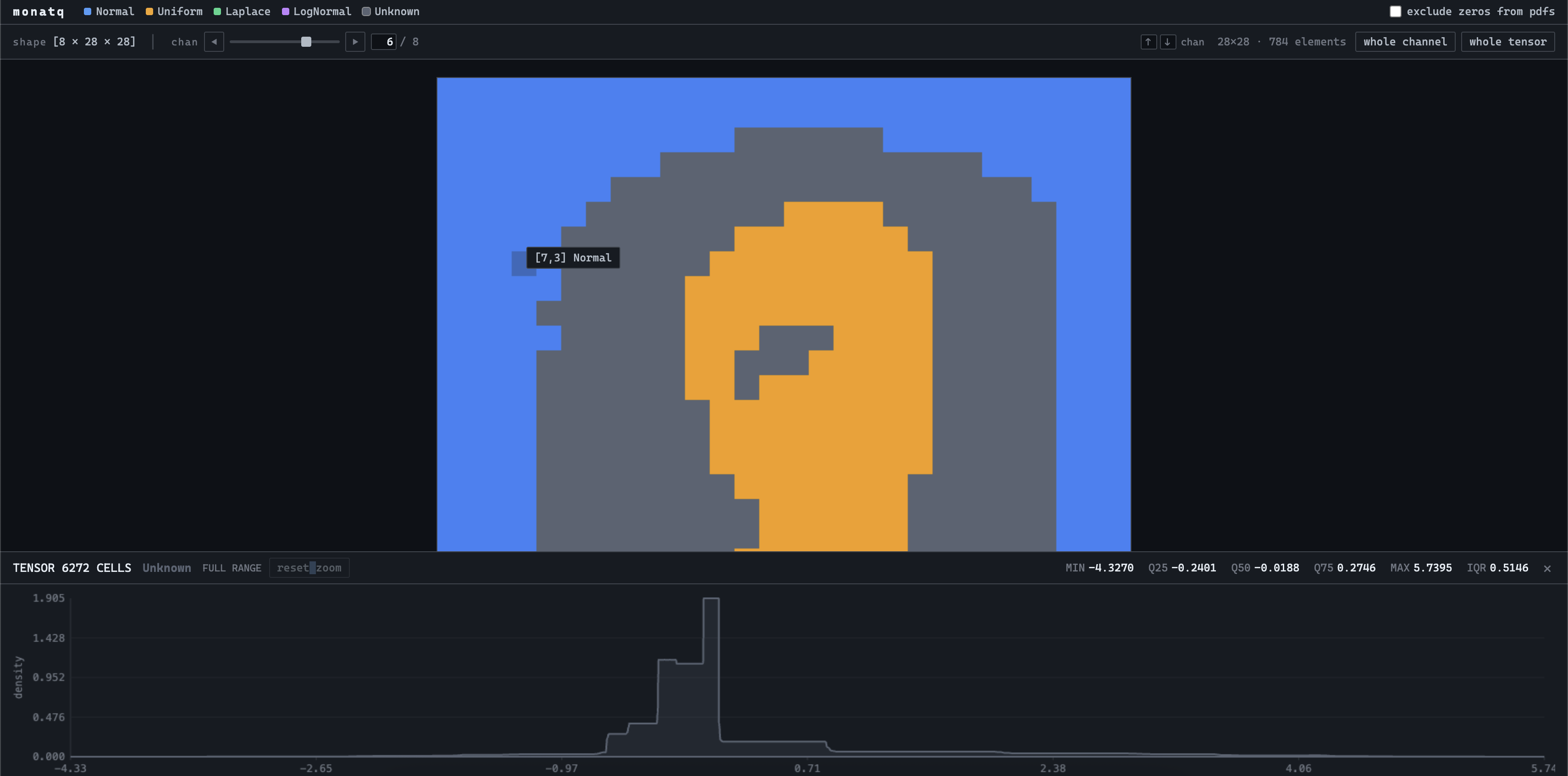
- Distribution analysis - classify each position as Normal, Uniform, Laplace, or LogNormal by fitting an empirical quantile profile
- Save / load - zstd-compressed bincode snapshots via
digest.save(path)/TensorDigest::load(path) - Visualisation - built-in HTTP server (
digest.visualize()) for browser-based inspection of a tensor
License
Apache-2.0 - see LICENSE.