# Typography
mirui shapes text into positioned glyphs, then optionally places those glyphs on a registered vector path. The same `Path` and `PathId` types drive drawing, clipping, hit testing, and text baselines.
## Text box overflow
Assign a finite width when text should wrap or show an ellipsis. `Ellipsis` also requires a font in the stack that maps U+2026. Explicitly sized axes clip ordinary `Text` to the transformed text box for both overflow policies; `Auto` and `Content` preserve glyph ink overhang within the ancestor clip. Path text uses its placed glyph geometry and ancestor clip because its ink can extend beyond the layout box.
```rust
ui! {
Text(
"A long status label",
width: Dimension::percent(100),
paragraph: ParagraphStyle {
wrap: TextWrap::NoWrap,
max_lines: Some(1),
overflow: TextOverflow::Ellipsis,
..ParagraphStyle::default()
}
)
};
```
## Text on a static path
`path!` stores its commands in the program image. Registering those commands with `insert_static` keeps the path borrowed and gives it a stable `PathId`.
```rust
use mirui::prelude::*;
static ARC: Path = path!(M 16 72 Q 96 8 176 72);
fn register_arc(app: &mut App<impl Surface>) -> PathId {
app.paths()
.insert_static(ARC.commands())
.expect("path capacity")
}
#[compose]
fn curved_title(arc: PathId) {
ui! {
Text("Status", path: arc, font_size: 24)
};
}
```
Passing a `PathId` uses subpath `0`, starts at distance `0`, follows the path forward, and uses the full available length.
## Place multiple lines
Each paragraph line uses one consecutive subpath, beginning at `TextPath::subpath()`. The usable length of each subpath constrains wrapping, alignment, justification, and ellipsis before glyph placement.
```rust
use mirui::prelude::*;
static LINES: Path = path!(
M 12 36 L 172 36
M 24 68 Q 92 104 160 68
);
fn register_lines(app: &mut App<impl Surface>) -> PathId {
app.paths()
.insert_static(LINES.commands())
.expect("path capacity")
}
#[compose]
fn multiline_label(lines: PathId) {
ui! {
Text(
"The first line stays straight and the next follows the curve.",
path: lines,
paragraph: ParagraphStyle {
wrap: TextWrap::Word,
max_lines: Some(2),
..ParagraphStyle::default()
},
)
};
}
```
No baseline array or copied command buffer is created. Line-only subpaths are sampled directly from `Path`; curved subpaths reuse the bounded measurement cache. A missing or invalid subpath rejects the path layout before placed glyph or caret frames are published.
## Select a range and direction
`TextPath` describes how text consumes a registered path without copying its commands.
```rust
use mirui::prelude::*;
let placement = TextPath::new(path)
.with_subpath(1)
.with_range(Fixed::from_int(12)..Fixed::from_int(180))
.with_offset(Fixed::from_int(8))
.with_direction(PathDirection::Reverse)
.with_seam(Fixed::from_int(36));
ui! {
Text("Reverse around the ring", path: placement)
};
```
`with_seam` chooses the distance treated as the start of a closed subpath. The selected range remains measured in path-length units after the seam is applied.
`with_offset` leaves a fixed-point leading inset inside the selected range. Wrapping, alignment, ellipsis, glyphs, and carets use the remaining path length.
The builder API accepts the same value:
```rust
let label = Text::build("Status")
.font_size(24)
.path(placement)
.spawn(cx.world_mut());
```
## Switch paths reactively
The DSL accepts a `Signal<PathId>` as a reactive `path` attribute. Replacing the signal value moves the existing text entity to the new path and transfers its path-change subscription.
```rust
#[compose]
fn selectable_path(first: PathId, second: PathId) {
let selected = Signal::new(first);
let selection = selected.clone();
ui! {
Column () {
Text("Live route", path: $selection)
Button ("Switch", width: 80, height: 36) on Tap {
selected.update(|path| {
*path = if *path == first { second } else { first };
});
}
}
};
}
```
## Derive path geometry from signals
Create one mutable path, reserve its command storage once, and bind its geometry to signals. `bind_path` installs an owner-bound effect: signal changes edit the existing path, advance its revision, and dirty every subscribed text or drawing entity.
```rust
#[compose]
fn elastic_baseline(amplitude: Signal<Fixed>) {
let mut geometry = Path::try_with_capacity(2).expect("path storage");
geometry
.move_to(Point::new(0, 48))
.quad_to(Point::new(80, 48), Point::new(160, 48));
let path = cx.paths().insert(geometry).expect("path capacity");
let live_amplitude = amplitude.clone();
cx.bind_path(path, move |geometry| {
let y = Fixed::from_int(48) - live_amplitude.get();
geometry
.set_command(1, mirui::render::path::PathCmd::QuadTo {
ctrl: Point::new(80, y),
end: Point::new(160, 48),
})
.expect("stable command shape");
})
.expect("mutable path");
ui! {
Text("Signal-driven curve", path: path)
};
}
```
The effect retains the path allocation and command capacity. Prefer `set_command` when the command topology is stable; use `clear` plus path-building methods when the topology itself changes.
## Edit a path from a handler
Event handlers receive the same scoped path access API. Editing by `PathId` preserves entity identity and updates all consumers of the path.
```rust
ui! {
Text("Tap to bend", path: path, height: 72) on Tap {
let _ = ctx.paths().edit(path, |geometry| {
geometry
.set_command(1, mirui::render::path::PathCmd::QuadTo {
ctrl: Point::new(80, 4),
end: Point::new(160, 48),
})
.expect("stable command shape");
});
}
};
```
## Query caret and selection geometry
`PathTextGeometry::for_widget` resolves the text entity's computed rectangle,
scroll offsets, and accumulated 2D or projective transform. Caret hit testing
and selection ribbons therefore use the same placed geometry as rendering.
```rust
use mirui::prelude::*;
fn inspect_path_text(
world: &World,
label: Entity,
pointer: Point,
mut visit: impl FnMut([Point; 4]),
) {
let Some(geometry) = PathTextGeometry::for_widget(world, label) else {
return;
};
if let Some(hit) = geometry
.hit_test(pointer, Fixed::from_int(6))
.expect("valid projection")
{
let mut storage = [PathSelectionRibbon::default(); 16];
let selection = hit.text_offset()..hit.text_offset().saturating_add(4);
let ribbons = geometry
.selection_into(selection, &mut storage)
.expect("selection capacity");
for ribbon in ribbons {
visit(ribbon.quad());
}
}
}
```
Mixed-direction selections are split at visual-run and line boundaries. A
render-only label pays no caret-frame cost; caret frames and ribbons are
created only when queried and use caller-provided bounded storage.
`PathTextGeometry::with_transform` accepts an explicit `Transform` or
`Transform3D` for scene tools that already hold the final render transform.
Projection through or behind the near plane returns
`PathTextGeometryError::InvalidProjection`. Selection output remains unchanged
when capacity or projection validation fails.
## Backend behavior
| Linear and affine | native | native | native run cache | native canvas path |
| Posed coverage | inverse sampled | instanced atlas | batched scalar atlas | per-glyph transform |
| Posed SDF | derivative-aware | derivative-aware | exact coverage route | exact coverage route |
| Projective glyphs | inverse sampled | projective atlas | bounded software target | bounded software target |
`render::PosedGlyphs` pairs borrowed positioned glyphs and placement frames for
render commands, Canvas calls, and scene replay. Construction rejects mismatched
slice lengths without allocating.
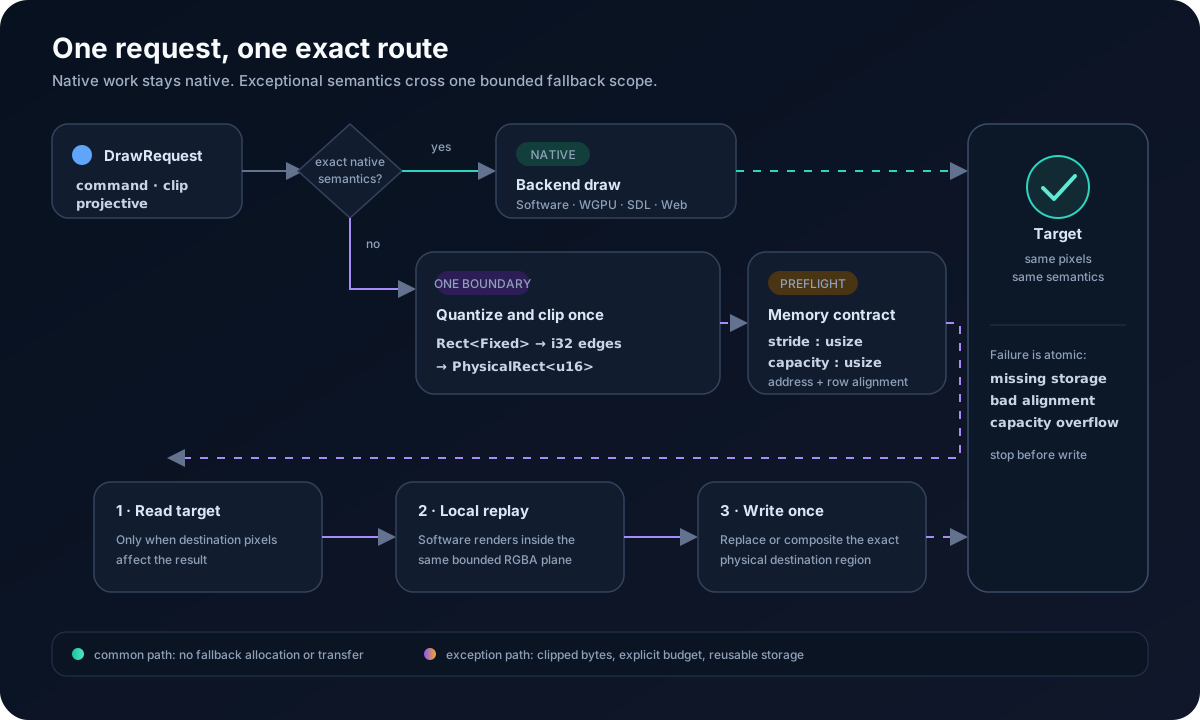
SDL GPU and Web Canvas use a `ProjectiveFallback` supplied through their
renderer factory for projective glyphs, fills, borders, and image blits with
rounded corners, opacity, and composite modes. Its
fixed RGBA storage is both the target and scratch space.
`ProjectiveFallback::borrowed(&mut bytes)` uses a caller-owned fixed buffer;
`ProjectiveFallback::new(bytes)` owns its buffer. Shape and image requests use
projected visual bounds to limit the required storage; glyph
requests use projected ink bounds. Preflight rejects missing or insufficient
capacity before drawing. Unsupported projective commands remain errors.
Gallery reserves 2 MiB for this target on Web Canvas and SDL GPU.
The complete routing, numeric-domain, and aligned-memory contract is described
in [Exact backend fallback](backend-fallback.md).
## Storage and invalidation
- `PathId` is a generational handle; removing a path invalidates stale handles.
- Static entries borrow command slices and reject edits.
- Mutable entries own or adopt their command storage and expose a monotonically advancing revision.
- Text entities subscribe to the path selected by their `TextPath` component.
- Baseline sampling, posed glyphs, caret frames, ink bounds, and hit testing are cached by path identity and revision.
- Path edits recompute affected line lengths and invalidate placement through the same path revision.
- Ordinary text without a `TextPath` stays on the linear shaping and rendering path.
Set the registry limit before inserting paths when the application needs a fixed budget:
```rust
app.with_path_capacity(24)?;
```
