
magic_sync
Keeps partial copies of PostgreSQL tables on SQLite replicas, and brings back what the replicas write. Offline-first: a replica keeps working while it is unreachable, and catches up when it is back — with nobody repairing data by hand.
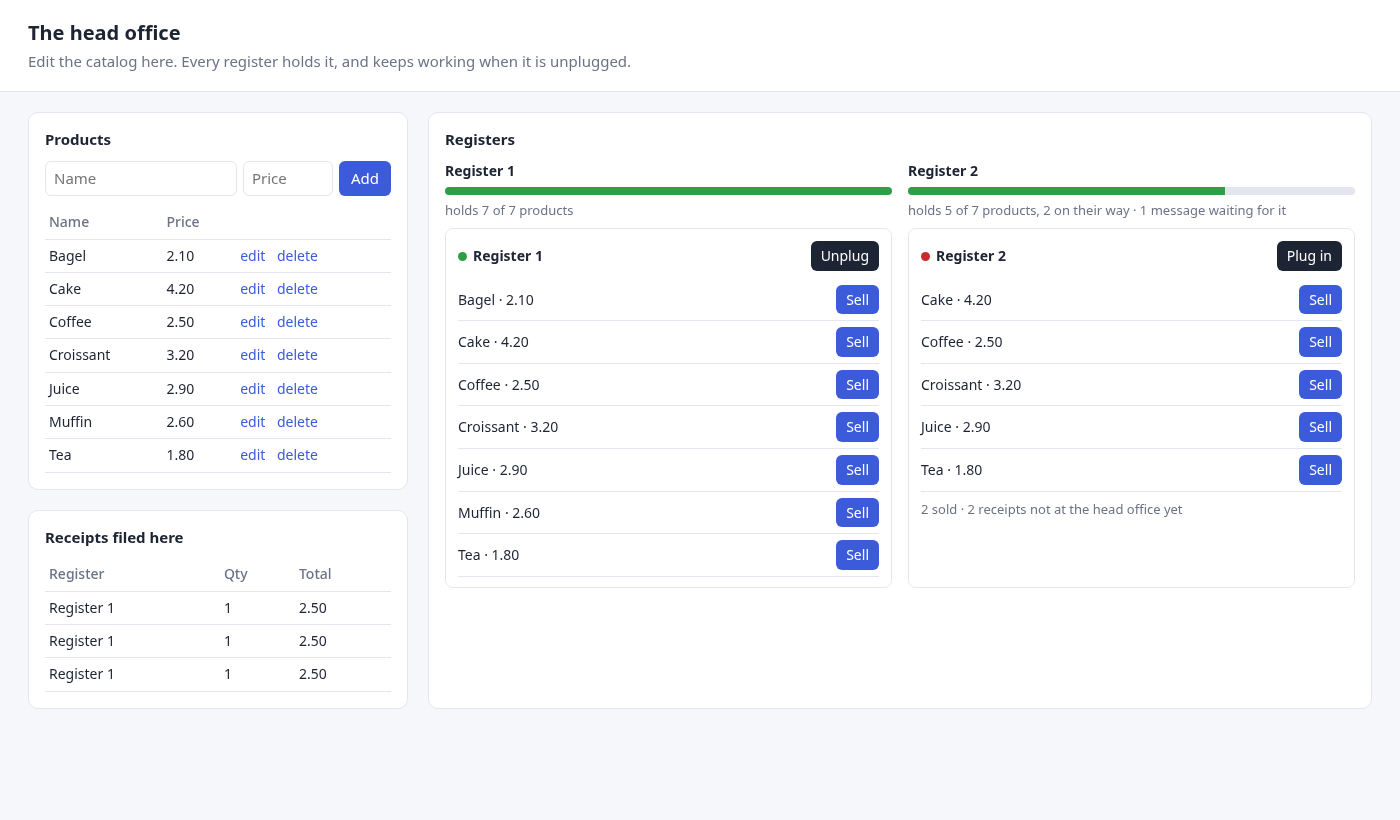
The shop example: register 2 is offline. It keeps selling from the products it holds; the head office knows it holds 5 of 7, and that two receipts are on their way. Bring it back online and both catch up.
// One struct is one table, and says how it travels. Both sides share it.
// The server (feature `postgres`), on a database your migrations set up.
// You say how bytes reach a replica; the engine runs itself.
let server = new;
spawn;
// Every message a replica sends up, from the replica your transport says sent it.
server.receive.await?;
// A replica (feature `sqlite`): its way up runs itself. Hand it what arrives,
// and acknowledge it to your transport once `receive` returned Ok.
let replica =
new;
spawn;
replica.receive.await?;
You write your tables, a struct per table, and how bytes travel between your server and your replicas. You do not write the sync.
Why another sync engine?
Most sync engines replay a log: every change becomes an event, sent in order, re-applied on the other side. A lost event is a divergence nothing heals; a failing event blocks everything behind it; repair is someone's afternoon.
magic_sync replays nothing. For every replica, the server keeps what that
replica holds. When something changes, it works out what the replica
should hold now, and sends the difference:
send   = should hold − holds
delete = holds − should hold
A change is never "an event that must be delivered" — it is a reason to compare two sets again. So a row a replica did not take is simply not counted as held, and the next comparison sends it, as it is then. A replica that missed a week catches up from the current state. Provisioning a new replica is a comparison against an empty set.
Built on that:
- Partial replication by rules. A row goes to every replica of its
partition (
broadcast), to the replica a column names (assigned(col)), to the replicas a group of rows is given to (grouped), or wherever its parent goes (follows(col)). - Referential closure, read from your schema. A replica sent an order is sent its customer too, and keeps the customer while anything of its own points at it. The engine reads the foreign keys; you declare nothing.
- Both directions. Replicas write rows of their own (receipts, readings) that go up and are filed under the replica that sent them — whatever the rows claim.
- Settings and wishes: a digital twin. A setting is a value a replica owns and acts on — a device's configuration, a printer's footer. The server keeps what the replica reports, and wishes it another value; the replica carries the wish out through your handler (hardware included), refuses it, or finds it changed first, and both sides end showing what it decided. Desired against reported state, in your own tables (Settings and wishes).
- A failure contract. Every failure is either transient (the network, the database — it waits and retries) or permanent (a bug, data no declaration allows — it is narrowed down to the one row, set aside, and retried after your next deploy). Nothing else waits for it. An hourly fingerprint of what each replica holds catches whatever nobody foresaw.
- Progress that does not lie. "Register 7 holds 480 of 500 products" counts only what the register confirmed it applied.
- Any transport. You implement one method that sends bytes to a replica (NATS JetStream, HTTP, a queue, a USB stick), and it provides what the protocol requires of a transport.
- Any language on the replica side. The protocol
is written down, its messages are a
.proto, and the engine's own replica is just one implementation of it.
Where it fits, and where it does not
It fits a system with one PostgreSQL server that owns the truth, and many replicas — devices, stores, vehicles, field laptops — that each hold part of it in SQLite, must keep working offline, and write records of their own.
It does not try to be a collaborative-editing engine: two writers on the same
column of the same row is not a case it resolves (a table either goes down,
goes up, or splits its columns between the two sides; a value the server must
change on a replica is a setting it wishes, which the replica alone writes). If you need
multi-writer merges, look at CRDT-based tools (Automerge, Yjs). If your
clients are browsers or mobile apps talking to a hosted service, look at
PowerSync or ElectricSQL. magic_sync is a library inside your own Rust
server — no extra service to run.
Learn it
- The book — the shop, built step by step: what you write, then what happens.
- How it works — the engine from the ground up: the idea, the life of a change, every failure and how it heals.
- The replica protocol — what a replica in any language must do.
- The shop example — run it in five minutes.
Status
0.1. Extracted from a system that keeps fleets of edge devices in sync; the
API is young and will change before 1.0. PostgreSQL 14 or later on the
server, SQLite on the replicas, sqlx underneath.
A build of the crate is one side: the postgres feature for the server, the
sqlite feature for a replica, each in a workspace of its own
(Set up a project).
The API reference of each side is
published with the book.
License
Licensed under either of Apache License, Version 2.0 or MIT license at your option.