
English | 简体中文
Lumesh — Your Next Default Shell



Codeberg | GitHub | Documentation | DeepWiki | Release Page 1 | Release Page 2 | Syntax Highlighting Plugin | NEWS
     ⚡┓
      ┃ ┓┏┏┳┓┏┓
      ┗┛┗┻┛┗┗┗  Lightweight · Ultimate · Modern · Efficient
Write like JavaScript, works like Bash, runs like light.

Are You Still Enduring These Bash Pains?
# Bash: String comparison requires quotes, otherwise errors
if [; then
# Bash: Arrays? Associative arrays? Syntax is like solving a puzzle
map["key"]="value"
for; do ; done
# Bash: Error handling relies almost entirely on set -e, one error crashes the whole script
||
# Bash: Want to process a JSON list? Install jq first, write a bunch of pipelines, then pray it doesn't error
result= ||
Bash was born in 1989. It was never designed for modern developers.
You fight its historical baggage every day:
- String and array syntax traps are maddening
- Error handling is either all-exit or all-ignore, no middle ground
- Structured data processing completely depends on external tools
- Long scripts become unmaintainable "shell spaghetti"
It's time to switch to a shell designed for modern people.
Meet Lumesh — Your Next Shell

Lumesh is a modern shell and scripting language written in Rust, fully compatible with external commands while bringing JavaScript-like programming capabilities.
No need to abandon your existing knowledge. ls, git, grep, curl — all commands run as usual. You just get everything better.
Compare and Feel the Difference
Error Handling: From Nightmare to Elegant
# Bash way: fragile, verbose
if ! ; then
fi
# Lumesh way: 7 precise error operators
Data Processing: Goodbye to awk/sed/jq Combo
# Filter large files, keep only entries above 5K, show only name and size
| ) | )
# Map/filter on lists, like writing JavaScript
| ) | )
# Batch operations: copy all files in current directory to /tmp/
|> cp
Variables and Data Structures: Finally Like a Normal Language
# Destructuring assignment
# Ranges and chained calls
)) # => "hello-world"
# Rich types: List, Map, Set, Range, all natively supported
Modular Scripting: Writing Large Projects Is No Longer a Disaster
)
) # Decorator: auto-retry 3 times on failure
) { }
Performance: Not Just Better to Use, But Faster
| Comparison Item | lume | bash | dash | fish |
|---|---|---|---|---|
| Speed (million loops) | ★★★★★ | ★★★ | ★★★★ | Cannot complete |
| Syntax Friendliness | ★★★★★ | ★★ | ★ | ★★★★ |
| Error Message Quality | ★★★★★ | ★ | ★ | ★★★ |
| Error Handling Capability | ★★★★★ | ★ | ★ | ★ |
| Built-in Function Library | ★★★★★ | — | — | ★ |
| Interactive Experience | ★★★★★ | ★★ | ★ | ★★★★★ |
| Binary Size | ★★★★ | ★★★ | ★★★★★ | ★★ |
| Structured Pipeline | √ | — | — | — |
| AI Assistance | ✅√ | — | — | — |
 |
 |
|---|
From v0.10.1, loop performance improved by about 2x; from v0.11.0, memory usage decreased by about 0.8 MB.
Bash vs Lumesh Syntax Quick Reference
| Scenario | Bash | Lumesh |
|---|---|---|
| Variable Assignment | name="Alice" |
let name = "Alice" |
| String Interpolation | echo "Hello $name" |
echo `Hello {name}` |
| Conditional Judgment | if [ "$a" -gt 1 ]; then;do ... done |
if a > 1 { ... } |
| Loop | for i in $(seq 1 10); do ... done |
for i in 1..10 { ... } |
| Function Definition | myfunc() { ... } |
fn myfunc() { ... } |
| Array | arr=(1 2 3) |
let arr = [1, 2, 3] |
| Dictionary/Map | Requires declare -A |
let m = {a: 1, b: 2} |
| Destructuring Assignment | Not supported | let {name, age} = user |
| Error Ignoring | command 2>/dev/null || true |
command ?. |
| Pipeline Structured Data | Not supported (requires jq/awk) | Native support |
| Chained Calls | Not supported | "hello".split(' ').join(',') |
| Module Import | Not supported | use mylib as lib |
Migration Guide: Replace Bash in Three Steps
Step 1: Install Lumesh
Method 1: Use Installation Script (Recommended)
# Download and run installation script
Method 2: Download Precompiled Binary
For command parameter auto-completion, extract
data.tgzfrom the release package to the data directory.
Method 3: Compile from Source Method 4: Install via Cargo
Step 2: Experience Interactive Shell
After installation, run lume directly to enter interactive mode:
You'll immediately get:
- Syntax Highlighting: Real-time highlighting of commands, variables, and strings during input, errors visible at a glance
- Smart Completion: Automatic completion for paths, commands, parameters (including fish-style parameter hints), even AI-assisted completion (
ALT+i) - Modern Hotkeys:
Ctrl+/command menu,Alt+gquick directory jump,CTRL_SHIFT_fquick file selection... - AI Assistance: Let AI help you write code (
ALT+Enter)
You can try:
helpcommand to understand built-in commandshelp docto view online documentation- Execute regular third-party commands
- Use built-in libraries to write functions and scripts
Step 3: Set Lumesh as Default Shell
Execute in lume:
After re-login, your terminal default will be Lumesh.
Migrate Existing Bash Scripts
Lumesh uses .lm as the script extension. When migrating Bash scripts, main changes focus on:
1. Shebang Line
#!/usr/bin/env lumesh
lumeshcan optionally link tolumeorlume-selume-seis a non-interactive lightweight script executor, suitable for CI/CD and automation scenarios.
2. Add let to Variable Declarations
# Bash
NAME="world"
# Lumesh
3. Conditional and Loop Syntax
# Bash
for; do
done
# Lumesh
for
4. Command Calls Need No Changes
Lumesh's CFM (Command First Mode) lets you call external commands directly like in Bash:
⚡ Rich Built-in Modules (No Need to Install Third-Party Tools)
| Module | Functionality |
|---|---|
list |
map, filter, reduce, sort, unique… |
string |
split, join, trim, replace, pad… |
fs |
ls, read, write, copy, move… |
map |
Mapping operations |
table |
Table operations |
regex |
Regex matching, replacement, extraction |
time |
Time formatting, calculation, timezone |
math |
Complete math function library |
into / from |
Data type conversion |
ui |
Interactive selection, confirmation dialogs |
log |
Structured log output |
| ... | Use help libs to see more |
Constant Modules
COLORMATHSTYLE
Multiple Binaries, Choose as Needed
| Binary | Size | Use Case |
|---|---|---|
lume |
~3.9 MB | Daily interactive Shell, includes REPL, completion, highlighting + local HTTP protocol AI assistance |
lume-se |
~2.7 MB | Script execution, CI/CD, embedded, fast startup |
lume-ai-https |
~5.4 MB | Interactive Shell + online HTTPS protocol AI assistance |
Syntax Highlighting Support
- In Terminal: Out-of-the-box, real-time highlighting
- In Editors: Via tree-sitter-lumesh supporting Neovim, Helix and other editors
Most Flexible Hotkey Support
- Users can bind custom hotkeys to custom functions
- This function can read and modify the currently entered command line
- This means you can unleash your creativity to accomplish any functionality you want
For example
- Auto-correct input errors
- Save/call history directory/bookmark commands
- Call
uimodule to create menus/dialogs for quick navigation - Call
xdg-opento quickly open files - Create specific command menus for specific workspaces
- ...
Version Highlights
- v0.8.0: CFM Command First Mode, daily commands need no quotes
- v0.10.0: Modular programming support
- v0.11.5: Middleware-style decorators, loop iterator optimization
- v0.11.6: Closure free variable capture, local variable support
- v0.12.7: HashMap/BTreeSet data types, constant support (COLOR/STYLE/MATH)
- v0.15.0: Rewritten editor for smoother experience
- v0.15.4: Richer auto-completion features
- v0.15.5: Rewritten lexer for higher parsing efficiency
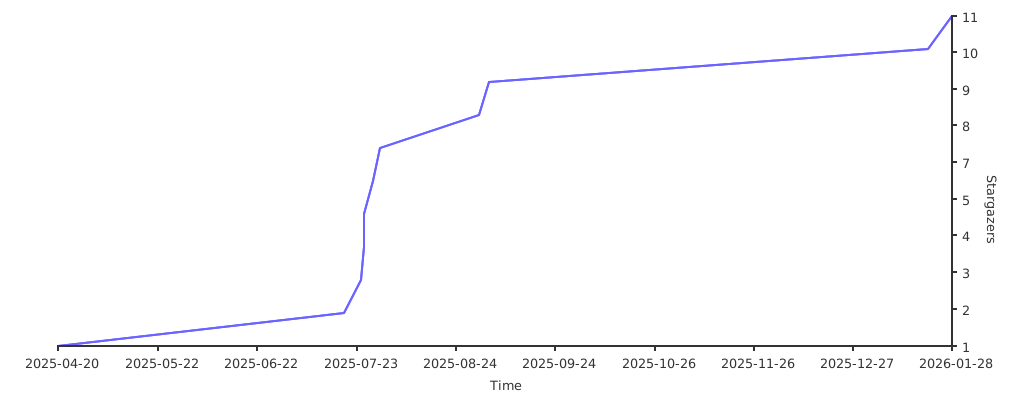
Start your Lumesh journey now and say goodbye to Bash's historical baggage.