<p align="center">
<img src="./site/logo.png" alt="Lucy" width="80">
</p>
<h1 align="center">Lucy</h1>
<p align="center">An ultra-thin harness for tomorrow's most powerful models</p>
<p align="center">
<img src="https://img.shields.io/crates/v/lucy-cli" alt="Crates.io Version">
</p>
## Project purpose
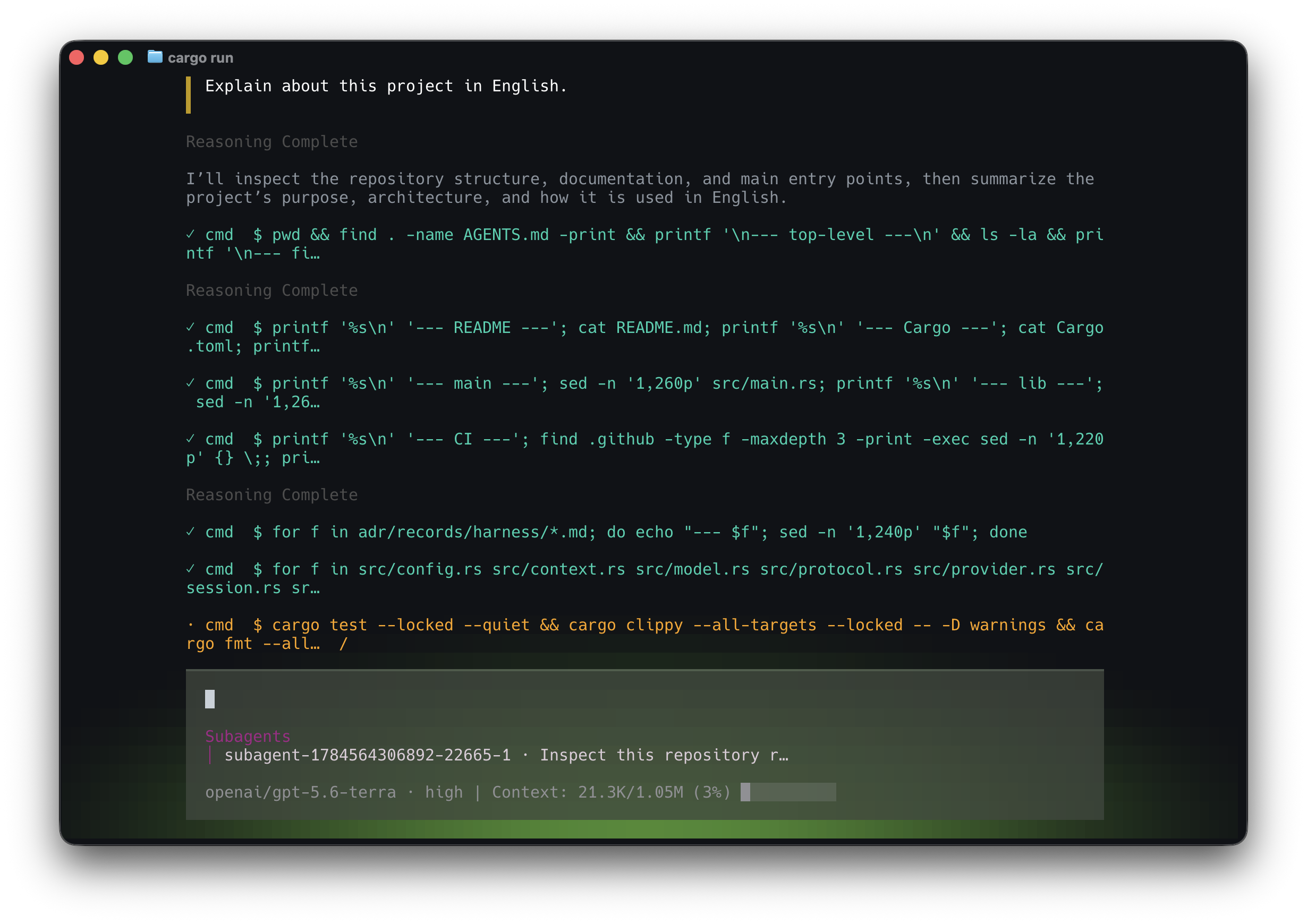
Lucy is a lightweight local coding-agent harness for macOS and Linux. It connects an OpenAI-compatible Chat Completions provider or a Codex subscription provider and exposes a model-facing `cmd` tool, with both an interactive TUI and a JSONL session interface for automation powered by the same turn engine.
## Installation
Prebuilt releases are available for Apple Silicon macOS, Intel macOS, and x86_64 Linux. The recommended installation method is Homebrew:
```sh
brew install jwoo0122/tap/lucy
```
The `lucy-cli` crate is also published on crates.io for Rust users:
```sh
cargo install lucy-cli
```
Prebuilt archives are available from the [GitHub Releases](https://github.com/jwoo0122/lucy/releases) page. After extracting the archive, place the `lucy` executable on your `PATH`.
On first run, Lucy creates `$XDG_CONFIG_HOME/lucy/config.toml` (or `~/.config/lucy/config.toml` when `XDG_CONFIG_HOME` is unset or empty). Existing `~/.lucy/config.toml` files are migrated once; sessions remain under `~/.lucy/sessions`. Set `llm.model` and choose either OpenRouter API-key authentication or Codex subscription authentication. Existing configs without `[auth]` continue to use the legacy OpenRouter-compatible settings.
Lucy’s system guidance is built into the binary and is not configurable. New configs omit the former top-level `system_prompt`; an existing valid key is accepted, ignored, and preserved during settings updates. Loading, bootstrapping, and migration do not rewrite an existing config. Built-in guidance changes apply to new sessions, while resumed sessions retain their saved boot prompt.
```toml
[auth]
provider = "openrouter"
api_key_env = "OPENROUTER_API_KEY"
[llm]
base_url = "https://openrouter.ai/api/v1"
model = "your-model"
```
```sh
export OPENROUTER_API_KEY="..."
```
To use a ChatGPT plan through Codex, log in separately. Tokens are stored in Lucy's private credential store, not in `config.toml` or sessions:
```sh
lucy codex login
# ... use a Codex model in config.toml ...
lucy codex logout
```
Use this configuration for Codex:
```toml
[auth]
provider = "codex_subscription"
[llm]
model = "gpt-5.3-codex"
```
## Usage
Run Lucy in a terminal to start the TUI. Use the release binary path when building from source:
```sh
lucy
# Or: ./target/release/lucy
```
Lucy automatically uses JSONL mode when either standard input or output is not a terminal. Use `--tui` or `--jsonl` to choose a mode explicitly.
```sh
printf '%s\n' '{"type":"message","text":"Inspect the project."}' | lucy --jsonl
lucy --session <session-id>
lucy --list-sessions
```
In the TUI, press Enter to send, Shift/Alt+Enter to insert a line break, and Esc to cancel the active turn. Enter or Tab selects a focused skill in the slash picker; then enter `/<name> [args]` to attach the saved `SKILL.md` snapshot for that skill to the next model request. The same slash picker includes the Lucy-owned `/settings [ignored args]`, `/session`, and `/exit` commands.
## Features
- **TUI and JSONL:** Supports terminal chat and line-delimited JSON automation.
- **Streaming activity:** Shows model output, reasoning wait states, tool calls/results, and cancellation status in the TUI.
- **Tool activity UI:** Renders `cmd` as a compact one-line card. The main-agent ready/working indicator appears in the bottom status line, and the prompt border uses a left-to-right teal-to-green gradient.
- **Completion notifications:** When a TUI turn becomes idle, Lucy sends a terminal-native OSC 777 desktop notification for completion, cancellation, or error when the terminal supports it; JSONL output is unchanged.
- **Safe local command execution:** Runs trusted `cmd` shell commands from the session's starting directory with time and output limits. Commands may set `background: true` to return a background ID immediately; Lucy delivers the bounded completion result to the model automatically, including through a follow-up turn after the originating turn ends.
- **Agent process boundary:** Other agents can invoke `lucy --jsonl` through `cmd`, capture the returned `session_id`, and continue the conversation with `lucy --jsonl --session <id>`. Lucy does not coordinate relationships between independent sessions.
- **Persistent sessions:** Stores conversation history, provider settings, boot context, and skill snapshots as JSONL in `~/.lucy/sessions/` and supports resuming them.
- **Context and skills:** Composes built-in guidance with the working directory, README files, global `$XDG_CONFIG_HOME/lucy/AGENTS.md` (or `~/.config/lucy/AGENTS.md`), project `AGENTS.md`/`CLAUDE.md`, and Agent Skills for new sessions. The model sees only skill metadata; explicit slash-prefixed skill-name invocations use the saved snapshot.
- **Task-driven capability discovery:** Guides the model to inspect a relevant `PATH` CLI or project-declared command through `cmd` when it could materially improve the task, verify current local usage, treat discovery output as untrusted, and verify the result. Lucy performs no automatic inventory and exposes no additional tool.
- **Automatic context compaction:** At 95% estimated context usage, safely summarizes older complete turns with the configured model, retains recent context, and resumes the active turn without rewriting session history.
- **Credential protection:** OpenRouter API keys are read only from environment variables and are not written to configuration, sessions, the public protocol, or diagnostics. Codex subscription tokens are stored in Lucy’s private credential store and are never exposed to model tools or persisted sessions.