use std::{array, fmt};
use typebool::False;
use crate::{
hsize,
prelude::*,
map::DenseMap,
};
use super::{TriFaces, SplitEdgeWithFacesResult};
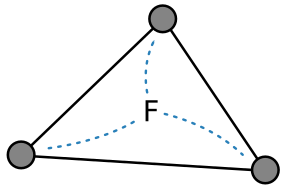
#[doc = include_str!("diagram.svg")]
#[derive(Clone, Empty)]
pub struct SharedVertexMesh {
vertices: DenseMap<VertexHandle, ()>,
faces: DenseMap<FaceHandle, [VertexHandle; 3]>,
}
impl Mesh for SharedVertexMesh {
type FaceKind = TriFaces;
type Orientable = False;
fn num_vertices(&self) -> hsize {
self.vertices.num_elements()
}
#[inline(always)]
fn next_vertex_handle_from(&self, start: VertexHandle) -> Option<VertexHandle> {
(start.idx()..self.vertices.next_push_handle().idx())
.map(VertexHandle::new)
.find(|&vh| self.vertices.contains_handle(vh))
}
#[inline(always)]
fn next_face_handle_from(&self, start: FaceHandle) -> Option<FaceHandle> {
(start.idx()..self.faces.next_push_handle().idx())
.map(FaceHandle::new)
.find(|&fh| self.faces.contains_handle(fh))
}
fn last_vertex_handle(&self) -> Option<VertexHandle> {
self.vertices.last_handle()
}
fn last_face_handle(&self) -> Option<FaceHandle> {
self.faces.last_handle()
}
fn contains_vertex(&self, vertex: VertexHandle) -> bool {
self.vertices.contains_handle(vertex)
}
fn num_faces(&self) -> hsize {
self.faces.num_elements()
}
fn contains_face(&self, face: FaceHandle) -> bool {
self.faces.contains_handle(face)
}
fn num_edges(&self) -> hsize {
unreachable!()
}
fn next_edge_handle_from(&self, _: EdgeHandle) -> Option<EdgeHandle> {
unreachable!()
}
fn last_edge_handle(&self) -> Option<EdgeHandle> {
unreachable!()
}
fn check_integrity(&self) {
for (f, &[va, vb, vc]) in self.faces.iter() {
assert!(self.vertices.contains_handle(va), "va = {:?} of faces {:?}", va, f);
assert!(self.vertices.contains_handle(vb), "vb = {:?} of faces {:?}", vb, f);
assert!(self.vertices.contains_handle(vc), "vc = {:?} of faces {:?}", vc, f);
if va == vb || va == vc || vb == vc {
panic!("bug: vertices of face {:?} are not unique: {:?}", f, [va, vb, vc]);
}
}
}
}
impl MeshMut for SharedVertexMesh {
fn add_vertex(&mut self) -> VertexHandle {
self.vertices.push(())
}
fn add_triangle(&mut self, [va, vb, vc]: [VertexHandle; 3]) -> FaceHandle {
assert!(self.vertices.contains_handle(va));
assert!(self.vertices.contains_handle(vb));
assert!(self.vertices.contains_handle(vc));
assert_ne!(va, vb, "vertices of new face are not unique");
assert_ne!(va, vc, "vertices of new face are not unique");
self.faces.push([va, vb, vc])
}
fn remove_isolated_vertex(&mut self, vertex: VertexHandle) {
self.vertices.remove(vertex);
}
fn remove_face(&mut self, face: FaceHandle) {
self.faces.remove(face);
}
fn remove_all_vertices(&mut self) {
assert!(
self.num_faces() == 0,
"call to `remove_all_vertices`, but there are faces in the mesh!",
);
self.vertices.clear();
}
fn remove_all_faces(&mut self) {
self.faces.clear();
}
fn split_face(&mut self, f: FaceHandle) -> VertexHandle {
let [va, vb, vc] = self.faces[f];
let center = self.add_vertex();
self.faces[f] = [va, vb, center];
self.faces.push([vb, vc, center]);
self.faces.push([vc, va, center]);
center
}
fn add_face(&mut self, _: &[VertexHandle]) -> FaceHandle {
unreachable!()
}
fn flip_edge(&mut self, _: EdgeHandle) {
unreachable!()
}
fn split_edge_with_faces(&mut self, _: EdgeHandle) -> SplitEdgeWithFacesResult {
unreachable!()
}
}
impl BasicAdj for SharedVertexMesh {
fn vertices_around_triangle(&self, face: FaceHandle) -> [VertexHandle; 3] {
self.faces[face]
}
type VerticesAroundFaceIter<'s> = array::IntoIter<VertexHandle, 3>;
fn vertices_around_face(&self, face: FaceHandle) -> Self::VerticesAroundFaceIter<'_> {
self.vertices_around_triangle(face).into_iter()
}
}
impl SupportsMultiBlade for SharedVertexMesh {}
impl fmt::Debug for SharedVertexMesh {
fn fmt(&self, f: &mut fmt::Formatter) -> fmt::Result {
struct VerticesDebug<'a>(&'a DenseMap<VertexHandle, ()>);
impl fmt::Debug for VerticesDebug<'_> {
fn fmt(&self, f: &mut fmt::Formatter) -> fmt::Result {
f.debug_list().entries(self.0.handles()).finish()
}
}
f.debug_struct("SharedVertexMesh")
.field("vertices", &VerticesDebug(&self.vertices))
.field("faces", &self.faces)
.finish()
}
}
#[cfg(test)]
mod test {
use super::*;
gen_mesh_tests!(SharedVertexMesh: [TriMesh, BasicAdj, SupportsMultiBlade]);
}