<div align="center">
# llmweb
**Extract any webpage to structured data — headless Chrome + LLM.**
[](https://crates.io/crates/llmweb)
[](https://crates.io/crates/llmweb)
[](LICENSE)
[](https://docs.rs/llmweb)
</div>
## Install
```toml
[dependencies]
llmweb = "0.1"
```
Default config reads `OPENAI_API_KEY`. For any OpenAI-compatible gateway
(DeepSeek, Groq, OpenRouter, z.ai, vLLM, Ollama, ...) use `LlmWeb::with_client`:
```rust
use llmweb::{LlmWeb, openai::{Client, OpenAIConfig}};
let client = Client::with_config(
OpenAIConfig::new()
.with_api_base("https://api.deepseek.com/v1")
.with_api_key("sk-..."),
);
let llmweb = LlmWeb::with_client(client, "deepseek-chat");
```
## Example
```rust
use llmweb::{Browser, Format, LlmWeb, RunOptions};
use serde::{Deserialize, Serialize};
use serde_json::json;
#[derive(Debug, Serialize, Deserialize)]
struct SearchResult {
title: String,
url: Option<String>,
snippet: Option<String>,
}
// json_schema mode requires an object root; wrap arrays in a named field.
#[derive(Debug, Serialize, Deserialize)]
struct GoogleSearchPage {
query: String,
results: Vec<SearchResult>,
}
#[tokio::main]
async fn main() -> Result<(), Box<dyn std::error::Error>> {
let browser = Browser::new().await?;
let tab = browser
.open("https://www.google.com/search?q=rust+programming+language")
.await?;
let llmweb = LlmWeb::new("gpt-4o-mini");
let schema = json!({
"type": "object",
"properties": {
"query": { "type": "string" },
"results": {
"type": "array",
"description": "Organic search results. Skip ads and knowledge cards.",
"items": {
"type": "object",
"properties": {
"title": { "type": "string" },
"url": { "type": "string" },
"snippet": { "type": "string" }
},
"required": ["title"]
}
}
},
"required": ["query", "results"]
});
// Markdown gives the LLM a far cleaner view than Google's heavy HTML.
let page: GoogleSearchPage = llmweb
.exec_on_tab(
&tab,
schema,
RunOptions { format: Format::Markdown, temperature: Some(0.0), ..Default::default() },
)
.await?;
println!("Query: {}\n", page.query);
for (i, r) in page.results.iter().enumerate() {
println!("[{i}] {}", r.title);
if let Some(u) = &r.url { println!(" {u}"); }
if let Some(s) = &r.snippet { println!(" {s}"); }
println!();
}
Ok(())
}
```
URL-based shortcut (library opens the tab for you): `llmweb.exec(url, schema).await?`.
<details>
<summary>Sample output</summary>
```
Query: rust programming language
[0] Rust Programming Language
https://www.rust-lang.org/en-US
Rust's rich type system and ownership model guarantee memory-safety and thread-safety — enabling you to eliminate many classes of bugs at compile-time.
[1] Rust (programming language) - Wikipedia
https://en.wikipedia.org/wiki/Rust_(programming_language)
Rust is a general-purpose programming language which emphasizes performance, type safety, concurrency, and memory safety.
[2] Rust - A Living Hell - The Perspective From A Programmer Of 30 Years
https://www.reddit.com/r/learnrust/comments/1binxlv/rust_a_living_hell_the_perspective_from_a/
Mar 19, 2024 · This has been the worst experience learning a programming language that I have ever had by far. I found absolutely no joy in it in any shape or form.
[3] The Rust Programming Language - Reddit
https://www.reddit.com/r/rust/
r/rust: A place for all things related to the Rust programming language—an open-source systems language that emphasizes performance, reliability, and…
... (10 results total)
```
</details>
## Features
- **Extract** — `exec` / `exec_on_tab` / `exec_on_html`: one LLM call → typed `R`.
- **Stream** — `stream` / `stream_on_tab` / `stream_on_html`: incremental partial-JSON snapshots via [`partial_stream`](./src/streaming.rs).
- **Codegen** — `generate` → JS extractor string; `run_script` replays it with **zero LLM cost**.
- **Recipe** — `generate_recipe` → declarative CSS-selector recipe; `run_recipe` executes it in **pure Rust** (no eval, no LLM).
- **5 preprocessing modes** — `html` (in-browser DOM cleanup), `raw_html`, `markdown` (via `htmd`), `text`, `image` (base64 screenshot for vision models).
- **Multi-provider** — any OpenAI-compatible endpoint via `LlmWeb::with_client`.
- **Logging** — `tracing` integration; `RUST_LOG=llmweb=debug` shows LLM raw responses.
## Examples
| [`hn.rs`](./examples/hn.rs) | Basic URL-shortcut extraction |
| [`google.rs`](./examples/google.rs) | Browser + tab, real-world Google search |
| [`v2ex_stream.rs`](./examples/v2ex_stream.rs) | Streaming partial output |
| [`codegen.rs`](./examples/codegen.rs) | Generate JS extractor, replay offline |
| [`recipe.rs`](./examples/recipe.rs) | Generate CSS-selector recipe |
| [`inline_html.rs`](./examples/inline_html.rs) | No browser — extract from a `&str` |
| [`hn_custom.rs`](./examples/hn_custom.rs) | Custom LLM endpoint + API key |
## CLI
```bash
cargo install llmweb
llmweb --schema-file schemas/hn_schema.json --format markdown <URL>
```
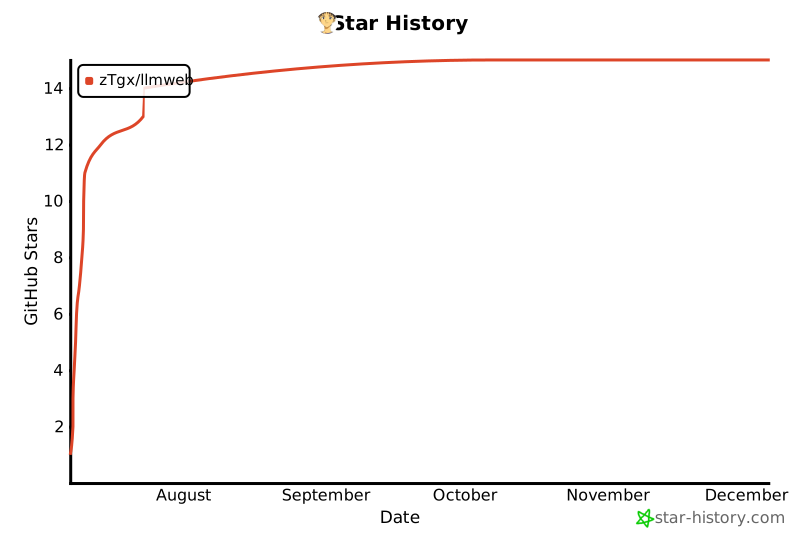
## Star History
[](https://www.star-history.com/#zTgx/llmweb&Date)
## License
MIT