# la-stack
[](https://doi.org/10.5281/zenodo.18158926)
[](https://crates.io/crates/la-stack)
[](https://crates.io/crates/la-stack)
[](./LICENSE)
[](https://docs.rs/la-stack)
[](https://github.com/acgetchell/la-stack/actions/workflows/ci.yml)
[](https://github.com/acgetchell/la-stack/actions/workflows/rust-clippy.yml)
[](https://codecov.io/gh/acgetchell/la-stack)
[](https://github.com/acgetchell/la-stack/actions/workflows/audit.yml)
[](https://github.com/acgetchell/la-stack/actions/workflows/codacy.yml)
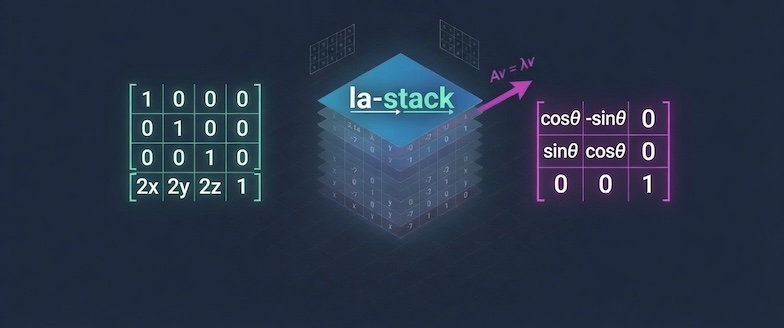
Fast, stack-allocated linear algebra for fixed dimensions in Rust.
This crate grew from the need to support [`delaunay`](https://crates.io/crates/delaunay) with fast, stack-allocated linear algebra primitives and algorithms
while keeping the API intentionally small and explicit.
## 📐 Introduction
`la-stack` provides a handful of const-generic, stack-backed building blocks:
- `Vector<const D: usize>` for fixed-length `f64` vectors backed by `[f64; D]`
- `Matrix<const D: usize>` for fixed-size square `f64` matrices backed by `[[f64; D]; D]`
- `Lu<const D: usize>` for LU factorization with partial pivoting (solve + det)
- `Ldlt<const D: usize>` for LDLT factorization without pivoting (solve + det; symmetric SPD/PSD)
## ✨ Design goals
- ✅ `Copy` types where possible
- ✅ Const-generic dimensions (no dynamic sizes)
- ✅ `const fn` where possible (compile-time evaluation of determinants, dot products, etc.)
- ✅ Explicit algorithms (LU, solve, determinant)
- ✅ Robust geometric predicates via optional exact arithmetic (`det_sign_exact`, `det_errbound`)
- ✅ Exact linear system solve via optional arbitrary-precision arithmetic (`solve_exact`, `solve_exact_f64`)
- ✅ No runtime dependencies by default (optional features may add deps)
- ✅ Stack storage only (no heap allocation in core types)
- ✅ `unsafe` forbidden
See [CHANGELOG.md](CHANGELOG.md) for release history and
[docs/roadmap.md](docs/roadmap.md) for current release planning.
## 🚫 Anti-goals
- Bare-metal performance: see [`blas-src`](https://crates.io/crates/blas-src), [`lapack-src`](https://crates.io/crates/lapack-src), [`openblas-src`](https://crates.io/crates/openblas-src)
- Comprehensive: use [`nalgebra`](https://crates.io/crates/nalgebra) if you need a full-featured library
- Large matrices/dimensions with parallelism: use [`faer`](https://crates.io/crates/faer) if you need this
- Alternate floating-point scalar families: `la-stack` supports `f64` and optional exact arithmetic, not `f32` / `f16` APIs
## 🔢 Scalar types
The scalar model is intentionally limited to `f64` for floating-point work and
exact rationals behind the optional `"exact"` feature. This matches the crate's
focus on small, robustness-sensitive numerical and computational geometry
workloads. When `f64` precision is insufficient (e.g. near-degenerate geometric
configurations), the optional `"exact"` feature provides arbitrary-precision
arithmetic via `BigRational` (see below).
Lower-precision `f32` / `f16` throughput-oriented workloads are outside the
crate's scope; they usually indicate large-matrix or accelerator-oriented use
cases better served by broader linear-algebra libraries.
## 🚀 Quickstart
Add this to your `Cargo.toml`:
```toml
[dependencies]
la-stack = "0.4.1"
```
Solve a 5×5 system via LU:
```rust
use la_stack::prelude::*;
fn main() -> Result<(), LaError> {
// This system requires pivoting (a[0][0] = 0), so it's a good LU demo.
// A = J - I: zeros on diagonal, ones elsewhere.
let a = Matrix::<5>::try_from_rows([
[0.0, 1.0, 1.0, 1.0, 1.0],
[1.0, 0.0, 1.0, 1.0, 1.0],
[1.0, 1.0, 0.0, 1.0, 1.0],
[1.0, 1.0, 1.0, 0.0, 1.0],
[1.0, 1.0, 1.0, 1.0, 0.0],
])?;
let b = Vector::<5>::try_new([14.0, 13.0, 12.0, 11.0, 10.0])?;
let lu = a.lu(DEFAULT_PIVOT_TOL)?;
let x = lu.solve_vec(b)?.into_array();
// Floating-point rounding is expected; compare with a tolerance.
let expected = [1.0, 2.0, 3.0, 4.0, 5.0];
for (x_i, e_i) in x.iter().zip(expected.iter()) {
assert!((*x_i - *e_i).abs() <= 1e-12);
}
Ok(())
}
```
Compute a determinant for a symmetric SPD matrix via LDLT (no pivoting).
For symmetric positive-definite matrices, `LDL^T` is essentially a square-root-free form of the Cholesky decomposition
(you can recover a Cholesky factor by absorbing `sqrt(D)` into `L`):
```rust
use la_stack::prelude::*;
fn main() -> Result<(), LaError> {
// This matrix is symmetric positive-definite (A = L*L^T) so LDLT works without pivoting.
let a = Matrix::<5>::try_from_rows([
[1.0, 1.0, 0.0, 0.0, 0.0],
[1.0, 2.0, 1.0, 0.0, 0.0],
[0.0, 1.0, 2.0, 1.0, 0.0],
[0.0, 0.0, 1.0, 2.0, 1.0],
[0.0, 0.0, 0.0, 1.0, 2.0],
])?;
let det = a.ldlt(DEFAULT_SINGULAR_TOL)?.det()?;
assert!((det - 1.0).abs() <= 1e-12);
Ok(())
}
```
> ⚠️ **LDLT invariant:** The input matrix must be **symmetric**. Asymmetric
> inputs passed to
> [`Matrix::ldlt`](https://docs.rs/la-stack/latest/la_stack/struct.Matrix.html#method.ldlt)
> return a typed `LaError::Asymmetric` before factorization starts. Use
> [`Matrix::first_asymmetry`](https://docs.rs/la-stack/latest/la_stack/struct.Matrix.html#method.first_asymmetry)
> to locate the offending pair, or fall back to `lu()` if your matrices may not
> be symmetric at all. Symmetric inputs with a negative LDLT diagonal return
> `LaError::NotPositiveSemidefinite`; zero or too-small non-negative diagonals
> return `LaError::Singular`.
## ⚡ Compile-time determinants (D ≤ 4)
`det_direct()` is a `const fn` providing closed-form determinants for D=0–4,
using fused multiply-add where applicable. `Matrix::<0>::zero().det_direct()`
returns `Ok(Some(1.0))` (the empty-product convention). For D=1–4, cofactor
expansion bypasses LU factorization entirely. This enables compile-time
evaluation when inputs are known:
```rust
use la_stack::prelude::*;
// Evaluated entirely at compile time — no runtime cost.
const DET: Result<Option<f64>, LaError> = {
let m = match Matrix::<3>::try_from_rows([
[2.0, 0.0, 0.0],
[0.0, 3.0, 0.0],
[0.0, 0.0, 5.0],
]) {
Ok(matrix) => matrix,
Err(_) => panic!("matrix entries must be finite"),
};
m.det_direct()
};
assert_eq!(DET, Ok(Some(30.0)));
```
The public `det()` method automatically dispatches through the closed-form path
for D ≤ 4 and falls back to LU for D ≥ 5. Finite inputs return a floating-point
determinant estimate in every dimension; `det()` does not surface
`LaError::Singular`. Tiny nonzero determinants are not flattened by a pivot
tolerance. Use `lu()` directly when you need tolerance-aware singularity
detection or the pivot-column diagnostic from the factorization, and use the
exact determinant APIs when exact singularity classification matters.
## 🔬 Exact arithmetic (`"exact"` feature)
The default build has **zero runtime dependencies**. Enable the optional
`exact` Cargo feature to add exact arithmetic methods using arbitrary-precision
rationals (this pulls in `num-bigint`, `num-rational`, and `num-traits` for
`BigRational`):
```toml
[dependencies]
la-stack = { version = "0.4.1", features = ["exact"] }
```
**Determinants:**
- **`det_exact()`** — returns the exact determinant as a `BigRational`
- **`det_exact_f64()`** — returns the exact determinant converted to the nearest `f64`
- **`det_sign_exact()`** — returns the provably correct sign (−1, 0, or +1)
**Linear system solve:**
- **`solve_exact(b)`** — solves `Ax = b` exactly, returning `[BigRational; D]`
- **`solve_exact_f64(b)`** — solves `Ax = b` exactly, converting the result to `Vector<D>` (f64)
```rust,ignore
use la_stack::prelude::*;
fn main() -> Result<(), LaError> {
// Exact determinant
let m = Matrix::<3>::try_from_rows([
[1.0, 2.0, 3.0],
[4.0, 5.0, 6.0],
[7.0, 8.0, 9.0],
])?;
assert_eq!(m.det_sign_exact()?, 0); // exactly singular
let det = m.det_exact()?;
assert_eq!(det, BigRational::from_integer(0.into())); // exact zero
// Exact linear system solve
let a = Matrix::<2>::try_from_rows([[1.0, 2.0], [3.0, 4.0]])?;
let b = Vector::<2>::try_new([5.0, 11.0])?;
let x = a.solve_exact_f64(b)?.into_array();
assert!((x[0] - 1.0).abs() <= f64::EPSILON);
assert!((x[1] - 2.0).abs() <= f64::EPSILON);
Ok(())
}
```
With the `exact` feature enabled, `BigInt` and `BigRational` are re-exported
from the crate root and prelude, alongside the most commonly needed
`num-traits` items (`FromPrimitive`, `ToPrimitive`, `Signed`). This lets
consumers construct exact values (`BigRational::from_f64`, `from_i64`), query
sign (`is_positive` / `is_negative`), and convert back to `f64` (`to_f64`)
with a single `use la_stack::prelude::*;` — no need to add `num-bigint`,
`num-rational`, or `num-traits` to their own `Cargo.toml`.
For `det_sign_exact()`, D ≤ 4 matrices use a fast f64 filter (error-bounded
`det_direct()`) that resolves the sign without allocating. Only near-degenerate
or large (D ≥ 5) matrices fall through to the exact Bareiss algorithm.
### Adaptive precision with `det_errbound()`
`det_errbound()` returns the conservative absolute error bound used by the fast
filter. This method does NOT require the `exact` feature — it uses pure f64
arithmetic and is available by default. This enables building custom
adaptive-precision logic for geometric predicates:
```rust,ignore
use la_stack::prelude::*;
fn main() -> Result<(), LaError> {
let m = Matrix::<3>::identity();
if let Some(bound) = m.det_errbound()? {
if let Some(det) = m.det_direct()? {
if det.abs() > bound {
// f64 sign is guaranteed correct
let sign = det.signum() as i8;
} else {
// Fall back to exact arithmetic (requires `exact` feature)
let sign = m.det_sign_exact()?;
}
}
} else {
// D ≥ 5: no fast filter, use exact directly (requires `exact` feature)
let sign = m.det_sign_exact()?;
}
Ok(())
}
```
The error coefficients (`ERR_COEFF_2`, `ERR_COEFF_3`, `ERR_COEFF_4`) are the
dimension-specific constants behind that bound. In plain terms, they answer:
"how many machine-epsilon-sized rounding mistakes can this closed-form
determinant formula accumulate?" To get an absolute error bound, `det_errbound()`
multiplies the coefficient by a size measure of the matrix entries, the
**absolute Leibniz sum**:
```text
For a 2×2 matrix `[[a, b], [c, d]]`, that scale is `|a*d| + |b*c|`, so:
```text
The coefficients are not tolerances and are not meant to be tuned by callers;
they are conservative constants derived from the fixed D ≤ 4 formulas and their
floating-point rounding chains. They are exposed for advanced users who want to
compose the same bound themselves.
## 🧩 API at a glance
| `Vector<D>` | `[f64; D]` | Fixed-length vector for input and computation | `try_new`, `zero`, `dot`, `norm2_sq` |
| `Matrix<D>` | `[[f64; D]; D]` | Square matrix for input and computation | See below |
| `Lu<D>` | `Matrix<D>` + pivot array | Factorization for solves/det | `solve_vec`, `det` |
| `Ldlt<D>` | `Matrix<D>` | Factorization for symmetric SPD/PSD solves/det | `solve_vec`, `det` |
Storage shown above reflects the intentional `f64` scalar model.
`Matrix<D>` key methods: `lu`, `ldlt`, `det`, `det_direct`, `det_errbound`,
`det_exact`¹, `det_exact_f64`¹, `det_sign_exact`¹, `solve_exact`¹, `solve_exact_f64`¹.
Matrix and vector methods validate non-finite inputs at public API boundaries and
carry private proof-bearing types through computation so successful factors do
not store NaN or infinity.
¹ Requires `features = ["exact"]`.
## 📊 Benchmarks (vs nalgebra/faer)

Raw data: [docs/assets/bench/vs_linalg_lu_solve_median.csv](docs/assets/bench/vs_linalg_lu_solve_median.csv)
Summary (median time; lower is better). The “la-stack vs nalgebra/faer” columns show the % time reduction relative to each baseline (positive = la-stack faster):
| 2 | 2.585 | 4.486 | 137.653 | +42.4% | +98.1% |
| 3 | 12.204 | 22.990 | 182.618 | +46.9% | +93.3% |
| 4 | 27.228 | 51.660 | 208.181 | +47.3% | +86.9% |
| 5 | 53.141 | 68.714 | 272.117 | +22.7% | +80.5% |
| 8 | 141.279 | 162.225 | 348.216 | +12.9% | +59.4% |
| 16 | 626.561 | 574.115 | 854.941 | -9.1% | +26.7% |
| 32 | 2,862.795 | 2,709.532 | 2,806.698 | -5.7% | -2.0% |
| 64 | 19,703.239 | 14,388.285 | 12,085.453 | -36.9% | -63.0% |
## 📋 Examples
The `examples/` directory contains small, runnable programs:
- **`solve_5x5`** — solve a 5×5 system via LU with partial pivoting
- **`det_5x5`** — determinant of a 5×5 matrix via LU
- **`ldlt_solve_3x3`** — solve a 3×3 symmetric positive definite system via LDLT
- **`const_det_4x4`** — compile-time 4×4 determinant via `det_direct()`
- **`exact_det_3x3`** — exact determinant value of a near-singular 3×3 matrix (requires `exact` feature)
- **`exact_sign_3x3`** — exact determinant sign of a near-singular 3×3 matrix (requires `exact` feature)
- **`exact_solve_3x3`** — exact solve of a near-singular 3×3 system vs f64 LU (requires `exact` feature)
```bash
just examples
# or individually:
cargo run --example solve_5x5
cargo run --example det_5x5
cargo run --example ldlt_solve_3x3
cargo run --example const_det_4x4
cargo run --features exact --example exact_det_3x3
cargo run --features exact --example exact_sign_3x3
cargo run --features exact --example exact_solve_3x3
```
## 🤝 Contributing
A short contributor workflow:
```bash
cargo install just
just setup # install/verify dev tools + sync Python deps
just check # lint/validate (non-mutating)
just fix # apply auto-fixes (mutating)
just ci # lint + tests + examples + bench compile
```
The repository uses Rust-native tooling for documentation and config checks:
`rumdl` for Markdown, `dprint` with `pretty_yaml` for YAML, `taplo` for TOML,
and `typos` for spelling. GitHub Actions references are SHA-pinned, restricted
to an explicit allowlist, and kept with readable version comments for review.
CI runs `just ci` on Ubuntu, macOS, and Windows to keep platform coverage
aligned with the local comprehensive validation path.
For coverage commands and report locations, see [`docs/COVERAGE.md`](docs/COVERAGE.md).
For the full set of developer commands, see `just --list` and `AGENTS.md`.
## 📝 Citation
If you use this library in academic work, please cite it using [CITATION.cff](CITATION.cff) (or GitHub's
"Cite this repository" feature). A Zenodo DOI will be added for tagged releases.
## 📚 References
For canonical references to the algorithms used by this crate, see [REFERENCES.md](REFERENCES.md).
## 🤖 AI Agents
This repository contains an `AGENTS.md` file, which defines the canonical rules and invariants
for all AI coding assistants and autonomous agents working on this codebase.
AI tools (including `ChatGPT`, `Claude`, `CodeRabbit`, `KiloCode`, and `WARP`) are expected to read
and follow `AGENTS.md` when proposing or applying changes.
Portions of this library were developed with the assistance of these AI tools:
- [ChatGPT](https://openai.com/chatgpt)
- [Claude](https://www.anthropic.com/claude)
- [CodeRabbit](https://coderabbit.ai/)
- [KiloCode](https://kilocode.ai/)
- [WARP](https://www.warp.dev)
> All code was written and/or reviewed and validated by the author.
For full tool citation metadata, see the [AI-Assisted Development Tools](REFERENCES.md#ai-assisted-development-tools)
section of `REFERENCES.md`.
## 📄 License
BSD 3-Clause License. See [LICENSE](./LICENSE).