<div align="center">
<img src="image.png" width="66.6%"/>
<h1>kiam</h1>
<a href="https://github.com/WaffleLapkin/kiam/actions">
<img alt="CI status" src="https://github.com/WaffleLapkin/kiam/workflows/Continuous%20integration/badge.svg">
</a>
<a href="https://crates.io/crates/kiam">
<img alt="crates.io" src="https://img.shields.io/crates/v/kiam">
</a>
<a href="https://docs.rs/kiam">
<img alt="documentation (docs.rs)" src="https://docs.rs/kiam/badge.svg">
</a>
<a href="https://kiam-rs.netlify.com">
<img alt="documentation (master)" src="https://img.shields.io/badge/docs-master-blue">
</a>
<a href="LICENSE">
<img alt="LICENSE" src="https://img.shields.io/badge/license-MIT-brightgreen.svg">
</a>
<i>("kiam" is "when" in Esperanto)</i>
</div>
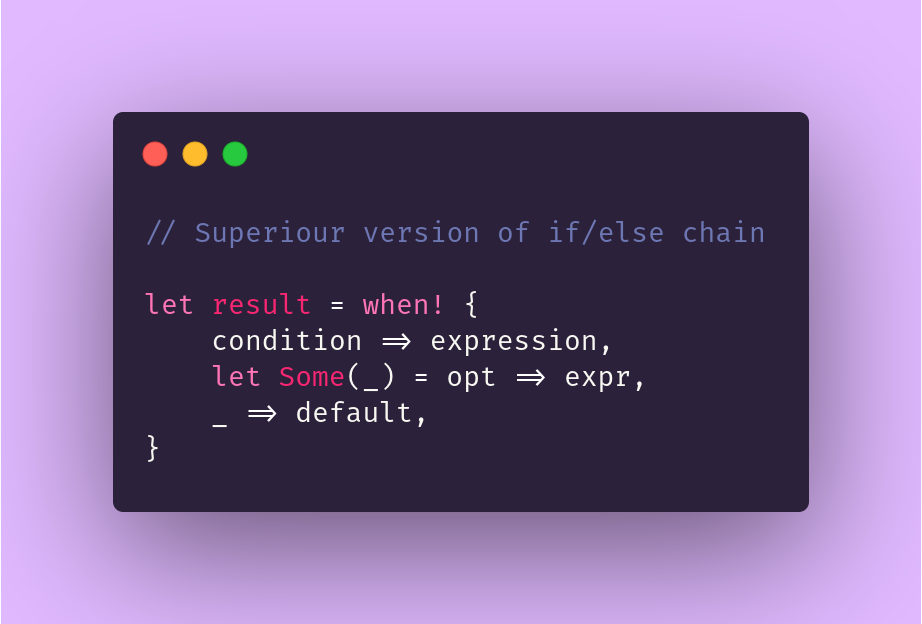
This crate introduces `when!` macro which provides better syntax for
`if`/`else if`/`else` chains. The syntax is similar to `match`.
(idea is borrowed from [kotlin][kt-when-expr])
```toml
[dependencies]
kiam = "0.1"
```
[kt-when-expr]: https://kotlinlang.org/docs/reference/control-flow.html#when-expression
## Usage
Usage is similar to the usage of `match`, but instead of patterns, branches are guarded by boolean expression:
```rust
kiam::when! {
false => (),
true => (),
// ...
}
```
`_` can be used as a default branch (it's also required to use `when!` in expression possition):
```rust
let x = kiam::when! {
false => 0,
_ => 1,
};
assert_eq!(x, 1);
```
You can also use `let <pat> =` to match a pattern, but in difference with `match` you'll have to provide an expression for every pattern:
```rust
let a = None;
let b = Some(17);
let x = kiam::when! {
let Some(x) = a => x,
let Ok(x) = fallible() => x,
let Some(x) = b => (x as u32) + 1,
_ => 1,
};
assert_eq!(x, 18);
```
Last notes:
- You can also compare structure litetals without brackets (you can't do this with `if`/`else if`/`else` chain)
- You can mixup boolean-braches with pattern matching
- Only one branch is executed (not to be confused with `switch` in C-like languages)
```rust
let mut x = 0;
kiam::when! {
let Ok(_) = Err::<(), _>(()) => x = 1,
true => x = 2,
true => x = 3,
let Some(n) = Some(42) => x = n,
};
assert_eq!(x, 2);
```
```compile_fail
#[derive(PartialEq)]
struct Struct { a: i32 }
// This does not compile because of the ambiguity
if Struct { a: 0 } == Struct { a: 0 } {
// ...
}
```
```rust
#[derive(PartialEq)]
struct Struct { a: i32 }
kiam::when! {
// This, on the other hand, compiles fine
Struct { a: 0 } == Struct { a: 0 } => {
// ...
},
}
```