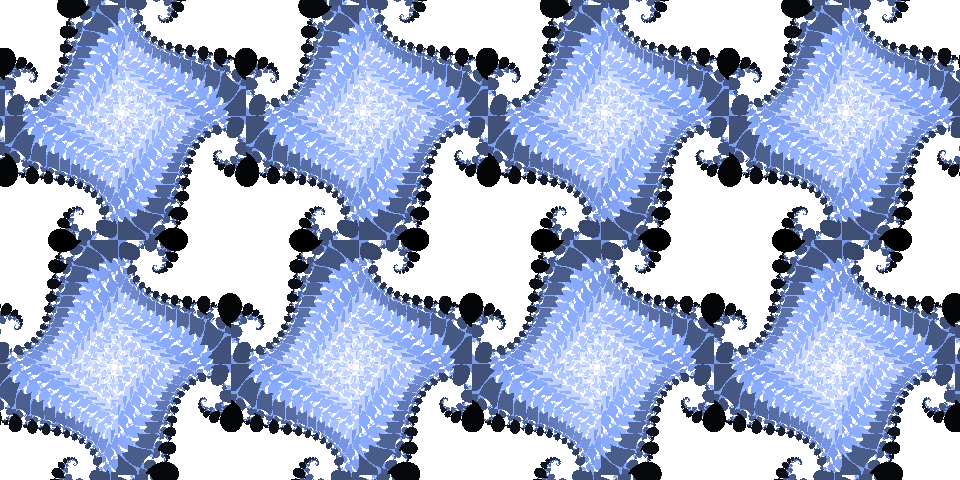
use anyhow::anyhow;
use image::{Luma, Rgb};
use structopt::StructOpt;
use std::{path::PathBuf, str::FromStr};
use julia_set::{
transform::{ApplyTransform, Negative, Palette, PixelTransform, Smoothstep},
Backend, Function, ImageBuffer, Params, Render,
};
type LumaTransform = dyn PixelTransform<Luma<u8>, Output = Luma<u8>>;
const ABOUT: &str = "CLI for rendering a Julia set to a file.";
#[derive(Debug, StructOpt)]
#[structopt(about = ABOUT)]
struct Args {
#[structopt(name = "output", long, short = "o", default_value = "image.png")]
output: PathBuf,
#[structopt(name = "backend", long, short = "b")]
backend: BackendName,
#[structopt(name = "size", long, short = "s", default_value = "640x480")]
size: Size,
#[structopt(name = "cx", long, default_value = "0")]
center_x: f32,
#[structopt(name = "cy", long, default_value = "0")]
center_y: f32,
#[structopt(name = "height", long, short = "h", default_value = "4")]
view_height: f32,
#[structopt(name = "inf", long, default_value = "3")]
infinity_distance: f32,
#[structopt(name = "iter", long, default_value = "100")]
max_iterations: u8,
#[structopt(name = "tr", long, default_value = "")]
transforms: NamedLumaTransforms,
#[structopt(name = "palette", long, short = "p")]
palette: Option<NamedPalette>,
#[structopt(name = "function")]
function: String,
}
impl Args {
fn luma_transform(&self) -> Box<LumaTransform> {
match self.transforms.0.as_slice() {
[] => Box::new(()),
[x] => x.to_pixel_transform(),
[x, rest @ ..] => rest
.iter()
.map(|y| y.to_pixel_transform())
.fold(x.to_pixel_transform(), |acc, y| Box::new((acc, y))),
}
}
fn run(self) -> anyhow::Result<()> {
println!("Running with {:?}", self);
let params = Params::new([self.size.width, self.size.height], self.view_height)
.with_view_center([self.center_x, self.center_y])
.with_infinity_distance(self.infinity_distance)
.with_max_iterations(self.max_iterations);
let function = self.function.parse()?;
let iterations = self.backend.compile_and_render(&function, ¶ms)?;
let transformed_luma = iterations.apply(self.luma_transform());
if let Some(palette) = self.palette {
transformed_luma
.apply(palette.to_palette())
.transform()
.save(&self.output)?;
} else {
transformed_luma.transform().save(&self.output)?;
}
Ok(())
}
}
#[derive(Debug)]
struct Size {
width: u32,
height: u32,
}
impl FromStr for Size {
type Err = anyhow::Error;
fn from_str(s: &str) -> anyhow::Result<Self> {
let parts: Vec<_> = s.split('x').collect();
match parts.as_slice() {
[width, height] => Ok(Self {
width: width.parse()?,
height: height.parse()?,
}),
_ => Err(anyhow!(
"Size should consist of width and height separated by `x`, e.g., `640x480`"
)),
}
}
}
#[derive(Debug, Clone, Copy)]
enum BackendName {
#[cfg(feature = "dyn_cpu_backend")]
Cpu,
#[cfg(feature = "opencl_backend")]
OpenCl,
#[cfg(feature = "vulkan_backend")]
Vulkan,
}
impl FromStr for BackendName {
type Err = anyhow::Error;
fn from_str(s: &str) -> anyhow::Result<Self> {
match s {
#[cfg(feature = "dyn_cpu_backend")]
"cpu" => Ok(Self::Cpu),
#[cfg(feature = "opencl_backend")]
"opencl" | "ocl" => Ok(Self::OpenCl),
#[cfg(feature = "vulkan_backend")]
"vulkan" => Ok(Self::Vulkan),
_ => Err(anyhow!(
"Invalid backend name. Use one of `cpu`, `opencl` or `vulkan`"
)),
}
}
}
impl BackendName {
fn compile_and_render(
self,
function: &Function,
params: &Params,
) -> anyhow::Result<ImageBuffer> {
Ok(match self {
#[cfg(feature = "dyn_cpu_backend")]
Self::Cpu => julia_set::Cpu.create_program(function)?.render(params)?,
#[cfg(feature = "opencl_backend")]
Self::OpenCl => julia_set::OpenCl
.create_program(function)
.map_err(|e| anyhow!(e))?
.render(params)
.map_err(|e| anyhow!(e))?,
#[cfg(feature = "vulkan_backend")]
Self::Vulkan => julia_set::Vulkan.create_program(function)?.render(params)?,
})
}
}
#[derive(Debug, Clone, Copy)]
enum NamedPalette {
Tree,
Gold,
Snow,
}
impl FromStr for NamedPalette {
type Err = anyhow::Error;
fn from_str(s: &str) -> anyhow::Result<Self> {
match s {
"tree" => Ok(Self::Tree),
"gold" => Ok(Self::Gold),
"snow" => Ok(Self::Snow),
_ => Err(anyhow!(
"Invalid palette. Use one of `tree`, `gold` or `snow`"
)),
}
}
}
impl NamedPalette {
fn to_palette(self) -> Palette<Rgb<u8>> {
match self {
Self::Tree => Palette::new(&[
Rgb([0, 0, 0]),
Rgb([170, 0, 0]),
Rgb([136, 204, 0]),
Rgb([170, 255, 136]),
Rgb([255, 255, 170]),
Rgb([255, 255, 255]),
]),
Self::Gold => Palette::new(&[
Rgb([0, 0, 0]),
Rgb([187, 187, 0]),
Rgb([255, 187, 0]),
Rgb([255, 255, 0]),
Rgb([255, 255, 136]),
Rgb([255, 255, 255]),
]),
Self::Snow => {
Palette::new(&[Rgb([0, 0, 0]), Rgb([136, 170, 255]), Rgb([255, 255, 255])])
}
}
}
}
#[derive(Debug, Clone, Copy)]
enum NamedLumaTransform {
Negative,
Smoothstep,
}
impl FromStr for NamedLumaTransform {
type Err = anyhow::Error;
fn from_str(s: &str) -> anyhow::Result<Self> {
match s {
"neg" | "negative" => Ok(Self::Negative),
"smooth" | "smoothstep" => Ok(Self::Smoothstep),
_ => Err(anyhow!("Invalid transform: {}", s)),
}
}
}
impl NamedLumaTransform {
fn to_pixel_transform(self) -> Box<LumaTransform> {
match self {
Self::Negative => Box::new(Negative),
Self::Smoothstep => Box::new(Smoothstep),
}
}
}
#[derive(Debug)]
struct NamedLumaTransforms(Vec<NamedLumaTransform>);
impl FromStr for NamedLumaTransforms {
type Err = anyhow::Error;
fn from_str(s: &str) -> anyhow::Result<Self> {
let trimmed = s.trim();
if trimmed.is_empty() {
Ok(Self(vec![]))
} else {
trimmed
.split(',')
.map(|part| part.trim().parse::<NamedLumaTransform>())
.collect::<anyhow::Result<Vec<_>>>()
.map(Self)
}
}
}
fn main() -> anyhow::Result<()> {
Args::from_args().run()
}