# JsonSift Documentation
This document defines the project's features, setup, and usage.
# About project
**JSON-Sift** is a parser that works with weather data of civil air flights that come from APIs in JSON format.
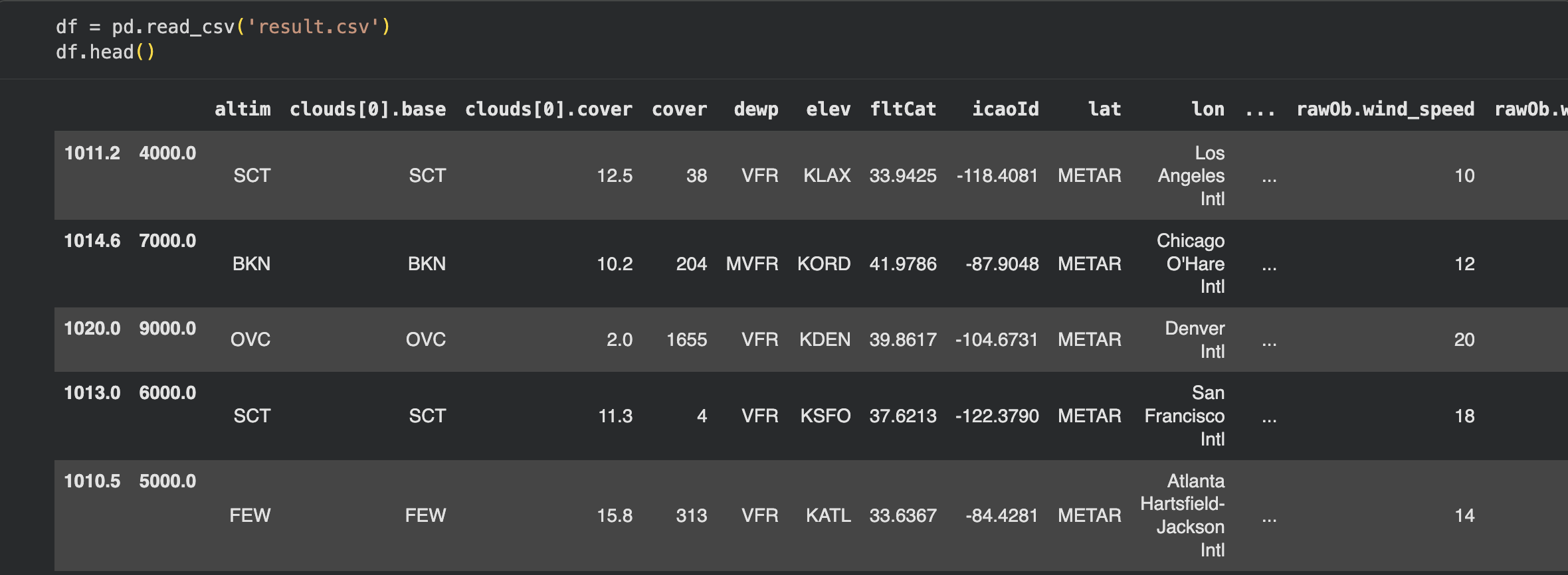
Such data contain various specific notations and a particular way of arrangement. It decrypts particular data and transforms it into a CSV format.
## Table of Contents
* [Purspose](#purpose)
* [Installation](#installation)
* [Logic](#logic)
* [Grammar](#grammar)
## Purpose
This parser is for METAR weather reports using `pest`,and helper utilities to export the parsed structure into JSON and CSV formats.
It is intended for tools and services that need reliable, machine-readable METAR data in CSV format, which is the most suitable for analysis.
## Installation
To get started, follow these instructions:
```
bash
git clone https://github.com/tsaebst/json_sift_parser_upd
cd json_sift_parser
cargo build
cargo install --path .
```
To see all commands availible in parser do:
```
jsonsift --help
```
## Logic
Detailed pipeline of my padser is divided into 2 parts: lib.rs and metar.rs for metar part.
It can be displayed as :
JSON input
* -> parse_json
* ->flatten
* -> parse_scalar
* -> Metar data:
* decode_metar -> SiftParser ->visit_metar -> SimplePattern -> apply_pattern ->normalized METAR fields
* -> not Metar:
* heuristics or token_n
* -> merge
* -> convert_to_csv
* -> CSV output
## `src/lib.rs`
My parser tries to be as flexible as possble, so I made it friendly to variations of Metar data
* `parse_json()`
Parses input string as JSON using `serde_json::from_str`
* `convert_to_csv()`
gets JSON object or array. flattens each entry, collects all keys as CSV headers, and writes rows via `csv::Writer` using sorted columns
* `flatten()`
Recursively walks though objects, arrays, scalars in json, builds indexed keys, and redirects string vals to `parse_scalar`
* `parse_scalar()`
Normalizes str, tries to decode it as METAR via `metar::decode_metar`. if not - tokenizes and uses simple metar patterns or creates `token_n` columns
---
## `src/metar.rs`
* `SiftParser`
Pest-generated parser using `grammar.pest` rules for METAR reports.
* `decode_metar()`
Parses a full METAR string with `SiftParser`, walks through parse tree, and returns a flat map of normalized METAR fields/`None`
* `visit_metar()`
visits Pest parse pairs, matches basic rules, and fills the output map by using `apply_pattern` where possible
* `complex_key_value()`
Splits a random string into tokens by whitespace and basic separators before pattern detection
* `is_code_like_token()` / `all_tokens_code_like()`
Detects whether tokens look like uppercase/number codes to decide if there's a pattern
* `SimplePattern`
Enum for recognized token types `TempDew`, `Wind`, `Pressure`, `Time`, `Visibility`, `Cloud`, `FlightCategory`.
* `holds_pattern_value()`
Classifies a single token into one of the `SimplePattern` variants
* `apply_pattern()`
Expands a recognized pattern token into one or more well-named columns
* `norm()`
Normalizes raw text
---
## Grammar
Parser uses grammar down below for METAR-like data:
```
WHITESPACE = _{ " " | "\t" | "\r" | "\n" }
ASCII_UPPER_ALPHA = _{ 'A'..'Z' }
metar_report = { SOI ~ token* ~ EOI }
time = { ASCII_DIGIT{6} ~ "Z" }
station = { SOI ~ ASCII_UPPER_ALPHA{4} ~ EOI }
wind_dir= {ASCII_DIGIT{3}} // 3 digits
wind_speed= { ASCII_DIGIT{2,3} } // 2 or 3 digits
wind_gust = {"G"~ASCII_DIGIT{2,3} } // optional G+num
wind_units= {"KT" | "MPS"}
wind = {wind_dir~wind_speed ~ wind_gust?~wind_units}//? baceuse might be absent
visibility = {(ASCII_ALPHA)?~ // one upperc prefix char
//num + "" + num + "/" + num; num + "/" + num; or num
((ASCII_DIGIT+ ~ " " ~ ASCII_DIGIT+ ~ "/" ~ ASCII_DIGIT+) | (ASCII_DIGIT+ ~ "/" ~ ASCII_DIGIT+)
| (ASCII_DIGIT+)) ~ "SM" // num + somethin
}
cloud_cover = { "FEW" | "SCT" | "BKN" | "OVC" }
cloud_alt = { ASCII_DIGIT{3} } //altitude
temp = { "M"? ~ ASCII_DIGIT{2} }
dew = { "M"? ~ ASCII_DIGIT{2} }
temp_dew = { temp ~ "/" ~ dew }
pressure = { "A" ~ ASCII_DIGIT{4} }
remarks = { "RMK" ~ (!NEWLINE ~ ANY)* }
known_keyword = {"COR" | "AUTO" | "AMD" | "TEMPO" | "NOSIG" }
uppercase_token = @{ ASCII_UPPER_ALPHA{2,} }
separator = _{ WHITESPACE+ }
```