# ilmari
[](https://crates.io/crates/ilmari)
[](https://github.com/bnomei/ilmari/actions/workflows/ci.yml)
[](https://crates.io/crates/ilmari)
[](https://crates.io/crates/ilmari)
[](https://discordapp.com/users/bnomei)
[](https://www.buymeacoffee.com/bnomei)
Ilmari is a tmux popup radar for coding-agent panes.
It scans the tmux panes you already have running, detects supported agent CLIs,
groups panes by workspace, shows each pane's state and recent output, and jumps
you back to the selected pane. It is observer-only: it does not launch agents,
manage workflows, or own your tmux layout.
[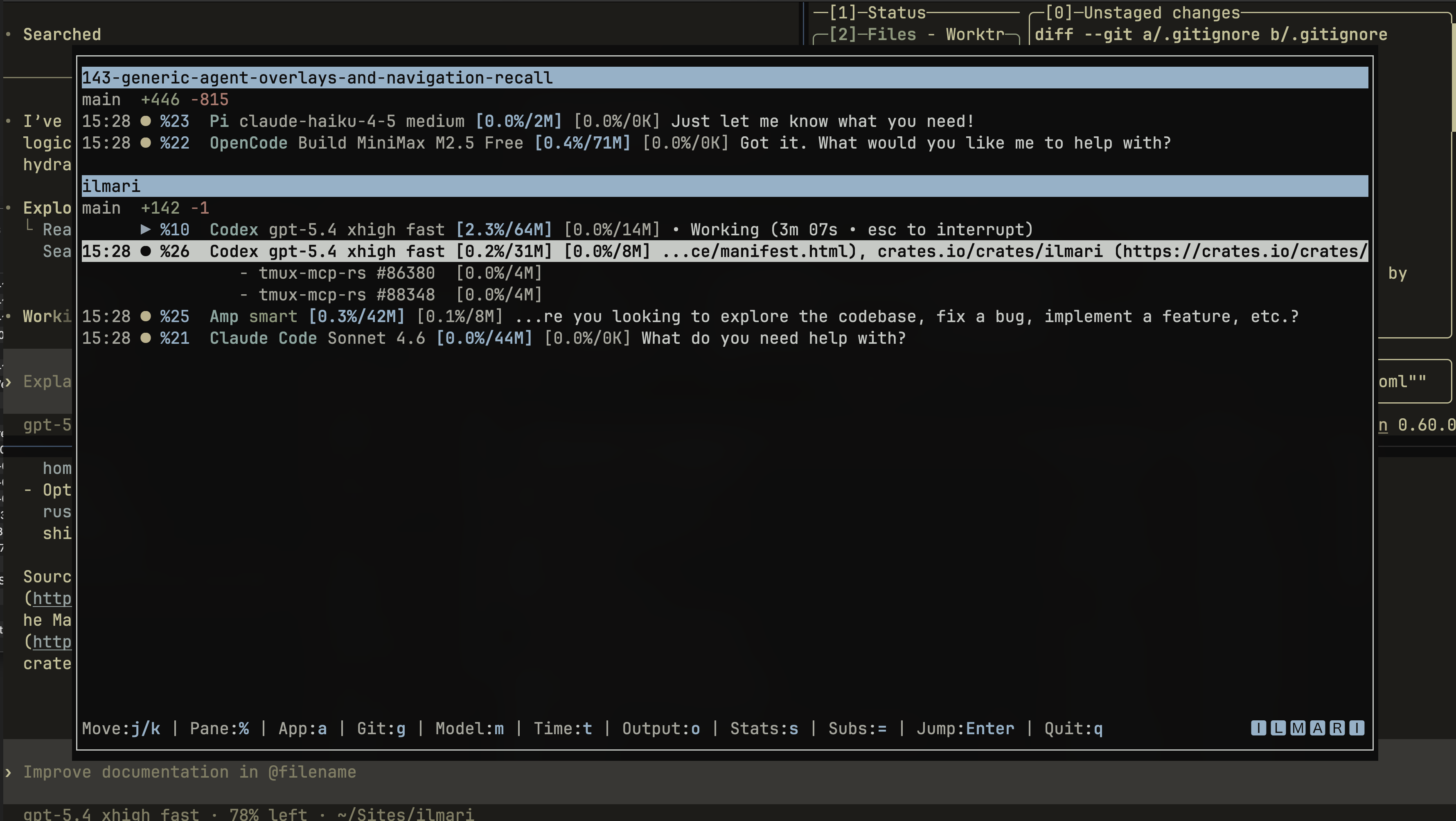](https://raw.githubusercontent.com/bnomei/ilmari/main/screenshot.png)
[](https://raw.githubusercontent.com/bnomei/ilmari/main/screenshot-2.png)
## What it helps you answer
Use Ilmari when one tmux workspace has several agent sessions and you need to
answer these questions quickly:
- Which agent pane is still running?
- Which pane is waiting for input?
- Which workspace does that pane belong to?
- What did the pane print most recently?
- How do I jump back to it without cycling through panes manually?
Ilmari can also run one provider-neutral collector daemon per tmux server. The
daemon accelerates popup refreshes, publishes optional tmux badge/status
fragments, and serves the same read-only pane state through a local Unix JSON
socket or loopback MCP resource server.
## Supported agents
Ilmari enables detection for these agent CLIs:
The table lists the canonical commands. Some adapters also recognize wrapped,
remote, or title-based executions when tmux metadata, the process tree, or pane
output identifies an enabled agent.
| Antigravity CLI | `agy` |
| Gemini CLI | `gemini` |
| Codex | `codex` |
| Amp | `amp` |
| Claude Code | `claude` |
| OpenCode | `opencode` |
| Pi | `pi`, `pi-agent` |
| Auggie | `auggie` |
| Grok | `grok` |
| GitHub Copilot CLI | `copilot` |
| Kiro CLI | `kiro-cli` |
Tracked but disabled agent adapters:
| Cursor CLI | [#11](https://github.com/bnomei/ilmari/issues/11) |
| Aider | [#12](https://github.com/bnomei/ilmari/issues/12) |
| Cline CLI | [#13](https://github.com/bnomei/ilmari/issues/13) |
| Goose CLI | [#14](https://github.com/bnomei/ilmari/issues/14) |
| OpenHands CLI | [#16](https://github.com/bnomei/ilmari/issues/16) |
## Platform support
Ilmari targets Unix-like tmux environments. Published release artifacts are
Linux and macOS binaries, and runtime usage assumes a Unix-like shell with
`tmux` available. Windows is currently out of scope because Windows tmux
behavior is not implemented or tested.
tmux popup usage requires tmux 3.2 or newer. Cargo builds require Rust 1.88.0
or newer.
## Quickstart
### Prerequisites
- `tmux` is installed and running.
- tmux is version 3.2 or newer if you want popup mode.
- At least one supported agent CLI is already running in a tmux pane.
### 1. Install Ilmari
```bash
cargo install ilmari
```
Verify the binary is on your `PATH`:
```bash
ilmari --version
```
Expected output:
```text
ilmari <version>
```
### 2. Connect Ilmari to tmux
#### TPM plugin (recommended)
Use [TPM (Tmux Plugin Manager)](https://github.com/tmux-plugins/tpm) when you
want the normal Ilmari experience: a popup key, a per-server collector daemon,
and cleanup when that daemon is stopped. TPM is tmux integration, not the
Ilmari installation. Install the `ilmari` binary first, and make it available
to the tmux server's `PATH`.
1. Add this line before TPM's `run ... tpm` line in `~/.tmux.conf`:
```tmux
set -g @plugin 'bnomei/ilmari'
```
2. Reload the tmux configuration:
```bash
tmux source-file ~/.tmux.conf
```
3. Press `prefix + I` so TPM fetches the plugin, then reload the configuration
once more.
With no `@ilmari_*` configuration, the plugin:
- binds `prefix + i` to open the Ilmari popup;
- starts one daemon for the tmux server that loaded the plugin;
- lets the popup use that daemon's fresh snapshot before falling back to a
direct tmux scan; and
- publishes empty-safe badge and summary fragments for you to place in your
own theme.
Run this from a pane in that tmux server to verify the default daemon started:
```bash
ilmari daemon status
```
Expected output:
```text
running
```
The plugin pins every lifecycle action to the tmux server that loaded it. A
reload does not start a duplicate healthy daemon.
#### TPM options (optional)
Configure these options before TPM initializes its plugins. You do not need to
set any of them for the defaults above.
| `@ilmari_key` | `i` | Prefix-table popup key. |
| `@ilmari_command` | `ilmari` | Command executed inside the popup. |
| `@ilmari_popup_width` | `90%` | Popup width. |
| `@ilmari_popup_height` | `85%` | Popup height. |
| `@ilmari_popup_extra` | empty | Additional whitespace-separated `display-popup` arguments. |
| `@ilmari_bind_key` | `on` | Whether the plugin installs the popup binding. |
| `@ilmari_daemon` | `on` | Whether this tmux server should run an Ilmari daemon. |
| `@ilmari_daemon_command` | `ilmari daemon start` | Foreground daemon command that the plugin starts in the background. |
| `@ilmari_daemon_stop_command` | `ilmari daemon stop` | Command used to stop the daemon when daemon management is disabled. Set it explicitly whenever the start command is customized. |
If tmux cannot find the binary even though your interactive shell can, configure
the popup and daemon commands as one matching absolute-path pair:
```tmux
set -g @ilmari_command '/absolute/path/to/ilmari'
set -g @ilmari_daemon_command '/absolute/path/to/ilmari daemon start'
set -g @ilmari_daemon_stop_command '/absolute/path/to/ilmari daemon stop'
```
Set `@ilmari_bind_key` to `off` when you want TPM to manage the daemon but use a
different popup binding. Set `@ilmari_daemon` to `off` to stop the daemon for
that tmux server and clear Ilmari's published pane and global state.
The start and stop options are an explicit pair of shell commands; the plugin
does not try to derive one from the other. If the start command uses an absolute
path, wrapper, or additional arguments, configure a matching stop command too.
Both commands receive the same originating `TMUX` context, including custom
socket paths that contain commas.
#### Manual popup binding (without TPM)
Use this alternative when you do not use TPM, or when `@ilmari_bind_key` is set
to `off` and you want a custom key or popup shape. It opens the interactive
radar but does not start the daemon for you:
```tmux
bind-key i display-popup -E -w 90% -h 85% "ilmari"
```
If you want daemon-backed refreshes and published tmux fragments without TPM,
run this foreground collector from that tmux server in a dedicated pane or under
your service manager:
```bash
ilmari daemon start
```
Reload tmux after changing the binding:
```bash
tmux source-file ~/.tmux.conf
```
### 3. Open the radar
Press your tmux prefix, then `i`.
Typical flow:
1. Open `ilmari`.
2. Move the selection with `j` / `k` or the arrow keys.
3. Press `Enter` to jump to the selected pane.
4. Press `q`, `Esc`, or `Ctrl-C` to quit.
When Ilmari runs in a tmux popup, activating a pane returns you to that pane and
closes the popup. When it runs directly in a pane, activation switches to the
target pane and Ilmari keeps running.
## Installation
### Cargo
```bash
cargo install ilmari
```
### Cargo binstall
Download the matching prebuilt release binary instead of compiling it locally:
```bash
cargo binstall ilmari
```
### npm / npx
The npm package is a small launcher: on its first run it downloads the matching
verified GitHub Release binary into a local cache, then forwards Ilmari's
arguments. Node.js 18 or newer is required.
```bash
npx @bnomei/ilmari --version
```
It supports macOS (Intel and Apple Silicon) and Linux (x86_64 and ARM64 musl)
only. Windows is intentionally unsupported because Ilmari requires a Unix-like
tmux environment. Set `ILMARI_NPM_CACHE` to choose a different binary cache
location.
### Homebrew
```bash
brew install bnomei/ilmari/ilmari
```
### GitHub Releases
Download a prebuilt Linux or macOS archive from
[GitHub Releases](https://github.com/bnomei/ilmari/releases), extract it, and
put `ilmari` on your `PATH`.
Windows archives are not published because Windows runtime behavior is not
supported.
### From source
```bash
git clone https://github.com/bnomei/ilmari.git
cd ilmari
cargo build --release
```
Verify the build:
```bash
target/release/ilmari --help
```
## Popup controls
| `j`, `Down` | Move to the next visible pane. |
| `k`, `Up` | Move to the previous visible pane. |
| `%`, then digits | Select a pane by tmux pane id. |
| `Enter` | Jump to the selected pane. |
| `q`, `Esc`, `Ctrl-C` | Quit. |
| `a` | Toggle the agent/app column. |
| `m` | Toggle the model/detail column. |
| `n` | Toggle the sticky attention column. |
| `t` | Toggle inactive time. |
| `o` | Toggle recent output excerpts. |
| `g` | Toggle git summaries. |
| `s` | Toggle CPU and memory stats. |
| `R` | Clear remembered views and restore explicit TOML values or built-ins. |
| `=` | Expand or collapse subprocess stats for the selected pane. |
| `b` | Toggle terminal bell alerts. |
Ilmari sorts panes by workspace. Inside each workspace, running panes appear
first, waiting panes appear next, and finished, terminated, or unknown panes
follow. The most recent waiting pane is selected automatically when possible.
## What the radar shows
| Workspace | Derived from each pane's current path. |
| Status | `running`, `waiting-input`, `finished`, `terminated`, or `unknown`. |
| Attention | The shared attention icon (default `?`) only for an unacknowledged sticky attention latch; blank otherwise. |
| Pane id | Stable tmux pane id such as `%12`. |
| Agent | Detected agent kind, such as `Codex` or `Claude Code`. |
| Detail | Agent-specific model or mode label when the adapter can extract one. |
| Output | Recent, sanitized pane output excerpt when output-tail capture is enabled. |
| Git | Branch plus insertion/deletion summary for the workspace repository. |
| Stats | Agent and spawned subprocess CPU/memory samples when stats are visible. |
Terminal bell alerts fire when a pane transitions into a waiting-input or
finished state from a running, unknown, or retained terminated state. Use `b` or
`--no-bell` to disable them for the current run.
Ilmari applies the same detection and state model to every enabled agent adapter.
A window containing several supported agent panes can therefore display several
badges; there are no Codex-specific lifecycle hooks.
## Daemon and popup fallback
TPM starts the daemon by default, or you can manage it directly:
```bash
ilmari daemon start
ilmari daemon status
ilmari daemon stop
ilmari status
```
`daemon start` is a foreground headless collector with its Unix socket enabled;
service managers may supervise it directly. It is singleton-safe for the
originating tmux server/socket. `daemon stop` requests a clean shutdown, and
`daemon status` reports whether a compatible daemon is available. Signals and
stop requests clear published options while that tmux server still exists. A
daemon also exits after repeated proof that its target tmux server has gone.
On every refresh, the popup prefers one compatible full daemon snapshot that is
still within its advertised TTL. If the daemon is unavailable or its reply is
stale, malformed, or from an incompatible schema, the popup retries the existing
direct tmux scan and will try the daemon again later. If both sources fail after
a successful refresh, the last good rows stay visible with a warning instead of
being replaced by an empty display.
`ilmari status` prints the compact nonzero attention and lifecycle summary used by
command-based tmux status and menu helpers. It exits successfully without output
when the renderer is disabled or no daemon state is available.
## Put Ilmari UI in your tmux theme
The default TPM setup starts the daemon and makes two format fragments
available, but it does not edit your tmux theme. Add the fragments after your
theme's own `window-status-*` and `status-*` settings. They are empty until a
daemon has published state, so leaving the placement in your configuration is
safe when no agents are running.
### Add badges to window tabs
Append the window fragment to both ordinary and selected window formats:
```tmux
set -ag window-status-format ' #{E:@ilmari_window_badges}'
set -ag window-status-current-format ' #{E:@ilmari_window_badges}'
```
`-a` preserves the format your theme already set. The one literal space before
`#{E:...}` is theme-owned separation; remove or change it if your existing
format already supplies spacing. `#{E:...}` expands the daemon-published
fragment as tmux format text. Set both options because tmux can use a different
format for the selected window.
`@ilmari_window_badges` can render more than one badge when a window contains
multiple agent panes. It preserves the enclosing tmux style for each badge, so
selected-window backgrounds remain continuous.
### Add the global summary to the status line
Choose one side of your status line and append the summary there. This example
uses the right side:
```tmux
set -ag status-right ' #{E:@ilmari_status_summary}'
```
Use `status-left` instead when that is where your theme keeps global indicators.
Do not set both unless you intentionally want the same summary twice. The
summary uses the same configured glyphs as the popup and shows only nonzero
counts: sticky attention first, then ordinary waiting, finished, running,
terminated, and unknown states.
### Control what is shown
Window badges include agent names only while the popup app column is enabled.
The built-in default is icon-only badges because `view.app` defaults to `false`.
Set `view.app = true` in Ilmari's TOML configuration, or press `a` in the
popup. With `view.remember = true` (the default), that popup choice is used by
the daemon on a later refresh.
Use these server-local tmux options to hide a placement without stopping the
daemon or removing your theme configuration:
```tmux
set -g @ilmari_badges_enabled 'off'
set -g @ilmari_status_enabled 'off'
```
A disabled renderer publishes an empty fragment; collection, snapshots, and
popup acceleration continue. Turn either option back to `on` to show it again.
### Published fragment and counter reference
`@ilmari_status_summary` is the recommended global fragment. For a custom tmux
format or menu helper, notification totals remain available as
`@ilmari_waiting_count` and `@ilmari_finished_count`, while
`@ilmari_running_count` is the live running count and
`@ilmari_attention_count` is the combined sticky total. Ordinary counts are
published separately as `@ilmari_waiting_state_count`,
`@ilmari_finished_state_count`, `@ilmari_terminated_count`, and
`@ilmari_unknown_count`, so no pane is counted in both attention and an
ordinary state. Pane-local `@ilmari_state` and `@ilmari_badge` are available to
advanced custom formats. Pane-local `@ilmari_attention` is `0` or `1` and
carries the sticky attention latch across a popup's failed daemon snapshot
followed by a direct scan; it is cleared with the other pane options when state
is cleaned up or when the focused pane acknowledges attention.
Running state is live. Waiting-input and finished attention is sticky only after
a qualifying transition occurs while that exact pane is not focused by any tmux
client. Focusing the pane acknowledges it. An unchanged later scan does not
recreate attention, but a later qualifying transition can. State for disappeared
panes is removed.
Before uninstalling the TPM plugin, either set `@ilmari_daemon off` and reload
tmux or run `ilmari daemon stop` from that tmux server. This stops its daemon and
clears Ilmari's published fragments, counts, pane state, socket path, and MCP URL.
Then remove the `@plugin` line and uninstall through TPM.
## Configuration
No configuration file is required. When present, Ilmari reads
`$XDG_CONFIG_HOME/ilmari/config.toml`, falling back to
`~/.config/ilmari/config.toml`. Malformed TOML, an unknown table/field, or an
invalid typed value produces a clear startup error rather than being silently
ignored.
This complete example also shows the built-in defaults:
```toml
[runtime]
refresh_seconds = 5
process_refresh_seconds = 15
[scanner]
git = true
output_tail = true
[tui]
enabled = true
bell = true
[palette]
# colors = "fg,bg,black,red,green,yellow,blue,magenta,cyan,white,bright_black,bright_red,bright_green,bright_yellow,bright_blue,bright_magenta,bright_cyan,bright_white"
[socket]
enabled = false
# path = "/home/me/.local/run/ilmari.sock"
[mcp]
enabled = false
port = 62778
[view]
app = false
attention = true
git = true
detail = false
time = true
output = true
stats = false
remember = true
[badges]
enabled = true
separator = " "
[status]
enabled = true
separator = " "
[states.running]
icon = "▶"
color = "palette:blue"
[states.waiting_input]
icon = "●"
color = "palette:yellow"
[states.finished]
icon = "●"
color = "palette:yellow"
[states.terminated]
icon = "✖"
color = "palette:red"
[states.unknown]
icon = "?"
color = "palette:bright_black"
[states.attention]
icon = "?"
color = "palette:yellow"
```
`[states]` is the shared presentation source for popup rows, window badges, and
the global tmux summary. The ordinary states default to blue `▶` for running,
yellow `●` for waiting and finished, red `✖` for terminated, and a bright-black
`?` for unknown. `attention` is separate: it is the yellow `?` used by sticky
tmux badges for panes that need focus. Attention takes precedence over a
waiting or finished pane's ordinary glyph until that pane is focused or leaves
that state. When any
`[states.*]` subtable is present, it wins over legacy nested renderer formats.
Every state has a plain `icon` and a validated `color`; colors accept
`palette:<slot>` for any of Ilmari's sixteen palette slots, `ansi:<name-or-index>`
(or a bare ANSI name/index), `#RRGGBB`, or `default`. Palette references use the
active popup palette's resolved color in both the popup and tmux. Icons must be
exactly one Unicode scalar with terminal display width one, and reject tmux
format/control delimiters. Colors are rendered from typed values rather than
inserted as raw tmux style strings.
`[badges]` and `[status]` continue to own only their enable flags and
separators. Existing legacy nested templates remain supported when `[states]`
is absent and at least one legacy state field is explicitly set:
```toml
[badges.running]
symbol = "run"
style = "fg=cyan"
[status.finished]
symbol = "done"
style = "fg=green"
```
`tui.enabled` defaults to `true` when the binary includes the `tui` feature and
to `false` otherwise. Omitting `[palette].colors` uses the terminal ANSI/reset palette. A socket path
implies `socket.enabled = true` unless explicitly disabled; specifying an MCP
port likewise implies `mcp.enabled = true` unless explicitly disabled. Use port
`0` for an OS-assigned free port.
Command-line flags override TOML for one run:
| `--refresh-seconds <SECONDS>` | Main tmux scan cadence. Positive integer seconds. |
| `--process-refresh-seconds <SECONDS>` | CPU and memory sampling cadence. Positive integer seconds. |
| `--palette <CSV>` | 18-slot terminal palette override. |
| `--no-tui` | Run without the terminal UI. Use with `--socket` or `--mcp` for headless publishing. |
| `--no-git` | Start with git summaries hidden. |
| `--no-output-tail` | Disable `tmux capture-pane` output tails. |
| `--no-bell` | Disable terminal bell alerts. |
| `--socket` / `--no-socket` | Enable or disable local JSON socket publishing. |
| `--socket-path <PATH>` | Override the local JSON socket path; implies `--socket` unless `--no-socket` is also supplied. |
| `--mcp` / `--no-mcp` | Enable or disable the loopback MCP resource server. |
| `--mcp-port <PORT>` | Override the MCP loopback port; implies `--mcp` unless `--no-mcp` is also supplied. |
| `-h`, `--help` | Print help. |
| `-V`, `--version` | Print version. |
The non-secret `ILMARI_*` settings used by older releases are no longer read.
Standard discovery variables remain in use: `TMUX` and `TMUX_PANE` identify the
active tmux context, `XDG_CONFIG_HOME`, `XDG_STATE_HOME`, and `XDG_RUNTIME_DIR`
select standard storage locations, and normal home/user/runtime-directory lookup
supplies fallbacks.
### Remembered views
With `view.remember = true` (the default), toggling app, attention, git, detail,
time, output, or stats writes only those seven booleans to a versioned JSON file at
`$XDG_STATE_HOME/ilmari/view.json`, falling back to
`~/.local/state/ilmari/view.json`. The replacement is atomic and private on
Unix. Pane output text, bell state, selection, subprocess expansion, and agent
state are never saved.
Each field resolves independently: a CLI override wins when one exists, then an
explicit TOML value, then the remembered value, then the built-in default.
Configured and remembered choices remain pinned instead of being changed by
responsive layout defaults. Press uppercase `R` to clear remembered state and
restore explicit TOML choices or built-ins. A corrupt state file is left in
place, ignored, and reported as a visible warning.
### Palette format
`--palette` and `[palette].colors` accept an 18-slot CSV palette in this order:
```text
fg,bg,black,red,green,yellow,blue,magenta,cyan,white,bright_black,bright_red,bright_green,bright_yellow,bright_blue,bright_magenta,bright_cyan,bright_white
```
Accepted color formats:
- `#RRGGBB`
- `0xRRGGBB`
- `0XRRGGBB`
- `RRGGBB`
- `rgb:RR/GG/BB`
- `rgb:RRRR/GGGG/BBBB`
Malformed palette values produce a clear configuration or argument error.
## Build-time features
The default Cargo build includes the TUI and both publishing endpoints:
```bash
cargo build
```
You can remove features when building:
```bash
cargo build --no-default-features
cargo build --no-default-features --features tui
cargo build --no-default-features --features socket
cargo build --no-default-features --features mcp
cargo build --no-default-features --features rmcp
cargo build --no-default-features --features socket,mcp
cargo build --no-default-features --features tui,socket,mcp
```
| `tui` | Builds the terminal UI and pulls in `ratatui` and `crossterm`. |
| `socket` | Builds the local Unix JSON socket endpoint. |
| `mcp` | Builds the loopback MCP resource endpoint and pulls in `rmcp`, `axum`, `tokio`, and `tokio-util`. |
| `rmcp` | Alias for `mcp`, for builds that name the backing crate explicitly. |
Runtime flags remain parseable when an endpoint is compiled out. Enabling a
compiled-out endpoint reports a status warning such as `socket support was not
compiled in` or `MCP support was not compiled in`. Builds without feature `tui`
run in headless mode.
## Local JSON socket
Enable the socket:
```bash
ilmari --socket
```
Run it without the TUI:
```bash
ilmari --no-tui --socket
```
The socket is a local Unix-domain socket, not a network listener. By default,
Ilmari puts it under `$XDG_RUNTIME_DIR` when that variable is set, otherwise
under `/tmp/ilmari-<user>/<tmux-hash>/ilmari.sock`. When Ilmari owns the
socket, it publishes the active path to the tmux global option
`@ilmari_socket_path`:
```bash
tmux show-option -gqv @ilmari_socket_path
```
If another live Ilmari process already owns the configured socket path, the
later process keeps running without taking over that endpoint.
The socket accepts one line command per request and returns one JSON object:
```text
ping
list
ls
snapshot
detail 12
detail %12
detail tmux:%12
detail ilmari://1/7/12
read ilmari://1/7/12
```
`detail` accepts bare pane numbers, tmux pane ids, `tmux:%12` ids, and Ilmari
resource URIs. `read` accepts Ilmari resource URIs. Responses use canonical tmux
pane ids such as `%12`.
`snapshot` is an additive, render-neutral full-state response for one refresh.
Its versioned JSON includes the enabled sessions, pane/session/window identity,
agent status and detail, output excerpt, process usage, workspace and git facts,
activity timestamps, warnings, revision, observation time, and TTL. Consumers
should reject incompatible versions and stale observations. The existing `ping`,
`list`/`ls`, `detail`, and `read` request/response contracts remain available.
`list` returns a compact action queue for consumers. Each item includes the pane
id, resource URI, consumer state, agent slug, workspace path, and a suggested
next action:
```json
{
"ok": true,
"type": "list",
"schema_version": 1,
"resource": "ilmari://list",
"items": [
{
"resource": "ilmari://1/7/12",
"id": "%12",
"state": "needs-input",
"agent": "codex",
"cwd": "/workspace/ilmari",
"next": {
"intent": "inspect",
"kind": "tmux",
"argv": ["tmux", "-S", "/path/to/tmux.sock", "capture-pane", "-p", "-J", "-t", "%12", "-S", "-80"]
}
}
],
"warnings": []
}
```
State mapping:
| `running` | `running` | `wait` |
| `waiting-input` | `needs-input` | `inspect` |
| `finished` | `done` | `result` |
| `terminated` | `gone` | `cleanup` |
| `unknown` | `unknown` | `inspect` |
## MCP resources
Enable the MCP server:
```bash
ilmari --no-tui --mcp
```
By default, Ilmari starts a local-only Streamable HTTP MCP server at
`http://127.0.0.1:62778/mcp`. Use `[mcp].port` or `--mcp-port <PORT>` to select
another port, or use port `0` for an OS-assigned free port.
When the server starts, Ilmari publishes the active URL to the tmux global
option `@ilmari_mcp_url`:
```bash
tmux show-option -gqv @ilmari_mcp_url
```
The MCP server exposes resources only. It does not expose tools.
| `ilmari://list` | Same JSON as socket `list`. |
| `ilmari://<session>/<window>/<pane>` | Same JSON as socket `detail`, using sigil-free tmux ids such as `ilmari://1/7/12`. |
Resource descriptors are plain for client compatibility. Resource contents carry
read-only metadata. Resource subscriptions are supported:
- Subscribers to a pane URI receive `notifications/resources/updated` when that
pane resource changes.
- Subscribers to `ilmari://list` receive `notifications/resources/updated` when
the list JSON changes.
- Subscribers to `ilmari://list` receive `notifications/resources/list_changed`
when the visible resource set changes.
## Pane output privacy
By default, Ilmari captures recent output from supported agent panes with
`tmux capture-pane` so it can classify waiting states and show output excerpts.
Pane buffer text can contain prompts, command output, file paths, tokens, or
other sensitive information.
Disable output-tail capture when you do not want Ilmari to read pane contents:
Set `scanner.output_tail = false` in `config.toml`, or disable capture for one
run:
```bash
ilmari --no-output-tail
```
Disabling output tails can reduce classification quality for adapters that need
recent terminal text.
The JSON socket is local-only and the default managed socket directories are
created as private user-owned directories. The MCP server binds to loopback only.
Both endpoints still expose pane state to local clients that can reach the
configured socket path or loopback port.
## Troubleshooting
### `no supported agent sessions detected`
Cause: tmux has no visible panes matching enabled agent adapters, or output-tail
capture is disabled for an adapter that needs recent terminal text.
Fix:
1. Start one of the supported agent CLIs in a tmux pane.
2. Run `ilmari` from inside tmux.
3. Re-enable output-tail capture if you disabled it.
### The popup does not open
Cause: tmux popup support needs tmux 3.2 or newer, or the binding is not loaded.
Fix:
1. Check the tmux version:
```bash
tmux -V
```
2. Reload your tmux config:
```bash
tmux source-file ~/.tmux.conf
```
3. Confirm `ilmari` is on the `PATH` visible to tmux.
### Headless mode appears to do nothing
Cause: `--no-tui` disables the terminal UI. Without `--socket` or `--mcp`, there
is no consumer-facing endpoint.
Fix:
```bash
ilmari --no-tui --socket
ilmari --no-tui --mcp
```
### `socket support was not compiled in`
Cause: the binary was built without the `socket` feature.
Fix:
```bash
cargo build --features socket
```
### `MCP support was not compiled in`
Cause: the binary was built without the `mcp` feature.
Fix:
```bash
cargo build --features mcp
```
### `refusing to use socket directory`
Cause: the configured socket parent directory is not private, is not owned by
the current user, or is not a directory.
Fix: choose a private socket path or update the directory ownership and
permissions before starting Ilmari.
## Development
Run the same checks as CI:
```bash
cargo fmt --all -- --check
cargo clippy --all-targets --all-features -- -D warnings
cargo test --all-targets
```
For endpoint feature coverage, also run:
```bash
cargo test --all-features
```
Source map:
| CLI flags and help text | [`src/cli.rs`](src/cli.rs) |
| Runtime config, refresh loop, key handling | [`src/app.rs`](src/app.rs) |
| Agent support and classification | [`src/agents/mod.rs`](src/agents/mod.rs), [`src/agents/adapters`](src/agents/adapters) |
| Shared status and view model types | [`src/model.rs`](src/model.rs) |
| tmux snapshot, output capture, and pane jumps | [`src/tmux.rs`](src/tmux.rs) |
| Unix JSON socket and published JSON shapes | [`src/ipc.rs`](src/ipc.rs) |
| MCP resource server | [`src/mcp.rs`](src/mcp.rs) |
| Terminal rendering and footer controls | [`src/ui.rs`](src/ui.rs) |
| Palette parsing | [`src/colors.rs`](src/colors.rs) |
## License
MIT. See [`LICENSE`](LICENSE).

