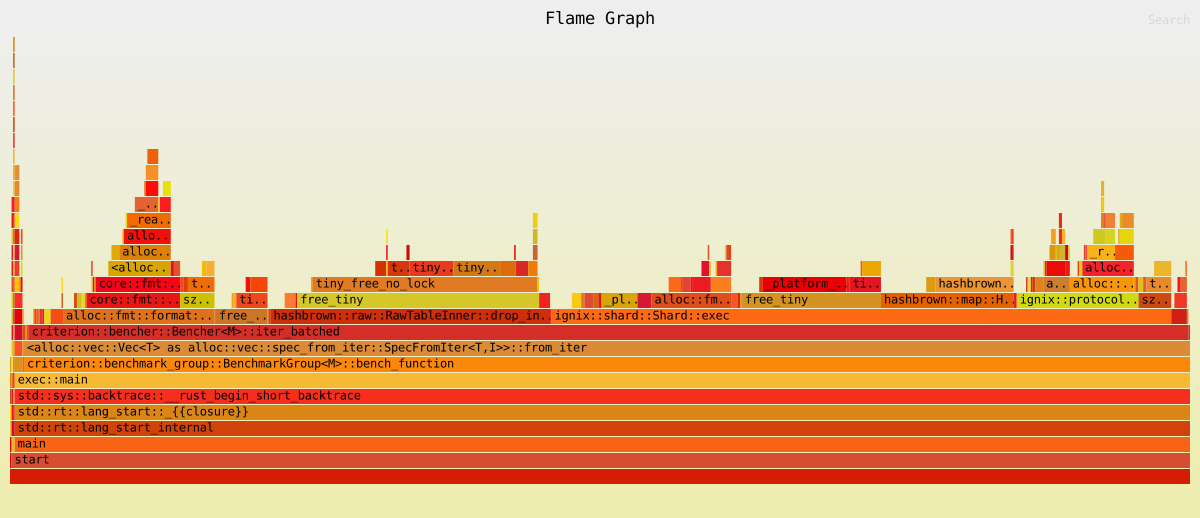
# 🔥 Ignix
**High-Performance Redis-Compatible Key-Value Store**
Ignix (from "Ignite" + "Index") is a blazing-fast, Redis-protocol compatible key-value store designed for modern multi-core systems. Built with Rust for maximum performance and safety.
[](https://www.rust-lang.org)
[](./LICENSE)
## ✨ Features
- 🚀 **High Performance**: Rust + reactor/worker model for parallel execution
- 🔌 **Redis Protocol Compatible**: Drop-in replacement for Redis clients
- 🧵 **Async I/O (mio)**: Non-blocking reactor + `mio::Waker` response path
- 💾 **AOF Persistence**: Background writer with bounded backpressure
- 🧠 **Concurrent Storage**: `DashMap` (sharded locking) in hot path
- 📊 **Benchmarks Included**: Scripts and criterion benches
## 🏗️ Architecture
Ignix v0.3.0 architecture:
- **Multi-Reactor (Thread-per-Core)**: Uses `SO_REUSEPORT` to spawn N independent worker threads (one per CPU core).
- **Shared Nothing**: Each thread has its own event loop (`mio::Poll`) and handles connections independently.
- **Zero-Lock Networking**: No shared listener lock; kernel distributes incoming connections.
- **RESP Protocol**: Full Redis Serialization Protocol support with optimized SWAR parsing.
- **Concurrent Storage**: `DashMap<Bytes, Value>` (sharded locking) for high-concurrency data access.
- **AOF Persistence**: Dedicated thread, bounded channel, periodic fsync.
## 🚀 Quick Start
### Prerequisites
- Rust 1.80+ (recommended: latest stable)
- Cargo package manager
### Installation
```bash
git clone https://github.com/CycleChain/ignix.git
cd ignix
cargo build --release
```
### Running the Server
```bash
cargo run --release
```
The server will start on `0.0.0.0:7379` by default.
### Testing with Client Example
```bash
# In another terminal
cargo run --example client
```
Expected output:
```
+OK
$5
world
```
## 📡 Supported Commands
Ignix supports the following Redis commands:
| `PING` | Test connectivity | `PING` → `+PONG` |
| `SET` | Set key-value pair | `SET key value` → `+OK` |
| `GET` | Get value by key | `GET key` → `$5\r\nvalue` |
| `DEL` | Delete key | `DEL key` → `:1` |
| `EXISTS` | Check if key exists | `EXISTS key` → `:1` |
| `INCR` | Increment integer value | `INCR counter` → `:1` |
| `RENAME` | Rename a key | `RENAME old new` → `+OK` |
| `MGET` | Get multiple values | `MGET key1 key2` → `*2\r\n...` |
| `MSET` | Set multiple key-value pairs | `MSET k1 v1 k2 v2` → `+OK` |
## 🔧 Configuration
### Environment Variables
- `RUST_LOG`: Set logging level (e.g., `debug`, `info`, `warn`, `error`)
### AOF Persistence
Ignix automatically creates an `ignix.aof` file for persistence. Data is written to AOF and flushed every second for durability.
## 🧪 Testing
### Run Unit Tests
```bash
cargo test
```
### Run Benchmarks
```bash
# Execute benchmark
cargo bench --bench exec
# RESP parsing benchmark
cargo bench --bench resp
```
### Example Benchmark Results
See the Performance section and `benchmark_results/benchmark_results.json`.
## 🔌 Client Usage
### Using Redis CLI
```bash
redis-cli -h 127.0.0.1 -p 7379
127.0.0.1:7379> PING
PONG
127.0.0.1:7379> SET hello world
OK
127.0.0.1:7379> GET hello
"world"
```
### Using Any Redis Client Library
Ignix is compatible with any Redis client library. Here's a Python example:
```python
import redis
# Connect to Ignix
r = redis.Redis(host='localhost', port=7379, decode_responses=True)
# Use like Redis
r.set('hello', 'world')
print(r.get('hello')) # Output: world
```
## 📊 Performance
Benchmarks reflect Ignix v0.3.0. Full raw results are in `benchmarks/results/`.
### SET Throughput (ops/sec)
| 64B | 1 | 9,249 | 9,116 | 0.99x |
| 64B | 10 | 17,628 | 22,360 | 1.27x |
| 64B | 50 | 18,236 | 23,993 | 1.32x |
| 256B | 1 | 14,615 | 4,738 | 0.32x |
| 256B | 10 | 17,880 | 16,273 | 0.91x |
| 256B | 50 | 16,898 | 16,959 | 1.00x |
| 1KB | 1 | 16,300 | 6,451 | 0.40x |
| 1KB | 10 | 16,936 | 24,323 | 1.44x |
| 1KB | 50 | 3,313 | 7,314 | 2.21x |
| 4KB | 1 | 11,286 | 8,581 | 0.76x |
| 4KB | 10 | 17,232 | 27,933 | 1.62x |
| 4KB | 50 | 16,343 | 20,675 | 1.27x |
### GET Throughput (ops/sec)
| 64B | 1 | 19,612 | 10,121 | 0.52x |
| 64B | 10 | 16,780 | 26,341 | 1.57x |
| 64B | 50 | 14,948 | 26,766 | 1.79x |
| 256B | 1 | 20,035 | 3,245 | 0.16x |
| 256B | 10 | 15,164 | 51,678 | 3.41x |
| 256B | 50 | 15,619 | 18,508 | 1.18x |
| 1KB | 1 | 17,525 | 10,436 | 0.60x |
| 1KB | 10 | 11,930 | 23,184 | 1.94x |
| 1KB | 50 | 2,491 | 1,687 | 0.68x |
| 4KB | 1 | 16,600 | 8,733 | 0.53x |
| 4KB | 10 | 7,532 | 20,399 | 2.71x |
| 4KB | 50 | 13,035 | 24,078 | 1.85x |
### Real-World Scenario (Session Store)
| Throughput | 3,201 ops/sec | 3,996 ops/sec | **1.25x** |
| Avg Latency | 13.56 ms | 10.38 ms | **0.76x** |
Notes:
- Values rounded from `benchmark_results/benchmark_results.json`.
- All runs showed 0 errors, 100% success.
### 📊 Benchmark Your Own Workload
Run comprehensive benchmarks with our included tools:
```bash
# Quick comparison
python3 quick_benchmark.py
# Detailed analysis with charts
python3 benchmark_redis_vs_ignix.py
# Custom test scenarios
python3 benchmark_redis_vs_ignix.py --data-sizes 64 256 1024 --connections 1 10 25
```
**Architecture Benefits:**
- **Sub-millisecond latency** for most operations
- **High throughput** with async I/O
- **Memory efficient** with zero-copy operations where possible
- **Minimal allocations** in hot paths
## 🏗️ Development
### Project Structure
```
src/
├── bin/ignix.rs # Server binary
├── lib.rs # Library exports
├── protocol.rs # RESP protocol parser/encoder
├── storage.rs # In-memory storage (Dict)
├── shard.rs # Command execution logic
├── net.rs # Networking and event loop
└── aof.rs # AOF persistence
examples/
└── client.rs # Example client
tests/
├── basic.rs # Basic functionality tests
└── resp.rs # Protocol parsing tests
benches/
├── exec.rs # Command execution benchmarks
└── resp.rs # Protocol parsing benchmarks
```
### Contributing
1. Fork the repository
2. Create a feature branch (`git checkout -b feature/amazing-feature`)
3. Make your changes
4. Add tests for new functionality
5. Run tests (`cargo test`)
6. Run benchmarks (`cargo bench`)
7. Commit your changes (`git commit -m 'Add amazing feature'`)
8. Push to the branch (`git push origin feature/amazing-feature`)
9. Open a Pull Request
### Code Style
- Follow Rust standard formatting (`cargo fmt`)
- Run Clippy lints (`cargo clippy`)
- Maintain test coverage for new features
## 🔍 Debugging
Enable debug logging: `RUST_LOG=debug cargo run --release`
Monitor AOF: `tail -f ignix.aof`
## 🚧 Roadmap (Short)
- More Redis commands (HASH/LIST/SET)
- RDB snapshots, metrics/monitoring
- Clustering and replication
## 🐛 Known Limitations
- Limited command set vs Redis (expanding)
- No clustering or replication yet
- RDB snapshots not yet available
## 📄 License
This project is licensed under the MIT License - see the [LICENSE](LICENSE) file for details.
## 🙏 Acknowledgments
- [Redis](https://redis.io/) for the protocol specification
- [mio](https://github.com/tokio-rs/mio) for async I/O
- The Rust community for excellent tooling and libraries
## 📞 Support
- **Issues**: [GitHub Issues](https://github.com/CycleChain/ignix/issues)
- **Discussions**: [GitHub Discussions](https://github.com/CycleChain/ignix/discussions)
---
**Built with ❤️ and 🦀 by the [CycleChain.io](https://cyclechain.io) team**