
Hotspots


Website: https://hotspots.dev | Docs: https://docs.hotspots.dev | Crates.io: 
Install: cargo install hotspots-cli | curl -fsSL https://raw.githubusercontent.com/Stephen-Collins-tech/hotspots/main/install.sh | sh
Find the code that's actually causing problems.
Your codebase has thousands of functions. Some are messy but never break. Others are complex AND change constantly—those are your hotspots, the 20% of code causing 80% of your bugs, incidents, and slowdowns.
Stop refactoring code that doesn't matter. Focus on what's hurting you right now.
The Problem
You know your codebase has tech debt. But which code should you actually refactor?
❌ Refactor by gut feeling → Waste weeks on code that rarely causes issues ❌ Refactor everything → Impossible, and you'll rewrite stable code that doesn't need touching ❌ Refactor nothing → Tech debt compounds until "fix this bug" becomes "rewrite everything"
The real question: Which functions are both complex AND frequently changed?
Those are the functions causing production incidents, slowing down features, and burning out your team.
The Solution
Hotspots analyzes your codebase and git history to find functions that are:
- Complex - High cyclomatic complexity, deep nesting, lots of branching
- Volatile - Changed frequently in recent commits
- Risky - The dangerous combination of both
Instead of guessing what to refactor, you get a prioritized list:
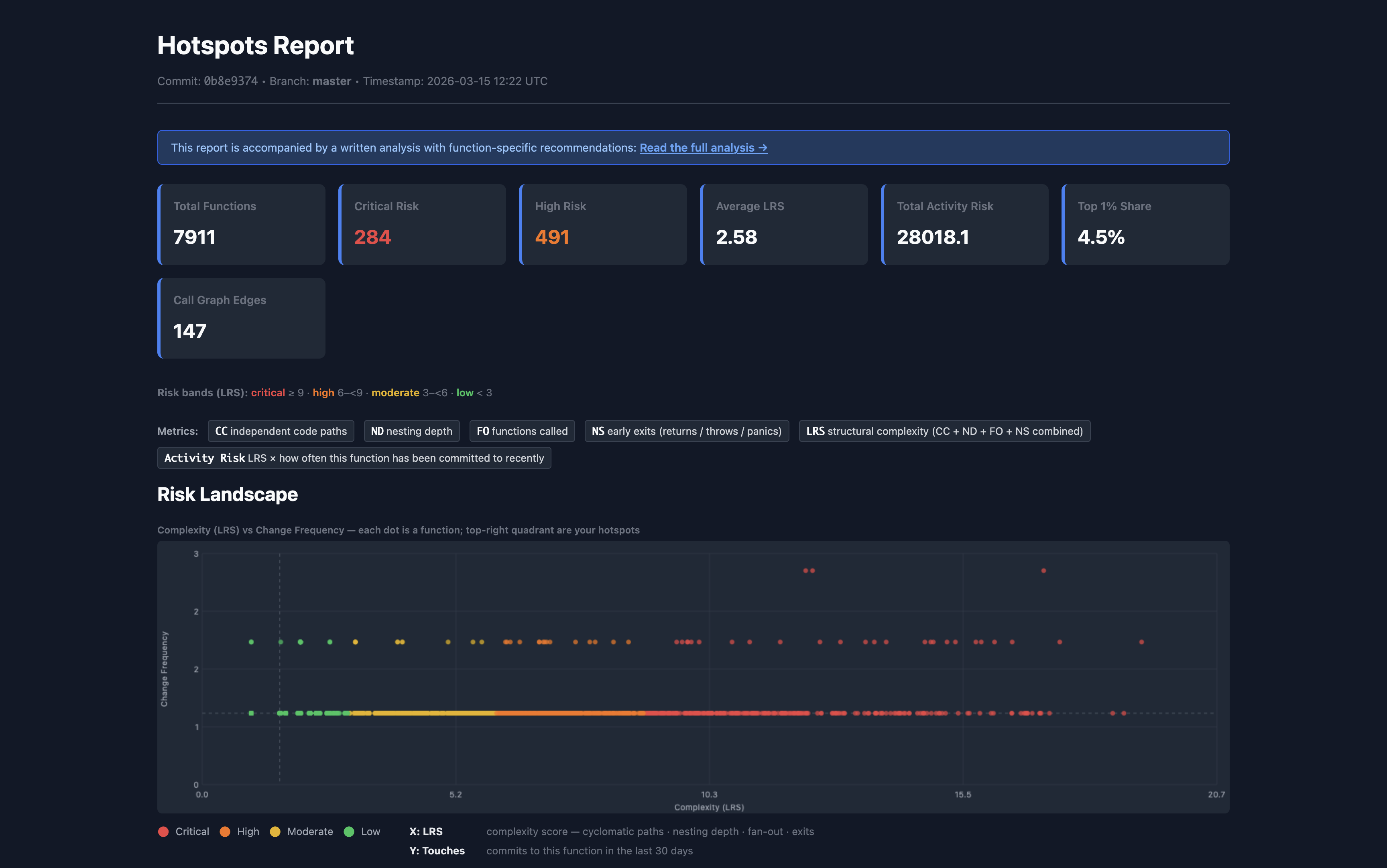
Risk Landscape from a real 7,911-function codebase: 284 Critical (red), 491 High (orange). Each dot is a function — top-right are your hotspots.
# Output:
)
)
Now you know exactly where to focus.
What You Get
✅ Refactor What Actually Matters
Stop wasting time on code that "looks messy" but never causes problems. Focus on the 20% of functions responsible for 80% of your incidents.
✅ Block Complexity Regressions in CI
Catch risky changes before they merge:
# Run in CI with policy checks
# Exit code 1 if policies fail → CI fails
Your CI fails if someone introduces high-risk code. No manual review needed.
GitHub Action coming soon. A native
hotspots-actionfor GitHub Actions is not yet available. Use the CLI directly in your workflows in the meantime.
✅ Ship with Confidence, Not Crossed Fingers
Know which files are landmines before you touch them. See complexity trends over time. Make informed decisions about refactoring vs rewriting vs leaving it alone.
✅ Get AI-Assisted Refactoring
Hotspots integrates with Claude Code, Cursor, and GitHub Copilot. Point your AI at the hottest functions and get refactoring suggestions that actually improve your codebase.
# Analyze changes in your project
# Get agent-optimized output (quadrant buckets + action text)
Quick Start
1. Install
cargo (Rust toolchain):
macOS / Linux:
|
Installs to ~/.local/bin/hotspots. Verify with hotspots --version.
GitHub Action: Coming soon. Use the CLI directly in your workflows for now.
2. Analyze Your Code
# Find your hotspots
# Filter to critical functions only
# Get per-function explanations with driver labels
# Get JSON for tooling/AI
# Stream JSONL for pipeline processing
# Compare with previous commit (delta mode)
3. Act on Results
Critical functions (LRS ≥ 9.0): Refactor now. These are your top priority. High functions (LRS 6.0-9.0): Watch closely. Refactor before they become critical. Moderate functions (LRS 3.0-6.0): Keep an eye on them. Block complexity increases. Low functions (LRS < 3.0): You're good. Don't overthink these.
Supported Languages
- TypeScript -
.ts,.tsx,.mts,.cts - JavaScript -
.js,.jsx,.mjs,.cjs - Go -
.go - Python -
.py - Rust -
.rs - Java -
.java
Full language parity across all metrics and features. See docs/reference/language-support.md for details.
How It Works
Hotspots computes a Local Risk Score (LRS) for each function based on:
- Cyclomatic Complexity (CC) - How many paths through the code?
- Nesting Depth (ND) - How deeply nested are your if/for/while statements?
- Fan-Out (FO) - How many other functions does this call?
- Non-Structured Exits (NS) - How many early returns, breaks, throws?
These metrics combine into a single Local Risk Score (LRS). Higher LRS = higher risk of bugs, incidents, and developer confusion.
LRS is then combined with Activity Risk signals from git history and the call graph:
- Churn — lines changed in the last 30 days (volatile code)
- Touch frequency — commit count touching this function
- Recency — days since last change (branch-aware)
- Fan-in — how many other functions call this one (call graph)
- Cyclic dependency — SCC membership (tightly coupled code)
- Neighbor churn — lines changed in direct dependencies
The call graph engine resolves imports to detect fan-in, PageRank, betweenness centrality, and SCC membership. Functions that are both complex AND heavily depended upon by other changing code rise to the top.
Understanding Quadrants
Every function is placed in one of four quadrants based on its structural complexity and recent activity:
| Quadrant | Complexity | Recent Activity | What it means |
|---|---|---|---|
| fire | High | High | Live regression risk — complex AND actively changing right now |
| debt | High | Low | Structural debt — complex but not recently touched; high blast radius when next changed |
| simple-active | Low | High | Active but manageable — monitor, low structural risk |
| simple-stable | Low | Low | Lowest priority |
Important: The activity-weighted risk score (and lrs) is a decay function computed over git history — it never reaches zero even if a function hasn't been touched in months. A high risk score alone does not mean a function is actively changing. Always check quadrant and touches_30d to determine whether a function is a live regression risk (fire) or structural debt (debt).
- fire: Refactor now — every commit is landing on a complex function
- debt: Schedule proactively — refactor before the next development push into that area, not urgently
- simple-active: Watch closely but don't over-invest in refactoring
- simple-stable: Leave it alone unless metrics change
Example:
// LRS: 12.4 (Critical) - Complex AND frequently changed
function processPlanUpgrade(user, newPlan, paymentMethod) {
  if (!user.isActive) return false;
  if (user.plan === newPlan) return true;

  if (paymentMethod.type === "card") {
    if (paymentMethod.isExpired) {
      try {
        paymentMethod = renewPaymentMethod(user);
      } catch (error) {
        logError(error);
        notifyUser(user, "payment_failed");
        return false;
      }
    }

    if (newPlan.price > user.plan.price) {
      const prorated = calculateProration(user, newPlan);
      if (!chargeCard(paymentMethod, prorated)) {
        return false;
      }
    }
  } else if (paymentMethod.type === "invoice") {
    // Different logic for invoice customers...
  }

  updateDatabase(user, newPlan);
  sendConfirmation(user);
  return true;
}
This function:
- CC: 15 (lots of branching)
- ND: 4 (deeply nested)
- FO: 8 (calls many functions)
- NS: 3 (multiple early returns)
- LRS: 12.4 ← This is a hotspot
Refactor this before it causes a production incident.
Features
🚦 Policy Enforcement (CI/CD)
Block risky code before it merges:
- Critical Introduction - Fail CI if new functions exceed LRS 9.0
- Excessive Regression - Fail CI if LRS increases by ≥1.0
- Watch/Attention Warnings - Warn about functions approaching thresholds
- Rapid Growth Detection - Catch functions growing >50% in complexity
# Run in CI with policy checks
# Exit code 1 if policies fail → CI fails
🔍 Driver Labels & Explain Mode
Understand why a function is flagged and get concrete refactoring advice:
Each function shows its primary driver (high_complexity, deep_nesting,
high_churn_low_cc, high_fanout_churning, high_fanin_complex, cyclic_dep,
composite) plus an Action line with dimension-specific guidance:
processPayment             /src/billing.ts:89
   LRS: 14.52 | Band: critical | Driver: high_complexity
   CC: 15, ND: 4, FO: 8, NS: 3
   Action: Reduce branching; extract sub-functions
Use --level file or --level module for higher-level aggregated views.
📊 Multiple Output Formats
Terminal (human-readable):
Critical (LRS ≥ 9.0):
processPlanUpgrade    src/api/billing.ts:142    LRS 12.4  CC 15  ND 4  FO 8  NS 3
JSON (machine-readable):
JSONL (streaming per-function):
|
One JSON object per line — ideal for large repos and shell pipeline processing.
HTML (interactive reports):
- Sortable, filterable tables
- Risk band visualization
- Shareable with stakeholders
- Upload as CI artifacts
🔇 Suppression Comments
Have complex code you can't refactor yet? Suppress warnings with a reason:
// hotspots-ignore: legacy payment processor, rewrite scheduled Q2 2026
function legacyBillingLogic() {
  // Complex but can't touch it yet
}
Functions with suppressions:
- ✅ Still appear in reports (visibility)
- ❌ Don't fail CI policies (pragmatism)
- 📝 Require a reason (accountability)
⚙️ Configuration
Customize thresholds, weights, and file patterns:
See docs/guide/configuration.md for all options.
🤖 AI Integration
Claude Code:
# Analyze changes and feed to Claude Code
# Get agent-optimized output
See docs/integrations/ai-agents.md for complete guide.
Cursor/GitHub Copilot:
|
# Feed results to your AI coding assistant
📈 Git History Analysis
Track complexity over time:
# Create baseline snapshot
# Compare current code vs baseline
# Compare any two git refs (branches, tags, SHAs)
# See complexity trends
# Prune unreachable snapshots (after force-push or branch deletion)
# Compact snapshot history
Delta mode and hotspots diff show:
- Functions that got more complex
- Functions that were simplified
- New high-complexity functions introduced
- Overall repository complexity trend
hotspots diff requires snapshots to exist for both refs (run hotspots analyze --mode snapshot at each ref first). Use --auto-analyze to generate missing snapshots automatically via git worktrees.
⚙️ Configuration Commands
# Show resolved configuration (weights, thresholds, filters)
# Validate configuration file without running analysis
Documentation
- 🚀 Quick Start - Get started in 5 minutes
- 📖 CLI Reference - All commands and options
- 🎯 GitHub Action - CI/CD integration (coming soon)
- 🤖 AI Integration - Claude, Cursor, Copilot
- 🏗️ Architecture - How it works
- 🤝 Contributing - Add languages, fix bugs, improve docs
Full documentation: docs/index.md
Why Hotspots?
vs ESLint Complexity Rules
ESLint: Checks individual metrics (CC > 10). No context about change frequency or real-world risk. Hotspots: Combines multiple metrics into LRS. Integrates git history. Prioritizes based on actual risk.
vs SonarQube / CodeClimate
SonarQube: Enterprise platform, complex setup, slow scans, requires server infrastructure. Hotspots: Single binary, instant analysis, zero config, works offline, git history built-in.
vs Code Reviews
Reviews: Catch complexity subjectively. Miss gradual regressions. Don't track trends. Hotspots: Objective metrics. Catches every change. Shows trends over time. Enforces policies automatically.
Use both: Hotspots + code reviews = comprehensive quality control.
Real-World Use Cases
🔥 Incident Prevention
"We had 3 production incidents in Q1. All originated from the same 5 functions. Hotspots flagged all 5 as critical. We refactored them in Q2. Zero incidents since."
🚀 Faster Onboarding
"New engineers use Hotspots to identify risky code before touching it. 'This function is LRS 11.2, be careful' = instant context."
🎯 Refactoring Sprints
"We allocate 1 sprint per quarter to reduce our top 10 hotspots. Dropped average LRS from 6.2 to 4.1 over 6 months."
🤖 AI-Guided Refactoring
"Feed hotspots JSON to Claude. It suggests refactorings for critical functions. Accept, commit, verify LRS dropped. Repeat."
⚖️ Technical Debt Metrics
"Execs ask 'How's our tech debt?' I show them: 23 critical functions (down from 31), average LRS 4.8 (down from 5.3). Clear progress."
Installation
Quick Install
cargo (Rust toolchain):
macOS / Linux:
|
Installs to ~/.local/bin/hotspots. Verify with hotspots --version.
Install a specific version:
HOTSPOTS_VERSION=v1.0.0 |
Build from Source
Requirements: Rust 1.75 or later
Contributing
We welcome contributions!
Want to add a language? See docs/contributing/adding-languages.md - we have a proven pattern for adding TypeScript, JavaScript, Go, Python, Rust, and Java.
License
MIT License - see LICENSE-MIT for details.
Next Steps
- ⚡ Install Hotspots (2 minutes)
- 🔍 Run your first analysis:
hotspots analyze src/ - 🎯 Identify your top 10 hotspots
- 🛠️ Refactor the worst offender
- 📊 Add to CI/CD:
hotspots analyze src/ --mode delta --policy(GitHub Action coming soon) - 🤖 Integrate with AI: AI Integration Guide
Questions? Open a GitHub Discussion.
Found a bug? Open an issue.
Stop refactoring guesswork. Start with Hotspots.