[](https://crates.io/crates/hashmatch)
[](https://opensource.org/licenses/MIT)
[](https://docs.rs/hashmatch)
# hashmatch
More efficient `static &str` matching when match #arm > 30.
## Usage
``` rust
use hashmatch::{hash_arm, hash_str};
// to avoid hash conflict
#[deny(unreachable_patterns)]
let res = match hash_str("ABC") {
hash_arm!("ABC") => 1,
hash_arm!("AAA") | hash_arm!("BBB") => 2,
_ => 3,
};
assert_eq!(res, 1);
```
The `hash_arm!` will compute each arm's hash during compiling, and expand it to
``` rust
let res = match hash_str("ABC") {
5661343534983258464u64 => 1,
8040774132769170485u64 | 15932663093540935610u64 => 2,
_ => 3,
};
```
## Why `hashmatch`?
For current rustc, the string matching with large arm number is linear complexity O(n). While the matching complexity of hash (`u64`) is O(log(n)).
`hashmatch` achieves matching string's hash from 2 sides:
1. For each match arm, using `hashmatch::hash_arm!` to get string's static hash during compiling.
2. For the value to be matched, use `hashmatch::hash_str` to get string's hash in runtime, which is consistent to `hashmatch::hash_arm!`.
**But there is a potential risk when encounter DOS attacks.**
## Benchmark
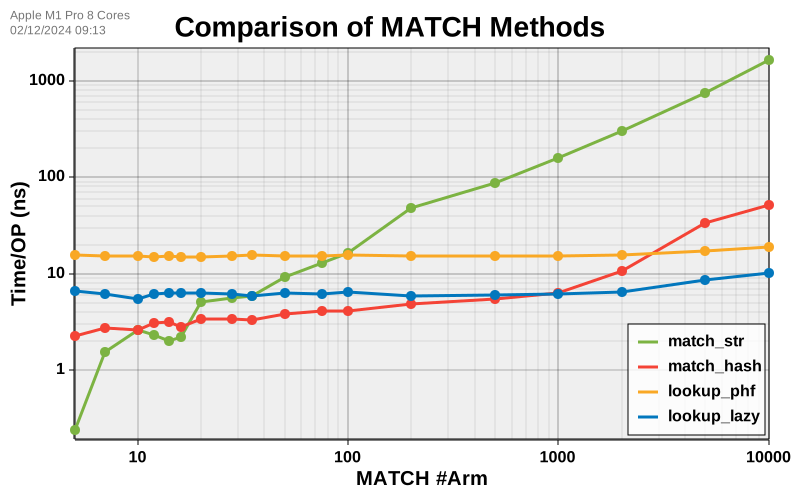
You can run the benchmark in your environment by `cargo bench`, requiring ~20min.
The benchmark compared 4 methods:
+ `match_str`: Directly match string. **O(n)**
``` rust
match s {
"xrxeclxu" => Some(0),
"vukddz" => Some(1),
"qwhkdyjog" => Some(2),
"dpesutax" => Some(3),
"tqgzzfcblp" => Some(4),
_ => None,
}
```
+ `match_hash`: (this) Compute string's hash, then match `u64`. **O(log(n))**
``` rust
match hash_str(s) {
hash_arm!("xrxeclxu") => Some(0),
hash_arm!("vukddz") => Some(1),
hash_arm!("qwhkdyjog") => Some(2),
hash_arm!("dpesutax") => Some(3),
hash_arm!("tqgzzfcblp") => Some(4),
_ => None,
}
```
+ `lookup_phf`: Create const hashmap in compiling time. **O(1)**
``` rust
const STRING_MAP: phf::Map<&str, usize> = phf::phf_map! {
"xrxeclxu" => 0,
"vukddz" => 1,
"qwhkdyjog" => 2,
"dpesutax" => 3,
"tqgzzfcblp" => 4
};
STRING_MAP.get(s).copied()
```
+ `lookup_lazy`: Create lazy hashmap. **O(1)**
``` rust
static STRING_MAP: std::sync::LazyLock<foldhash::HashMap<&str, usize>> =
std::sync::LazyLock::new(|| {
use foldhash::HashMapExt;
let mut map = foldhash::HashMap::with_capacity(5);
map.insert("xrxeclxu", 0);
map.insert("vukddz", 1);
map.insert("qwhkdyjog", 2);
map.insert("dpesutax", 3);
map.insert("tqgzzfcblp", 4);
map
});
STRING_MAP.get(s).copied()
```
