# haruspex
[](https://github.com/0xdea/haruspex)
[](https://crates.io/crates/haruspex)
[](https://crates.io/crates/haruspex)
[](https://hex-rays.com/ida-pro)
[](https://twitter.com/0xdea)
[](https://infosec.exchange/@raptor)
[](https://github.com/0xdea/haruspex/actions/workflows/build.yml)
[](https://github.com/0xdea/haruspex/actions/workflows/doc.yml)
> "Hacking is the discipline of questioning all your assumptions all of the time."
>
> -- Dave Aitel
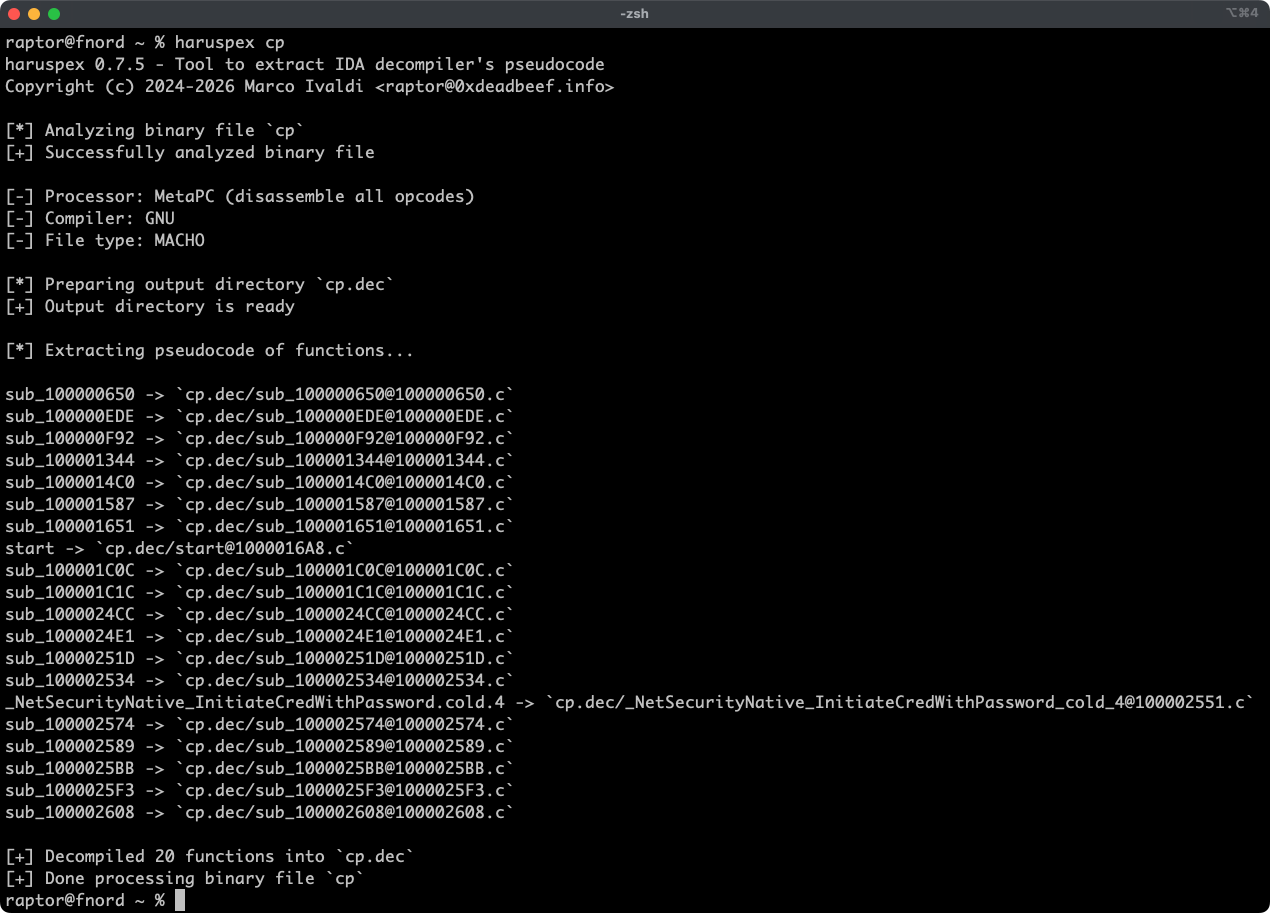
Haruspex is a blazing fast IDA Pro headless plugin that extracts pseudocode generated by IDA Pro's
decompiler in a format that should be suitable to be imported into an IDE, or parsed by static
analysis tools such as [Semgrep](https://semgrep.dev/), [weggli](https://github.com/weggli-rs/weggli),
or [oneiromancer](https://crates.io/crates/oneiromancer).
## Features
- Blazing fast, headless user experience courtesy of IDA Pro 9.x and Binarly's idalib Rust bindings.
- Support for binary targets for any architecture implemented by IDA Pro's Hex-Rays decompiler.
- Pseudocode of each function is stored in a separated file in the output directory for easy inspection.
- External crates can invoke [`decompile_to_file`] to decompile a function and save its pseudocode to disk.
## Blog posts
- <https://hex-rays.com/blog/streamlining-vulnerability-research-idalib-rust-bindings>
- <https://hnsecurity.it/blog/streamlining-vulnerability-research-with-ida-pro-and-rust>
## See also
- <https://github.com/0xdea/ghidra-scripts/blob/main/Haruspex.java>
- <https://github.com/0xdea/semgrep-rules>
- <https://github.com/0xdea/weggli-patterns>
- <https://docs.hex-rays.com/release-notes/9_0#headless-processing-with-idalib>
- <https://github.com/idalib-rs/idalib>
- <https://github.com/xorpse/parascope>
- <https://hnsecurity.it/blog/automating-binary-vulnerability-discovery-with-ghidra-and-semgrep>
## Installing
The easiest way to get the latest release is via [crates.io](https://crates.io/crates/haruspex):
1. Download, install, and configure IDA Pro (see <https://hex-rays.com/ida-pro>).
2. Install LLVM/Clang (see <https://rust-lang.github.io/rust-bindgen/requirements.html>).
3. On Linux/macOS, install as follows:
```sh
export IDADIR=/path/to/ida cargo install haruspex
```
On Windows, instead, use the following commands:
```powershell
$env:LIBCLANG_PATH="\path\to\clang+llvm\bin"
$env:PATH="\path\to\ida;$env:PATH"
$env:IDADIR="\path\to\ida" # if not set, the build script will check common locations
cargo install haruspex
```
## Compiling
Alternatively, you can build from [source](https://github.com/0xdea/haruspex):
1. Download, install, and configure IDA Pro (see <https://hex-rays.com/ida-pro>).
2. Install LLVM/Clang (see <https://rust-lang.github.io/rust-bindgen/requirements.html>).
3. On Linux/macOS, compile as follows:
```sh
git clone --depth 1 https://github.com/0xdea/haruspex
cd haruspex
export IDADIR=/path/to/ida cargo build --release
```
On Windows, instead, use the following commands:
```powershell
git clone --depth 1 https://github.com/0xdea/haruspex
cd haruspex
$env:LIBCLANG_PATH="\path\to\clang+llvm\bin"
$env:PATH="\path\to\ida;$env:PATH"
$env:IDADIR="\path\to\ida" # if not set, the build script will check common locations
cargo build --release
```
## Usage
1. Make sure IDA Pro is properly configured with a valid license.
2. Run as follows:
```sh
haruspex <binary_file>
```
3. Find the extracted pseudocode of each decompiled function in the `binary_file.dec` directory:
```sh
vim <binary_file>.dec
code <binary_file>.dec
```
## Compatibility
Only the latest IDA Pro release is officially supported, but older versions may work as well. The following table
summarizes the latest compatible release for each IDA Pro version:
| v9.0.240925 | v0.2.4 |
| v9.0.241217 | v0.3.5 |
| v9.1.250226 | v0.6.2 |
| v9.2.250908 | v0.7.5 |
| v9.3.260213 | v0.8.1 |
| v9.3.260327 | current release |
> [!NOTE]
> Check the [idalib](https://github.com/idalib-rs/idalib) documentation for additional information.
## Changelog
- [CHANGELOG.md](https://github.com/0xdea/haruspex/blob/master/CHANGELOG.md)
## TODO
- Use the `.cpp` extension instead of `.c` to output pseudocode (see
this [issue](https://github.com/0xdea/semgrep-rules/issues/12))?
- Integrate with Semgrep scanning (see <https://github.com/0xdea/semgrep-rules>).
- Integrate with weggli scanning (see <https://github.com/0xdea/weggli-patterns>).
- Improve decompiler output in the style of [HexRaysPyTools](https://github.com/igogo-x86/HexRaysPyTools)
and [abyss](https://github.com/patois/abyss).
- Implement parallel analysis (see <https://github.com/fugue-re/fugue-mptp>).