# Guillotine
[](https://github.com/mempirate/guillotine/actions/workflows/ci.yml)
[](https://crates.io/crates/guillotine)
[](https://crates.io/crates/guillotine)
[](https://docs.rs/guillotine)
[](https://deepwiki.com/mempirate/guillotine)
A `no-std`, allocation-fre graphical user interface framework for embedded devices prioritizing efficiency and ergonomics. The UI declaration API is heavily inspired by [GPUI](https://github.com/zed-industries/zed/tree/main/crates/gpui). Built with (and inherits compatibility from)
[`embedded-graphics`](https://docs.rs/embedded-graphics/latest/embedded_graphics/).
## Demo
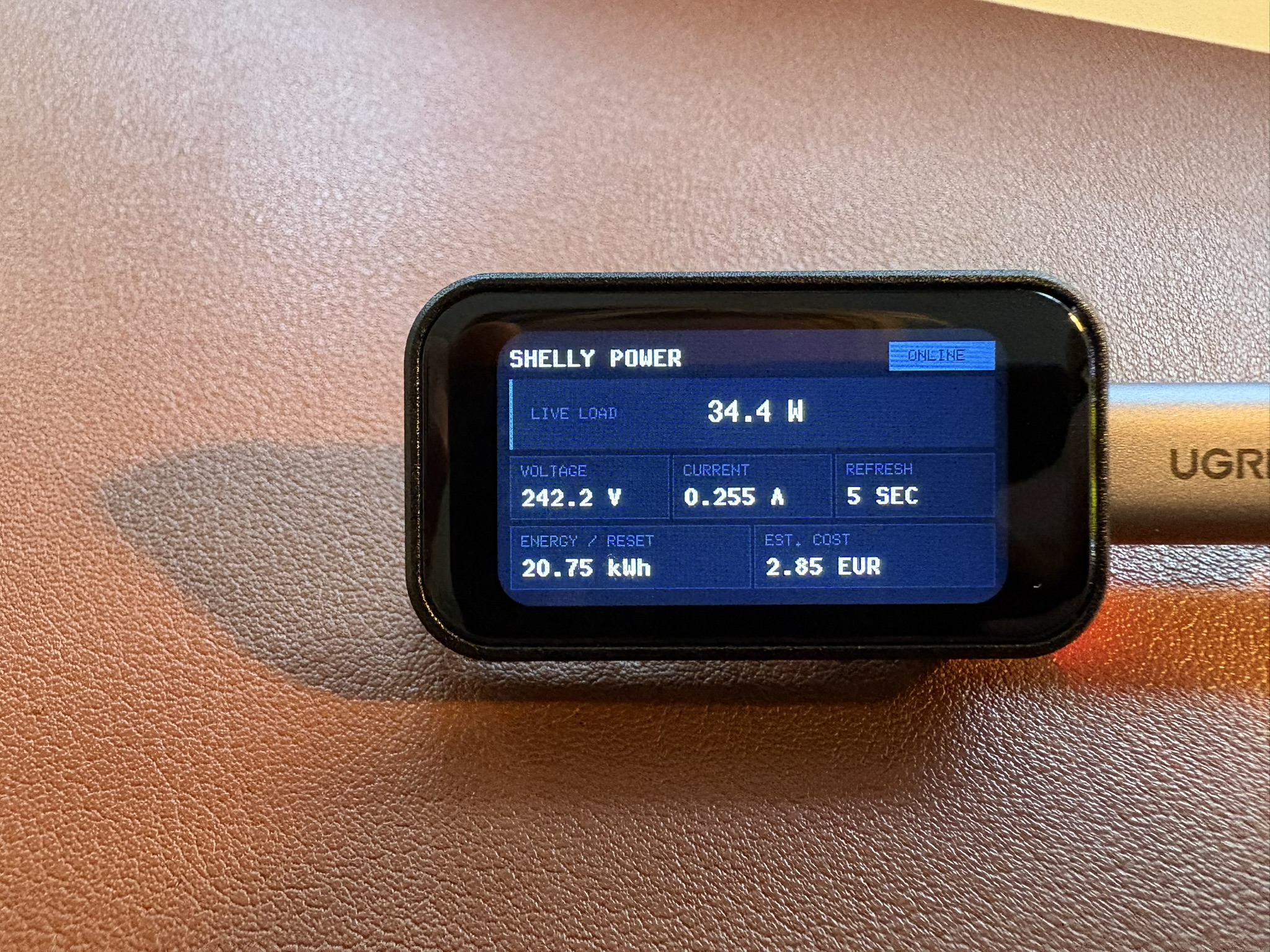
A demo Guillotine UI on a Waveshare ESP32-C6 1.47" LCD board from the [`shellyctl`](https://github.com/mempirate/shellyctl) project:
## Quickstart
This example uses the optional `flexbox` feature.
```rust,ignore
use embedded_graphics::{
mock_display::MockDisplay,
mono_font::ascii::{FONT_6X10, FONT_9X18_BOLD},
pixelcolor::Rgb565,
prelude::Size,
};
use guillotine::{style::JustifyContent, *};
const CANVAS: Rgb565 = Rgb565::new(2, 4, 6);
const PANEL: Rgb565 = Rgb565::new(4, 9, 12);
const ACCENT: Rgb565 = Rgb565::new(7, 47, 25);
struct BasicView {
greeting: &'static str,
}
impl Render for BasicView {
// Render lets you declaratively build your UI tree.
fn render(&self, cx: &Context<'_>) -> impl ElementBuilder {
cx.column()
.size(Size::new(320, 172))
.padding(12)
.gap(8)
.background(CANVAS)
.justify_content(JustifyContent::Center)
.child(
cx.row()
.child(cx.text("GUILLOTINE").flex_grow(1).font(Font::mono(&FONT_9X18_BOLD)))
.child(
cx.text("READY")
.padding((4, 9))
.background(ACCENT)
.font(Font::mono(&FONT_6X10)),
),
)
.child(
cx.row()
.gap(8)
.child(
cx.text(self.greeting)
.font(Font::mono(&FONT_6X10))
.flex(3)
.padding(10)
.background(PANEL),
)
.child(
cx.text("7 nodes, 54 bytes")
.font(Font::mono(&FONT_6X10))
.flex(2)
.padding(6)
.background(ACCENT),
),
)
}
}
fn main() {
// Display should implement embedded_graphics DrawTarget
let display = MockDisplay::<Rgb565>::new();
let view = BasicView { greeting: "Build tiny interfaces." };
// Initialize stack-based storage for the frame. Capacity: 32 elements
// and 128 bytes of UTF-8 text.
let storage = FrameStorage::<Rgb565, 32, 128>::default();
// Create a new UI with a direct display target. Used here for brevity;
// if you have memory available, use `BufferedTarget`.
let mut ui = Ui::new(DirectTarget::new(display), storage).with_background(CANVAS);
// Render the view
ui.render(&view).unwrap();
}
```
## Frame Buffers
The `framebuffer` feature (on by default) provides a `BufferedTarget` type that
works with caller-provided frame buffers. It is highly recommended to use this
over `DirectTarget`, since it can dramatically increase frame rates and reduce
flicker to near unnoticeable if you can cover the whole display.
```rust,ignore
use embedded_graphics::{pixelcolor::Rgb565, mock_display::MockDisplay};
use static_cell::ConstStaticCell;
use guillotine::{*, buffered::BufferedTarget};
/// The size of the frame buffer, should ideally cover your whole display
/// (width * height).
const FRAMEBUFFER_PIXELS: usize = 320 * 172;
/// Allocate the buffer in static memory with your
/// chosen color.
static FRAMEBUFFER: ConstStaticCell<[Rgb565; FRAMEBUFFER_PIXELS]> =
ConstStaticCell::new([Rgb565::new(0, 0, 0); FRAMEBUFFER_PIXELS]);
fn main() {
let mut display = MockDisplay::<Rgb565>::new();
// Initialize stack-based storage for the frame. Capacity: 32 elements
// and 128 bytes of UTF-8 text.
let storage = FrameStorage::<Rgb565, 32, 128>::default();
/// Initialize the buffered display target
let target = BufferedTarget::new(&mut display, FRAMEBUFFER.take());
let mut ui = Ui::new(target, storage);
// ... render something
}
```
Large buffers should generally use static storage (with [`static_cell`](https://docs.rs/static_cell/latest/static_cell/struct.ConstStaticCell.html)).
Small buffers can live on the stack if the stack size permits it.
Note that the memory used by an `Rgb565` buffer is `pixels x 2 bytes`.
### Picking Sizes
Ideally, your frame buffer covers the whole display. However, you can provide a
buffer of any size, and `render()` will execute a greedy top-down traversal to
find the first subtree that fits.
Passing buffers that are smaller than the area of any element on the screen will
fall back to direct drawing.
> [!NOTE]
> If your frame buffer doesn't fit the root element, it is painted directly
> before its children are considered. An opaque root background may therefore
> appear as a visible clear before buffered children are presented, so you
> may still notice a flicker.
## Memory Management
Guillotine does not require an allocator, and uses [`heapless`](https://docs.rs/heapless/latest/heapless/) to store fixed-capacity node and text arrays inline.
This library exposes `FrameStorage` as the frontend for all memory management. The `FrameStorage`
signature looks like this:
```rust,ignore
pub struct FrameStorage<C: PixelColor, const N: usize = 64, const T: usize = 1024>
```
Since `heapless` stores
data inline, capacity has to be specified upfront through const generics. `FrameStorage` contains 2 buffers:
1. `nodes` with capacity `N` (number of nodes): stores the tree of UI elements. 64 by default.
2. `text` with capacity `T` (bytes): stores the UTF-8 bytes for all text elements present in the UI. 1024 by default.
It's recommended to tune `N` and `T` to fit the specifics
of your UI. `FrameStorage` exposes some methods to help you do that:
- `usage()` returns the used length of both buffers.
- `capacity()` returns the capacity of both buffers.
> [!NOTE]
> These buffers are only populated *after* calls to `render()`, and will contain the element tree and
> text bytes for the currently rendered frame.
## Layout
By default, Guillotine supports a limited subset of the flexbox layout engine. Rows are start-aligned
containers along the horizontal axis with support for gaps, and columns are their vertical counterpart.
### Flexbox
More complete flexbox support is gated behind a `flexbox` feature and is turned off by default,
because these flexbox properties require the layout tree to be traversed
twice, demanding extra compute and slightly render latency.
With `flexbox` on, you'll get access to CSS-like flexbox functionality, including `justify-content` and
`align-items` (for containers), and `flex-grow` and `flex` for items.
> [!TIP]
> Some properties, like `AlignItems::Stretch`, currently have a complexity of `O(N x D)`,
> where `N` is the number of nodes and `D` is the tree depth. For small trees, this shouldn't be a problem,
> but keep it in mind if you have more complex layouts.
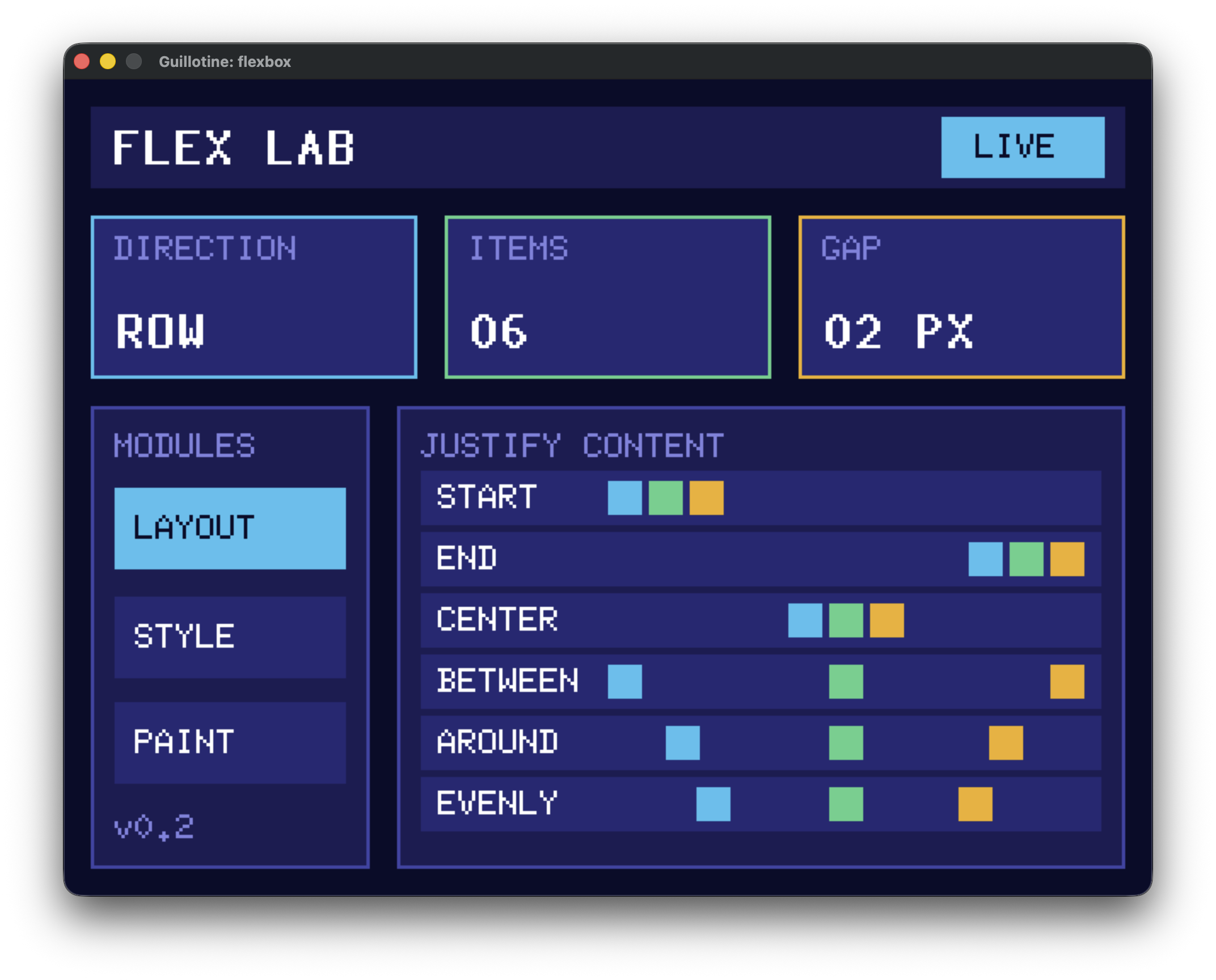
Refer to [`flexbox.rs`](/examples/flexbox.rs) for a flexbox layout example:
## Styling
### Insets and the box model
Margin, padding, and border widths accept CSS-like physical-edge shorthands:
```rust,ignore
cx.column()
.margin(10) // all edges
.padding((4, 8)) // vertical, horizontal
.border((1, 2, 3)) // top, horizontal, bottom
.margin((4, 8, 12, 16)); // top, right, bottom, left
```
Use `Insets::new(top, right, bottom, left)` when a named value is clearer. Insets are non-negative
pixel lengths. Guillotine doesn't currently support percentages, `auto`, logical edges, negative
margins, margin collapsing, per-edge border colors, or border styles. Adjacent margins in rows and
columns add together.
`size`, `width`, and `height` configure border-box dimensions: padding and border are placed inside
them, and margin is added outside. Width and height are independent; an omitted dimension is sized
automatically from the element's contents. Configured dimensions grow to contain padding and border
when parent constraints allow.
## Examples
See the [examples README](./examples).
## Core Concepts
### Declarative Definition
- Explain the idea of declaratively building your UI
Status: implemented ✅
### Hybrid Immediate & Retained Mode
Status: unimplemented ❌
### Similar tree-based layout to X
- GPUI
Status: implemented ✅
### State Management
### Layout Engine
- Conceptually similar to Flutter (i.e. constraints go down, sizes go up)
- constraints flow downward, sizes flow upward, positions flow downward
- Requirement: single pass.
Status: implemented ✅
## Why?
I was trying to build a clean-looking dashboard on a small LCD screen powered by an ESP32-C6, that's supposed to monitor and display the power consumption of my home lab (project [here](https://github.com/mempirate/shellyctl)). I wanted to do this in Rust, with the esp-rs ecosystem. The ecosystem is quite mature, but I couldn't really find a UI framework that was:
1. Performant
2. Very low memory footprint (no Slint / LVGL)
3. Beautiful
Additionally, I wanted to learn what it would take to build something like this.
## Roadmap
### v0.0.1
- [x] Try to mimic GPUI declaration style: <https://github.com/zed-industries/zed/blob/main/crates/gpui/examples/hello_world.rs>
- [x] Low-level `Element` / `ParentElement` trait for custom elements and widgets
- [x] Support generic `PixelColor`
- [x] Full immediate mode redrawing
- [x] Make repo ready for publishing:
- [x] README documentation (a la Dioxus)
- [x] Rustdoc documentation
- [x] Examples
- Sizing (insets)
- Fonts
- Cool
- ESP32
- [x] Fix exports
- [x] Dual Apache / MIT license
- [x] Fix sdl2 vendoring for embedded-graphics-simulator
- [x] `TextStyle` fonts
- [x] Support for non-interactive elements:
- [x] Row
- [x] (formatted) Text
- [x] Column
### v0.1.0
- [x] No alloc
### v0.2.1
- [x] `framebuffer` feature with frame buffer support
### v0.3.0
- [x] Refactored layout engine
- [x] Support flexbox layout (`flexbox` feature)
### v0.3.1
- [ ] Support for [absolute positioning](https://taffylayout.com/docs/styling/position)
(relative by default). Introduces a new explicit `position` property to `Style`.
### v0.3.2
- [ ] New elements
- [ ] Dialogs / Modals (floating containers)
- [ ] Charts
- [ ] Spinner (going to be interesting as this is essentially a self-rendering element). Will
probably require a global `frame_rate` to be set on the `Ui`. However, this would be a full
retained mode approach with an async polling loop.
Another approach is to first implement incremental redrawing, and rely
on the caller to call `render()` at their chosen rate. However, each `render()` would do
a bunch of compute, so probably not super efficient?
### Backlog
- [ ] Mirrored debugger / inspector:
- When plugged into an MCU, this feature launches an interactive inspector
on your host machine (think the Chrome inspector). Displays realtime total / per element
memory consumption, frame rendering times, boxes, frame buffer utilization etc.
Builds on the embedded-graphics simulator.
- [ ] Add memory usage for examples
- cargo binutils for examples in CI (cargo size). This will detect regressions.
- [ ] Documentation
- [ ] Guide for finding the ideal `FrameStorage` capacity.
- [ ] Benchmarks for:
- [ ] Frame rendering
- [ ] Frame drawing
- [ ] Stats for frame buffers (to determine optimal sizing)
- [ ] Incremental drawing behind an `inremental` feature
- [ ] Explicit behaviour:
- [x] Hidden
- [ ] Visible
- [ ] Scroll
- [ ] Custom elements
- [ ] Support for interaction behind an `interaction` feature
- [ ] Support interactive elements:
- [ ] Button
- [ ] Slider
## Prior Work & Inspiration
- [Clay by Nic Barker](https://github.com/nicbarker/clay#retained-mode-rendering)
- [Kolibri by Yandrik](https://github.com/Yandrik/kolibri)
- [GPUI by Zed](https://github.com/zed-industries/zed/tree/main/crates/gpui)
- [Taffy by Dioxus Labs](https://github.com/DioxusLabs/taffy)
- [`embedded-gui` by Leftger](https://github.com/leftger/embedded-gui)