<p align="center">
<a href="https://www.rust-lang.org/"><img alt="Rust" src="https://img.shields.io/badge/Rust-2024-000000?logo=rust" /></a>
<a href="https://rhai.rs/book/index.html"><img alt="Rhai" src="https://img.shields.io/badge/Rhai-scripting-2b2b2b" /></a>
<a href="https://github.com/ratatui/ratatui"><img alt="ratatui" src="https://img.shields.io/badge/TUI-ratatui-1f2937" /></a>
</p>
# Gridline ✨
Gridline is a proof-of-concept terminal spreadsheet with Rhai support. Cells can contain numbers, text, or formulas powered by the [Rhai scripting language](https://rhai.rs/book/index.html). Your sheet lives in a plain text file, and your reusable logic can live in a separate `.rhai` functions file.
What you get (today):
- TUI grid with a formula bar and command mode
- A1-style references in formulas (`=A1 + B2`) and range functions (`=SUM(A1:B5)`)
- Dependency tracking and recalculation
- Load/reload user functions from a `.rhai` file (`-f` at startup, `:source` at runtime)
- Vim keybindings by default, optional Emacs keymap
- Custom keymaps via TOML (optional override)
- Plain text storage format (one cell per line)
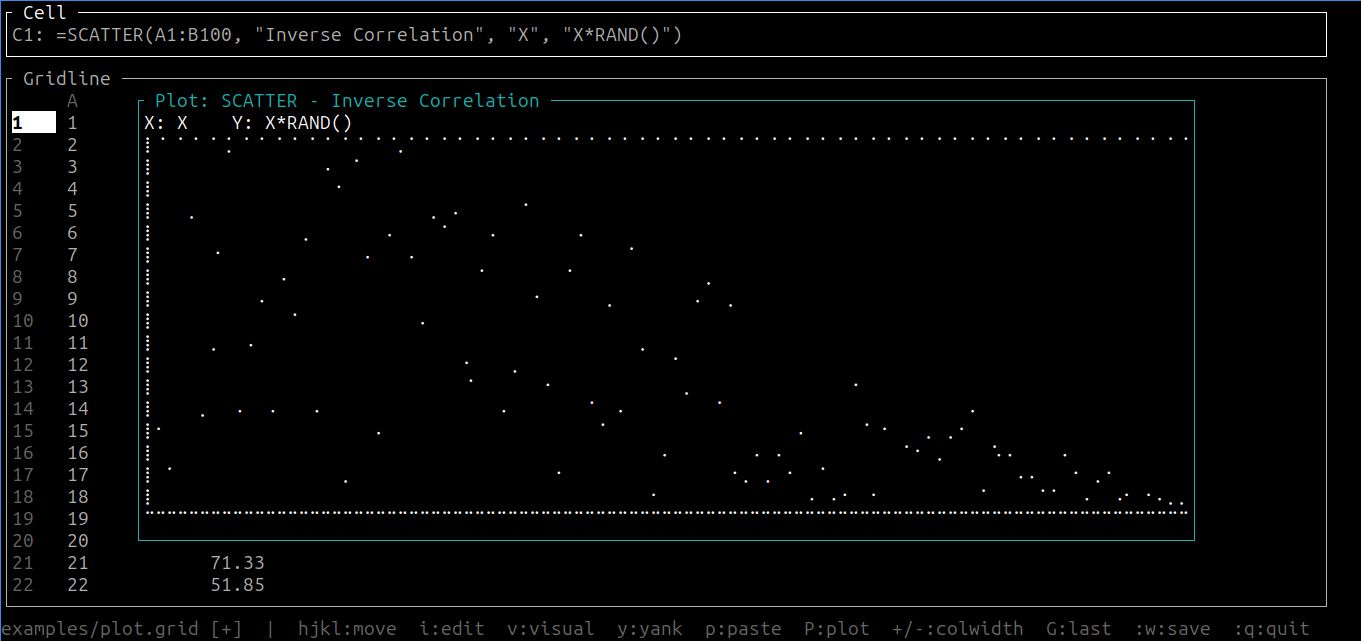
- Simple plotting in a modal (bar/line/scatter)
Project status: this is a POC. Expect rough edges (especially around plotting and any non-trivial spreadsheet ergonomics).
Why it's fun:
- 🧾 Plain-text sheets you can diff and version
- 🧠 Formulas are real Rhai scripts (with spreadsheet sugar)
- 📈 Quick plots right in the terminal
## Screenshots
<p align="center">
<a href="screen.jpg">
<img src="screen.jpg" alt="Gridline spreadsheet view" width="900" />
</a>
<br />
<sub>Fast, keyboard-first spreadsheets in your terminal: formulas, ranges, and a real formula bar.</sub>
</p>
<p align="center">
<a href="plot.jpg">
<img src="plot.jpg" alt="Gridline plotting modal" width="900" />
</a>
<br />
<sub>Turn data into insight without context-switching: quick plots right where you work.</sub>
</p>
<p align="center">
<a href="spill.jpg">
<img src="spill.jpg" alt="Gridline SPILL and map example" width="900" />
</a>
<br />
<sub>Go beyond cell-by-cell: SPILL + Rhai lets you generate and reshape tables with reusable logic.</sub>
</p>
## Quick Start 🚀
Build and run:
```bash
cargo run
```
Open an example file:
```bash
cargo run -- examples/plot.grid
```
Load custom Rhai functions at startup (can specify multiple files):
```bash
cargo run -- -f examples/functions.rhai examples/plot.grid
cargo run -- -f lib1.rhai -f lib2.rhai examples/plot.grid
```
Auto-load a default functions file if present:
- config directory `gridline/default.rhai` (platform-specific)
- Linux: `~/.config/gridline/default.rhai`
- macOS: `~/Library/Application Support/gridline/default.rhai`
- Windows: `%APPDATA%\\gridline\\default.rhai`
Load or reload functions at runtime:
```text
:source examples/functions.rhai
:so # reload all loaded files
```
## Cell Input Rules 🧾
Gridline interprets cell input like this:
- empty / whitespace => empty cell
- leading `=` => formula (Rhai script; stored without the `=`)
- quoted `"text"` => text (quotes stripped)
- otherwise, parseable as `f64` => number
- else => text
Examples:
```text
A1: 10
A2: "hello"
A3: =A1 * 2
A4: =SUM(A1:A3)
```
## Formulas (Rhai + Spreadsheet Sugar) 🧠
Inside formulas:
- `A1` becomes `cell(0, 0)` (0-indexed internally)
- `@A1` becomes `value(0, 0)` (typed access: numbers/text/bools)
- `SUM(A1:B5)` becomes `sum_range(0, 0, 4, 1)`
Arrays "spill" down the column.
If you need to do an in-place operation that returns `()` (like Rhai's `Array.sort()`), use `OUTPUT`:
```text
A1: 30
A2: 10
A3: 20
Typed refs are useful when a referenced cell contains text (or a formula that returns text):
```text
B1: =if C1 > 100 { "expensive" } else { "cheap" }
A1: =len(@B1)
```
Built-in range functions (ALL CAPS):
- `SUM`, `AVG`, `COUNT`, `MIN`, `MAX`
- `SUMIF(range, |x| condition)` - sum values where predicate is true
- `COUNTIF(range, |x| condition)` - count cells where predicate is true
- `BARCHART`, `LINECHART`, `SCATTER`
- `VEC` (convert a range to an array; respects direction: `VEC(A3:A1)` returns `[A3, A2, A1]`)
Other built-ins:
- `ROW()` - current cell's row (1-indexed)
- `COL()` - current cell's column (1-indexed)
- `RAND()` - random float in `[0.0, 1.0)`
- `RANDINT(min, max)` - random integer in `[min, max]` inclusive
### Custom Functions Example 🧩
Create a `.rhai` file:
```rhai
fn fib(n) {
if n < 2 { n } else { fib(n - 1) + fib(n - 2) }
}
```
Load it (either `-f` or `:source`), then use it in a cell:
```text
A1: "Fibonacci"
B1: 10
C1: =fib(B1)
```
## Plotting 📈
Plotting works by making a formula cell return a tagged plot spec. The grid shows a placeholder (e.g. `<BAR>`), and you can open the plot modal.
Example (`examples/plot.grid`):
```text
C1: =SCATTER(A1:B5, "title", "xaxis", "yaxis")
D1: =BARCHART(B1:B5)
```
Open the plot modal:
- Vim keymap: `P`
- Emacs keymap: `M-p`
## Commands ⌨️
Command mode:
- Vim: `:`
- Emacs: `M-x`
Useful commands:
- `:w` or `:w <path>` save
- `:q` quit (warns if modified)
- `:q!` force quit
- `:wq` save and quit
- `:e <path>` open file
- `:goto A100` (alias `:g A100`) jump to a cell
- `:colwidth 15` set current column width
- `:colwidth A 15` set a specific column width
- `:source <file.rhai>` (alias `:so`) load functions; `:so` reloads the last functions file
## Keymaps 🗺️
Select keybindings:
```bash
gridline --keymap vim
gridline --keymap emacs
gridline --keymap vim --keymap-file /path/to/keymaps.toml
```
Keymap files (optional):
- Default location: config directory `gridline/keymaps.toml` (platform-specific)
- Override with `--keymap-file <path>`
- If a keymap name is not found in the file, Gridline falls back to the built-in map (`vim` or `emacs`)
- Linux: `~/.config/gridline/keymaps.toml`
- macOS: `~/Library/Application Support/gridline/keymaps.toml`
- Windows: `%APPDATA%\\gridline\\keymaps.toml`
Sample keymap file:
- `docs/keymaps.toml`
Status bar has an always-on cheat sheet, but the core controls are:
Vim:
- `hjkl` move, `i`/`Enter` edit, `Esc` cancel
- `v` visual select, `y` yank, `p` paste
- `:w` save, `:q` quit
Emacs:
- `C-n/p/f/b` move, `Enter` edit, `C-g` cancel
- `C-SPC` set mark (visual), `M-w` copy, `C-y` paste
- `M-x` command mode, `:w` save, `:q` quit
## File Format 📝
Gridline files are plain text. Non-empty, non-comment lines look like:
```text
CELLREF: VALUE
```
Comments start with `#`. Values follow the same input rules as interactive editing.
## Development 🔧
```bash
cargo fmt
cargo clippy --all-targets -- -D warnings
cargo test
```
## License 📜
Licensed under either of:
- Apache License, Version 2.0 (`LICENSE-APACHE`)
- MIT license (`LICENSE-MIT`)