# gpui_interop
Display frames rendered by external graphics engines, hardware video decoders, or separate processes
directly inside a GPUI window without copying pixels through the CPU.
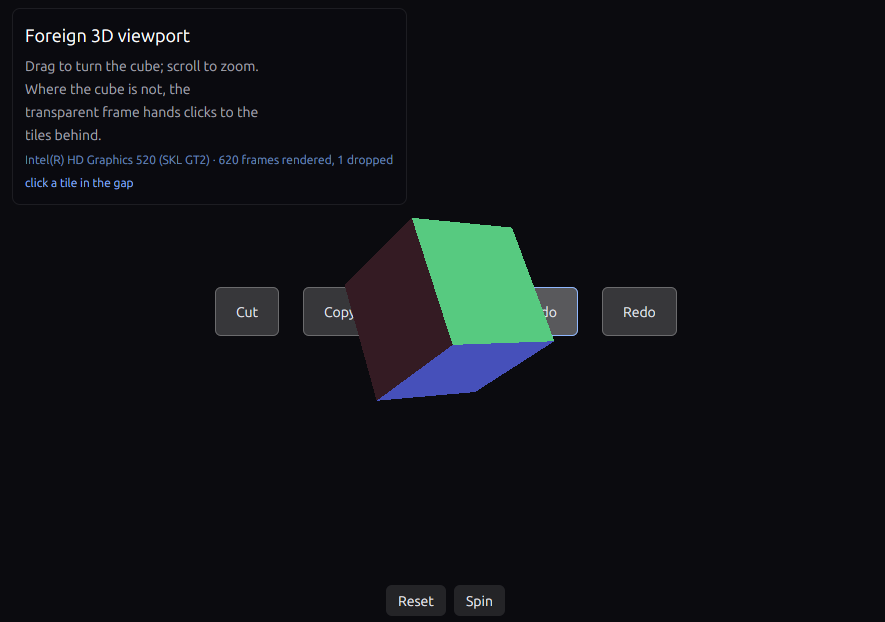
*The `interop_cube_drag` example: a separate Vulkan renderer draws the 3D cube and passes it to GPUI
as a `dma-buf`. GPUI composites the transparent frame directly into the scene, drawing the background
tiles underneath it and the UI panel and buttons on top.*
Normally, GPUI can only sample textures that live on its own GPU device. If you are embedding a 3D
engine (such as a custom Vulkan renderer or a `wgpu` viewport) or a hardware video decoder that
manages its own GPU device, standard texture sharing will not work without downloading the frame to
system RAM and re-uploading it.
`gpui_interop` avoids that CPU round-trip. Your renderer draws a frame on its own device, exports an
OS-level handle (a `dma-buf` on Linux or a shared texture on Windows), and passes it to GPUI's
`surface()` element. GPUI's renderer imports that handle and samples the texture directly on the GPU.
This crate is **experimental**. It is built against the **`bite-gpui` 1.24 line** — the published
`bite-gpui`, `bite-gp-engine`, `bite-gp-wgpu` and `bite-gp-windows` packages.
## Install
The crate's public API speaks GPUI's types, so a consumer also needs the facade as a direct
dependency. The published packages are aliased back to their standard crate names:
```toml
[dependencies]
gpui_interop = { version = "0.1", features = ["gpui", "wgpu"] }
gpui = { package = "bite-gpui", version = "1.24", default-features = false, features = ["platform"] }
gpui_wgpu = { package = "bite-gp-wgpu", version = "1.24" }
```
Drop `platform` for a producer that does not open a window. A producer that renders on `wgpu`
needs this crate's `wgpu` feature; the viewport input helpers need `gpui`; the guest runner needs
`guest` and a backend renderer such as `gpui_wgpu`'s `headless` feature.
## Features
| *(default)* | Core library and platform transport types (`SharedBuffer`, `SharedSurface`, `Fence`) for Linux and Windows. |
| `wgpu` | `Adapter::wgpu`, `WgpuSurface` and, on Linux, `WgpuSharedBuffer`. |
| `gpui` | The viewport input helpers (`surface_input`, `SurfaceInput`, `SurfaceEvent`, `SurfacePoint`). |
| `guest` | `Guest`, the headless worker-thread runner that hands frames to a foreign host loop. |
| `example` | Dependencies for the three library examples; not needed by consumers. |
| `readback-test`, `wgpu-test`, `input-test`, `guest-test` | The opt-in integration suites. |
## Supported platforms
| **Linux** | `SharedBuffer` → `gpui::DmaBufHandle` | Exports a Vulkan image as a `dma-buf` with its DRM format modifier (linear or driver-tiled, single-plane or two-plane NV12). `SharedBuffer::new` lets the driver choose the layout; `SharedBuffer::export_at` pushes one the producer declares. A `Fence` exports the `sync_file` that orders the hand-off. |
| **Windows** | `SharedSurface` + `Fence` | Exports a shared texture from a Direct3D 12 renderer and opens it on GPUI's Direct3D 11 device, using a shared fence to synchronize the two GPU queues. |
| **macOS** | `IOSurface` | **Not yet implemented.** Planned support will wrap an external renderer's `IOSurface` in an `MTLTexture`. |
A wgpu producer has two shapes, both starting from `Adapter::wgpu`:
- `WgpuSharedBuffer` (Linux) renders into an exportable image and hands GPUI a `dma-buf` with its
modifier and a `sync_file` — the cross-device shape another backend imports with `paint_surface`.
- `WgpuSurface` is the same-device fast path, composited with `paint_texture`: no export and no
fence.
- `WgpuSharedBufferRing` owns three `WgpuSharedBuffer` slots and their release eventfds for a
producer that renders continuously. `begin()` hands out a free slot, `submit()` exports the frame,
and `present()` returns only a frame whose acquire fence has already signalled — or repeats the
last good one while a new frame is still running. GPUI therefore never polls a pending fence.
## Quick start
The bridge is installed inside GPUI's `gpu_canvas` callback, where the window's renderer and its GPU
device exist:
```rust
use gpui_interop::{attach, Unavailable};
fn bridge(gpu: &mut gpui::GpuCanvasContext) -> Result<(), Unavailable> {
// 1. Connect to the window's active renderer.
let interop = attach(gpu.try_device::<gpui_wgpu::WgpuRenderer>())?;
// 2. A wgpu producer gets a device and queue on the renderer's GPU.
let (device, queue) = interop.adapter().wgpu().expect("no matching GPU adapter found");
// 3. Render into a WgpuSurface (same device) or WgpuSharedBuffer (exported dma-buf), then
// paint it through the canvas. A Vulkan producer uses Adapter::gpu_device and SharedBuffer;
// a Direct3D 12 one uses SharedSurface.
Ok(())
}
```
On Windows with the Direct3D 11 renderer, `Adapter::wgpu` matches the adapter by LUID and creates a
separate DX12 device on it, for the native `SharedSurface` hand-off. A Vulkan producer that owns its
device uses `interop.adapter().gpu_device()` instead.
## Examples and full guide
The repository has five demos. The three small ones are examples in this package and build with the
`example` feature: `interop_linux`, `interop_cube` and `interop_cube_drag`. The two producer demos
are separate crates in the workspace: `interop_wgpu` and `interop_bevy`.
See the [repository README](https://github.com/bite-gpui/gpui_interop#examples) for the full
walkthrough, the Linux `dma-buf` code, the guest runner, the measured producer numbers, and the
design notes.
## Requirements
- **Linux:** a Vulkan loader (`libvulkan.so.1`) and a driver that supports `dma-buf` export
(`VK_EXT_external_memory_dma_buf` and `VK_EXT_image_drm_format_modifier`). On Debian or Ubuntu:
`sudo apt-get install -y libvulkan1 mesa-vulkan-drivers`.
- **Windows:** Direct3D 11 and Direct3D 12 support, including the Windows SDK resource compiler.
- **Rust:** edition 2024.
## License
Licensed under the Apache-2.0 License. See [LICENSE-APACHE](LICENSE-APACHE).