# FunDSP
## Audio Processing and Synthesis Library for Rust
[FunDSP](https://github.com/SamiPerttu/fundsp)
is an audio DSP ([digital signal processing](https://en.wikipedia.org/wiki/Digital_signal_processing))
library with a focus on usability.
FunDSP features a powerful inline graph notation that
empowers users to accomplish diverse audio processing tasks with ease and elegance.
The custom notation taps into composable, zero-cost abstractions
that express audio processing networks as [Rust](https://www.rust-lang.org/) types.
Another innovative feature of FunDSP is its signal flow system, which can
determine analytic [frequency responses](https://en.wikipedia.org/wiki/Frequency_response)
for any [linear network](https://en.wikipedia.org/wiki/Linear_filter).
FunDSP comes with a combinator environment containing
a suite of audio components, math and utility functions and
procedural generation tools.
### Uses
- Audio processing and synthesis for games and applications
- Education
- Music making
- Sound hacking and audio golfing
- Prototyping of DSP algorithms
### Rust Audio Discord
To discuss FunDSP and other topics, come hang out with us at the
[Rust Audio Discord](https://discord.gg/3hfDXS6hhQ).
### Graph Notation
*FunDSP Composable Graph Notation* expresses audio networks
in algebraic form, using graph operators. It
was developed together with the functional
environment to minimize the number
of typed characters needed to accomplish common audio tasks.
Many common algorithms can be expressed in a natural form
conducive to understanding.
For example, an [FM oscillator](https://ccrma.stanford.edu/~jos/sasp/Frequency_Modulation_FM_Synthesis.html)
can be written simply as:
```rust
sine_hz(f) * f * m + f >> sine()
```
The above expression defines an audio graph that is
compiled into a stack allocated, inlined form using
the powerful generic abstractions built into [Rust](https://www.rust-lang.org/).
Connectivity errors are detected during compilation, saving
development time.
### Audio DSP Becomes a First-Class Citizen
With no macros needed, the FunDSP graph notation
integrates audio DSP tightly into the [Rust programming language](https://www.rust-lang.org/)
as a first-class citizen. Native Rust operator precedences
work in harmony with the notation, minimizing
the number of parentheses needed.
FunDSP graph expressions offer even more economy in being generic
over channel arities, which are encoded at the type level.
A mono network can be expressed
as a stereo network simply by replacing its mono generators and
filters with stereo ones, the graph notation remaining the same.
FunDSP Composable Graph Notation was developed by Sami Perttu,
with contributions from Benjamin Saunders.
## Basics
### Component Systems
There are two parallel component systems: the static `AudioNode` and the dynamic `AudioUnit`.
Both systems operate on audio signals synchronously as an infinite stream.
---
| `AudioNode` | generic (`f32` or `f64`) | static, inlined | stack | input and output arity fixed at compile time |
| `AudioUnit32` | `f32` | dynamic, object safe | heap | input and output arity fixed after construction |
| `AudioUnit64` | `f64` | -..- | -..- | -..- |
---
`AudioNode`s can be stack allocated for the most part.
At the moment, block processing via `AudioNode::process` requires heap allocation.
Some nodes may also use the heap for audio buffers and the like.
The purpose of the `AudioUnit` system is to grant more flexibility in dynamic situations:
decisions about input and output arities and contents can be deferred to runtime.
### Processing
Processing samples is easy in both `AudioNode` and `AudioUnit` systems.
The `tick` method is for processing single
sample frames, while the `process` method processes whole blocks.
Mono samples can be retrieved with `get_mono` and `filter_mono` methods. The `get_mono` method
returns the next sample from a generator that has no inputs and one output,
while the `filter_mono` method filters the next sample from
a node that has one input and one output:
```rust
let out_sample = node.get_mono();
let out_sample = node.filter_mono(sample);
```
Stereo samples can be retrieved with `get_stereo` and `filter_stereo` methods.
The `get_stereo` method returns the next stereo sample pair from a generator that
has no inputs and one or two outputs,
while the `filter_stereo` method filters the next sample
from a node that has two inputs and two outputs.
```rust
let (out_left_sample, out_right_sample) = node.get_stereo();
let (out_left_sample, out_right_sample) = node.filter_stereo(left_sample, right_sample);
```
### Sample Rate Independence
Of the signals flowing in graphs, some contain audio while others are controls of different kinds.
With control signals and parameters in general, we prefer to use natural units like Hz and seconds.
It is useful to keep parameters independent of the sample rate, which we can then adjust as we like.
In addition to sample rate adjustments, natural units enable support for
selective oversampling (the `oversample` component)
in nested sections that are easy to configure and modify.
Some low-level components ignore the sample rate by design, such as the single sample delay `tick`.
The default sample rate is 44.1 kHz.
In both systems, a component `A` can be reinitialized
with a new sample rate: `A.reset(Some(sample_rate))`.
## Audio Processing Environment
FunDSP preludes define convenient combinator environments for audio processing.
There are three name-level compatible versions of the prelude.
The default environment (`fundsp::prelude`) offers a generic interface.
It is flexible and attempts to conform to Rust practices.
The 64-bit hacker environment (`fundsp::hacker`) for audio hacking
is fully 64-bit to minimize type annotations and maximize audio quality.
The hacker interface uses 1 floating point type (`f64`) and 1 integer type (`i64`) only.
The 32-bit hacker environment (`fundsp::hacker32`) aims to offer
maximum processing speed.
An application interfacing `fundsp` can mix and match preludes as needed.
The aims of the environments are:
- Minimize the number of characters needed to type to express an idiom.
- Keep the syntax clean so that a subset of the hacker environment
can be parsed straightforwardly as a high-level DSL for quick prototyping.
- Make the syntax usable even to people with no prior exposure to programming.
- Exemplify an effective procedural style.
### Deterministic Pseudorandom Phase
FunDSP uses a deterministic pseudorandom phase system for audio generators.
Generator phases are seeded from network structure and node location.
Thus, two identical networks sound identical separately but different when combined.
This means that `noise() | noise()` is a stereo noise source, for example.
## Operators
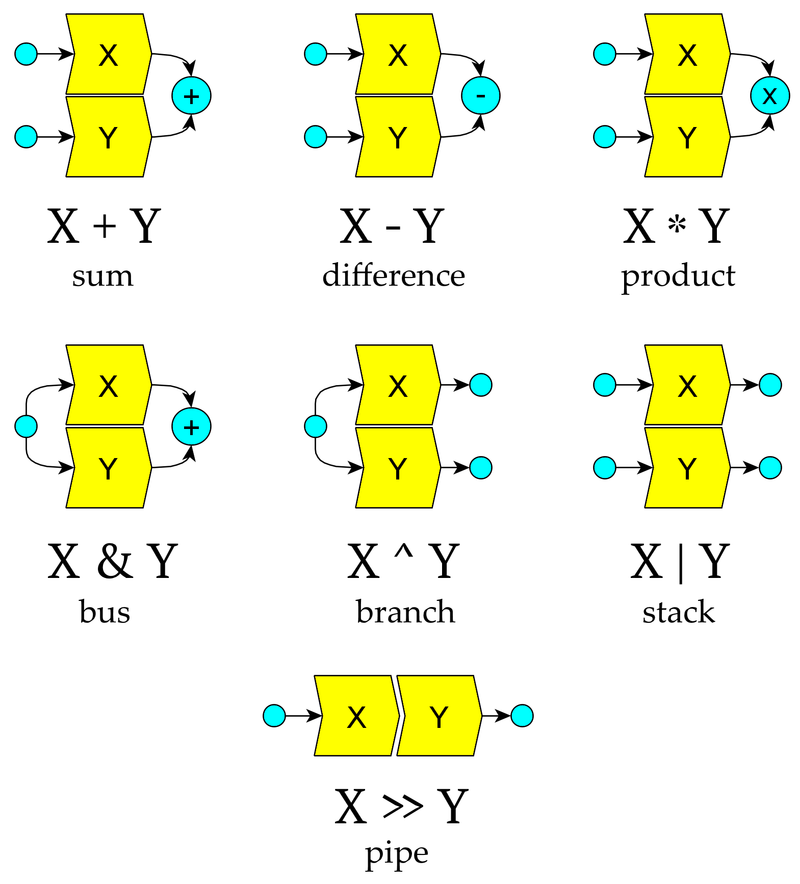
Custom operators are available for combining audio components inline.
In order of precedence, from highest to lowest:
---
| `-A` | negate `A` | `a` | `a` | Negates any number of outputs, even zero. |
| `!A` | thru `A` | `a` | same as inputs | Passes through extra inputs. |
| `A * B` | multiply `A` with `B` | `a` `+` `b` | `a` `=` `b` | Aka amplification, or ring modulation when both are audio signals. Number of outputs in `A` and `B` must match. |
| `A` `*` `constant` | multiply `A` | `a` | `a` | Broadcasts constant. Same applies to `constant * A`. |
| `A + B` | sum `A` and `B` | `a` `+` `b` | `a` `=` `b` | Aka mixing. Number of outputs in `A` and `B` must match. |
| `A` `+` `constant` | add to `A` | `a` | `a` | Broadcasts constant. Same applies to `constant + A`. |
| `A - B` | difference of `A` and `B` | `a` `+` `b` | `a` `=` `b` | Number of outputs in `A` and `B` must match. |
| `A` `-` `constant` | subtract from `A` | `a` | `a` | Broadcasts constant. Same applies to `constant - A`. |
| `A >> B` | pipe `A` to `B` | `a` | `b` | Aka chaining. Number of outputs in `A` must match number of inputs in `B`. |
| `A & B` | bus `A` and `B` | `a` `=` `b` | `a` `=` `b` | Sum `A` and `B`. `A` and `B` must have identical connectivity. |
| `A ^ B` | branch input to `A` and `B` in parallel | `a` `=` `b` | `a` `+` `b` | Number of inputs in `A` and `B` must match. |
| `A \| B` | stack `A` and `B` in parallel | `a` `+` `b` | `a` `+` `b` | Concatenates `A` and `B` inputs and outputs. |
---
In the table, `constant` denotes an `f32` or `f64` value.
All operators are associative, except the left associative `-`.
### Operators Diagram
### Broadcasting
Arithmetic operators are applied to outputs channel-wise.
Arithmetic between two components never broadcasts channels: channel arities have to match always.
Direct arithmetic with `f32` and `f64` values, however, broadcasts to an arbitrary number of channels.
The negation operator broadcasts also: `-A` is equivalent with `(0.0 - A)`.
For example, `A * constant(2.0)` and `A >> mul(2.0)` are equivalent and expect `A` to have one output.
On the other hand, `A * 2.0` works with any `A`, even *sinks*.
#### Thru
The thru (`!`) operator is syntactic sugar for chaining filters with similar connectivity.
It adjusts output arity to match input arity and passes through any missing outputs to the next node.
The missing outputs are parameters to the filter.
For example, while `lowpass()` is a 2nd order lowpass filter, `!lowpass() >> lowpass()`
is a steeper 4th order lowpass filter with identical connectivity.
### Generators, Filters and Sinks
Components can be broadly classified into generators, filters and sinks.
*Generators* have only outputs, while *filters* have both inputs and outputs.
Sinks are components with no outputs. Direct arithmetic on a sink translates to a no-op.
In the prelude, `sink()` returns a mono sink.
### Graph Combinators
Of special interest among operators are the four custom combinators:
*pipe* ( `>>` ), *bus* ( `&` ), *branch* ( `^` ), and *stack* ( `|` ).
The pipe is a serial operator where components appear in *processing* order. Branch, stack, and
arithmetic operators are parallel operators where components appear in *channel* order.
Bus is a commutative operator where components may appear in any order.
The other operators are not commutative in general.
All four are fully associative, and
each come with their own connectivity rules.
#### Pipe
The pipe ( `>>` ) operator builds traditional processing chains akin to composition of functions.
In `A >> B`, each output of `A` is piped to a matching input of `B`, so
the output arity of `A` must match the input arity of `B`.
It is possible to pipe a sink to a generator. This is similar to stacking.
Processing works as normal and the sink processes its inputs before the generator is run.
#### Branch
Where the arithmetic operators are reducing in nature,
the branch ( `^` ) operator splits a signal into parallel branches.
In `A ^ B`, both components receive the same input but their outputs are disjoint.
Because the components receive the same input, the number of inputs in `A` and `B` must match.
In `A ^ B`, the outputs of `A` appear first, followed with outputs of `B`.
Branching is useful for building *banks* of components such as filters.
#### Bus
The bus ( `&` ) operator can be thought of as an inline [audio bus](https://en.wikipedia.org/wiki/Audio_bus)
with a fixed set of input and output channels.
It builds signal buses from components with identical connectivity.
In `A & B`, the same input is sent to both `A` and `B`, and their outputs are mixed together.
Components in a bus may appear in any order.
The bus is especially useful because it does not alter connectivity:
we can always bus together any set of matching components
without touching the rest of the expression.
Both `A + B` and `A & B` are mixing operators. The difference between the two is that `A + B` is *reducing*:
`A` and `B` have their own, disjoint inputs, which are combined at the output.
In `A & B`, both components source from the same inputs, and the number of inputs must match.
#### Stack
The stack ( `|` ) operator builds composite components.
It can be applied to any two components.
As a graph operator, the stack corresponds to the *disjoint union*.
In `A | B`, the inputs and outputs of `A` and `B`
are disjoint and they are processed independently, in parallel.
In stacks, components are written in channel order.
In `A | B | C`, channels of `A` come first, followed by channels of `B`, then `C`.
## Expressions Are Graphs
The expression `A >> (B ^ C ^ D)` defines a signal processing graph.
It has whatever inputs `A` has, and outputs everything from `B` and `C` and `D` in parallel.
The whole structure is packed, monomorphized and inlined with the constituent nodes consumed.
If you want to reuse components, define them as functions or closures.
See the preludes for examples.
Connectivity is checked during compilation.
Mismatched connectivity will result in a compilation error complaining about mismatched
[`typenum`](https://crates.io/crates/typenum) [types](https://docs.rs/typenum/1.12.0/typenum/uint/struct.UInt.html).
The arrays `Frame<T, Size>` that connect components come from the
[`generic-array`](https://crates.io/crates/generic-array) and
[`numeric-array`](https://crates.io/crates/numeric-array) crates.
### Computational Structure
Graph combinators consume their arguments.
This prevents cycles and imposes an overall tree shape on the resulting computation graph.
Implicit cycle prevention means that the built structures are always computationally efficient
in the dataflow sense. All reuse of computed data takes place locally, inside combinators and components.
There are two main ways to structure the reuse of signals in FunDSP graph notation:
*branching* and *busing*. Both are exposed as fundamental operators,
guiding toward efficient structuring of computation.
Dataflow concerns are thus explicated in the graph notation itself.
## Input Modalities And Ranges
Some signals found flowing in audio networks.
| frequency | Hz | |
| phase | 0...1 | The wavetable oscillator uses this range. |
| time | s | |
| audio data | -1...1 | Inner processing may use any range that is convenient. However, only special output formats can store audio data outside this range. |
| stereo pan | -1...1 (left to right) | For ergonomy, consider clamping any pan input to this range. |
| control amount | 0...1 | If there is no natural interpretation of the parameter. |
## Signal Flow Analysis
FunDSP features a comprehensive signal flow system that analyzes
causal latencies and frequency responses in audio networks.
The system can calculate the [frequency response](https://en.wikipedia.org/wiki/Frequency_response)
of any *[linear network](https://en.wikipedia.org/wiki/Linear_filter)*
analytically by composing [transfer functions](https://en.wikipedia.org/wiki/Transfer_function#Linear_time-invariant_systems)
and folding constants. Linear networks are constructed from filters, delays, and the operations of:
* Mixing.
* Chaining. Chaining of filters and delays maintains linearity.
* Constant scaling. Signals may be scaled by constant factors.
Signal latencies are similarly analyzed from input to output in detail,
facilitating automatic removal of pre-delay from effects chains.
For example,
[FIR](https://en.wikipedia.org/wiki/Finite_impulse_response) filters
can be composed inline from single sample delays (the `tick` opcode) and arithmetic.
Signal flow analysis will readily reveal that a 2-point averaging filter
has zero gain at the [Nyquist](https://en.wikipedia.org/wiki/Nyquist_frequency) frequency,
while a 3-point averaging filter does not:
```rust
assert!((pass() & tick()).response(0, 22050.0).unwrap().norm() < 1.0e-9);
assert!((pass() & tick() & tick() >> tick()).response(0, 22050.0).unwrap().norm() > 0.1);
```
However, with appropriate scaling a 3-point FIR can vanish, too:
```rust
assert!((0.5 * pass() & tick() & 0.5 * tick() >> tick()).response(0, 22050.0).unwrap().norm() < 1.0e-9);
```
### List of Linear Filters
Verified frequency responses are available for all linear filters.
---
| `allpass` | allpass (2nd order) | frequency, Q | [Simper SVF](https://cytomic.com/files/dsp/SvfLinearTrapOptimised2.pdf) | |
| `allpole` | allpass (1st order) | delay | 1st order | Adjustable delay in samples. |
| `bandpass` | bandpass (2nd order) | frequency, Q | Simper SVF | |
| `bell` | peaking (2nd order) | frequency, Q, gain | Simper SVF | Adjustable amplitude gain. |
| `butterpass` | lowpass (2nd order) | frequency | [biquad](https://en.wikipedia.org/wiki/Digital_biquad_filter) | [Butterworth](https://en.wikipedia.org/wiki/Butterworth_filter) lowpass has a maximally flat passband and monotonic frequency response. |
| `dcblock` | DC blocker (1st order) | frequency | 1st order | Zero centers signal, countering any constant offset ("direct current"). |
| `fir` | FIR | - | [FIR](https://en.wikipedia.org/wiki/Finite_impulse_response) | |
| `follow` | lowpass (3rd order) | response time | nested 1st order | Smoothing filter with adjustable edge response time. |
| `highpass` | highpass (2nd order) | frequency, Q | Simper SVF | |
| `highpole` | highpass (1st order) | frequency | 1st order | |
| `highshelf` | high shelf (2nd order) | frequency, Q, gain | Simper SVF | Adjustable amplitude gain. |
| `lowpass` | lowpass (2nd order) | frequency, Q | Simper SVF | |
| `lowpole` | lowpass (1st order) | frequency | 1st order | |
| `lowshelf` | low shelf (2nd order) | frequency, Q, gain | Simper SVF | Adjustable amplitude gain. |
| `morph` | morphing (2nd order) | frequency, Q, morph | Simper SVF | Morphs between lowpass, peaking and highpass modes. |
| `notch` | notch (2nd order) | frequency, Q | Simper SVF | |
| `peak` | peaking (2nd order) | frequency, Q | Simper SVF | |
| `pinkpass` | lowpass (3 dB/octave) | - | mixed FIR / 1st order | Turns white noise into pink noise. |
| `resonator` | bandpass (2nd order) | frequency, bandwidth | biquad | Gain stays constant as bandwidth is varied. |
### List of Nonlinear Filters
Unlike linear filters, nonlinear filters may be sensitive to incoming signal level.
Due to nonlinearity, we do not attempt to calculate frequency responses for these filters.
---
| `moog` | lowpass (4th order) | frequency, Q | Moog ladder | Sensitive to input level. |
---
### Parametric Equalizer Recipe
In this example we make a 12-band, double precision parametric equalizer
using the peaking `bell` filter.
First, declare the processing pipeline.
Here we space the bands at 1 kHz increments starting from 1 kHz, set Q values to 1.0
and set gains of all bands to 0 dB initially:
```rust
use fundsp::hacker::*;
where `i` ranges from 0 to 11.
Set band 0 to amplify by 10 dB at 500 Hz with Q set to 2.0:
```rust
equalizer.node_mut(0).set_gain(db_amp(10.0));
equalizer.node_mut(0).set_center(500.0);
equalizer.node_mut(0).set_q(2.0);
```
For plotting the frequency response, we can query the equalizer.
Query equalizer gain at 1 kHz:
```rust
let decibel_gain_at_1k = equalizer.response_db(0, 1000.0).unwrap();
```
The default sample rate is 44.1 kHz. Set sample rate to 48 kHz:
```rust
equalizer.reset(Some(48_000.0));
```
---
## Free Functions
These free functions are available in the environment.
---
### Component Opcodes
The type parameters in the table refer to the hacker prelude.
`M`, `N`, `U` are type-level integers. They are `U0`, `U1`, `U2`...
---
| `add(x)` | `x` | `x` | Adds constant `x` to signal. |
| `allpass()` | 3 (audio, frequency, Q) | 1 | Allpass filter (2nd order). |
| `allpass_hz(f, q)` | 1 | 1 | Allpass filter (2nd order) centered at `f` Hz with Q `q`. |
| `allpass_q(q)` | 2 (audio, frequency) | 1 | Allpass filter (2nd order) with Q `q`. |
| `allpole` | 2 (audio, delay) | 1 | Allpass filter (1st order). 2nd input is delay in samples (`delay` > 0). |
| `allpole_delay(delay)` | 1 | 1 | Allpass filter (1st order) with `delay` in samples (`delay` > 0). |
| `bandpass()` | 3 (audio, frequency, Q) | 1 | Bandpass filter (2nd order). |
| `bandpass_hz(f, q)` | 1 | 1 | Bandpass filter (2nd order) centered at `f` Hz with Q `q`. |
| `bandpass_q(q)` | 2 (audio, frequency) | 1 | Bandpass filter (2nd order) with Q `q`. |
| `bell()` | 4 (audio, frequency, Q, gain) | 1 | Peaking filter (2nd order) with adjustable amplitude gain. |
| `bell_hz(f, q, gain)` | 1 | 1 | Peaking filter (2nd order) centered at `f` Hz with Q `q` and amplitude gain `gain`. |
| `bell_q(q, gain)` | 2 (audio, frequency) | 1 | Peaking filter (2nd order) with Q `q` and amplitude gain `gain`. |
| `brown()` | - | 1 | Brown noise. |
| `branch::<U, _, _>(f)` | `f` | `U * f` | Branch into `U` nodes from indexed generator `f`. |
| `branchf::<U, _, _>(f)`| `f` | `U * f` | Branch into `U` nodes from fractional generator `f`, e.g., `\| x \| resonator_hz(xerp(20.0, 20_000.0, x), xerp(5.0, 5_000.0, x))`. |
| `bus::<U, _, _>(f)` | `f` | `f` | Bus together `U` nodes from indexed generator `f`, e.g., `\| i \| mul(i as f64 + 1.0) >> sine()`. |
| `busf::<U, _, _>(f)` | `f` | `f` | Bus together `U` nodes from fractional generator `f`. |
| `butterpass()` | 2 (audio, frequency) | 1 | Butterworth lowpass filter (2nd order). |
| `butterpass_hz(f)` | 1 | 1 | Butterworth lowpass filter (2nd order) with cutoff frequency `f` Hz. |
| `clip()` | 1 | 1 | Clip signal to -1...1. |
| `clip_to(min, max)` | 1 | 1 | Clip signal to min...max. |
| `constant(x)` | - | `x` | Constant signal `x`. Synonymous with `dc`. |
| `dc(x)` | - | `x` | Constant signal `x`. Synonymous with `constant`. |
| `dcblock()` | 1 | 1 | Zero centers signal with cutoff frequency 10 Hz. |
| `dcblock_hz(f)` | 1 | 1 | Zero centers signal with cutoff frequency `f`. |
| `declick()` | 1 | 1 | Apply 10 ms of fade-in to signal. |
| `declick_s(t)` | 1 | 1 | Apply `t` seconds of fade-in to signal. |
| `delay(t)` | 1 | 1 | Delay of `t` seconds. Delay time is rounded to the nearest sample. |
| `dsf_saw()` | 2 (frequency, roughness) | 1 | Saw-like discrete summation formula oscillator. |
| `dsf_saw_r(roughness)` | 1 (frequency) | 1 | Saw-like discrete summation formula oscillator with roughness in 0...1. |
| `dsf_square()` | 2 (frequency, roughness) | 1 | Square-like discrete summation formula oscillator. |
| `dsf_square_r(roughness)`| 1 (frequency) | 1 | Square-like discrete summation formula oscillator with roughness in 0...1. |
| `envelope(f)` | - | `f` | Time-varying control `f` with scalar or tuple output, e.g., `\|t\| exp(-t)`. Synonymous with `lfo`. |
| `envelope2(f)` | 1 (x) | `f` | Time-varying, input dependent control `f` with scalar or tuple output, e.g., `\|t, x\| exp(-t * x)`. Synonymous with `lfo2`. |
| `envelope3(f)` | 2 (x, y) | `f` | Time-varying, input dependent control `f` with scalar or tuple output, e.g., `\|t, x, y\| y * exp(-t * x)`. Synonymous with `lfo3`. |
| `fdn(x)` | `x` | `x` | Encloses feedback circuit `x` (with equal number of inputs and outputs) using diffusive Hadamard feedback. |
| `feedback(x)` | `x` | `x` | Encloses feedback circuit `x` (with equal number of inputs and outputs). |
| `fir(weights)` | 1 | 1 | FIR filter with the specified weights, for example, `fir((0.5, 0.5))` |
| `follow(t)` | 1 | 1 | Smoothing filter with halfway response time `t` seconds. |
| `follow((a, r))` | 1 | 1 | Asymmetric smoothing filter with halfway attack time `a` seconds and halfway release time `r` seconds. |
| `goertzel()` | 2 (audio, frequency) | 1 (power) | Frequency detector. |
| `goertzel_hz(f)` | 1 (audio) | 1 (power) | Frequency detector of DFT component `f` Hz. |
| `highpass()` | 3 (audio, frequency, Q) | 1 | Highpass filter (2nd order). |
| `highpass_hz(f, q)` | 1 | 1 | Highpass filter (2nd order) with cutoff frequency `f` Hz and Q `q`. |
| `highpass_q(q)` | 2 (audio, frequency) | 1 | Highpass filter (2nd order) with Q `q`. |
| `highpole()` | 2 (audio, frequency) | 1 | Highpass filter (1st order). |
| `highpole_hz(f)` | 1 | 1 | Highpass filter (1st order) with cutoff frequency `f` Hz. |
| `highshelf()` | 4 (audio, frequency, Q, gain) | 1 | High shelf filter (2nd order) with adjustable amplitude gain. |
| `highshelf_hz(f, q, gain)`| 1 | 1 | High shelf filter (2nd order) centered at `f` Hz with Q `q` and amplitude gain `gain`. |
| `highshelf_q(q, gain)` | 2 (audio, frequency) | 1 | High shelf filter (2nd order) with Q `q` and amplitude gain `gain`. |
| `join::<U>()` | `U` | 1 | Average together `U` channels. Inverse of `split`. |
| `lfo(f)` | - | `f` | Time-varying control `f` with scalar or tuple output, e.g., `\|t\| exp(-t)`. Synonymous with `envelope`. |
| `lfo2(f)` | 1 (x) | `f` | Time-varying, input dependent control `f` with scalar or tuple output, e.g., `\|t, x\| exp(-t * x)`. Synonymous with `envelope2`. |
| `lfo3(f)` | 2 (x, y) | `f` | Time-varying, input dependent control `f` with scalar or tuple output, e.g., `\|t, x, y\| y * exp(-t * x)`. Synonymous with `envelope3`. |
| `limiter((a, r))` | 1 | 1 | Look-ahead limiter with attack time `a` seconds and release time `r` seconds. |
| `limiter_stereo((a, r))`| 2 | 2 | Stereo look-ahead limiter with attack time `a` seconds and release time `r` seconds. |
| `lowpass()` | 3 (audio, frequency, Q) | 1 | Lowpass filter (2nd order). |
| `lowpass_hz(f, q)` | 1 | 1 | Lowpass filter (2nd order) with cutoff frequency `f` Hz and Q `q`. |
| `lowpass_q(q)` | 2 (audio, frequency) | 1 | Lowpass filter (2nd order) with Q `q`. |
| `lowpole()` | 2 (audio, frequency) | 1 | 1-pole lowpass filter (1st order). |
| `lowpole_hz(f)` | 1 | 1 | 1-pole lowpass filter (1st order) with cutoff frequency `f` Hz. |
| `lowshelf()` | 4 (audio, frequency, Q, gain) | 1 | Low shelf filter (2nd order) with adjustable amplitude gain. |
| `lowshelf_hz(f, q, gain)`| 1 | 1 | Low shelf filter (2nd order) centered at `f` Hz with Q `q` and amplitude gain `gain`. |
| `lowshelf_q(q, gain)` | 2 (audio, frequency) | 1 | Low shelf filter (2nd order) with Q `q` and amplitude gain `gain`. |
| `map(f)` | `f` | `f` | Map channels freely, e.g., `map(\|i: &Frame<f64, U2>\| max(i[0], i[1]))`. |
| `meter(mode)` | 1 | 1 (meter) | Analyzes input and outputs a summary according to the metering mode. |
| `mls()` | - | 1 | White [MLS noise](https://en.wikipedia.org/wiki/Maximum_length_sequence) source. |
| `mls_bits(n)` | - | 1 | White MLS noise source from `n`-bit MLS sequence. |
| `monitor(mode, id)` | 1 | 1 | Pass-through node that analyzes data passed through as a parameter that can be queried. |
| `moog()` | 3 (audio, frequency, Q) | 1 | Moog resonant lowpass filter (4th order). |
| `moog_hz(f, q)` | 1 | 1 | Moog resonant lowpass filter (4th order) with cutoff frequency `f` and resonance `q`. |
| `moog_q(q)` | 2 (audio, frequency) | 1 | Moog resonant lowpass filter (4th order) with resonance `q`. |
| `morph` | 4 (audio, frequency, Q, morph) | 1 | Morphing filter with morph input in -1...1 (-1 = lowpass, 0 = peaking, 1 = highpass) |
| `morph_hz(f, q, morph)` | 1 | 1 | Morphing filter with center frequency `f`, Q `q` and morph `morph` (-1 = lowpass, 0 = peaking, 1 = highpass) |
| `mul(x)` | `x` | `x` | Multiplies signal with constant `x`. |
| `multijoin::<M, N>()` | `M * N` | `M` | Average `N` branches of `M` channels into one. Inverse of `multisplit`. |
| `multipass::<U>()` | `U` | `U` | Passes multichannel signal through. |
| `multisink::<U>()` | `U` | - | Consumes multichannel signal. |
| `multisplit::<M, N>()` | `M` | `M * N` | Splits `M` channels into `N` branches. |
| `multitap::<N>(min_delay, max_delay)` | `N + 1` (audio, delay...) | 1 | Tapped delay line with cubic interpolation. Number of taps is `N`. |
| `multitick::<U>()` | `U` | `U` | Multichannel single sample delay. |
| `multizero::<U>()` | - | `U` | Multichannel zero signal. |
| `noise()` | - | 1 | [White noise](https://en.wikipedia.org/wiki/White_noise) source. Synonymous with `white`. |
| `notch()` | 3 (audio, frequency, Q) | 1 | Notch filter (2nd order). |
| `notch_hz(f, q)` | 1 | 1 | Notch filter (2nd order) centered at `f` Hz with Q `q`. |
| `notch_q(q)` | 2 (audio, frequency) | 1 | Notch filter (2nd order) with Q `q`. |
| `oversample(x)` | `x` | `x` | 2x oversample enclosed node `x`. |
| `pan(pan)` | 1 | 2 | Fixed mono-to-stereo equal power panner with pan in -1...1. |
| `panner()` | 2 (audio, pan) | 2 | Mono-to-stereo equal power panner with pan in -1...1. |
| `pass()` | 1 | 1 | Passes signal through. |
| `peak()` | 3 (audio, frequency, Q) | 1 | Peaking filter (2nd order). |
| `peak_hz(f, q)` | 1 | 1 | Peaking filter (2nd order) centered at `f` Hz with Q `q`. |
| `peak_q(q)` | 2 (audio, frequency) | 1 | Peaking filter (2nd order) with Q `q`. |
| `pink()` | - | 1 | [Pink noise](https://en.wikipedia.org/wiki/Pink_noise) source. |
| `pinkpass()` | 1 | 1 | Pinking filter (3 dB/octave). |
| `pipe::<U, _, _>(f)` | `f` | `f` | Chain together `U` nodes from indexed generator `f`. |
| `pipef::<U, _, _>(f)` | `f` | `f` | Chain together `U` nodes from fractional generator `f`. |
| `pluck(f, gain, damping)` | 1 (excitation) | 1 | Karplus-Strong plucked string oscillator with frequency `f` Hz, `gain` per second (`gain` <= 1) and high frequency `damping` in 0...1. |
| `pulse()` | 2 (frequency, duty cycle) | 1 | Bandlimited pulse wave with duty cycle in 0...1. |
| `resonator()` | 3 (audio, frequency, bandwidth) | 1 | Constant-gain bandpass resonator (2nd order). |
| `resonator_hz(f, bw)` | 1 | 1 | Constant-gain bandpass resonator (2nd order) with center frequency `f` Hz and bandwidth `bw` Hz. |
| `reverb_stereo(wet, t)`| 2 | 2 | Stereo reverb with `wet` signal balance in 0...1 and reverberation time `t` in seconds. |
| `saw()` | 1 (frequency) | 1 | Bandlimited saw wave oscillator. |
| `saw_hz(f)` | - | 1 | Bandlimited saw wave oscillator at `f` Hz. |
| `shape(mode)` | 1 | 1 | Shape signal with waveshaper mode `mode`. |
| `shape_fn(f)` | 1 | 1 | Shape signal with waveshaper function `f`, e.g., `tanh`. |
| `sine()` | 1 (frequency) | 1 | Sine oscillator. |
| `sine_hz(f)` | - | 1 | Sine oscillator at `f` Hz. |
| `sink()` | 1 | - | Consumes signal. |
| `split::<U>()` | 1 | `U` | Split signal into `U` channels. |
| `square()` | 1 (frequency) | 1 | Bandlimited square wave oscillator. |
| `square_hz(f)` | - | 1 | Bandlimited square wave oscillator at frequency `f` Hz. |
| `stack::<U, _, _>(f)` | `U * f` | `U * f` | Stack `U` nodes from indexed generator `f`. |
| `stackf::<U, _, _>(f)` | `U * f` | `U * f` | Stack `U` nodes from fractional generator `f`, e.g., `\| x \| delay(xerp(0.1, 0.2, x))`. |
| `sub(x)` | `x` | `x` | Subtracts constant `x` from signal. |
| `sum::<U, _, _>(f)` | `U * f` | `f` | Sum `U` nodes from indexed generator `f`. |
| `sumf::<U, _, _>(f)` | `U * f` | `f` | Sum `U` nodes from fractional generator `f`, e.g., `\| x \| delay(xerp(0.1, 0.2, x))`. |
| `swap()` | 2 | 2 | Swap stereo channels. |
| `tag(id, value)` | - | 1 | Tagged constant with tag `id` (`i64`) and initial value `value` (`f64`). |
| `tap(min_delay, max_delay)` | 2 (audio, delay) | 1 | Tapped delay line with cubic interpolation. All times are in seconds. |
| `tick()` | 1 | 1 | Single sample delay. |
| `timer(id)` | - | - | Timer node that presents time as a parameter that can be queried. |
| `triangle()` | 1 (frequency) | 1 | Bandlimited triangle wave oscillator. |
| `triangle_hz(f)` | - | 1 | Bandlimited triangle wave oscillator at `f` Hz. |
| `wave32(wave, channel, loop_point)` | - | 1 | Play back a channel of `Wave32`. Optional loop point is the index to jump to at the end of the wave. |
| `wave64(wave, channel, loop_point)` | - | 1 | Play back a channel of `Wave64`. Optional loop point is the index to jump to at the end of the wave. |
| `white()` | - | 1 | [White noise](https://en.wikipedia.org/wiki/White_noise) source. Synonymous with `noise`. |
| `zero()` | - | 1 | Zero signal. |
#### Subsampled Controls
`envelope(f)` is a node that samples a time varying control function `f`.
For example, `envelope(|t| exp(-t))` is an exponentially decaying [envelope](https://en.wikipedia.org/wiki/Envelope_(music)).
A control function is something that is expected to change relatively slowly.
Therefore, we can save time by not calling it at every sample.
The argument to the function is time in seconds.
Whenever the node is reset, time resets to zero.
`envelope` is generic over channel arity:
The return type of the function - scalar or tuple - determines the number of outputs.
The samples are spaced at an average of 2 ms apart, jittered by noise derived from pseudorandom phase.
The values in between are linearly interpolated.
`lfo` (Low Frequency Oscillator) is another name for `envelope`.
#### Indexed And Fractional Generator Functions
`branch`, `bus`, `pipe`, `sum` and `stack` are opcodes that combine multiple nodes,
according to their first generic argument.
They accept a generator function that is issued `i64` integers starting from 0.
For example, to create 20 pseudorandom noise bands in 1 kHz...2 kHz:
```rust
use fundsp::hacker::*;
These are arguments to the `shape` opcode.
- `Shape::Clip`: Clip signal to -1...1.
- `Shape::ClipTo(minimum, maximum)`: Clip signal between the two arguments.
- `Shape::Tanh(hardness)`: Apply `tanh` distortion with configurable hardness. Argument to `tanh` is multiplied by the hardness value.
- `Shape::Softsign(hardness)`: Apply `softsign` distortion with configurable hardness. Argument to `softsign` is multiplied by the hardness value.
- `Shape::Crush(levels)`: Apply a staircase function with configurable number of levels per unit.
- `Shape::SoftCrush(levels)`: Apply a smooth staircase function with configurable number of levels per unit.
#### Tagged Constants As Parameters
Tagged single channel constants can be instantiated with `tag(id, value)`, where `id` is `i64` and the initial value `value` is `f64`.
Tagged constants enable a simple parameter system where a parameter can be set (recursively) with `set(id, value)`
and queried (recursively) with `get(id)`. `set` sets all matching parameters to the value,
while `get` retrieves the first matching parameter, if any.
The `timer(id)` opcode instantiates current time in seconds as a parameter that can be queried.
It has no inputs or outputs; it can be added to any node by stacking.
#### Metering Modes
The `monitor(mode, id)` opcode is a pass-through node that presents
some aspect of data passed through as parameter `id`. Metering modes are:
- `Meter::Sample`: Retains the latest value passed through.
- `Meter::Peak(smoothing)`: Peak amplitude meter with `smoothing` as per-sample smoothing factor in 0...1.
- `Meter::Rms(smoothing)`: Root mean square meter with `smoothing` as per-sample smoothing factor in 0...1.
- `Meter::Detect(frequency)`: Detects presence of a single frequency. Outputs detected power.
The same modes are used in the `meter` opcode.
---
### Math And Utility Functions
---
| `abs(x)` | absolute value of `x` |
| `a_weight(f)` | [A-weighted](https://en.wikipedia.org/wiki/A-weighting) amplitude response at `f` Hz (normalized to 1.0 at 1 kHz) |
| `bpm_hz(bpm)` | convert `bpm` BPM (beats per minute) to Hz |
| `ceil(x)` | ceiling function |
| `clamp(min, max, x)` | clamp `x` between `min` and `max` |
| `clamp01(x)` | clamp `x` between 0 and 1 |
| `clamp11(x)` | clamp `x` between -1 and 1 |
| `cos(x)` | cos |
| `cos_hz(f, t)` | cosine that oscillates at `f` Hz at time `t` seconds |
| `cubed(x)` | cube of `x` |
| `db_amp(x)` | convert `x` dB to amplitude (or gain) with 0 dB = 1.0 |
| `delerp(x0, x1, x)` | recover linear interpolation amount `t` in 0...1 from interpolated value |
| `delerp11(x0, x1, x)` | recover linear interpolation amount `t` in -1...1 from interpolated value |
| `dexerp(x0, x1, x)` | recover exponential interpolation amount `t` in 0...1 from interpolated value (`x0`, `x1`, `x` > 0) |
| `dexerp11(x0, x1, x)` | recover exponential interpolation amount `t` in -1...1 from interpolated value (`x0`, `x1`, `x` > 0) |
| `dissonance(f0, f1)` | dissonance amount in 0...1 between pure tones at `f0` and `f1` Hz |
| `dissonance_max(f)` | maximally dissonant pure frequency above `f` Hz |
| `downarc(x)` | concave quarter circle easing curve (inverse function of `uparc` in 0...1) |
| `ease_noise(ease, seed, x)` | value noise in -1...1 interpolated with easing function `ease`, e.g., `smooth3` |
| `ease_noise((rise, fall), seed, x)` | value noise in -1...1 interpolated with easing function `rise` in rising segments and `fall` in falling segments, e.g., `(uparc, downarc)` |
| `exp(x)` | exp |
| `exp10(x)` | 10 to the power of `x` |
| `exp2(x)` | 2 to the power of `x` |
| `floor(x)` | floor function |
| `fract(x)` | fract function |
| `fractal_noise(seed, octaves, roughness, x)` | fractal spline noise (`octaves` > 0, `roughness` > 0) |
| `fractal_ease_noise(ease, seed, octaves, roughness, x)` | fractal ease noise (`octaves` > 0, `roughness` > 0) interpolated with easing function `ease` |
| `id(x)` | identity function (linear easing function) |
| `lerp(x0, x1, t)` | linear interpolation between `x0` and `x1` with `t` in 0...1 |
| `lerp11(x0, x1, t)` | linear interpolation between `x0` and `x1` with `t` in -1...1 |
| `log(x)` | natural logarithm |
| `log10(x)` | base 10 logarithm |
| `log2(x)` | binary logarithm |
| `midi_hz(x)` | convert [MIDI](https://en.wikipedia.org/wiki/MIDI) note number `x` to Hz (69.0 = *A4* = 440 Hz) |
| `min(x, y)` | minimum of `x` and `y` |
| `max(x, y)` | maximum of `x` and `y` |
| `m_weight(f)` | [M-weighted](https://en.wikipedia.org/wiki/ITU-R_468_noise_weighting) amplitude response at `f` Hz (normalized to 1.0 at 1 kHz) |
| `pow(x, y)` | `x` raised to the power `y` |
| `rnd(i)` | pseudorandom number in 0...1 from integer `i` |
| `round(x)` | round `x` to nearest integer |
| `semitone(x)` | convert interval `x` semitones to frequency ratio |
| `signum(x)` | sign of `x` |
| `sin(x)` | sin |
| `sin_hz(f, t)` | sine that oscillates at `f` Hz at time `t` seconds |
| `smooth3(x)` | smooth cubic easing polynomial |
| `smooth5(x)` | smooth 5th degree easing polynomial (commonly used in computer graphics) |
| `smooth7(x)` | smooth 7th degree easing polynomial |
| `smooth9(x)` | smooth 9th degree easing polynomial |
| `softexp(x)` | polynomial alternative to `exp` |
| `softmix(x, y, bias)` | weighted average of `x` and `y` according to `bias`: polynomial softmin when `bias` < 0, average when `bias` = 0, polynomial softmax when `bias` > 0 |
| `softsign(x)` | softsign function, a polynomial alternative to `tanh` |
| `squared(x)` | square of `x` |
| `sqrt(x)` | square root of `x` |
| `spline(x0, x1, x2, x3, t)` | [Catmull-Rom](https://en.wikipedia.org/wiki/Cubic_Hermite_spline#Catmull%E2%80%93Rom_spline) cubic interpolation between `x1` and `x2`, taking `x0` and `x3` into account |
| `spline_mono(x0, x1, x2, x3, t)` | [monotonic cubic interpolation](https://en.wikipedia.org/wiki/Monotone_cubic_interpolation) between `x1` and `x2`, taking `x0` and `x3` into account |
| `spline_noise(seed, x)`| value noise in -1...1 interpolated with a cubic spline, with one interpolation point per integer cell |
| `tan(x)` | tan |
| `tanh(x)` | hyperbolic tangent |
| `uparc(x)` | convex quarter circle easing curve (inverse function of `downarc` in 0...1) |
| `xerp(x0, x1, t)` | exponential interpolation between `x0` and `x1` (`x0`, `x1` > 0) with `t` in 0...1 |
| `xerp11(x0, x1, t)` | exponential interpolation between `x0` and `x1` (`x0`, `x1` > 0) with `t` in -1...1 |
---
### Easing Functions
*Easing functions* are interpolation curves that remap the range 0...1.
These math functions have the shape of an easing function.
| `cubed(x)` | cube of `x` |
| `downarc(x)` | concave quarter circle easing curve (inverse function of `uparc` in 0...1) |
| `id(x)` | identity function (linear easing function) |
| `smooth3(x)` | smooth cubic easing polynomial |
| `smooth5(x)` | smooth 5th degree easing polynomial (commonly used in computer graphics) |
| `smooth7(x)` | smooth 7th degree easing polynomial |
| `smooth9(x)` | smooth 9th degree easing polynomial |
| `squared(x)` | square of `x` |
| `sqrt(x)` | square root of `x` |
| `uparc(x)` | convex quarter circle easing curve (inverse function of `downarc` in 0...1) |
---
### Noise Functions


---
## Examples
Some examples of graph expressions.
---
| `pass() ^ pass()` | 1 | 2 | mono-to-stereo splitter |
| `split::<U2>()` | 1 | 2 | -..- |
| `mul(0.5) + mul(0.5)` | 2 | 1 | stereo-to-mono mixdown (inverse of mono-to-stereo splitter) |
| `join::<U2>()` | 2 | 1 | -..- |
| `pass() ^ pass() ^ pass()` | 1 | 3 | mono-to-trio splitter |
| `split::<U3>()` | 1 | 3 | -..- |
| `sink() \| zero()` | 1 | 1 | replace signal with silence |
| `mul(0.0)` | 1 | 1 | -..- |
| `mul(db_amp(3.0))` | 1 | 1 | amplify signal by 3 dB |
| `sink() \| pass()` | 2 | 1 | extract right channel |
| `pass() \| sink()` | 2 | 1 | extract left channel |
| `sink() \| zero() \| pass()` | 2 | 2 | replace left channel with silence |
| `mul(0.0) \| pass()` | 2 | 2 | -..- |
| `mul((0.0, 1.0))` | 2 | 2 | -..- |
| `pass() \| sink() \| zero()` | 2 | 2 | replace right channel with silence |
| `pass() \| mul(0.0)` | 2 | 2 | -..- |
| `mul((1.0, 0.0))` | 2 | 2 | -..- |
| `(pass() & tick()) * 0.5` | 1 | 1 | 2-point averaging FIR filter |
| `fir((0.5, 0.5))` | 1 | 1 | -..- |
| `fir(Frame::from([0.5, 0.5]))` | 1 | 1 | -..- |
| `!butterpass() >> lowpole()` | 2 | 1 | 2nd order and 1-pole lowpass filters in series (3rd order) |
| `!butterpass() >> !butterpass() >> butterpass()` | 2 | 1 | triple lowpass filter in series (6th order) |
| `!resonator() >> resonator()` | 3 | 1 | double resonator in series (4th order) |
| `oversample(sine_hz(f) * f * m + f >> sine())` | - | 1 | Oversampled [FM (frequency modulation)](https://ccrma.stanford.edu/~jos/sasp/Frequency_Modulation_FM_Synthesis.html) oscillator at `f` Hz with modulation index `m` |
| `sine() & mul(2.0) >> sine()` | 1 | 1 | frequency doubled dual sine oscillator |
| `envelope(\|t\| exp(-t)) * noise()` | - | 1 | exponentially decaying white noise |
| `feedback(delay(1.0) * db_amp(-3.0))` | 1 | 1 | 1 second feedback delay with 3 dB attenuation |
| `feedback((delay(1.0) \| delay(1.0)) >> swap() * db_amp(-6.0))` | 2 | 2 | 1 second ping-pong delay with 6 dB attenuation. |
| `sine() & mul(semitone(4.0)) >> sine() & mul(semitone(7.0)) >> sine()` | 1 | 1 | major chord |
| `dc(midi_hz(72.0)) >> sine() & dc(midi_hz(76.0)) >> sine() & dc(midi_hz(79.0)) >> sine()` | 0 | 1 | C major chord generator |
| `!zero()` | 0 | 0 | A null node. Stacking it with another node modifies its sound subtly, as the hash is altered. |
| `!-!!!--!!!-!!--!zero()` | 0 | 0 | Hot-rodded null node outfitted with a custom hash. Uses more electricity. |
---
### Examples From The Prelude
Many functions in the prelude itself are defined as graph expressions.
---
| `brown()` | - | 1 | `white() >> lowpole_hz(10.0) * constant(13.7)` |
| `goertzel_hz(f)` | 1 | 1 | `(pass() \| constant(f)) >> goertzel()` |
| `mls()` | - | 1 | `mls_bits(29)` |
| `pink()` | - | 1 | `white() >> pinkpass()` |
| `saw_hz(f)` | - | 1 | `constant(f) >> saw()` |
| `sine_hz(f)` | - | 1 | `constant(f) >> sine()` |
| `square_hz(f)` | - | 1 | `constant(f) >> square()` |
| `triangle_hz(f)` | - | 1 | `constant(f) >> triangle()` |
| `zero()` | - | 1 | `constant(0.0)` |
---
### Equivalent Expressions ###
There are usually many ways to express a particular graph. The following expression pairs are identical.
---
| `(pass() ^ mul(2.0)) >> sine() + sine()` | `sine() & mul(2.0) >> sine()` | Busing is often more convenient than explicit branching followed with summing. |
| `--sink()-42.0^sink()&---sink()*3.14` | `sink()` | Branching, busing and arithmetic on sinks are no-ops. |
| `constant(0.0) \| dc(1.0)` | `constant((0.0, 1.0))` | Stacking concatenates channels. |
| `sink() \| zero()` | `zero() \| sink()` | The order does not matter because `sink()` only adds an input, while `zero()` only adds an output. |
| `(butterpass() ^ (sink() \| pass())) >> butterpass()` | `!butterpass() >> butterpass()` | Running a manual bypass. |
| `!(noise() \| noise())` | `!noise()` | The thru operator nullifies any generator. |
---
### Audio Graph Types
The `AudioNode` component system represents audio network structure at the type level.
The representation contains input and output arities,
which are encoded as types `U0`, `U1`, ..., by the `typenum` crate.
The associated types are `AudioNode::Inputs` and `AudioNode::Outputs`.
The representation contains sample and inner processing types when applicable, encoded in that order.
These are chosen statically. The associated sample type, which is used to transport
data between nodes, is `AudioNode::Sample`.
The preludes employ the wrapper type `An<X: AudioNode>`
containing operator overloads and other trait implementations.
The wrapper also implements either of `AudioUnit32` or `AudioUnit64` traits.
The type encoding is straightforward. As an example, in the hacker prelude
```rust
noise() & constant(440.0) >> sine()
```
is represented as
```rust
An<Bus<f64, Noise<f64>, Pipe<f64, Constant<U1, f64>, Sine<f64>>>>
```
The compiler reports these types in an opaque form.
An attached utility, `examples/type.rs`, can unscramble such opaque types.
This invocation prints the above type:
```sh
cargo run --example type -- "fundsp::combinator::An<Bus<f64, Noise<f64>, Pipe<f64, Constant<typenum::uint::UInt<typenum::uint::UTerm, typenum::bit::B1>, f64>, Sine<f64>>>>"
```
It is also possible to declare the return type as an `impl AudioNode`.
However, this type is also opaque and cannot be stored as an `AudioNode`;
conversion to `AudioUnit32` or `AudioUnit64` may be necessary in this case.
Declaring the full arity in the signature does enable use of the node
in further combinations. For example:
```rust
fn split_quad() -> An<impl AudioNode<Sample = f64, Inputs = U1, Outputs = U4>> {
pass() ^ pass() ^ pass() ^ pass()
}
```
---
## License
Licensed under either of <a href="LICENSE-APACHE">Apache License, Version 2.0</a>
or <a href="LICENSE-MIT">MIT license</a> at your option.
Unless you explicitly state otherwise, any contribution intentionally submitted
for inclusion in FunDSP by you, as defined in the Apache-2.0 license,
shall be dual licensed as above, without any additional terms or conditions.


