
freeswitch-log-parser





Rust library for parsing FreeSWITCH log files. Three-layer streaming
architecture, no regex, single runtime dependency (freeswitch-types
for typed enums).
Layers
Layer 1: parse_line()       &str -> RawLine        (stateless, zero-alloc)
Layer 2: LogStream          Iterator -> LogEntry    (structural state machine)
Layer 3: SessionTracker     LogStream -> EnrichedEntry (per-UUID state)
Layer 1 classifies individual log lines into five formats (Full, System, UuidContinuation, BareContinuation, Truncated) and extracts positional fields (UUID, timestamp, log level, source, message).
Layer 2 groups continuation lines, detects block boundaries
(CHANNEL_DATA dumps, SDP bodies), reassembles multi-line variable
values, and classifies messages into semantic MessageKind variants:
Execute, Dialplan, ChannelData, ChannelField, Variable,
SdpMarker, StateChange, CodecNegotiation, Media,
ChannelLifecycle, SipInvite, EventSocket, General, plus the
synthetic FileChange/DateChange markers. SipInvite is the
canonical sip_call_id ↔ channel_uuid correlation primitive — sofia
emits it for every inbound and outbound call regardless of dialplan.
Every entry carries both a typed Block and raw attached lines.
Codec negotiation blocks are typed per media type: audio and video traces
carry different fields and never share a block, and near-match verdicts are
recorded rather than treated as parse failures. With the sdp feature,
Block::sdp_codecs() parses an SDP body on demand through
freeswitch-types — the only place text and DTMF payloads appear, since the
negotiation trace never mentions them. It is off by default so a Layer 2
consumer keeps the crate's minimal dependency tree; fslog enables it.
Layer 3 maintains per-UUID session state (dialplan context, channel
state, learned variables, call direction, caller/destination numbers,
negotiated codecs per media type)
and propagates it across entries. Also links bridged a-leg ↔ b-leg
sessions via other_leg_uuid — from the explicit Peer UUID: suffix
when present, by matching a live b-leg channel_name when FreeSWITCH
omits it, or by mod_loopback's A/B leg naming. Conference membership is
tracked per conference instance, so a name reused by a later conference
does not merge the two; SessionTracker::conference_members lists an
instance's UUIDs. SessionState::variable reads a learned variable by
typed name, taking any of freeswitch-types' variable-name enums. Yields
EnrichedEntry with a SessionSnapshot alongside the raw LogEntry.
Each layer wraps the previous and can be used independently.
Alongside them the crate exposes the primitives a consumer would
otherwise re-derive: find_uuids/is_uuid locate channel UUIDs inside a
message or a needle without a regex, for_each_peer_uuid walks the
channel variables that name another leg (for_each_peer_uuid_with takes a
predicate for names a deployment adds), parse_bridge_args reads a
bridge() argument list, and log_rotation_stamp/normalize_entry_timestamp
put a rotated filename and an entry timestamp into one comparable form.
For rewriting log text — redacting a caller id, colorizing a channel
name — message_fields and LogEntry::fields return the byte ranges the
classifier located (FieldKind::ChannelName, CallerIdNumber, CallId,
IpAddr, …), each carrying the FieldLocation that says whether it
indexes the message or an attached line. LogEntry::render_with applies
a replacement per span; overlaps and character boundaries come back as
RenderError rather than a panic. fslog --stats reports which kinds a
corpus yields.
Performance
Built to handle the worst mod_logfile produces — 2 KiB buffer
truncations, multi-line CHANNEL_DATA dumps with embedded SDP/XML,
write-contention collisions. An 11 MB fixture (185 physical lines
averaging ~60 KB each) parses in ~60 ms. LogEntry::attached uses
a compact contiguous buffer (AttachedLines) instead of
Vec<String> to amortize allocations on CHANNEL_DATA-heavy entries
— iteration via &entry.attached works unchanged.
Usage
use ;
use ;
let lines = stdin.lock.lines.map;
let stream = new;
for enriched in new
Unclassified data tracking
Lines that can't be fully classified are tracked, never silently dropped:
use ;
let mut stream = new
.unclassified_tracking;
for entry in stream.by_ref
let stats = stream.stats;
eprintln!;
Custom relationship detection
The built-in leg linking handles standard FreeSWITCH patterns. For application-specific patterns (Lua API results, custom SIP headers), register a hook:
let tracker = new
.with_post_hook;
A pre-hook (with_pre_hook) runs before built-in detection, so state it
seeds is visible to the built-in patterns of the same entry.
See examples/custom_hooks.rs for a complete example.
Multi-file input with segment tracking
TrackedChain concatenates named input segments (typically rotated log
files) into a single iterator and records where each segment starts.
SegmentTracker then maps any line number back to its source file —
useful for emitting FileChange markers or reporting errors with the
original filename:
use ;
let segments = vec!;
let = new;
let stream = new;
// ... consume stream; query tracker.segment_for_line(n) as needed.
fslog binary
The crate ships an fslog CLI that turns the parser into a log-search
tool: structured, UUID-aware, and able to follow a call across its
bridged and transferred legs. It reads rotated .xz files directly and
chains them in date order, so a single query spans the whole retention
window.
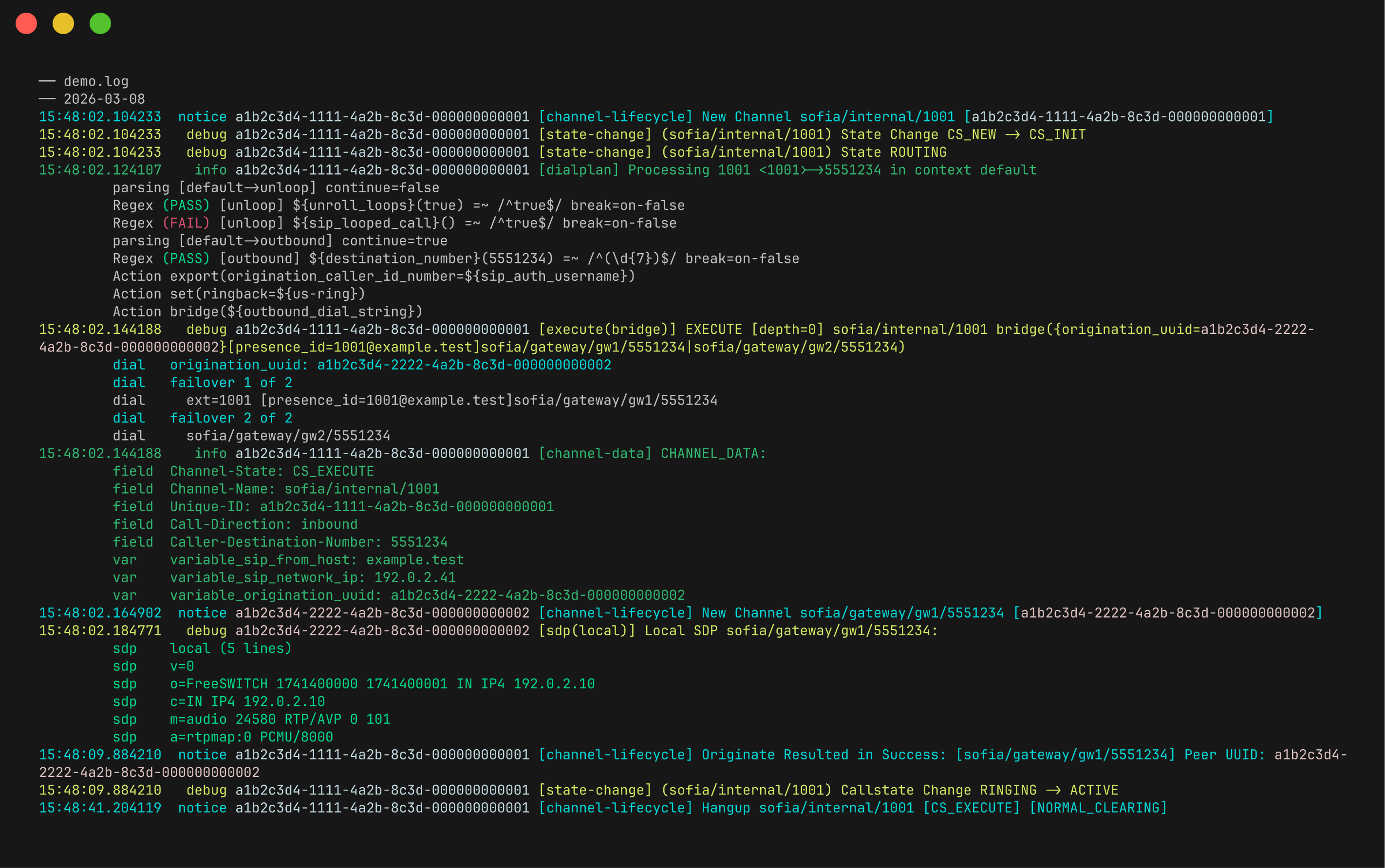
fslog read docs/demo.log --blocks — one synthetic call, start to hangup.
Install
Each release carries an amd64 and an arm64 .deb (binary plus
bash/zsh/fish completions), the same binaries standalone, and
SHA256SUMS:
curl -LO https://github.com/ticpu/freeswitch-log-parser/releases/latest/download/fslog_<version>_amd64.deb
sudo dpkg -i fslog_<version>_amd64.deb
They are built in a Debian bullseye container, so they run on any glibc
2.30 or newer — Debian 11+, Ubuntu 20.04+, RHEL 9+ — and need only
liblzma5 beyond libc. make deb reproduces them locally with podman
(DEB_ARCH=arm64 for the other architecture).
From source, build with cargo build --release --features cli for
everything below, or --features tui to also get the monitor
dashboard. The library itself pulls no CLI dependencies unless a feature
is enabled.
Commands
| Command | Purpose |
|---|---|
fslog list |
List discovered log files with dates and sizes |
fslog search |
Filter entries across many files (date range, UUID, level, pattern) |
fslog read [FILE] |
Parse a single file (or stdin with -) |
fslog tail [FILE] |
Follow a file live, parsed and colorized |
fslog monitor |
Live TUI call table (requires --features tui) |
fslog completions <SHELL> |
Emit a shell completion script |
Global flags: --dir <PATH> (or FSLOG_DIR, default
/var/log/freeswitch), --color auto|always|never, --pager (alias
--less), --version.
Output goes straight to stdout unless --pager is given, and the pager is
started only once there is something to show, so an empty search never leaves
less holding the terminal. FSLOG_PAGER overrides the command (default
less -RFX); tail and completions never page.
search
fslog search [OPTIONS] [PATTERN]
PATTERN is a case-insensitive fixed-string shorthand for --fgrep.
Filtering:
-u, --uuid <UUID>— session UUID substring, matched against the channel-UUID column; repeat for OR matching-l, --level <LEVEL>— minimum severity (debug…console)-c, --category <KIND>— message kind (execute,dialplan,media, …); repeat for OR matching--fgrep <PATTERN>— case-insensitive fixed-string match on the message--grep <REGEX>— regex match on the message--codec <NAME>— codec named in a negotiation or SDP block, including on a stream the SDP holds, case-insensitive; repeat for OR matching--match-blocks— also match--fgrep/--grep/PATTERNinside attached block lines (SDP, CHANNEL_DATA, codec negotiation), not just the message--related— expand matching sessions to their bridged/transferred peer legs (originate,bridge(),uuid_bridge,Other-Leg-Unique-ID, peer-UUID channel variables, mod_loopback A/B legs) and to everyone in the same conference
Pattern search reads the message field; -u reads the channel-UUID column.
Neither reaches the other's, so --grep <uuid> shows only the lines that name
the session and -u <uuid> only the lines it produced. Entries kept out by
that boundary alone are counted and reported on stderr at end of run, with the
flag — and where the pattern names a UUID, the command — that widens to them:
$ fslog read --grep 393d8167-062d-4652-b86e-c4e0acf488ff
17:03:56.190807  notice 393d8167-…88ff [channel-lifecycle] New Channel sofia/…
note: 49 more entries carry this pattern in the channel-UUID column, which --grep does not search
hint: rerun with -u 393d8167-062d-4652-b86e-c4e0acf488ff
Context (grep-style), with -- dividers between non-contiguous groups:
-A, --after-context <N>,-B, --before-context <N>,-C, --context <N>
Output and selection:
--blocks— expand structured content inline (see below)--session— annotate each entry with tracked state (context, channel state, channel name, conference and member id)--stats/--unclassified— summary and unclassified-line report-n, --line-numbers— show physical line numbers--from <DATE>/--until <DATE>— bound discovery (progressive:2026-03,2026-03-08,2026-03-08T15:48)--on <DATE>— a single day;--today— today, in the machine's local timezone--file <FILE>— scan explicit files instead of date discovery (repeatable)-y, --yes— skip the confirmation prompt for large scans
Reading the output
Each entry is one line — time, level, UUID, message kind, message — followed by whatever structure it carries. Time and level share the level's color, so a run of one severity reads as a band down the left edge.
UUIDs get a stable per-call truecolor, in the UUID column and wherever one appears inside a message or a continuation line, so a bridge target is the same color as the leg it names.
Continuation lines the parser did not fold into a typed block — dialplan
condition traces, EXECUTE output — print inline under --blocks, with
(PASS) and (FAIL) verdicts colored. Without --blocks they collapse to
a count, unless there is only one.
A dialplan block prints its channel once, on the header, and every line under it starts with what differs:
19:06:09.550802    info 9865d278-…78f2 [dialplan] Dialplan: sofia/internal/1262@pbx:5062
         parsing [default->unloop] continue=false
         Regex (PASS) [unloop] ${unroll_loops}(true) =~ /^true$/ break=on-false
         Regex (FAIL) [unloop] ${sip_looped_call}() =~ /^true$/ break=on-false
         Action set(call_debug=false)
--blocks also expands:
- CHANNEL_DATA — every field and variable, values in full
- SDP — the body, tagged local or remote, over a summary of the codecs and DTMF/comfort-noise payloads it offers and of the streams it holds or the parser reads no payload type from
- Codec negotiation — offered-versus-local comparisons and what matched
- Dial strings —
bridge()andatt_xfer()arguments broken into their global variables, failover groups and endpoints, withARRAY::values split into entries andpresence_idsurfaced as the extension
Speed
search decompresses and parses only what it must. When the search term is
a full UUID or a SIP Call-ID — identifiers that cannot span a line break —
candidate files are scanned for the raw bytes in parallel first, and those
that cannot match are never parsed. Free-text and regex searches read
everything, because a match there can legitimately span an entry and the
continuation lines the parser reassembles into it.
Scanning a large set prompts first; -y skips the prompt, and
FSLOG_CONFIRM_SIZE (bytes) moves the threshold. When nothing matches,
search reports the span of log files on hand, so "not in these logs" is
distinguishable from "already rotated away".
Examples
# Follow one call across all its legs, with session state
# grep a string with two lines of context on each side
# Find calls by an SDP attribute that only appears in the media block
# Every leg that negotiated or was offered opus, with the codec detail
# Errors and worse from one session, expanding structured blocks
# Today's dialplan and execute traces, expanded
Related crates
FreeSWITCH and SIP crates by the same author, usable independently:
freeswitch-types— typed FreeSWITCH enums (call direction, channel/call state, hangup causes). This crate's only runtime dependency.freeswitch-sofia-trace-parser— parses sofia'stportSIP traces. Complements this crate:fsloggives you the channel-level view, the trace parser gives you the SIP messages behind it.freeswitch-esl-tokio— async ESL client, for reading events off a live switch rather than off its logs.sip-uri— RFC 3261 SIP/SIPS, RFC 3966tel:, RFC 8141 URN parser. Zero dependencies.sip-header— SIP header field parsers (name-addr, Call-Info, History-Info, Geolocation, conference-info).
License
LGPL-2.1-or-later