# FlowDB Supabase Server — Web UI with Axum
[« Back to Tutorials](../index.md)
---
In this tutorial, you'll build a **Supabase-like API server** with an HTML/JS web UI using **Axum** on top of FlowDB's JsonDB layer.
By the end, you will have:
- A REST API for user auth (signup/login) and todo CRUD
- Row-Level Security (RLS) enforced on every request
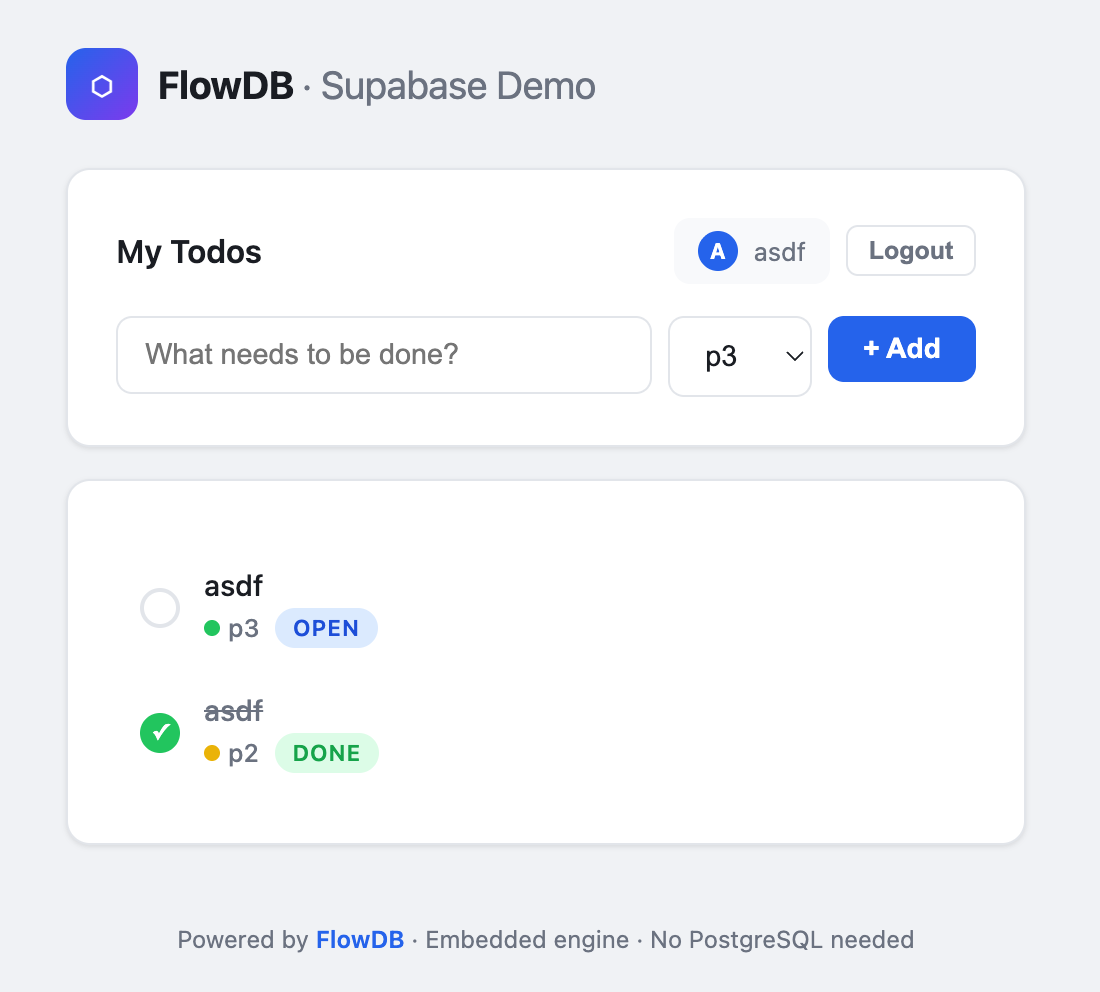
- A single-page web UI that consumes the API
- Everything running in a single binary — no PostgreSQL, no Docker
> **Source code**: [`examples/supabase-server.rs`](https://github.com/restsend/flowdb/blob/main/examples/supabase-server.rs)
> **UI template**: [`examples/supabase-ui.html`](https://github.com/restsend/flowdb/blob/main/examples/supabase-ui.html)
---
## Step 1 — Dependencies
Add to `Cargo.toml`:
```toml
[dependencies]
flowdb = "0.6"
serde = { version = "1", features = ["derive"] }
serde_json = "1"
tokio = { version = "1", features = ["full"] }
axum = "0.8"
tower-http = { version = "0.6", features = ["cors"] }
tracing-subscriber = "0.3"
tempfile = "3"
```
---
## Step 2 — Application State
```rust
use std::sync::Arc;
use flowdb::jsondb::JsonDB;
struct AppState {
db: JsonDB,
}
```
We'll wrap `AppState` in `Arc` so it can be shared across handler closures.
---
## Step 3 — Request / Response Types
```rust
use serde::{Deserialize, Serialize};
#[derive(Deserialize)]
struct SignUpReq { email: String, password: String }
#[derive(Serialize)]
struct AuthRes { user_id: String, token: String }
#[derive(Deserialize)]
struct LoginReq { email: String, password: String }
#[derive(Deserialize)]
struct CreateTodoReq {
title: String,
#[serde(default = "default_priority")]
priority: i64,
}
fn default_priority() -> i64 { 0 }
#[derive(Deserialize)]
struct UpdateTodoReq {
title: Option<String>,
status: Option<String>,
priority: Option<i64>,
}
```
These are the JSON payloads for each endpoint. Using `Option` for update fields lets the client send partial updates.
---
## Step 4 — Auth Helpers
```rust
fn uuid_v4() -> String {
use std::sync::atomic::{AtomicU64, Ordering};
static COUNTER: AtomicU64 = AtomicU64::new(1);
let n = COUNTER.fetch_add(1, Ordering::Relaxed);
format!("{:08x}-{:04x}-4{:03x}-{:04x}-{:012x}", n, 0, 0, 0, 0)
}
```
A deterministic UUID generator (for reproducibility). In production, use the `uuid` crate.
```rust
fn extract_user_id(auth: &str, db: &JsonDB) -> Result<String, StatusCode> {
let token = auth
.strip_prefix("Bearer ")
.ok_or(StatusCode::UNAUTHORIZED)?;
let session = db
.get("sessions", &json!(token))
.map_err(|_| StatusCode::INTERNAL_SERVER_ERROR)?
.ok_or(StatusCode::UNAUTHORIZED)?;
session["user_id"]
.as_str()
.map(String::from)
.ok_or(StatusCode::UNAUTHORIZED)
}
```
This extracts the `Bearer` token from the `Authorization` header, looks up the session in JsonDB, and returns the `user_id`.
---
## Step 5 — Database Schema
When the server starts, initialise the object stores and indexes:
```rust
db.create_object_store("users", "id").unwrap();
db.create_index("users", "by_email", &["email"], true).unwrap();
db.create_object_store("sessions", "token").unwrap();
db.create_index("sessions", "by_user", &["user_id"], false).unwrap();
db.create_object_store("todos", "id").unwrap();
db.create_index("todos", "by_user_status", &["user_id", "status"], false).unwrap();
db.create_index("todos", "by_user_priority", &["user_id", "priority"], false).unwrap();
```
---
## Step 6 — Auth Handlers
### Sign Up (POST /api/signup)
```rust
async fn signup_handler(
State(state): State<Arc<AppState>>,
Json(req): Json<SignUpReq>,
) -> Result<Json<AuthRes>, StatusCode> {
let user_id = uuid_v4();
let token = uuid_v4();
let mut tx = state
.db
.transaction(&["users", "sessions"], TransactionMode::ReadWrite)
.map_err(|_| StatusCode::INTERNAL_SERVER_ERROR)?;
tx.put("users", json!({
"id": user_id, "email": req.email,
"password": req.password, "created_at": now_iso(),
})).map_err(|_| StatusCode::CONFLICT)?;
tx.put("sessions", json!({
"token": token, "user_id": user_id, "created_at": now_iso(),
})).map_err(|_| StatusCode::INTERNAL_SERVER_ERROR)?;
tx.commit().map_err(|_| StatusCode::INTERNAL_SERVER_ERROR)?;
Ok(Json(AuthRes { user_id, token }))
}
```
Key points:
- An explicit **transaction** ensures the user + session are created atomically.
- If the email is a duplicate, the unique `by_email` index causes `put` to return `Err`, which we map to `409 CONFLICT`.
### Login (POST /api/login)
```rust
async fn login_handler(
State(state): State<Arc<AppState>>,
Json(req): Json<LoginReq>,
) -> Result<Json<AuthRes>, StatusCode> {
let users = state.db
.get_by_index("users", "by_email", &json!(req.email))
.map_err(|_| StatusCode::INTERNAL_SERVER_ERROR)?;
let user = users.into_iter().next().ok_or(StatusCode::UNAUTHORIZED)?;
if user["password"] != req.password {
return Err(StatusCode::UNAUTHORIZED);
}
let user_id = user["id"].as_str().unwrap();
let token = uuid_v4();
state.db.put("sessions", json!({
"token": token, "user_id": user_id, "created_at": now_iso(),
})).map_err(|_| StatusCode::INTERNAL_SERVER_ERROR)?;
Ok(Json(AuthRes { user_id: user_id.to_string(), token }))
}
```
The `by_email` unique index makes email lookup fast — O(log n) in the number of users.
---
## Step 7 — Todo Handlers
### List Todos (GET /api/todos)
```rust
async fn list_todos_handler(
State(state): State<Arc<AppState>>,
headers: HeaderMap,
) -> Result<Json<Vec<serde_json::Value>>, StatusCode> {
let auth = headers.get("authorization").and_then(|v| v.to_str().ok())
.ok_or(StatusCode::UNAUTHORIZED)?;
let user_id = extract_user_id(auth, &state.db)?;
let todos = state.db.query("todos")
.where_eq("user_id", json!(user_id))
.order_by("priority", SortDir::Desc)
.collect().map_err(|_| StatusCode::INTERNAL_SERVER_ERROR)?;
Ok(Json(todos))
}
```
RLS: the query is scoped by `user_id` extracted from the session. The compound index `by_user_status` is used implicitly by the query planner (or falls back to `by_user_priority` for ordering).
### Create Todo (POST /api/todos)
```rust
async fn create_todo_handler(
State(state): State<Arc<AppState>>,
headers: HeaderMap,
Json(req): Json<CreateTodoReq>,
) -> Result<Json<serde_json::Value>, StatusCode> {
let auth = headers.get("authorization")...;
let user_id = extract_user_id(auth, &state.db)?;
let doc = json!({
"id": uuid_v4(),
"user_id": user_id,
"title": req.title,
"status": "open",
"priority": req.priority,
"created_at": now_iso(),
});
state.db.put("todos", doc.clone())...;
Ok(Json(doc))
}
```
### Update Todo (PUT /api/todos/:id)
```rust
async fn update_todo_handler(
State(state): State<Arc<AppState>>,
headers: HeaderMap,
Path(id): Path<String>,
Json(req): Json<UpdateTodoReq>,
) -> Result<Json<serde_json::Value>, StatusCode> {
let user_id = extract_user_id(...)?;
let mut doc = state.db.get("todos", &json!(id))?
.ok_or(StatusCode::NOT_FOUND)?;
// RLS: only the owner can mutate
if doc["user_id"] != user_id {
return Err(StatusCode::FORBIDDEN);
}
if let Some(title) = req.title { doc["title"] = json!(title); }
if let Some(status) = req.status { doc["status"] = json!(status); }
if let Some(priority) = req.priority { doc["priority"] = json!(priority); }
state.db.put("todos", doc.clone())...;
Ok(Json(doc))
}
```
### Delete Todo (DELETE /api/todos/:id)
```rust
async fn delete_todo_handler(
State(state): State<Arc<AppState>>,
headers: HeaderMap,
Path(id): Path<String>,
) -> Result<Json<serde_json::Value>, StatusCode> {
let user_id = extract_user_id(...)?;
let doc = state.db.get("todos", &json!(id))?
.ok_or(StatusCode::NOT_FOUND)?;
if doc["user_id"] != user_id {
return Err(StatusCode::FORBIDDEN);
}
state.db.delete("todos", &json!(id))...;
Ok(Json(json!({"deleted": true})))
}
```
---
## Step 8 — Wire Up the Router
```rust
let app = Router::new()
.route("/", get(index_handler))
.route("/api/signup", post(signup_handler))
.route("/api/login", post(login_handler))
.route("/api/todos", get(list_todos_handler).post(create_todo_handler))
.route("/api/todos/{id}", put(update_todo_handler).delete(delete_todo_handler))
.layer(CorsLayer::permissive())
.with_state(state);
let listener = tokio::net::TcpListener::bind("0.0.0.0:3000").await.unwrap();
axum::serve(listener, app).await.unwrap();
```
---
## Step 9 — HTML/JS Single-Page UI
The `index_handler` returns an embedded HTML page with vanilla JavaScript that:
- Shows a login/signup form when not authenticated
- Shows the todo list when authenticated
- Calls the REST API using `fetch()` with `Authorization: Bearer <token>`
- Supports create, toggle status, and delete
The full HTML lives in [`examples/supabase-ui.html`](https://github.com/restsend/flowdb/blob/main/examples/supabase-ui.html) and is loaded at compile time via `include_str!`:
```rust
async fn index_handler() -> Html<&'static str> {
Html(include_str!("supabase-ui.html"))
}
```
This keeps the Rust code clean and lets you edit the UI independently.
---
## Run It
```bash
cargo run --example supabase-server
```
Then open [http://localhost:3000](http://localhost:3000).
### Test the API
```bash
# Sign up
curl -X POST http://localhost:3000/api/signup \
-H 'Content-Type: application/json' \
-d '{"email":"alice@test.com","password":"secret"}'
# Create a todo
curl -X POST http://localhost:3000/api/todos \
-H "Authorization: Bearer <token>" \
-H 'Content-Type: application/json' \
-d '{"title":"Buy milk","priority":2}'
# List todos
curl http://localhost:3000/api/todos \
-H "Authorization: Bearer <token>"
```
---
## Architecture Recap
```
Browser ──HTTP──> Axum Router ──> JsonDB (FlowDB)
│
┌────┴────┐
│ Auth │
│ (users, │
│ sessions)│
└────┬────┘
│
┌────┴────┐
│ App │
│ (todos, │
│ RLS) │
└─────────┘
```
- Every request goes through the Axum router.
- Auth endpoints (signup/login) manage users and sessions.
- Todo endpoints use the `user_id` from the session to enforce RLS.
- JsonDB provides ACID transactions (for signup) and fast indexed queries (for todo listing).
- The whole stack runs in a single process with zero external dependencies.