
fenestra
A pure-Rust native GUI framework with web-grade aesthetics — and first-class headless rendering, so both humans and AI coding agents can see what they build.
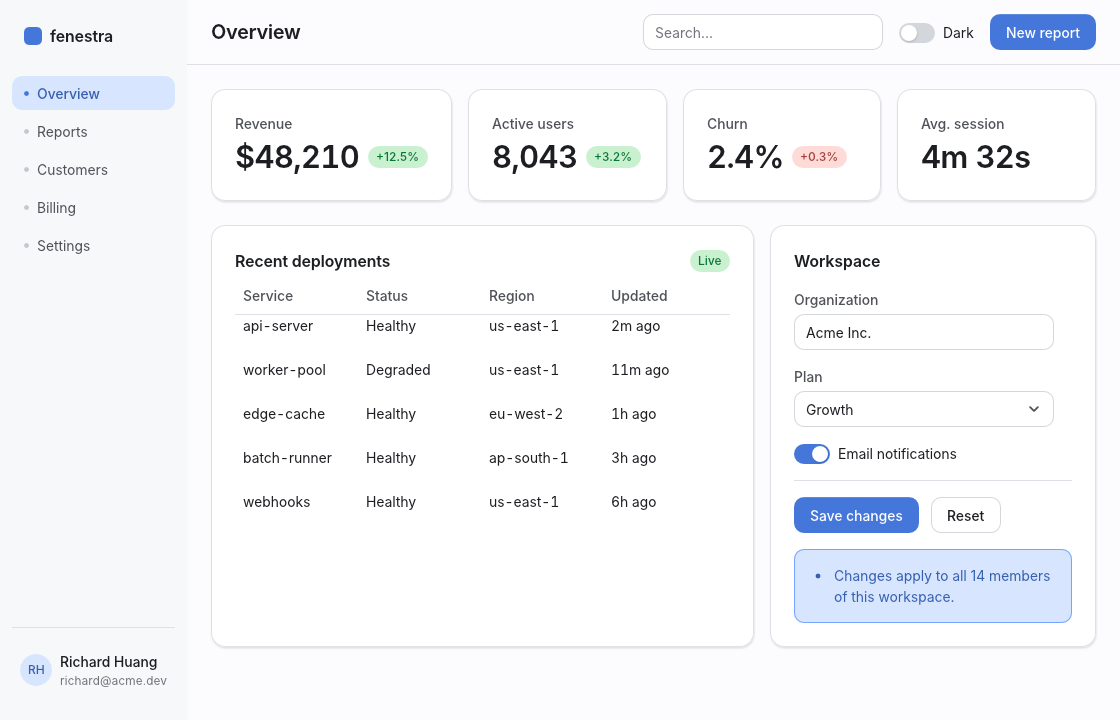
▶ Try the live demo — the dashboard and widget galleries running in your browser via WebGPU. No DOM, no CSS: every pixel is vello on wgpu, the same code as the native window. Read the book for the guided tour.
| Light | Dark |
|---|---|
 |
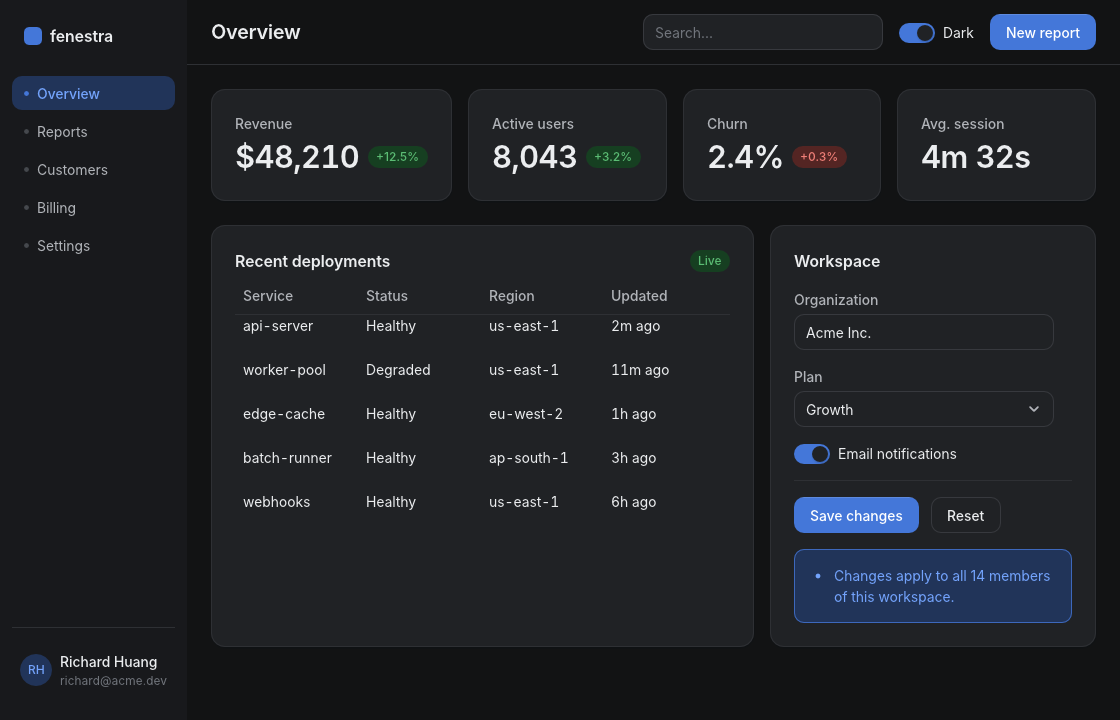 |
No browser. No webview. No HTML or CSS parser. fenestra draws everything itself with vello on wgpu, lays out with taffy (flexbox + grid), shapes text with parley, and ships a themed widget kit that looks like a polished modern web app: layered soft shadows, OKLCH color ramps, real typographic hierarchy, hover/focus transitions, and first-class light and dark themes.
Quickstart
use *;
cargo add fenestra, paste, cargo run. Or start from the template —
cargo generate richer-richard/fenestra-template — which includes a
headless UI test and CI. The whole view is rebuilt, laid out, and
repainted on every redraw — no diffing, no macros, everything
autocompletes.
Agents can see what they build
Rendering (element tree, theme, size) to pixels is a pure function, and it
runs without a window or display server:
use ;
// A picture of any element tree:
let image = render_element;
image.save?;
// Or drive a full app with scripted input and look at the result:
let image = render_app;
assert_eq!;
Headless rendering is deterministic (embedded fonts, fixed scale, reduced motion), which makes pixel-exact golden tests practical — fenestra's own widget kit is tested this way, on CI, with no GPU display attached.
The verification envelope, stated plainly. A headless render is a deliberate subset of the live window — that subset is what makes it deterministic — so trust it accordingly. It uses the embedded fonts (Inter covers Latin; the real monospace, CJK, emoji, and RTL faces come from the OS and so appear only in a real window), forces reduced motion, and is referenced against one GPU backend (macOS/Metal; Linux/lavapipe within a wider tolerance). The full Liquid-Glass optics — backdrop blur, edge lensing, adaptive vibrancy — render only in the headless/golden path; the live single-pass window shows the translucent tint plus the specular rim and sheen. So headless is the right oracle for layout, semantics, color, and the large majority of pixels — but confirm non-Latin/monospace text and full glass in a window. On the web target, AccessKit, the OS clipboard, and the glass passes are compiled out.
Working with an AI agent? AGENTS.md is the manual for the build → render → look → verify loop (and llms.txt for context loaders).
Philosophy: web aesthetics without the web platform
The web's look — soft elevation, tinted neutrals, OKLCH ramps, 4px-grid
spacing, focus rings, 120–300ms easing — is the best-tested visual language
in software. The web platform is a heavy way to get it. fenestra encodes
that language as typed Rust values: a Theme generated from one accent hue,
spacing/radius/shadow/motion tokens, and a builder vocabulary (row(),
.p(SP4), .rounded(R_MD), .shadow(ShadowToken::Sm)) small enough to
memorize and regular enough for rust-analyzer (or a language model) to
autocomplete. Every widget routes every color through the theme; flip one
Mode and the whole app is dark.
The kit
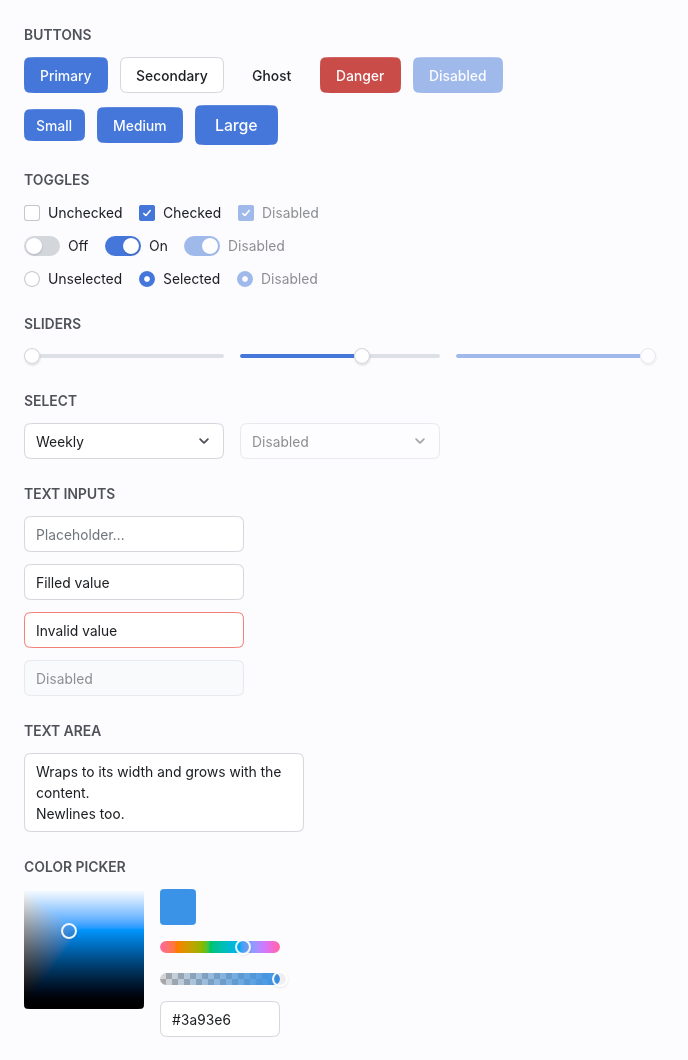
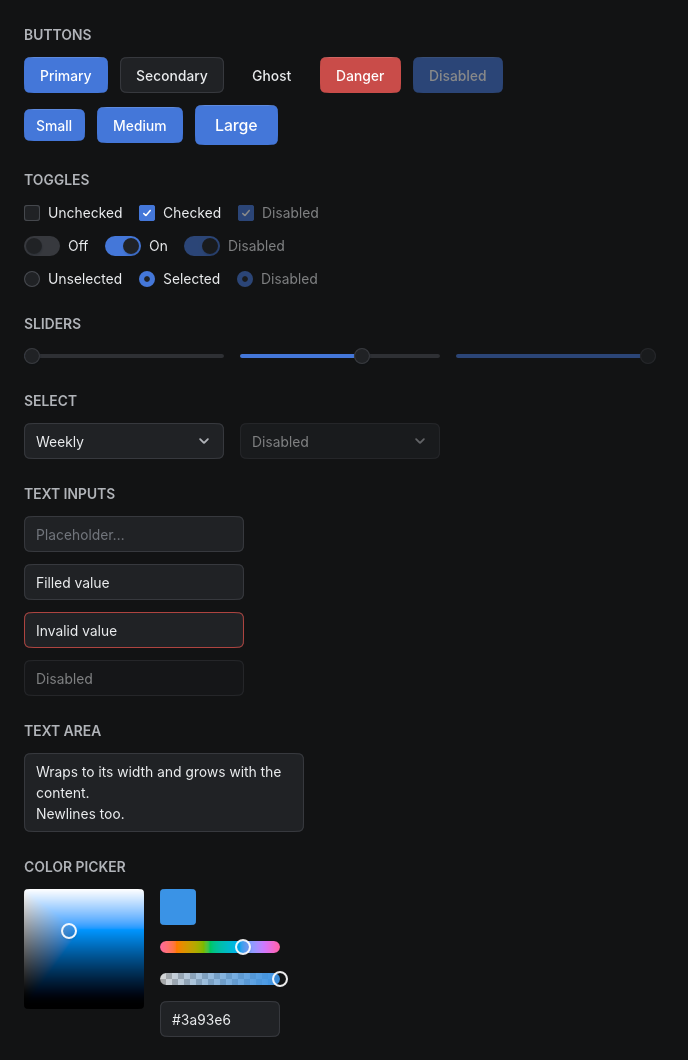
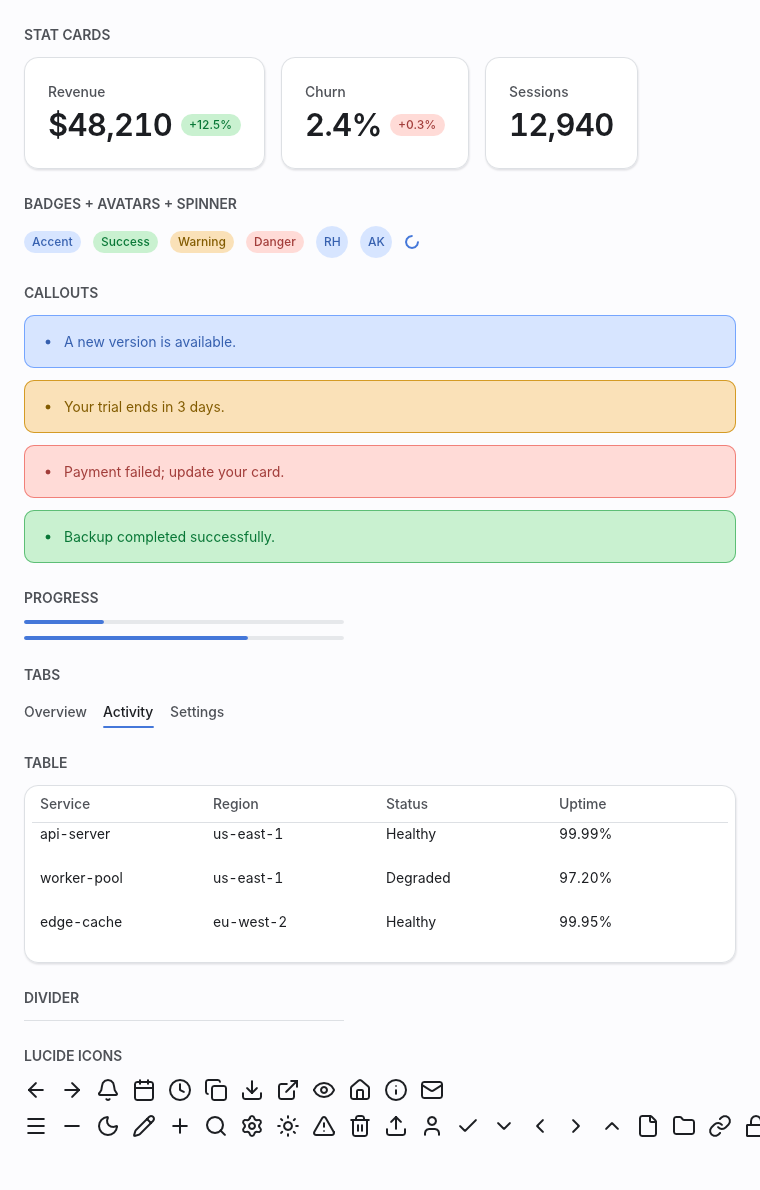
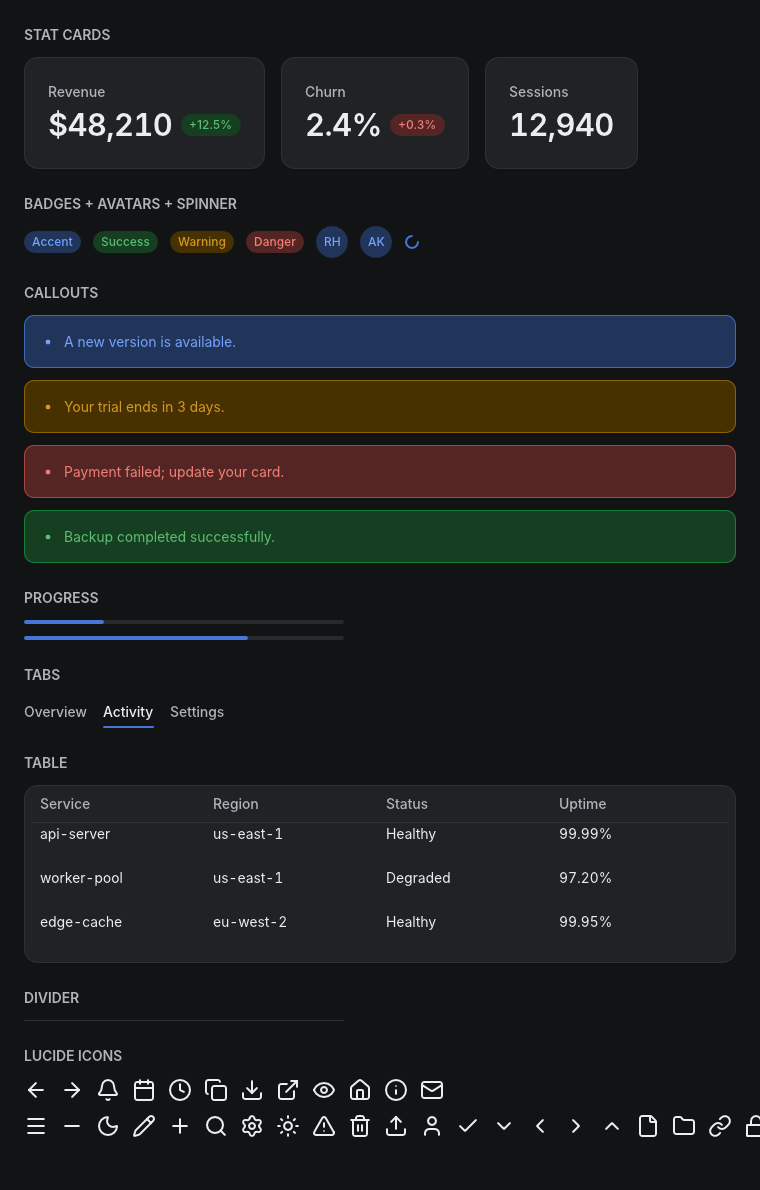
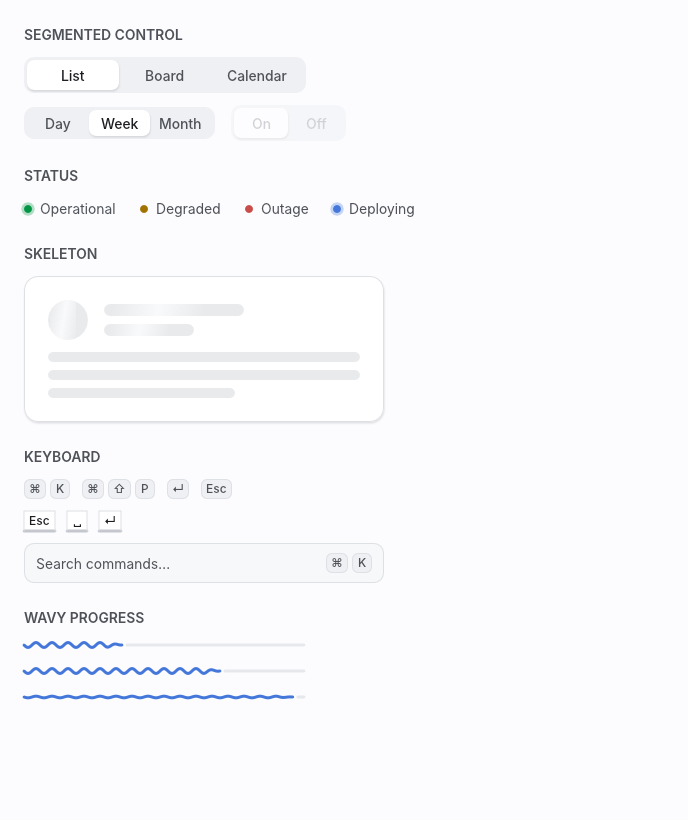
Button, IconButton, Checkbox, Switch, Radio, Slider, SegmentedControl, TextInput (parley editing, clipboard, IME), TextArea (multiline, auto-growing), Select, Tooltip, Modal (focus trap + backdrop), Toasts, Tabs, Card, StatCard, Badge, Avatar, StatusIndicator (with a live pulse), Kbd key-caps, Skeleton loaders, Divider, Progress (including a Material-3 Expressive wavy bar), Spinner, Table, Callout, and a vendored Lucide icon subset — every state, both themes:
 |
 |
 |
 |
 |
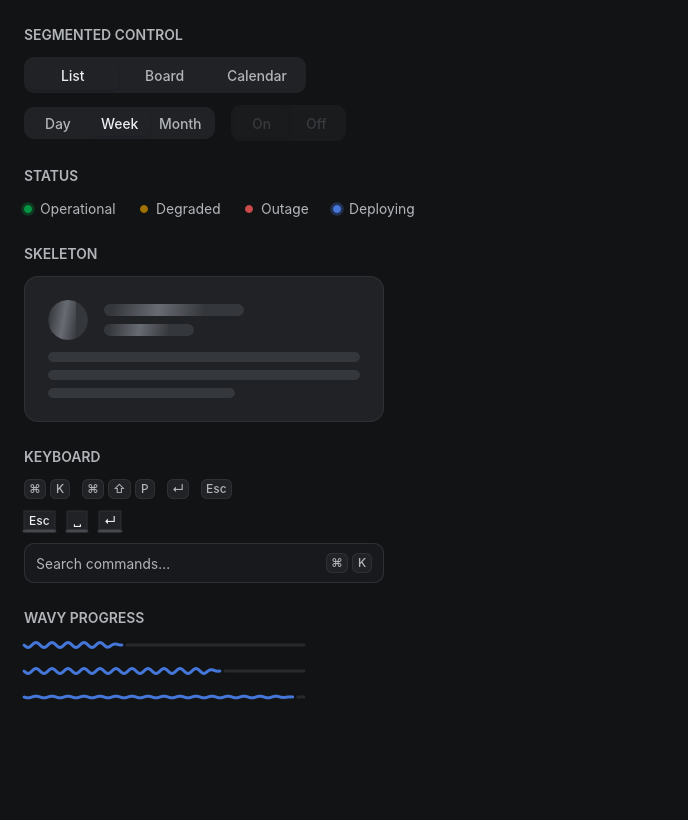 |
Regenerate this corpus any time with cargo run --example gallery — it
renders headlessly.
Workspace
| Crate | Role |
|---|---|
fenestra |
Facade: prelude, run(), examples |
fenestra-core |
Element IR, theme/tokens, layout, text, paint, input, transitions |
fenestra-shell |
winit + wgpu window runner and the headless renderer |
fenestra-kit |
The themed widget kit, built only on core's public API |
fenestra-motion |
Frame-pure motion graphics: timelines, headless frame/video rendering, temporal lints, the motion CLI |
See ARCHITECTURE.md for how the pipeline, widget identity, transitions, and overlays work — recorded decision-by-decision as the framework was built — and BENCHMARKS.md for honest frame-cost numbers (a full screen rebuilds, lays out, and paints in ~0.3 ms; 100k-row lists virtualize to ~0.09 ms).
Design range
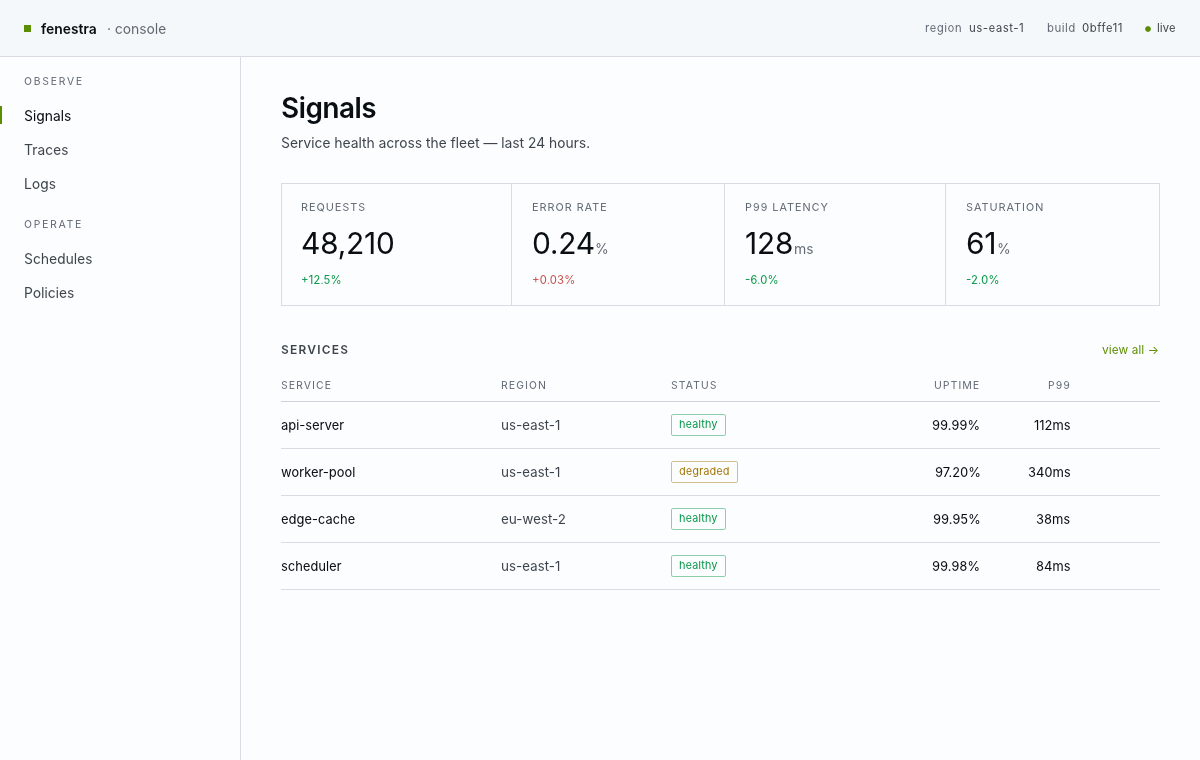
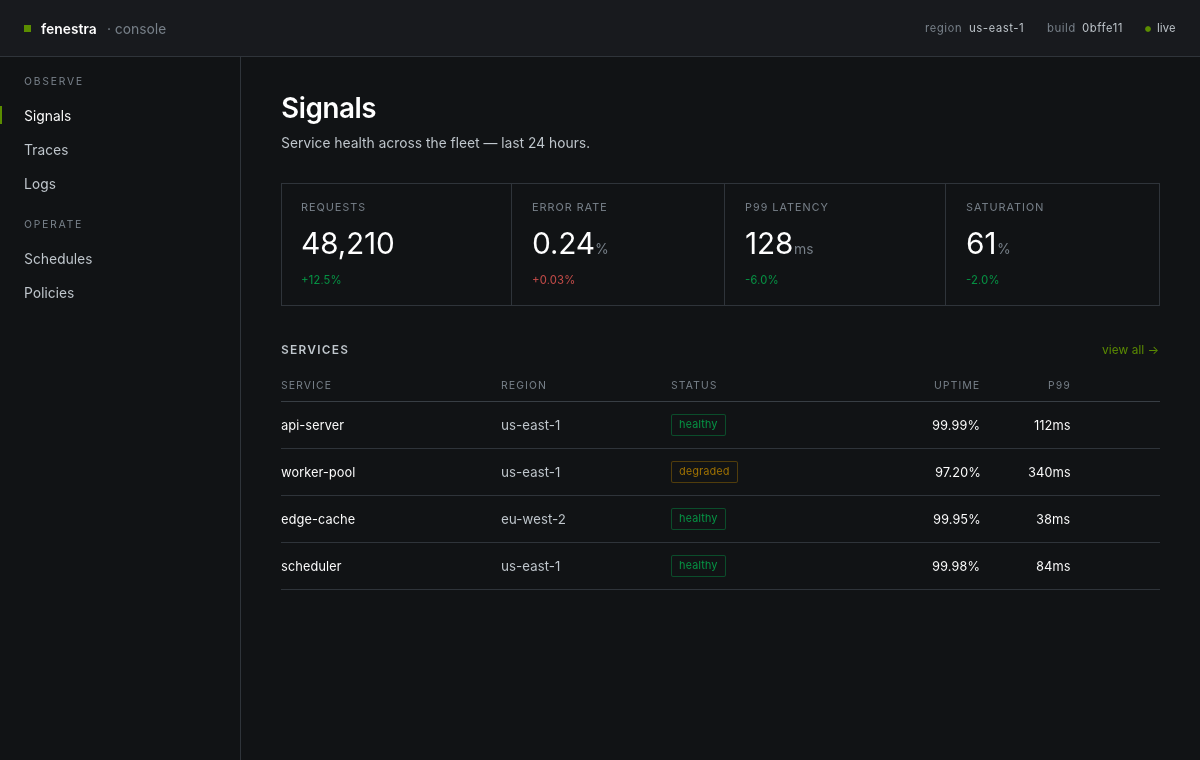
The same framework, the same tokens — a different design language. The
fenestra-looks crate bundles six ready voices (product, editorial, terminal,
console, warm-editorial, playful — enumerate them with all()), and one knob
re-skins the whole kit: Theme::with_radius(RadiusScale::sharp()) for
un-rounded tech chrome, Theme::with_elevation(Elevation::Flat) for
border-not-shadow surfaces, and Theme::duotone for atmospheric fields instead
of neutral grays (custom display faces register under font roles via
Fonts::register). The opposite end of the range from the soft default
dashboard above — a sharp, hairline-ruled console: slate with a single lime
accent and mono numerals, rendered headlessly and golden-tested.
| Light | Dark |
|---|---|
 |
 |
Composition, commands, accessibility
Components written around their own message type compose with
Element::map. Background work flows in through App::init, which hands
the app a cloneable Proxy<Msg> — spawn a thread, send messages, the
window repaints (examples/clock.rs, examples/toasts.rs). Every widget
exposes its role, state, and name: headlessly via Frame::access_tree()
(assert your UI is labeled, in CI), and to real assistive technology
through AccessKit in the windowed runner. Ambient motion comes from
looping Keyframes timelines; images from image_rgba8 (round avatars
via .rounded_full()).
Status
0.2 covers the spec'd milestones M0–M7 — rendering, theme, text, layout
and scrolling, interactivity and transitions, text input, overlays, the
full kit, the dashboard — plus the M8 set: Element::map, the command
proxy, images, multiline text areas, toasts, keyframe timelines, a Lucide
icon subset, and the AccessKit tree. Out of scope so far: the
screen-reader text-editing protocol, live regions, and rich text.
License
MIT or Apache-2.0, at your option. The embedded Inter font, the Playfair
Display faces (poster and editorial looks), the Fraunces variable text serif
(the opsz/optical-sizing serif in the warm-editorial look), and JetBrains
Mono (terminal look) are licensed under the SIL Open Font License 1.1; the
vendored Lucide icon path data is ISC (see fenestra-kit/LICENSE-LUCIDE.txt).