# fasttime
[](https://github.com/RustedBytes/fasttime/actions/workflows/test.yml)
[](https://crates.io/crates/fasttime)
`fasttime` is a small UTC-focused date/time library for Rust. It is built
around [Ben Joffe's constant-time 64-bit days→date algorithm](https://www.benjoffe.com/fast-date-64) and offers a simple,
`no_std`-friendly API for calendar math, parsing, and formatting. The crate
only depends on `core` by default and enables a handful of conveniences (such as
`DateTime::now_utc()`) when the optional `std` feature is on.
**🐍 Python bindings are now available!** See [PYTHON.md](PYTHON.md) or [python/README.md](python/README.md) for details.
## Features
- Works in `no_std` environments; opt into `std` when you need wall-clock time.
- `Date`, `Time`, `DateTime`, `Duration`, `UtcOffset`, and `OffsetDateTime`
types with ISO/RFC 3339 style `Display` implementations.
- Parsing helpers for the common textual formats used in logs and APIs.
- Fixed-offset RFC 3339 timestamps with nanosecond precision.
- Simple arithmetic helpers: add days, add durations, compute differences, and
fetch ordinals or weekdays without extra allocations.
- **Python 3.10+ bindings** via PyO3 with full type hints and ergonomic API.
## Installation
### Rust
```toml
[dependencies]
fasttime = "0.1"
```
### Python
```bash
pip install maturin
maturin develop --release
```
See [PYTHON.md](PYTHON.md) for Python-specific documentation.
Disable the default `std` feature when targeting bare-metal or embedded
environments:
```toml
[dependencies]
fasttime = { version = "0.1", default-features = false }
```
## Example
```rust
use fasttime::{
Date, DateError, DateTime, Duration, OffsetDateTime, Time, UtcOffset,
};
fn main() -> Result<(), DateError> {
// Fetch the current UTC date and time, works only with `std` feature.
// let now = DateTime::now_utc()?;
// println!("Current UTC time: {now}");
// Build calendar dates either from year-month-day or days since the Unix epoch.
let jan_first = Date::from_ymd(2024, 1, 1)?;
let epoch = Date::from_days_since_unix_epoch(0)?;
println!("{jan_first} weekday {}", jan_first.weekday().number_from_monday());
println!("{epoch} ordinal {}", epoch.ordinal());
// Combine dates and times to work with UTC instants.
let dt = DateTime::from_unix_timestamp(1_700_000_000, 123_456_789)?;
let later = dt.add_duration(Duration::seconds(90))?;
println!("Delta: {} ns", later.difference(dt).total_nanos());
// Parse ISO/RFC 3339 style strings and work with fixed offsets.
let parsed_date: Date = "2024-03-15".parse()?;
let parsed_time: Time = "11:22:33.123".parse().unwrap();
let offset = UtcOffset::from_hours_minutes(true, 2, 0).unwrap();
let local = OffsetDateTime::from_local(parsed_date, parsed_time, offset)?;
println!("{local} (offset {})", offset);
Ok(())
}
```
## Benchmarks
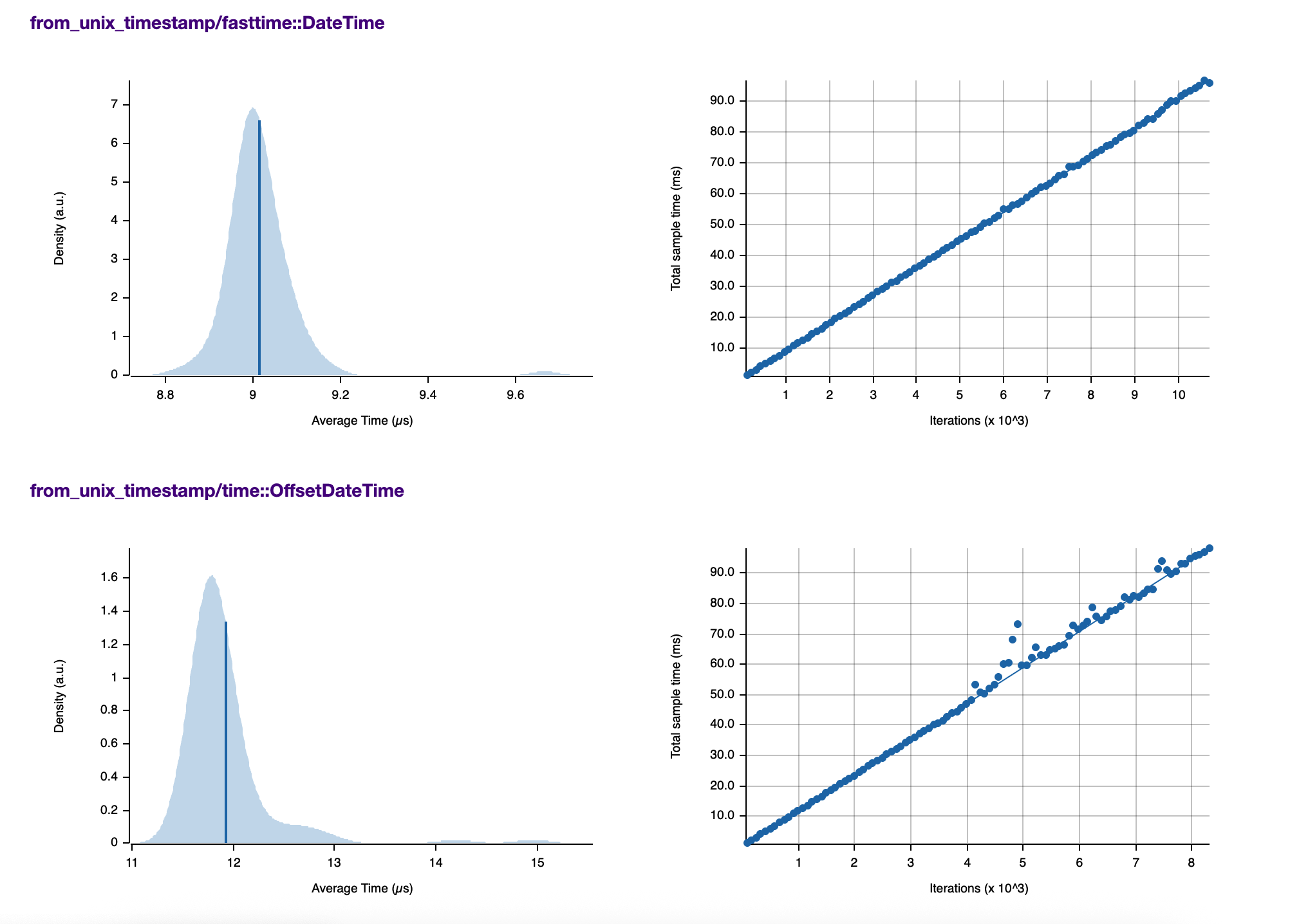
`cargo bench --bench unix_timestamp` runs Criterion benchmarks that compare `fasttime` with the `time` crate when converting to and from Unix timestamps:
- `from_unix_timestamp`: constructor taking `(secs, nanos)`.
- `to_unix_timestamp`: extracting integral seconds.
- `to_unix_timestamp_nanos`: extracting nanoseconds as `i128`.
Each group runs the conversions over 64, 1,024, and 16,384 timestamp samples to
show how performance scales with dataset size.
### Example output
```
from_unix_timestamp/fasttime::default-n=1024
time: [7.5703 µs 7.5711 µs 7.5721 µs]
change: [-4.0811% -4.0481% -4.0177%] (p = 0.00 < 0.05)
Performance has improved.
Found 7 outliers among 100 measurements (7.00%)
1 (1.00%) high mild
6 (6.00%) high severe
from_unix_timestamp/time::default-n=1024
time: [8.0240 µs 8.0287 µs 8.0347 µs]
change: [-0.1042% -0.0677% -0.0232%] (p = 0.00 < 0.05)
Change within noise threshold.
Found 9 outliers among 100 measurements (9.00%)
3 (3.00%) high mild
6 (6.00%) high severe
to_unix_timestamp/fasttime::default-n=1024
time: [3.2994 µs 3.2996 µs 3.2999 µs]
change: [+0.0822% +0.1046% +0.1245%] (p = 0.00 < 0.05)
Change within noise threshold.
Found 7 outliers among 100 measurements (7.00%)
4 (4.00%) high mild
3 (3.00%) high severe
to_unix_timestamp/time::default-n=1024
time: [1.8323 µs 1.8326 µs 1.8330 µs]
change: [-0.0536% -0.0195% +0.0093%] (p = 0.24 > 0.05)
No change in performance detected.
Found 5 outliers among 100 measurements (5.00%)
2 (2.00%) high mild
3 (3.00%) high severe
to_unix_timestamp_nanos/fasttime::default-n=1024
time: [3.7286 µs 3.7313 µs 3.7342 µs]
change: [+1.7513% +1.9180% +2.0849%] (p = 0.00 < 0.05)
Performance has regressed.
Found 5 outliers among 100 measurements (5.00%)
4 (4.00%) high mild
1 (1.00%) high severe
to_unix_timestamp_nanos/time::default-n=1024
time: [2.0604 µs 2.0607 µs 2.0610 µs]
change: [+0.0420% +0.0554% +0.0703%] (p = 0.00 < 0.05)
Change within noise threshold.
Found 6 outliers among 100 measurements (6.00%)
4 (4.00%) high mild
2 (2.00%) high severe
```
## Development
- Format and lint the crate with your preferred Rust tooling (`cargo fmt`,
`cargo clippy`).
- Run the tests with `cargo test`.
## License
Licensed under the Apache-2.0