# fastnum
[](https://crates.io/crates/fastnum)
[](https://docs.rs/fastnum/latest/fastnum)

Fixed-size decimal numbers implemented in pure Rust. Suitable for
financial, crypto and any other fixed-precision calculations.
[API Docs](https://docs.rs/fastnum/latest/fastnum)
## Overview
This crate is inspired by [num_bigint](https://docs.rs/num-bigint/0.4.6/num_bigint/)
and [bigdecimal](https://docs.rs/bigdecimal/latest/bigdecimal/) - an amazing crates that allows you to store big
integers and arbitrary precision fixed-point decimal numbers almost any precision.
[BigInt](https://docs.rs/num-bigint/latest/num_bigint/struct.BigInt.html) internally uses a [
`Vec`](https://doc.rust-lang.org/std/vec/struct.Vec.html) of decimal digits
the size of which is theoretically limited only by the `usize` max value or memory capacity.
Under the hood [BigDecimal](https://docs.rs/bigdecimal/latest/bigdecimal/struct.BigDecimal.html) uses
a [BigInt](https://docs.rs/num-bigint/latest/num_bigint/struct.BigInt.html) object, paired with a 64-bit integer which
determines the position of the decimal point. Therefore, the precision is not actually arbitrary, but limited to 2<sup>
63</sup> decimal places.
Despite the seemingly undeniable advantages at first glance, this approach also has a number of fundamental
disadvantages:
- Non-copyable types for both integers and fixed point numbers.
- Dynamic allocation to store even very small numbers, for example, `0` or `1`.
- Extra dynamic allocation for almost any operation (mathematical operations, parsing, converting, etc.).
- Constant calculations are not available.
- Potentially uncontrolled growth of memory consumption and the need to artificially limit it.
Because most practical problems requiring the use of fixed-point numbers do not require so much
limit on the number of digits, such as `usize`, but as a rule it is limited:
| United States Dollar (USD) | 0.01 | 2 |
| United States Dollar, stock (USD) | 0.0001 | 4 |
| Bitcoin (BTC) | 10<sup>-8</sup> | 8 |
| Ethereum (ETH) | 10<sup>-18</sup> | 18 |
Then most real numbers for financial and other systems requiring accuracy can use 256-bit or even 128-bit
integer to store decimal digits.
So In this library, a different approach was chosen.
### Decimals
`fastnum` provides a signed and unsigned decimal numbers suitable for financial calculations that require significant
integral and fractional digits with no round-off errors.
Under the hood any `fastnum` decimal type consists of a N-bit big unsigned integer, paired with a 64-bit signed integer
scaling factor which determines the position of the decimal point and sign (for signed types only). Trailing zeros are
preserved and may be exposed when in string form. These can be truncated using the normalize or
round functions.
Thus, fixed-point numbers are trivially copyable and do not require any dynamic allocation. This allows you to get
additional performance gains by eliminating not only dynamic allocation, like such, but also will get rid of one
indirect addressing, which improves cache-friendliness and reduces the CPU load.
## Why fastnum?
- **Blazing fast**: `fastnum` numerics are as fast as native types, well almost :).
- **Trivially copyable types**: all `fastnum` numerics are trivially copyable (both integer and decimal, ether signed
and unsigned) and can be stored on the stack, as they are fixed size.
- **No dynamic allocation**: no expensive sys-call's, no indirect addressing, cache-friendly.
- **Compile-time integer and decimal parsing**: all the `from_*` methods on `fastnum` integers
and decimals are `const`, which allows parsing of integers and numerics from string slices and floats at compile time.
Additionally, the string to be parsed does not have to be a literal: it could, for example, be obtained via [
`include_str!`](https://doc.rust-lang.org/core/macro.include_str.html), or [
`env!`](https://doc.rust-lang.org/core/macro.env.html).
- **Const-evaluated in compile time macro-helpers**: any type has its own macro helper which can be used for
definitions of constants or variables whose value is known in advance. This allows you to perform all the necessary
checks at the compile time.
- **Short dependencies list by default**: `fastnum` does not depend on many other crates by default. Support for crates
such
as [`rand`](https://docs.rs/rand/latest/rand/) and [`serde`](https://docs.rs/serde/latest/serde/) can be enabled with
crate [features](#features).
- **`no-std` compatible**: `fastnum` can be used in `no_std` environments.
- **`const` evaluation**: nearly all methods defined on `fastnum` integers and decimals are `const`, which allows
complex compile-time calculations and checks.
## Installation
To install and use `fastnum`, simply add the following line to your `Cargo.toml` file in the `[dependencies]` section:
```toml
fastnum = "0.0.12"
```
Or, to enable various `fastnum` features as well, add for example this line instead:
```toml
fastnum = { version = "0.0.12", features = ["serde"] } # enables the "serde" feature
```
## Example Usage
```rust
use fastnum::{udec256, UD256};
fn main() {
const ZERO: UD256 = udec256!(0);
const ONE: UD256 = udec256!(1.0);
let a = udec256!(12345);
println!("a = {a}");
}
```
## Features
### Generic numeric `num_traits` and `num_integer` trait implementations
The `numtraits` feature includes implementations of traits from the [
`num_traits`](https://docs.rs/num-traits/latest/num_traits/) and [
`num_integer`](https://docs.rs/num-integer/latest/num_integer/) crates, e.g. [
`AsPrimitive`](https://docs.rs/num-traits/latest/num_traits/cast/trait.AsPrimitive.html), [
`Signed`](https://docs.rs/num-traits/latest/num_traits/sign/trait.Signed.html), [
`Integer`](https://docs.rs/num-integer/latest/num_integer/trait.Integer.html), etc.
### Random Number Generation
The `rand` feature allows creation of random `fastnum` decimals via the [`rand`](https://docs.rs/rand/latest/rand/)
crate.
### Serialization and Deserialization
The `serde` feature enables serialization and deserialization of `fastnum` decimals via the [
`serde`](https://docs.rs/serde/latest/serde/) crate. More details about serialization and deserialization you can found
in
### Zeroize
The `zeroize` feature enables the [`Zeroize`](https://docs.rs/zeroize/latest/zeroize/trait.Zeroize.html) trait from
the [`zeroize`](https://docs.rs/zeroize/latest/zeroize/) crate.
### Database ORM's support
The `diesel` feature enables serialization and deserialization of `fastnum` decimals for [
`diesel`](https://docs.rs/diesel/latest/diesel/) crate.
The `sqlx` feature enables serialization and deserialization of `fastnum` decimals for [
`sqlx`](https://docs.rs/sqlx/latest/sqlx/) crate.
### Autodocs crates support
The `utoipa` feature enables support of `fastnum` decimals for autogenerated OpenAPI documentation via the [
`utoipa`](https://docs.rs/utoipa/latest/utoipa/) crate.
## Performance
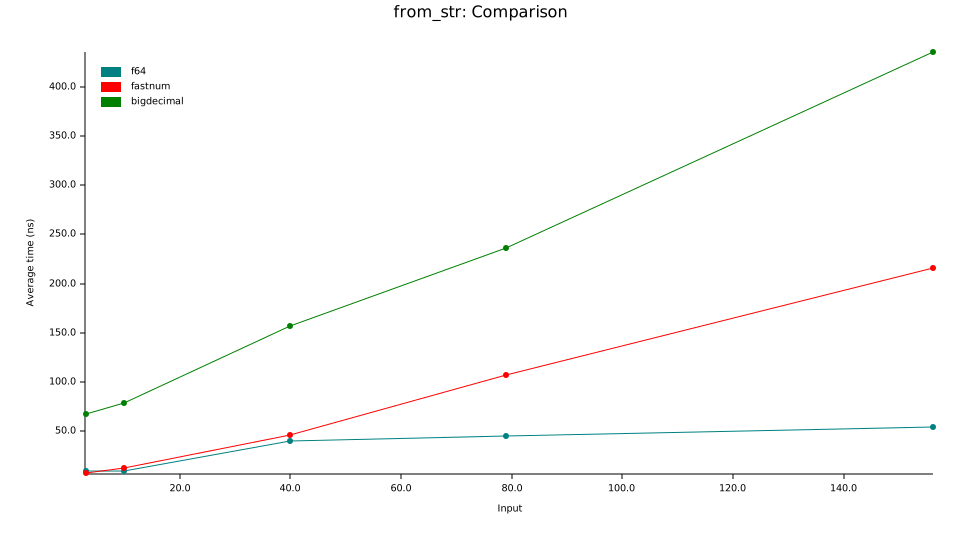
`fastnum` is blazing fast. As much as possible given the overhead of arbitrary precision support. It **x10** faster than
`bigdecimal` and **x1.1 - x4** slower than native floating point `f64` Rust type.
Some benchmark reports are shown below:
### Parse from string
### Allocation

You can run benchmark tests with [`Criterion.rs`](https://bheisler.github.io/criterion.rs/book/criterion_rs.html) tool:
```shell
cd benchmark
cargo criterion
```
## Testing
This crate is tested with the [`rstest`](https://docs.rs/rstest/latest/rstest/) crate as well as with specific edge
cases.
We have more than `4500` tests, so we recommend run it using [`nextest`](https://nexte.st/):
```shell
cargo nextest run --all-features
```
## Minimum Supported Rust Version
The current Minimum Supported Rust Version (MSRV) is `1.82.0`.
## Documentation
[API Docs](https://docs.rs/fastnum/latest/fastnum)
**NB**: `fastnum` is currently pre-`1.0.0`. As per
the [Semantic Versioning guidelines](https://semver.org/#spec-item-4),
the public API may contain breaking changes while it is in this stage. However, as the API is designed to be as similar
as possible to the API of Rust's primitive integers, it is unlikely that there will be a large number of breaking
changes.
## Compile-Time Configuration
You can set a few default parameters at _compile-time_ via environment variables:
| `RUST_FASTNUM_DEFAULT_ROUNDING_MODE` | `HalfUp` |
| `RUST_FASTNUM_FMT_EXPONENTIAL_LOWER_THRESHOLD` | 5 |
| `RUST_FASTNUM_FMT_EXPONENTIAL_UPPER_THRESHOLD` | 15 |
| `RUST_FASTNUM_FMT_MAX_INTEGER_PADDING` | 1000 |
| `RUST_FASTNUM_SERDE_DESERIALIZE_MODE` | `Strict` |
## Future Work
There are several areas for further work:
- Micro-optimization of big integer types using vector extensions (SSE2, SSE4.2, AVX2, AVX512F, etc.).
- Const trait implementations once they are stabilized in Rust. (https://github.com/rust-lang/rust/issues/67792)
- Integration with a large number of crates (ORM's, auto-docs crates, etc.).
## Licensing
This code is dual-licensed under the permissive
[MIT](https://opensource.org/licenses/MIT) &
[Apache 2.0](https://opensource.org/licenses/Apache-2.0) licenses.
## Contribution
Unless you explicitly state otherwise, any contribution intentionally
submitted for inclusion in the work by you, as defined in the
Apache-2.0 license, shall be dual licensed as above, without any
additional terms or conditions.