1
2
3
4
5
6
7
8
9
10
11
12
13
14
15
16
17
18
19
20
21
22
23
24
25
26
27
28
29
30
31
32
33
34
35
36
37
38
39
40
41
42
43
44
45
46
47
48
49
50
51
52
53
54
55
56
57
58
59
60
61
62
63
64
65
66
67
68
69
70
71
72
73
74
75
76
77
78
79
80
81
82
83
84
85
86
87
88
89
90
91
92
93
94
95
96
97
98
99
100
101
102
103
104
105
106
107
108
109
110
111
112
113
114
115
116
117
118
119
120
121
122
123
124
125
126
127
128
129
130
131
132
133
134
135
136
137
138
139
140
141
142
143
144
145
146
147
148
149
150
151
152
153
154
155
156
157
158
159
160
161
162
163
164
165
166
167
168
169
170
171
172
173
174
175
176
177
178
179
180
181
182
183
184
185
186
187
188
189
190
191
192
193
194
195
196
197
198
199
200
201
202
203
204
205
206
207
208
209
210
211
212
213
214
215
216
217
218
219
220
221
222
223
224
225
226
227
228
229
230
231
232
233
234
235
236
237
238
239
240
241
242
243
244
245
246
247
248
249
250
251
252
253
254
255
256
257
258
259
260
261
262
263
264
265
266
267
268
269
270
271
272
273
274
275
276
277
278
279
280
281
282
283
284
285
286
287
288
289
290
291
292
293
294
295
296
297
298
299
300
301
302
303
304
305
306
307
308
309
310
311
312
313
314
315
316
317
318
319
320
321
322
323
324
325
326
327
328
329
330
331
332
333
334
335
336
337
338
339
340
341
342
343
344
345
346
347
348
349
350
351
352
353
354
355
356
357
358
359
360
361
362
363
364
365
366
367
368
369
370
371
372
373
374
375
376
377
378
379
380
381
382
383
384
385
386
387
388
389
390
391
392
393
394
395
396
397
398
399
400
401
402
403
404
405
406
407
408
409
410
411
412
413
414
415
416
417
418
419
420
421
422
423
424
425
426
427
428
429
430
431
432
433
434
435
436
437
438
439
440
441
442
443
444
445
446
447
448
449
450
451
452
453
454
455
456
457
458
459
460
461
462
//! # FastNN
//!
//! A robust deep learning library in Rust with CUDA kernels.
//!
//! FastNN trains neural networks in Rust. It has tensors with automatic
//! differentiation, the layers and optimizers behind MLPs, CNNs, RNNs and
//! transformers, data loading, and checkpoints a run can resume from. It runs on
//! the CPU out of the box and on NVIDIA GPUs with the `cuda` feature.
//!
//! The whole stack is in this crate: Rust on the CPU, and with the `cuda`
//! feature the kernels in the same repository. It is written to be read, so you
//! can follow `loss.backward()` from your training loop down to the kernel.
//! Every backward rule is tested against finite differences of its own forward,
//! every CUDA kernel against the CPU path, and `unsafe` appears only in the
//! CUDA bindings.
//!
//! 
//!
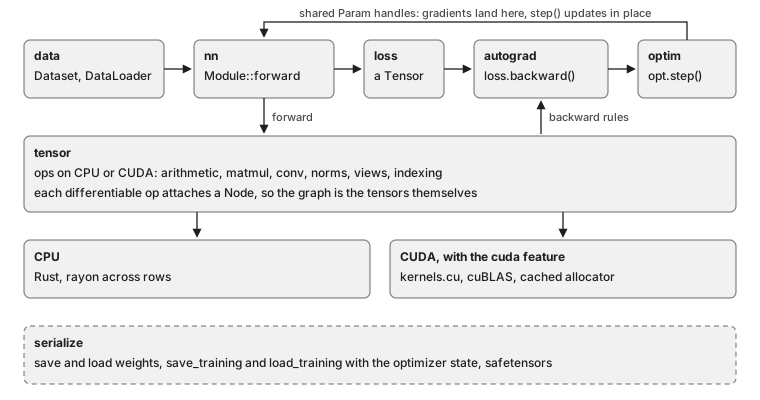
//! A batch goes through the model, the ops build a graph as they run, and the
//! loss sits at its end. `backward()` walks that graph and leaves a gradient in
//! each [`Param`](nn::Param). The optimizer holds the same `Param` handles, so
//! `step()` reads the gradients and updates the weights in place.
//!
//! # Quick start
//!
//! Train a classifier on MNIST:
//!
//! ```no_run
//! use fastnn::prelude::*;
//! use fastnn::data::{Mnist, Split};
//!
//! # fn main() -> fastnn::Result<()> {
//! let train = Mnist::load(Split::Train)?;
//! let loader = DataLoader::new(&train, 128).shuffle(true);
//!
//! let model = Sequential::new()
//! .add(Flatten::new())
//! .add(Linear::new(784, 128))
//! .add(ReLU)
//! .add(Linear::new(128, 10));
//!
//! let mut opt = Adam::new(model.parameters(), 1e-3);
//!
//! for batch in loader.iter() {
//! let loss = cross_entropy(&model.forward(&batch.inputs), &batch.labels());
//!
//! opt.zero_grad();
//! loss.backward();
//! opt.step();
//! }
//!
//! save(&model, "mnist.fdl")?;
//! # Ok(())
//! # }
//! ```
//!
//! The [examples] are complete programs. Run one with
//! `cargo run --release --example <name>`:
//!
//! | Example | What it shows |
//! |---|---|
//! | `simple_mlp` | MLP learning XOR, the smallest training loop |
//! | `mnist_mlp` | Dataset download, batching, evaluation, checkpointing |
//! | `mnist_cnn` | Convolutions, batch norm, pooling, an LR schedule |
//! | `char_lm` | Small GPT trained from scratch, resumes after Ctrl-C |
//! | `finetune` | Pretrain, freeze the backbone, train a new head |
//! | `gan` | Two networks trained against each other |
//! | `vae` | Variational autoencoder on 2-D data |
//! | `reinforce` | Policy gradient on a bandit |
//! | `multi_task` | Shared trunk, two heads, one combined loss |
//!
//! Use `--release`. Debug builds are about 50x slower.
//!
//! [examples]: https://github.com/CanReader/FastNN/tree/master/examples
//!
//! # A Tour of FastNN
//!
//! A training project meets the crate in a fixed order: build a model, train it,
//! feed it data, save it, move it to a GPU, maybe generate from it, and debug it
//! when a run goes bad. This tour follows that order and shows the API for each
//! step. Everything a script needs is in the [`prelude`], and each module's own
//! page goes deeper.
//!
//! ## Models
//!
//! A model is anything that implements [`Module`](nn::Module), and
//! [`Sequential`](nn::Sequential) chains layers into one. A layer's weights are
//! [`Param`](nn::Param) handles, shared with the optimizer, so training never has
//! to borrow the model.
//!
//! ```
//! use fastnn::prelude::*;
//!
//! let model = Sequential::new()
//! .add(Linear::new(16, 32))
//! .add(ReLU)
//! .add(Dropout::new(0.1))
//! .add(Linear::new(32, 4));
//!
//! let logits = model.forward(&Tensor::randn(&[8, 16]));
//! assert_eq!(logits.shape(), &[8, 4]);
//! assert_eq!(model.num_parameters(), 16 * 32 + 32 + 32 * 4 + 4);
//! ```
//!
//! Your own layer needs `forward`, plus `named_parameters` if it has weights.
//! Device placement, parameter counting and gradient zeroing follow from those.
//!
//! ```
//! use fastnn::nn::module::scoped;
//! use fastnn::prelude::*;
//!
//! struct Residual { inner: Linear }
//!
//! impl Module for Residual {
//! fn forward(&self, x: &Tensor) -> Tensor {
//! x.add(&self.inner.forward(x).relu())
//! }
//! fn named_parameters(&self) -> Vec<(String, Param)> {
//! scoped("inner", self.inner.named_parameters())
//! }
//! }
//! ```
//!
//! [`nn`] has the rest: convolutions with dilation and groups, pooling, batch,
//! layer and RMS normalization, embeddings, LSTM and GRU, multi-head attention,
//! and transformer encoder and decoder stacks.
//!
//! ## Training
//!
//! An optimizer takes the model's parameters and a learning rate. A
//! [`LrSchedule`](optim::LrSchedule) maps the step to a rate, and `set_lr`
//! applies it. The losses are plain functions in [`nn`].
//!
//! ```
//! use fastnn::prelude::*;
//!
//! let model = Sequential::new().add(Linear::new(4, 3));
//! let mut opt = AdamW::new(model.parameters(), 1e-3);
//! let schedule = Warmup::new(CosineAnnealing::new(1e-3, 1000), 100);
//!
//! let x = Tensor::randn(&[8, 4]);
//! let targets = [0, 1, 2, 0, 1, 2, 0, 1];
//!
//! for step in 0..3 {
//! opt.set_lr(schedule.lr_at(step));
//! let loss = cross_entropy(&model.forward(&x), &targets);
//!
//! opt.zero_grad();
//! loss.backward();
//! clip_grad_norm(opt.parameters(), 1.0);
//! opt.step();
//! }
//! ```
//!
//! [`Dropout`](nn::Dropout) and [`BatchNorm2d`](nn::BatchNorm2d) behave
//! differently at inference, so call `model.eval()` before validation and
//! `model.train()` after.
//!
//! To fine-tune, freeze what should not move. A frozen parameter hands out a
//! detached tensor, so the backward pass stops there and no gradient is computed
//! for it at all. The optimizer skips a parameter with no gradient.
//!
//! ```
//! # use fastnn::prelude::*;
//! let backbone = Linear::new(16, 16);
//! backbone.freeze();
//!
//! let model = Sequential::new().add(backbone).add(ReLU).add(Linear::new(16, 2));
//! let mut opt = Adam::new(model.parameters(), 1e-3); // only the head will move
//! ```
//!
//! [`optim`] has [`SGD`](optim::SGD), [`Adam`](optim::Adam),
//! [`AdamW`](optim::AdamW), [`RMSprop`](optim::RMSprop),
//! [`Adagrad`](optim::Adagrad), [`Adadelta`](optim::Adadelta),
//! [`RAdam`](optim::RAdam) and [`Lion`](optim::Lion), the
//! [`Lookahead`](optim::Lookahead) and [`Ema`](optim::Ema) wrappers, and the
//! [`Warmup`](optim::Warmup), [`CosineAnnealing`](optim::CosineAnnealing),
//! [`OneCycle`](optim::OneCycle) and [`StepDecay`](optim::StepDecay) schedules.
//! [`CrossEntropyLoss`](nn::CrossEntropyLoss) adds label smoothing, class weights
//! and an ignore index to the plain function.
//!
//! ## Data
//!
//! A [`Dataset`](data::Dataset) is anything indexable that can write one item
//! into a slice. A [`DataLoader`](data::DataLoader) turns it into shuffled
//! batches and can place them on a device. Items go into one buffer per batch,
//! so batching 60,000 images does not allocate 60,000 tensors.
//!
//! ```
//! use fastnn::prelude::*;
//!
//! let inputs = Tensor::randn(&[100, 8]);
//! let targets = Tensor::from_vec((0..100).map(|i| (i % 3) as f32).collect(), &[100]);
//! let dataset = TensorDataset::new(&inputs, &targets);
//!
//! let loader = DataLoader::new(&dataset, 32).shuffle(true);
//! for batch in loader.iter() {
//! let labels = batch.labels(); // targets as class ids
//! assert_eq!(batch.inputs.dim(0), labels.len());
//! }
//! ```
//!
//! [`Mnist::load`](data::Mnist::load) downloads the digits once and caches them.
//! The [`data`] page shows a dataset written from scratch.
//!
//! ## Checkpoints
//!
//! [`save`](serialize::save) writes the weights, which is all a finished model
//! needs. A run that has to survive a crash needs more: Adam's moments and step
//! count drive its bias correction, and restored without them it restarts at
//! step 1 with an oversized first update.
//! [`save_training`](serialize::save_training) writes the weights, the optimizer
//! state and the step together, and [`load_training`](serialize::load_training)
//! refuses a plain weights file rather than silently resetting the optimizer.
//!
//! ```
//! # use fastnn::prelude::*;
//! # let dir = std::env::temp_dir().join("fastnn-doc-resume");
//! # std::fs::create_dir_all(&dir)?;
//! # let path = dir.join("run.fdl");
//! # let _ = std::fs::remove_file(&path);
//! # let model = Sequential::new().add(Linear::new(4, 2));
//! # let mut opt = Adam::new(model.parameters(), 1e-3);
//! # let total = 500;
//! let mut step = load_training(&model, &mut opt, &path).unwrap_or(0);
//!
//! while step < total {
//! // one training step
//! step += 1;
//! if step % 500 == 0 {
//! save_training(&model, &opt, step, &path)?;
//! }
//! }
//! # Ok::<(), fastnn::Error>(())
//! ```
//!
//! [`save_safetensors`](serialize::save_safetensors) and
//! [`load_safetensors`](serialize::load_safetensors) exchange weights with other
//! tools. F16 and BF16 files load and are widened to `f32`.
//!
//! ## GPU
//!
//! Everything starts on the CPU. Move the model and the loader, and the training
//! loop stays the same. Mixing devices panics instead of copying behind your back.
//!
//! ```no_run
//! # use fastnn::prelude::*;
//! # let model = Sequential::new();
//! # let dataset: fastnn::data::TensorDataset = unimplemented!();
//! let device = Device::best(); // the first GPU, else the CPU
//! model.to_device(device);
//! let loader = DataLoader::new(&dataset, 128).to_device(device);
//! ```
//!
//! Matmul goes through cuBLAS and everything else through the kernels in
//! `cuda/kernels.cu`, each checked against the CPU path by the parity tests. The
//! kernels use fast math, so GPU and CPU results differ in the last few digits.
//!
//! ## Generation
//!
//! A causal [`TransformerStack`](nn::TransformerStack) decodes through a
//! [`StackCache`](nn::StackCache), so each new token attends to the whole prefix
//! without recomputing it. [`Sampler`](nn::Sampler) turns logits into a token,
//! and [`BeamSearch`](nn::BeamSearch) finds the most probable sequence instead.
//!
//! ```
//! use fastnn::prelude::*;
//!
//! let (vocab, width) = (50, 32);
//! let tokens = Embedding::new(vocab, width);
//! let positions = Embedding::new(64, width);
//! let stack = TransformerStack::causal(width, 4, 64, 2, 0.0);
//! let head = Linear::new(width, vocab);
//! let sampler = Sampler::new().temperature(0.8).top_k(10);
//!
//! let mut ids = vec![1];
//! let mut cache = stack.new_cache();
//! no_grad(|| {
//! for _ in 0..5 {
//! let last = *ids.last().unwrap();
//! let x = tokens.lookup(&[last]).add(&positions.lookup(&[cache.len()]));
//! let hidden = stack.forward_cached(&x.reshape(&[1, 1, -1]), &mut cache);
//! ids.push(sampler.sample(&head.forward(&hidden)));
//! }
//! });
//! assert_eq!(ids.len(), 6);
//! ```
//!
//! Sampling draws from the thread's random source, so
//! [`manual_seed`](rng::manual_seed) makes a generation reproducible.
//!
//! ## Debugging
//!
//! One non-finite gradient poisons the weights, and by the time the loss prints
//! NaN the op at fault is long gone. [`detect_anomaly`](autograd::detect_anomaly)
//! checks every gradient as it is produced and panics at the first bad one,
//! naming the op:
//!
//! ```should_panic
//! # use fastnn::prelude::*;
//! let w = Param::new(Tensor::from_vec(vec![0.0], &[1]));
//! detect_anomaly(|| w.tensor().log().sum().backward());
//! // panics: anomaly: Log produced inf at element 0 of [1] in the gradient for input 0
//! ```
//!
//! It reads every gradient, so keep it for debugging. The cheap guard for a
//! healthy loop is
//! [`gradients_are_finite`](optim::Optimizer::gradients_are_finite):
//!
//! ```
//! # use fastnn::prelude::*;
//! # let model = Linear::new(4, 2);
//! # let mut opt = Adam::new(model.parameters(), 1e-3);
//! if !opt.gradients_are_finite() {
//! opt.zero_grad(); // skip this batch instead of stepping into NaN
//! }
//! ```
//!
//! Shape and device mistakes panic with a message naming both shapes, since they
//! are bugs in the calling code. Where a shape comes from outside your code, a
//! config file or an upload, the `try_` variants return an [`Error`] instead:
//!
//! ```
//! # use fastnn::tensor::Tensor;
//! let a = Tensor::randn(&[2, 3]);
//! assert!(a.try_matmul(&Tensor::randn(&[4, 4])).is_err());
//! ```
//!
//! # Tensors
//!
//! A [`Tensor`](tensor::Tensor) is an immutable `f32` array on the CPU or a GPU.
//! Ops return new tensors and broadcast the way NumPy does.
//!
//! ```
//! use fastnn::tensor::Tensor;
//!
//! let a = Tensor::from_vec(vec![1.0, 2.0, 3.0, 4.0, 5.0, 6.0], &[2, 3]);
//! let bias = Tensor::from_vec(vec![10.0, 20.0, 30.0], &[3]);
//!
//! let shifted = a.add(&bias); // [2, 3] + [3] broadcasts over the rows
//! assert_eq!(shifted.to_vec(), vec![11.0, 22.0, 33.0, 14.0, 25.0, 36.0]);
//!
//! let gram = a.matmul(&a.transpose()); // [2, 3] x [3, 2]
//! assert_eq!(gram.shape(), &[2, 2]);
//!
//! assert_eq!(a.sum_axis(1).to_vec(), vec![6.0, 15.0]);
//! assert_eq!(a.argmax(1), vec![2, 2]);
//! assert_eq!(a.narrow(0, 1, 1).to_vec(), vec![4.0, 5.0, 6.0]);
//! assert_eq!(a.reshape(&[3, -1]).shape(), &[3, 2]);
//! ```
//!
//! [`Tensor::zeros`](tensor::Tensor::zeros), [`ones`](tensor::Tensor::ones),
//! [`randn`](tensor::Tensor::randn), [`arange`](tensor::Tensor::arange) and
//! [`eye`](tensor::Tensor::eye) create tensors, and the Kaiming and Xavier
//! initialisers are there for weights. [`to`](tensor::Tensor::to) moves a tensor
//! between devices. The [`tensor::ops`] page lists every operation by kind.
//!
//! # Autograd
//!
//! A tensor made by a differentiable op carries a node: the rule that made it and
//! the tensors it consumed. `backward()` walks those nodes and leaves each
//! weight's gradient in its [`Param`](nn::Param). A tensor with no node is plain
//! data, so there is no `requires_grad` flag and no tape. Drop the loss and the
//! graph is freed with it.
//!
//! ```
//! use fastnn::prelude::*;
//!
//! let w = Param::new(Tensor::from_vec(vec![1.0, 2.0], &[2]));
//! let x = Tensor::from_vec(vec![3.0, 4.0], &[2]);
//!
//! let loss = w.tensor().mul(&x).sum(); // 1*3 + 2*4
//! loss.backward();
//!
//! assert_eq!(w.grad().unwrap().to_vec(), vec![3.0, 4.0]);
//! ```
//!
//! Wrap inference in [`no_grad`](autograd::no_grad) and no graph is built:
//!
//! ```
//! # use fastnn::prelude::*;
//! # let w = Param::new(Tensor::randn(&[2]));
//! let y = no_grad(|| w.tensor().exp());
//! assert!(y.grad_fn().is_none());
//! ```
//!
//! Every op is two small functions: the forward in `tensor/ops/` and its rule in
//! [`autograd::ops`], in files with the same names. The rule returns gradients in
//! input order and saves only detached tensors, and `tests/gradcheck.rs` checks
//! it against central finite differences of its own forward. Adding an op is
//! adding those two functions and a test case.
//!
//! # Feature flags
//!
//! - `cuda` compiles `cuda/kernels.cu` with `nvcc` and links the CUDA runtime,
//! cuBLAS and cuRAND. It needs a CUDA toolkit and targets GPUs from Turing to
//! Hopper (`sm_75` to `sm_90`). It is off by default. Without it every op runs
//! on the CPU and [`Device::cuda`](tensor::Device::cuda) returns an error.
//!
//! These docs are built without `cuda`, since docs.rs has no CUDA toolkit.
//!
//! # Platform support
//!
//! FastNN needs Rust 1.87 or newer.
//!
//! | Platform | CPU | CUDA |
//! |---|---|---|
//! | Linux x86_64 | Tested in CI | Built in CI, parity tested on real hardware |
//! | Linux ARM64 | Built for releases | Not supported |
//! | macOS (Intel, Apple Silicon) | Tested in CI | Not available |
//! | Windows x86_64 | Tested in CI | Should build, not tested |
//!
//! # Modules
//!
//! - [`tensor`] is the array type, its ops and devices.
//! - [`autograd`] is the graph and the backward rules, one file per op category.
//! - [`nn`] is layers, losses, sampling and beam search.
//! - [`optim`] is optimizers, schedules and gradient clipping.
//! - [`data`] is datasets, batching and MNIST.
//! - [`serialize`] is checkpoints and safetensors.
//! - [`cuda`] is GPU memory and the kernel bindings.
pub use ;
/// The usual imports for a training script.
///
/// ```
/// use fastnn::prelude::*;
/// ```