# fast-surface-nets
A fast, chunk-friendly implementation of Naive Surface Nets on regular grids.
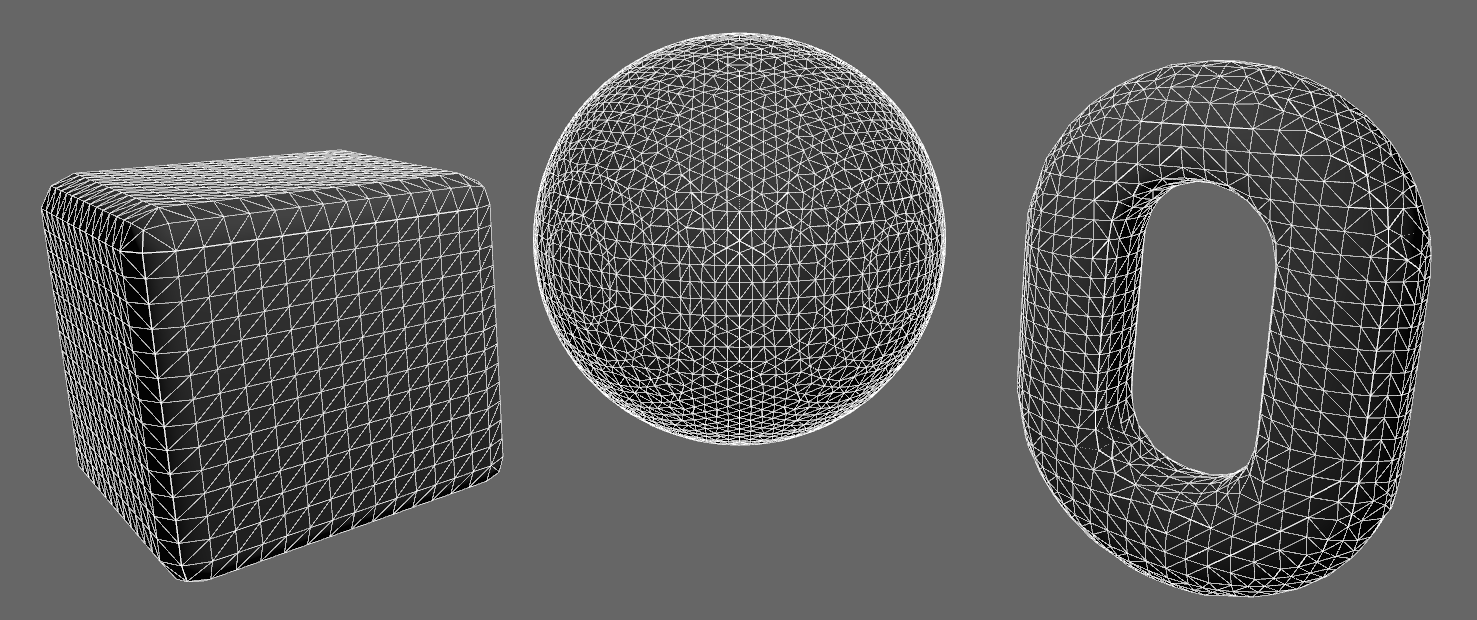
Surface Nets is an algorithm for extracting an isosurface mesh from a [signed distance
field](https://en.wikipedia.org/wiki/Signed_distance_function) sampled on a regular grid. It is nearly the same as Dual
Contouring, but instead of using hermite (derivative) data to estimate surface points, Surface Nets will do a simpler form
of interpolation (average) between points where the isosurface crosses voxel cube edges.
Benchmarks show that [`surface_nets`](crate::surface_nets) generates about 20 million triangles per second on a single core
of a 2.5 GHz Intel Core i7. This implementation achieves high performance by using small lookup tables and SIMD acceleration
provided by `glam` when doing 3D floating point vector math. (Users are not required to use `glam` types in any API
signatures.) To run the benchmarks yourself, `cd bench/ && cargo bench`.
High-quality surface normals are estimated by:
1. calculating SDF derivatives using central differencing
2. using bilinear interpolation of SDF derivatives along voxel cube edges
When working with sparse data sets, [`surface_nets`](crate::surface_nets) can generate meshes for array chunks that fit
together seamlessly. This works because faces are not generated on the positive boundaries of a chunk. One must only apply a
translation of the mesh into proper world coordinates for the given chunk.
## Example Code
```rust
use fast_surface_nets::ndshape::{ConstShape, ConstShape3u32};
use fast_surface_nets::{surface_nets, SurfaceNetsBuffer};
// A 16^3 chunk with 1-voxel boundary padding.
type ChunkShape = ConstShape3u32<18, 18, 18>;
// This chunk will cover just a single octant of a sphere SDF (radius 15).
let mut sdf = [1.0; ChunkShape::USIZE];
for i in 0u32..ChunkShape::SIZE {
let [x, y, z] = ChunkShape::delinearize(i);
sdf[i as usize] = ((x * x + y * y + z * z) as f32).sqrt() - 15.0;
}
let mut buffer = SurfaceNetsBuffer::default();
surface_nets(&sdf, &ChunkShape {}, [0; 3], [17; 3], &mut buffer);
// Some triangles were generated.
assert!(!buffer.indices.is_empty());
```
License: MIT OR Apache-2.0