
extend-docx

Extend's native Rust parser, document model, and serializer, shared with the React viewer through WebAssembly. It accepts OOXML DOCX and Word 97–2003 binary DOC through the existing format adapter. No browser, Word installation, or network service is required for parsing.
Installation
The Cargo package is extend-docx; the Rust import is extend_docx. The source lives in crates/extend-docx within extend-hq/react-docx. Rust crate versions are independent of the @extend-ai/react-docx npm versions. The internal docx-wasm package provides the JavaScript bindings and is not published to crates.io.
Native builds enable native-deflate by default, using libdeflate for whole-buffer ZIP decompression and reusing its decoder across package entries. This requires a C compiler at build time. Disable default features to use the portable Rust decoder. WebAssembly always uses the Rust decoder. Both paths retain the same fallback for entries whose declared size cannot be used for bounded preallocation.
[]
= { = "0.1", = false }
Usage
let package = parse_document_bytes?;
let model = build_doc_model;
let blocks = extract_document_blocks;
let json = to_string?;
parse_document_blocks(&bytes) combines these steps. cargo run --example parse_blocks -- input.docx writes the block JSON to standard output.
Word spans are optional:
let options = ExtractDocumentBlocksOptions ;
let blocks = parse_document_blocks_with_options?;
Use extract_document_blocks_with_options(&model, options) for an existing model, or add --include-words to the CLI. The TypeScript equivalent is extractDocumentBlocks(model, { includeWords: true }). Existing calls omit word data.
Paragraph-derived blocks, including those in tables and auxiliary stories, then include words. Each word has an ID, its parent blockId, original content, and document-bound source references with UTF-16 start/end offsets into the paragraph block's content. Segmentation uses Unicode word boundaries and includes punctuation and symbols; whitespace-only segments are omitted. It is not dictionary-based linguistic segmentation. Styled run boundaries do not split a word, and capitalization formatting does not rewrite its source text. Word rectangles are resolved by the viewer after layout, just like block rectangles.
The versioned output uses Extend's 15 block type names. Each block retains document-bound source references; paragraphs retain styled inline content, tables retain cells and spans, and text boxes retain nested content. Header/footer stories, notes, comments, form controls, and equations are represented where supported by the parser. Image blocks expose their render payload through details.imageUrl, including SVG composites, charts, text boxes, and converted images. Existing details.asset values continue to identify source package parts. A data URI carries its payload with the block; external URLs remain references and are never fetched during extraction. If an imported model has image bytes but no nonblank URL, extraction encodes those bytes as a data URI. Empty payloads do not create an imageUrl field. Original image bytes remain available in the parsed package.
document_source_graph(&package) provides an optional namespace-aware tree of XML elements, attributes, text, and an asset manifest. Original XML and binary assets remain in package. XML byte ranges refer to the decoded UTF-8 strings. For legacy DOC, the graph describes the adapter's OOXML output; keep the original DOC bytes to preserve unsupported binary structures.
Page numbers and bounding boxes require layout. The native parser deliberately returns geometryStatus: "requires_layout". Use the matching React viewer to resolve source references against rendered pages. Source identity is a SHA-256 digest of the sorted, decoded package parts and assets, independent of ZIP compression and entry order. It is not the digest of the original ZIP bytes. Keep the original upload digest separately. Imported source IDs are stable for the same package and parser version; reimport edited bytes as a new document version.
The source graph preserves structure beyond the semantic block model. This is not a promise of complete semantic extraction or Word-identical rendering. Imported HTML, subdocuments, embedded programs/objects, diagrams, and equation layout have explicit diagnostics where recognized. Unknown extension markup can be inspected in the source graph. Dynamic fields use imported values; they are not a general field calculation engine. Encrypted files and older binary formats are not covered by the Word 97–2003 adapter.
Logical and physical table columns
Table-cell gridSpan and structured table columnIndex, columnSpan, and columnCount describe the logical OOXML grid. A fixed-layout table can retain distinct logical columns whose resolved physical boundaries coincide. Its model style then includes collapsedGridColumns, listing the zero-width logical intervals in columnWidthsTwips. These intervals are not independently drawable columns. Structured table details describe logical extraction and are not a replacement for the model's layout grid.
The matching React viewer projects marked tables to their positive-width physical columns before layout, border resolution, DOM spans, and resize measurement. Structural edits materialize that physical grid and invalidate the edited table's source cache and any containing table caches. Untouched export and supported text edits retain the original source grid. Source-less export projects to the physical grid without changing the logical input model.
Rust callers can use table_grid::materialize_collapsed_table_grid before structural edits. table_grid::validate_collapsed_table_grids checks the entire model, including nested tables, image content, and auxiliary stories. serialize_docx and the WASM serialization entry points call this validation and reject unsupported markers. The legacy infallible model_to_document_xml and serialize_doc_model APIs retain their return types; callers supplying external models must validate first. Unsupported style or border changes must materialize the marked grid before applying the change.
For fixed-layout tables with automatic table width, supported conflicting cell-width preferences resolve against shared logical columns. The bounded solver requires complete positive singleton anchors and explicit positive cell preferences, excludes vertical-merge continuation preferences, and preserves source spans. Tables outside those conditions retain the existing fallback; this does not claim universal Word layout equivalence.
Shared formatting in the Rust model
Run, form-field, paragraph-mark, and imported provenance formatting use SharedTextStyle, which owns a fully resolved TextStyle through Arc. Cloning these values shares the formatting allocation. Mutable access copies it only when another model value still shares it, so editing a run cannot change another run or its imported provenance. The model remains transferable across threads.
This changes these Rust fields from Option<TextStyle> to Option<SharedTextStyle>. Convert an owned style with .into() when constructing a field, use .as_deref() to borrow a TextStyle from an optional field, or call .into_owned() to obtain an owned style. Standalone parse_run_style continues to return Option<TextStyle>.
Serde serializes the complete underlying formatting object transparently. JSON and TypeScript field shapes are unchanged, and style resolution finishes during parsing.
ParagraphChildNode::Image and ParagraphChildNode::FormField hold boxed payloads, keeping ordinary text slots small. Rust callers constructing these variants should wrap their payload with Box::new; borrowed field access continues through dereferencing. Serialization includes the complete payload with no additional wrapper.
See the repository's structured-block design document for the viewer contract, integration steps, validation evidence, and remaining coverage gaps.
Third-party notices
The symbol-font Unicode mapping is derived from dingbat-to-unicode 1.0.1 by Michael Williamson, distributed under the BSD 2-Clause license. The complete notice is in third-party/dingbat-to-unicode-LICENSE and is included in the WASM and viewer distributions.
Typed structured details in Rust
DocumentBlock.details uses structured::BlockDetails. Generated paragraph details are BlockDetails::Paragraph(Box<ParagraphDetails>), with a typed ParagraphInline sequence and shared, fully resolved text styles. Text, classification, field instructions, inline ordering, UTF-16 offsets, and formatting are computed eagerly during extraction. This avoids constructing a second generic JSON tree for every paragraph and run; it does not defer semantic parsing or style resolution.
Serde writes the same JSON object shape, including explicit nulls in paragraph and inline fields. Rust callers can match BlockDetails::Paragraph to read or edit the typed data. Call .to_json_value() explicitly when a serde_json::Value view is needed; this performs serialization and allocation. There is no implicit indexing or lazy conversion. Existing arbitrary JSON details can be constructed with BlockDetails::Raw(value) or value.into().
Deserializing BlockDetails stores Raw(Value) to retain unknown fields, including unknown nested inline or style fields. Re-serialization preserves that JSON data, and equality compares JSON values so generated and deserialized representations remain semantically comparable. The native extraction result is a typed model and structured representation; JSON encoding remains a separate explicit operation.
Parser latency comparisons
The native Rust parser is extend-docx, also used by the JavaScript package through WebAssembly. It builds an editable document model and structured blocks with source references. The comparisons below measure native parsing and extraction; browser loading, layout, pagination, and editing are outside the timing scope.
DOCX latency and text accuracy
Measured November 2, 2026, on a seeded 1,000-document DOCX corpus. Latency uses the 999 inputs all four parsers completed; accuracy includes every reference-bearing input and counts parser failures as zero. Comparison versions: docx-rs 0.4.22, office_oxide 0.1.15, undoc 0.27.1.
| Parser | Parsed | Median | p95 | Body-text F1 | Ordered-text F1 |
|---|---|---|---|---|---|
| extend-docx | 1,000/1,000 | 0.673 ms | 5.080 ms | 99.983% | 99.995% |
| docx-rs | 999/1,000 | 1.193 ms | 9.499 ms | 99.740% | 99.747% |
| office_oxide | 1,000/1,000 | 0.750 ms | 5.380 ms | 99.917% | 99.926% |
| undoc | 1,000/1,000 | 1.130 ms | 14.260 ms | 99.988% | 99.975% |
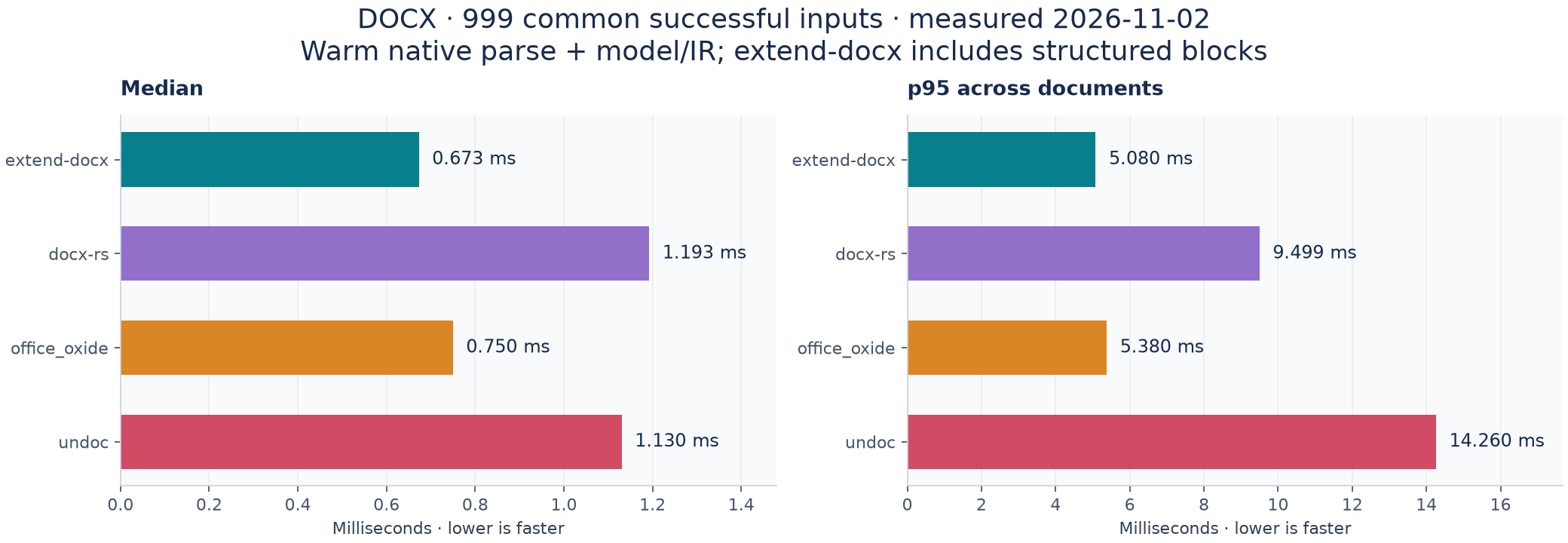
Extend-docx has the lowest median and p95 in this run. Its median is 10.3% lower than office_oxide's; this does not establish a 5× speedup. Undoc has the highest five-gram text F1, while extend-docx has the highest ordered-text F1.
Each document has five warm samples, each averaging 1–20 parses. Timings include parsing and native model/IR construction; extend-docx also projects structured blocks. File reads, process startup, JSON serialization, object destruction, and reference generation are excluded. The p95 is across document medians. Results come from a shared development machine and the libraries retain different amounts of structure.
Latency by document size and complexity
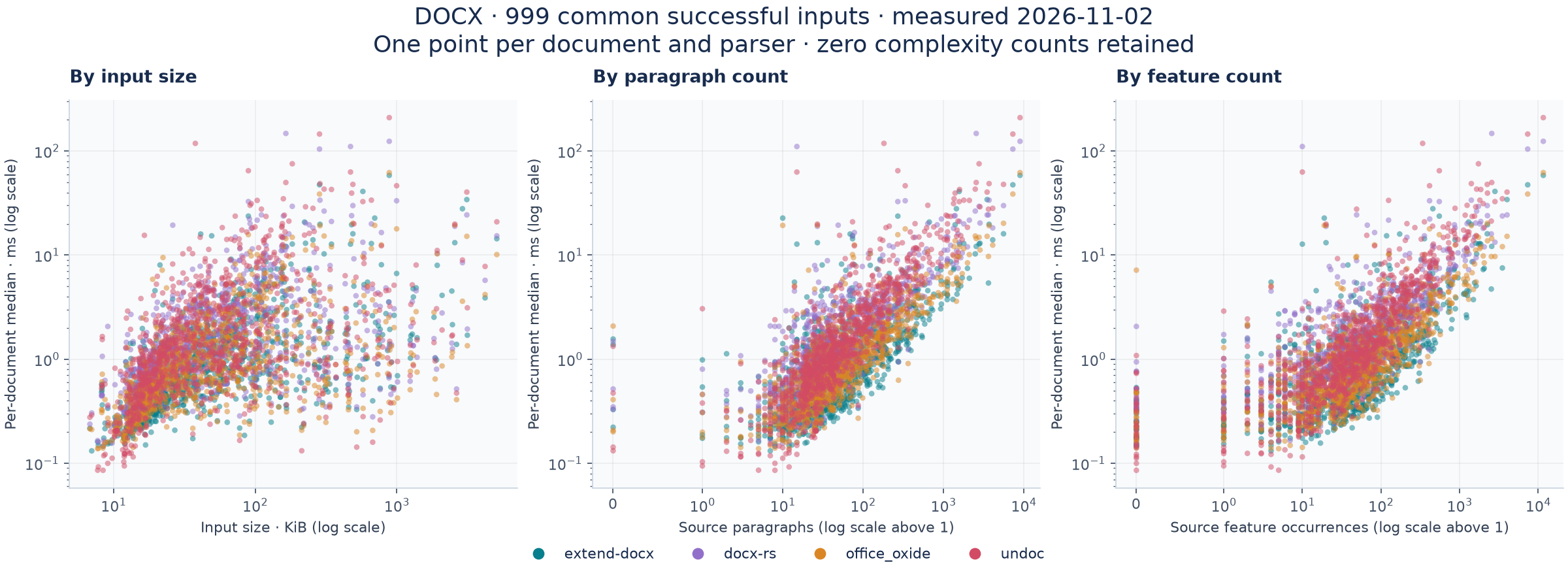
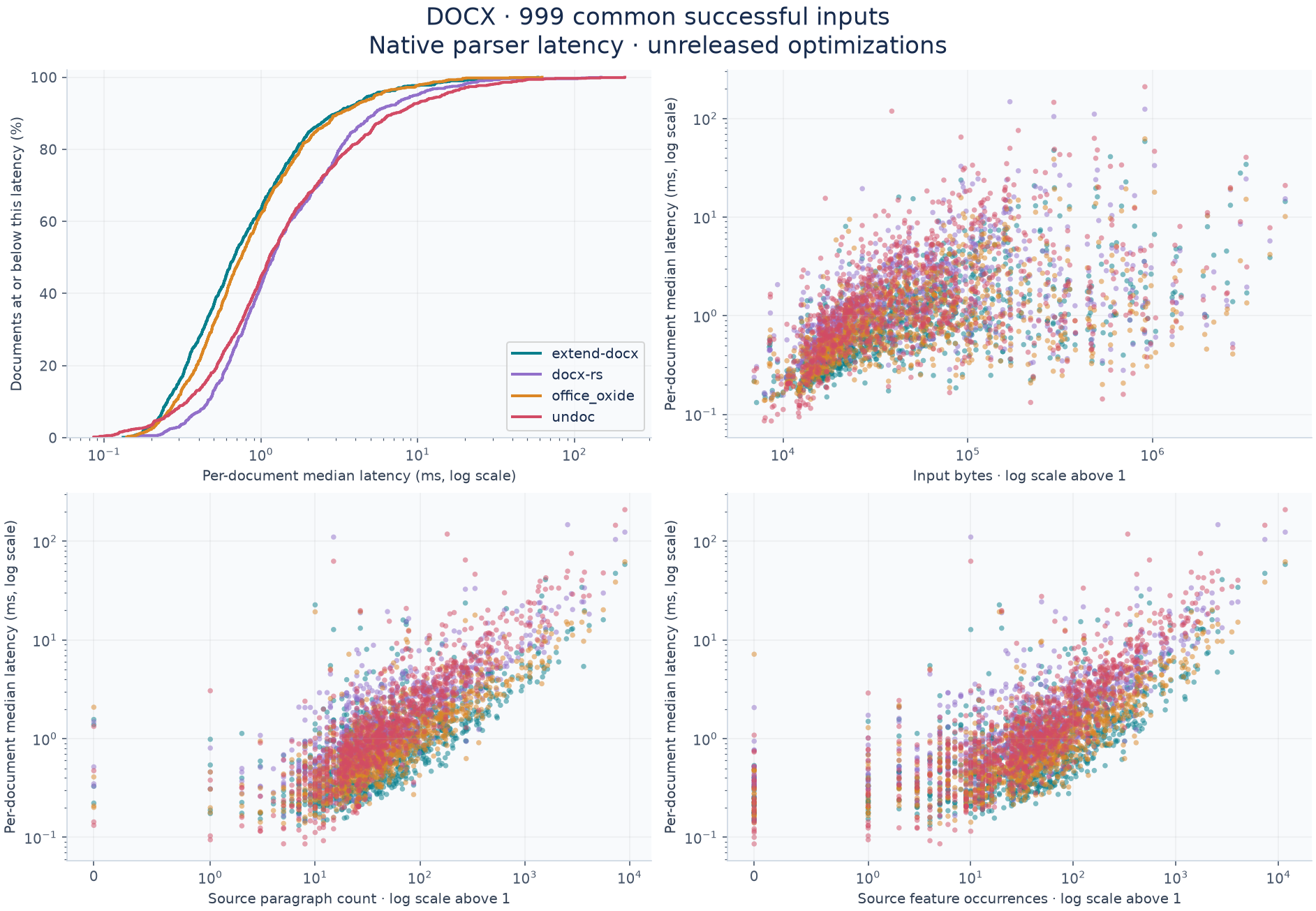
The same 999 successful inputs appear for every library. Each point is one document's median latency. Complexity counts come from the source reference and are shared across parsers. Logarithmic axes retain zero complexity counts.
Feature recall on 1,000 DOCX inputs
These are recall checks against an independent source-XML extractor, not universal accuracy or Word rendering scores. Image occurrences match retained payload bytes and multiplicity. Literal table/span checks allow additional output characters; exact-anchor checks remain separately available. Positive explicit-formatting recall does not establish precision or inherited-style correctness.
| Check | Expected units | extend-docx | docx-rs | office_oxide | undoc |
|---|---|---|---|---|---|
| Images · payload-matched occurrences | 1,069 | 100.000% | 97.381% | 95.603% | 97.568% |
| Explicit bold · aligned characters | 680,435 | 100.000% | 94.577% | 99.948% | 98.016% |
| Tables · literal text retained | 2,267 | 100.000% | 96.427% | 99.868% | 97.706% |
| Horizontal spans · literal text + exact span | 3,706 | 99.946% | 98.354% | 100.000% | 99.217% |
| Headings · text + level | 6,741 | 99.985% | 53.004% | 99.466% | 86.219% |
| Lists · paragraph membership | 15,361 | 99.980% | 98.568% | 91.758% | 93.184% |
| Vertical merges · start markers | 1,398 | 99.571% | 99.928% | 98.069% | 94.134% |
| Textboxes · exact text anchors | 2,652 | 99.774% | 35.633% | 99.623% | 100.000% |
| Check | Expected units | extend-docx | docx-rs | office_oxide | undoc |
|---|---|---|---|---|---|
| Tables · exact text anchors | 2,267 | 98.985% | 96.427% | 97.045% | 97.706% |
| Table cells · exact text anchors | 62,518 | 99.744% | 99.520% | 99.575% | 99.659% |
| Nested tables · text anchors | 97 | 100.000% | 97.938% | 98.969% | 97.938% |
| Horizontal spans · exact text + span | 3,706 | 96.492% | 98.354% | 96.114% | 99.217% |
| Headers · paragraph text | 807 | 100.000% | 69.888% | 99.504% | 100.000% |
| Footers · paragraph text | 818 | 100.000% | 61.858% | 98.044% | 100.000% |
| Footnotes · paragraph text | 339 | 100.000% | 0.000% | 100.000% | 92.035% |
| Endnotes · paragraph text | 46 | 100.000% | 0.000% | 100.000% | 95.652% |
| Comments · paragraph text | 40 | 100.000% | 100.000% | 100.000% | 0.000% |
| Equations · occurrence count proxy | 52 | 100.000% | 0.000% | 0.000% | 0.000% |
| Images · node-count proxy | 1,069 | 87.278% | 97.381% | 95.603% | 97.755% |
| Explicit bold · run five-grams | 548,210 | 98.236% | 96.942% | 98.247% | 98.236% |
| Explicit italic · run five-grams | 378,087 | 99.270% | 98.035% | 99.215% | 99.269% |
| Hyperlinks · text five-grams | 88,320 | 99.341% | 95.138% | 96.355% | 68.332% |
| Explicit italic · aligned characters | 433,678 | 100.000% | Not scored | Not scored | Not scored |
| Hyperlink targets · aligned characters | 101,572 | 100.000% | Not scored | Not scored | Not scored |
Run-based checks are sensitive to segmentation and inherited formatting. Image node counts can undercount composite SVGs even when all payloads are retained. “Not scored” means that adapter has no measurement for the stated native semantic audit; the comparable five-gram rows remain above. Original measurements, precision/F1, and denominators are preserved in the aggregate data.
Independent Microsoft Word reference sample
Measured November 3, 2026, on 25 documents selected from the start of the fixed manifest without score filtering. All four parsers completed all inputs. Text uses Microsoft Word's object model; image payload checks use the original source bytes. This small sample supplements the larger XML-reference benchmark.
| Parser | Median / p95 | Word body recall | Word body F1 | Source image payloads |
|---|---|---|---|---|
| extend-docx | 0.530 / 6.880 ms | 99.949% | 99.952% | 52/52 · 100.000% |
| docx-rs | 1.089 / 6.606 ms | 99.939% | 99.947% | 48/52 · 92.308% |
| office_oxide | 0.680 / 3.668 ms | 99.937% | 99.946% | 48/52 · 92.308% |
| undoc | 1.084 / 11.990 ms | 99.949% | 96.999% | 52/52 · 100.000% |
Extend-docx has the lowest median in this sample; office_oxide has the lowest p95. Body F1 here pools ordered character counts; it is a different metric and cohort from the macro-averaged source-XML scores above.
Each cell below is precision / recall. Resolved formatting covers only 10 documents whose Word capture completed within its time budget. Native table and hyperlink references cover 24.
| Word object-model check | extend-docx | docx-rs | office_oxide | undoc |
|---|---|---|---|---|
| Resolved bold · 611 characters | 100.000% / 99.836% | 100.000% / 93.781% | 100.000% / 93.781% | 93.558% / 99.836% |
| Resolved italic · 387 characters | 100.000% / 100.000% | 100.000% / 88.372% | 100.000% / 100.000% | 100.000% / 100.000% |
| Top-level tables · 28 text anchors | 100.000% / 100.000% | 89.286% / 89.286% | 96.429% / 96.429% | 100.000% / 100.000% |
| Hyperlinks · 73 text anchors | 69.307% / 95.890% | 95.745% / 61.644% | 97.183% / 94.521% | 97.222% / 95.890% |
The hyperlink reference omits some field-generated links, so additional valid output can lower apparent precision. Word can normalize or repair input; its exports and the custom extractor each have limits. Neither benchmark establishes visual fidelity, exact image placement, or complete OOXML conformance.
Other Word formats
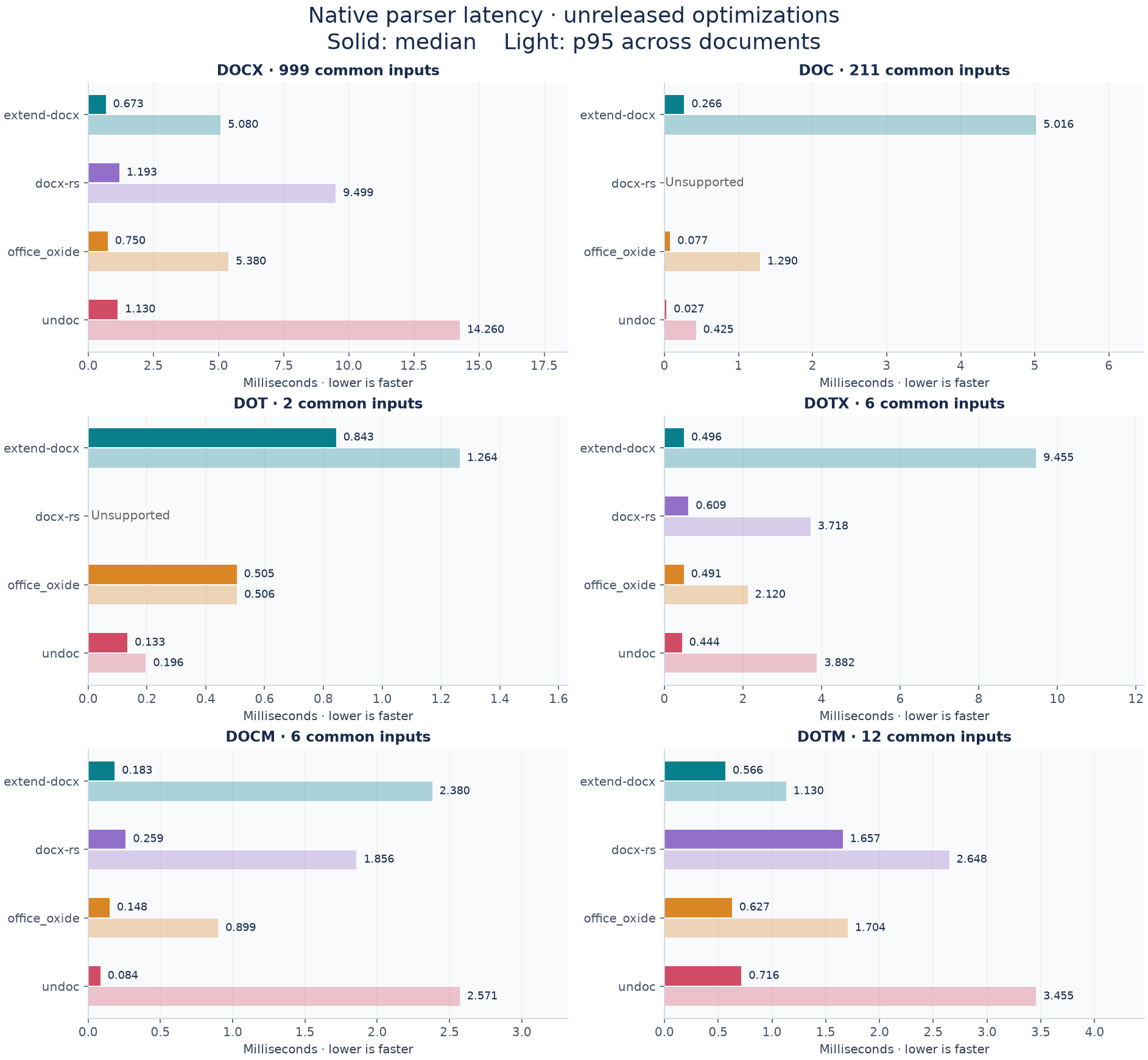
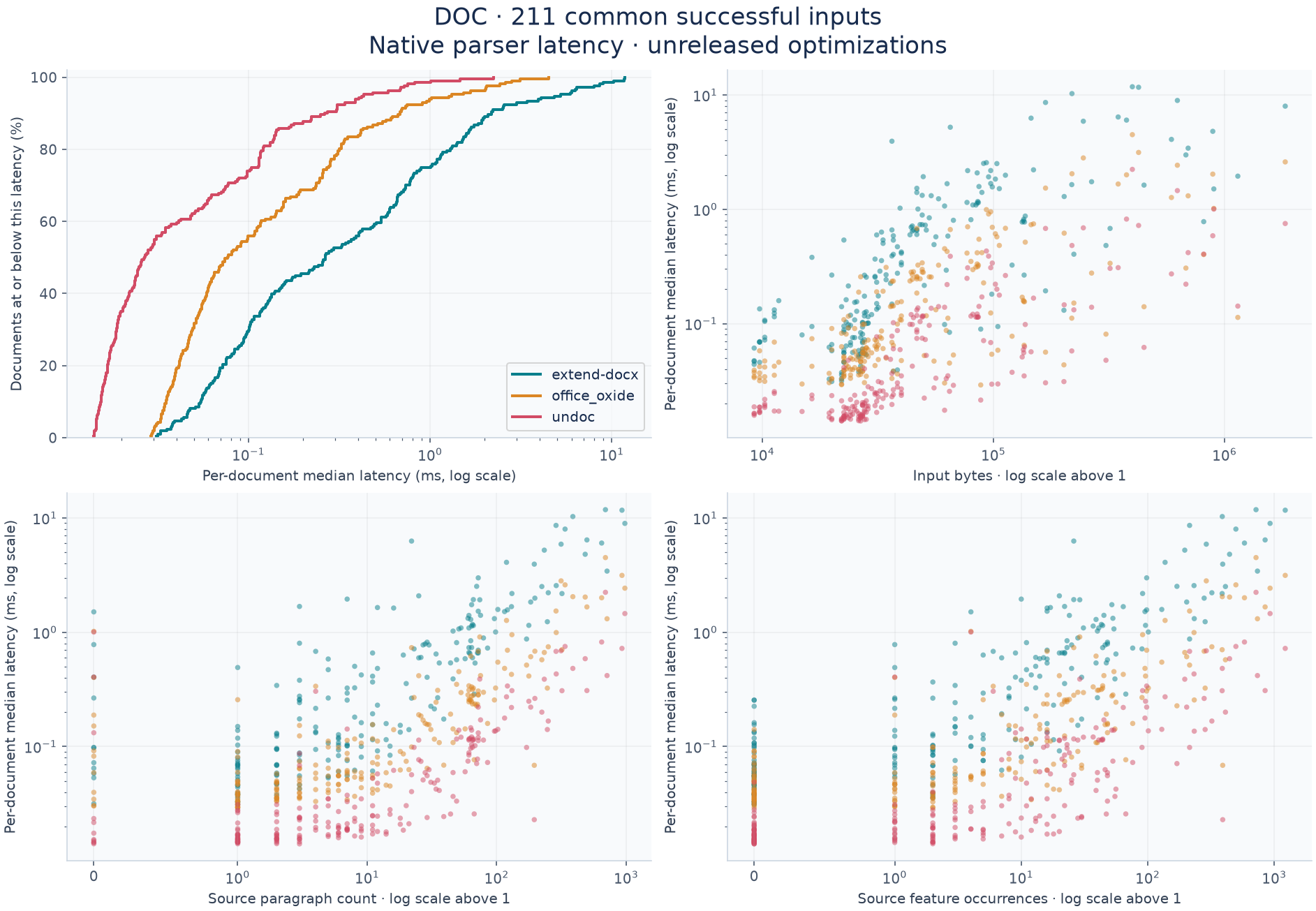
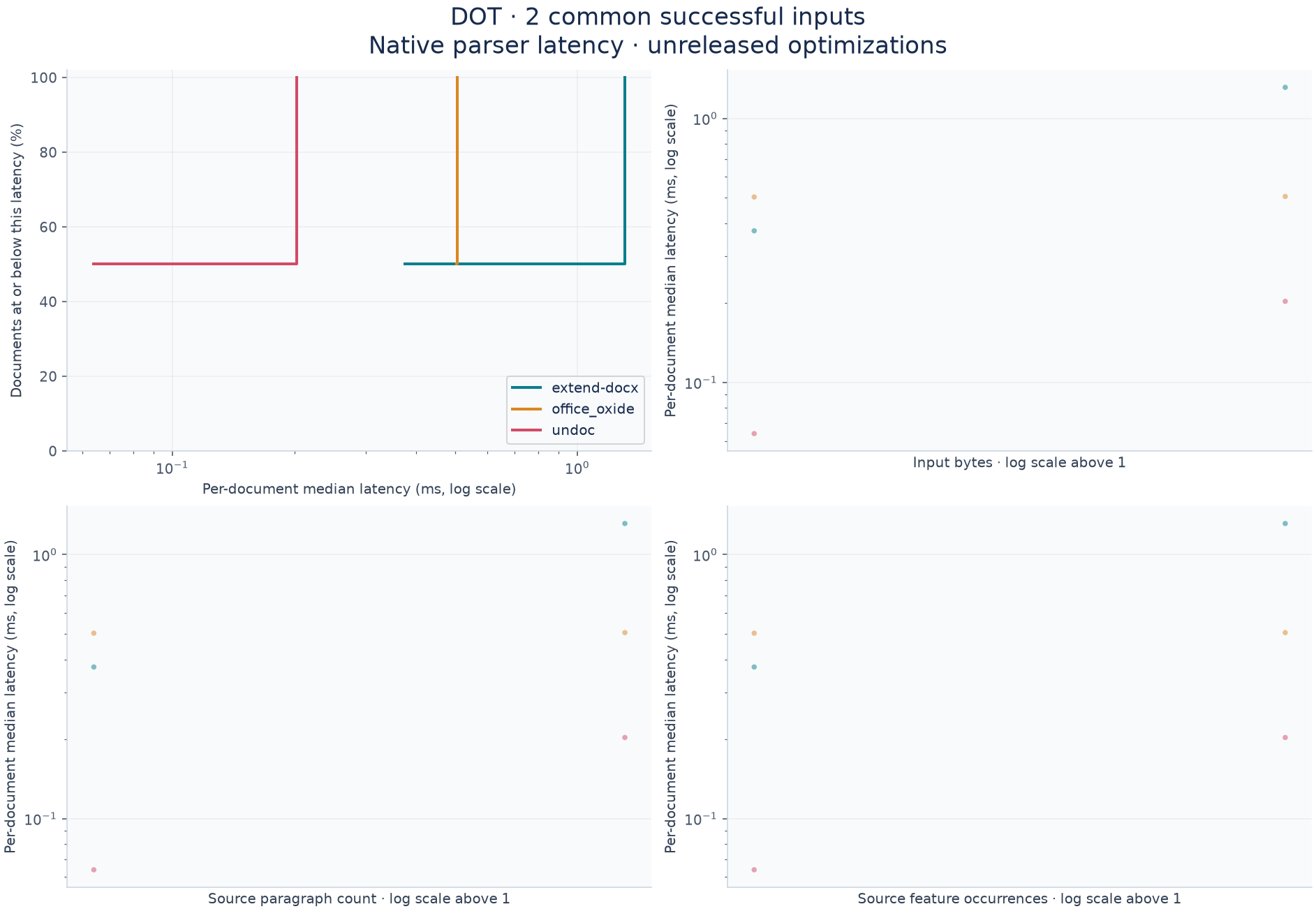
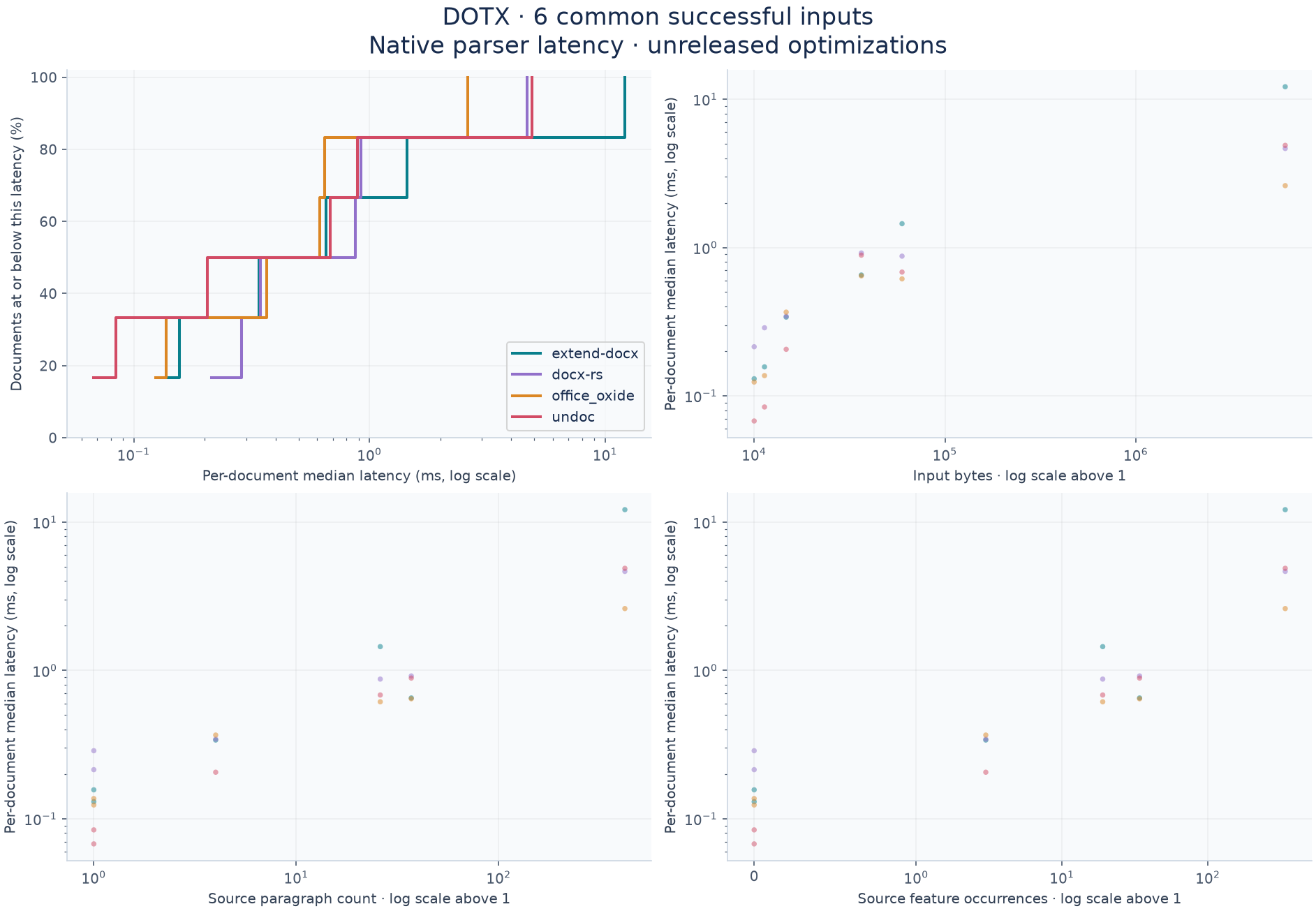
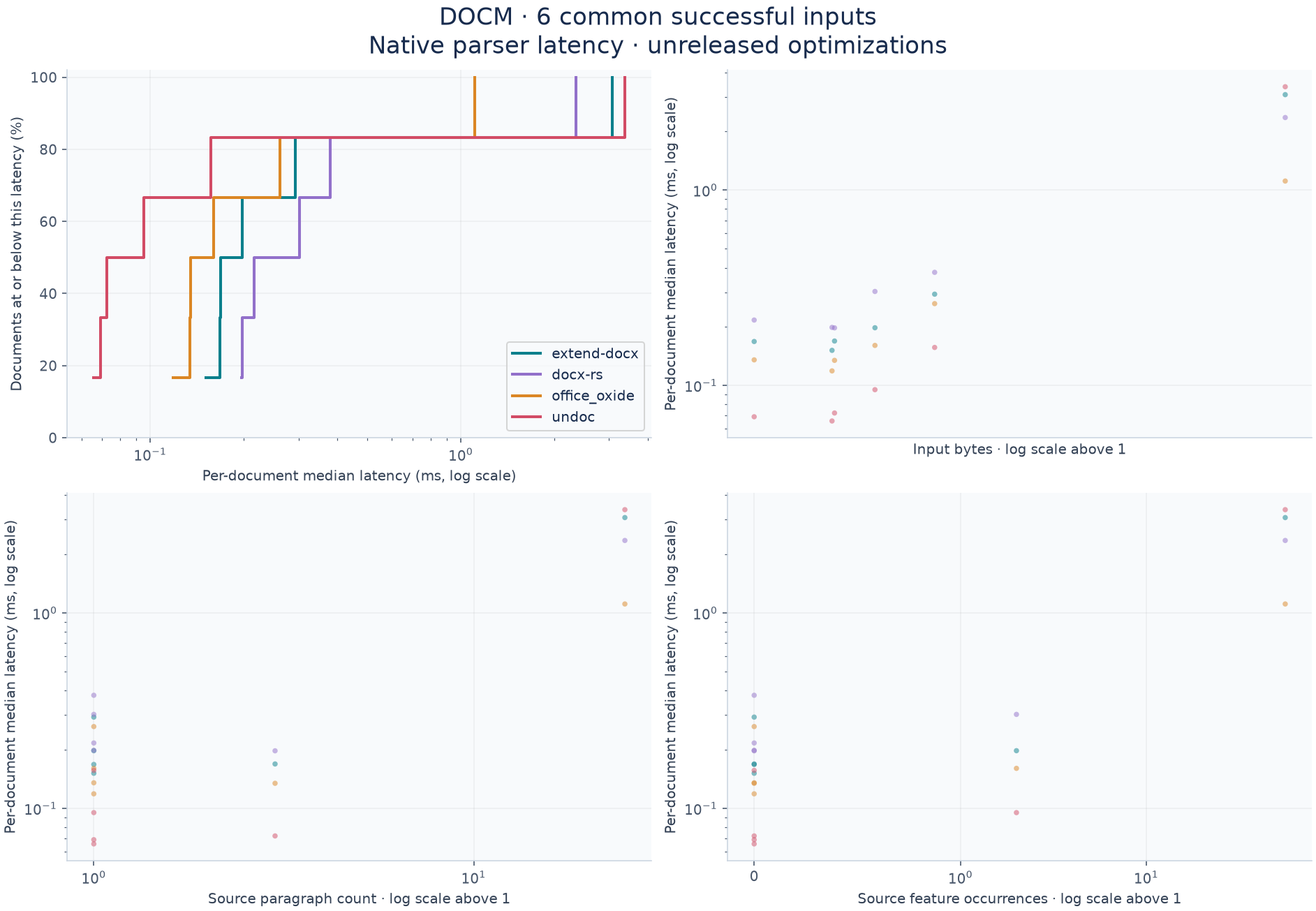
Binary DOC and DOT use LibreOffice conversion as a reference proxy. Template/macro cohorts have only 2–12 inputs each. The retained optimization improves DOC adaptation, but extend-docx remains slower than office_oxide and undoc on binary DOC. Macros are never executed.
Each cell is body-text F1 · median / p95 milliseconds. Accuracy and latency use the per-format scopes described above.
| Format | extend-docx | docx-rs | office_oxide | undoc |
|---|---|---|---|---|
| DOCX | 99.983% · 0.673 / 5.080 | 99.740% · 1.193 / 9.499 | 99.917% · 0.750 / 5.380 | 99.988% · 1.130 / 14.260 |
| DOC | 98.748% · 0.266 / 5.016 | Unsupported | 97.979% · 0.077 / 1.290 | 95.293% · 0.027 / 0.425 |
| DOT | 100.000% · 0.843 / 1.264 | Unsupported | 99.902% · 0.505 / 0.506 | 100.000% · 0.133 / 0.196 |
| DOTX | 100.000% · 0.496 / 9.455 | 99.756% · 0.609 / 3.718 | 99.813% · 0.491 / 2.120 | 99.911% · 0.444 / 3.882 |
| DOCM | 100.000% · 0.183 / 2.380 | 100.000% · 0.259 / 1.856 | 100.000% · 0.148 / 0.899 | 100.000% · 0.084 / 2.571 |
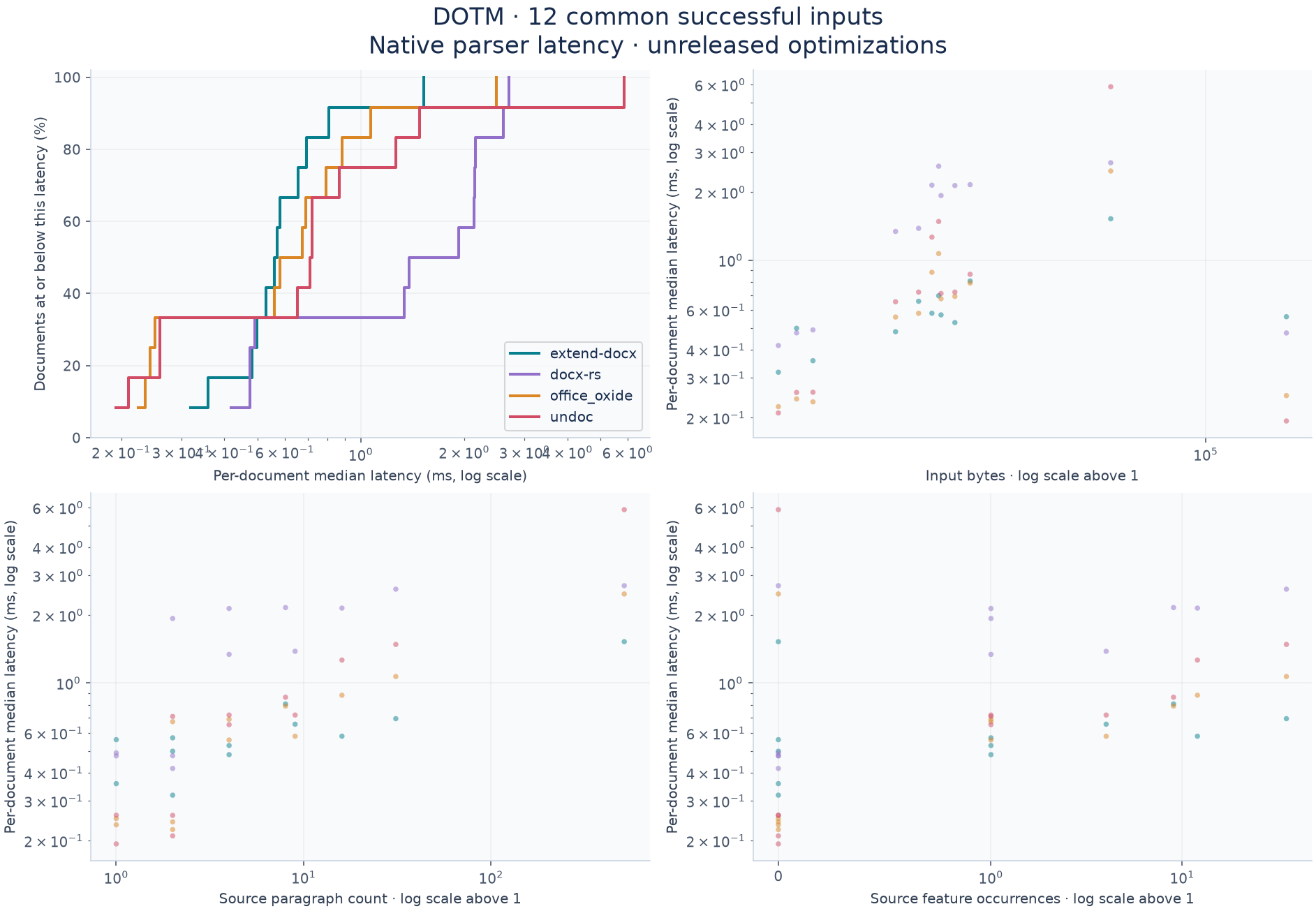
| DOTM | 100.000% · 0.566 / 1.130 | 100.000% · 1.657 / 2.648 | 100.000% · 0.627 / 1.704 | 100.000% · 0.716 / 3.455 |
Reproducibility and detailed results
- Measured revisions, timing protocol, validation, and paired optimization results
- Word capture/scoring methods, coverage, and unresolved reference limitations
- Source-reference accuracy aggregates, latency summary, and anonymous scatter data
- Word-reference aggregate precision, recall, F1, and coverage for every measured category
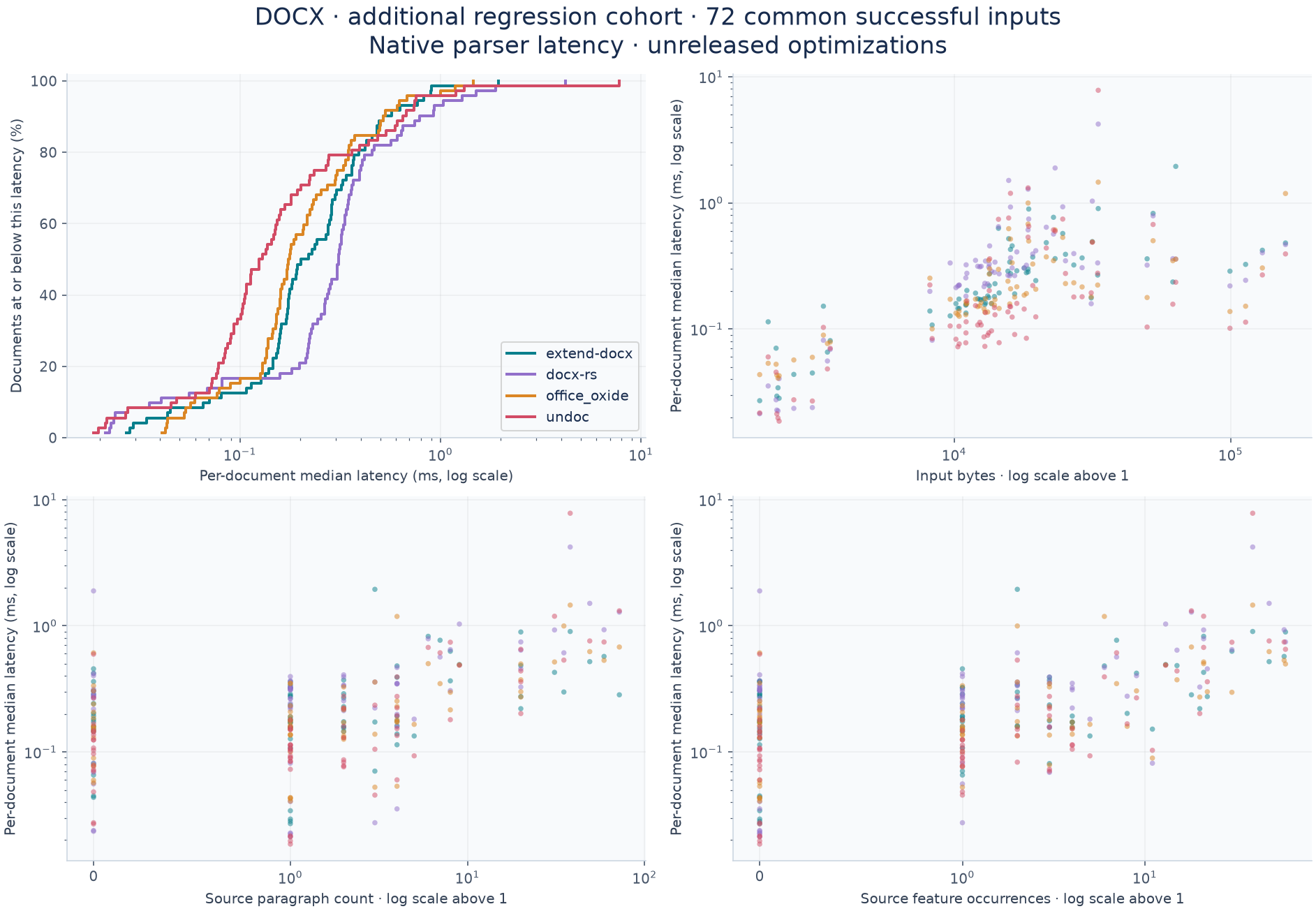
- Per-format distribution and complexity charts and historical npm 0.13.0 results
These are retained completed runs, not new measurements of a documentation release. Source revisions and executable hashes identify each measured build. Historical records use the internal engine identifier docx-core; chart and table labels use the published crate name extend-docx. Public data contains aggregate counts and anonymous numeric points, without source documents or extracted text.
Per-format charts
With Matplotlib and NumPy installed, regenerate charts from the published data without the original documents:
Regression inputs
The public suite uses generated inputs and inline XML. Run cargo test --workspace --locked from the repository root. To smoke-test a local corpus explicitly, set DOCX_TEST_CORPUS to a directory containing DOC or DOCX inputs and run cargo test -p extend-docx --test doc_fixture -- --ignored. Corpus documents and diagnostic outputs stay local and are not distributed with the package.