1
2
3
4
5
6
7
8
9
10
11
12
13
14
15
16
17
18
19
20
21
22
23
24
25
26
27
28
29
30
31
32
33
34
35
36
37
38
39
40
41
42
43
44
45
46
47
48
49
50
51
52
53
54
55
56
57
58
59
60
61
62
63
64
65
66
67
68
69
70
71
72
73
74
75
76
77
78
79
80
81
82
83
84
85
86
87
88
89
90
91
92
93
94
95
96
97
98
99
100
101
102
103
104
105
106
107
108
109
110
111
112
113
114
115
116
117
118
119
120
121
122
123
124
125
126
127
128
129
130
131
132
133
134
135
136
137
138
139
140
141
142
143
144
145
146
147
148
149
150
151
152
153
154
155
156
157
158
159
160
161
162
163
164
165
166
167
168
169
170
171
172
173
174
175
176
177
178
179
180
181
182
183
184
185
186
187
188
189
190
191
192
193
194
195
196
197
198
199
200
201
202
203
204
205
206
207
208
209
210
211
212
213
214
215
216
217
218
219
220
221
222
223
224
225
226
227
228
229
230
231
232
233
234
235
236
237
238
239
240
241
242
243
244
245
246
247
248
249
250
251
252
253
254
255
256
257
258
259
260
261
262
263
264
265
266
267
268
269
270
271
272
273
274
275
276
277
278
279
280
281
282
283
284
285
286
287
288
289
290
291
292
293
294
295
296
297
298
299
300
301
302
303
304
305
306
307
308
309
310
311
312
313
314
315
316
317
318
319
320
321
322
323
324
325
326
327
328
329
330
331
332
333
334
335
336
337
338
//! > Self-referencial structs using async stacks
//!
//! Escher is an extremely simple library providing a safe and sound API to build
//! self-referencial structs. It works by (ab)using the async await trasformation
//! of rustc. If you'd like to know more about the inner workings please take a
//! look at the [How it works](#how-it-works) section and the source code.
//!
//! Compared to the state of the art escher:
//!
//! * Is only around 100 lines of well-commented code
//! * Contains only two `unsafe` calls that are well argued for
//! * Uses rustc for all the analysis. If it compiles, the self references are correct
//! * Contains no procedural macros, compilation is very fast
//!
//! # How it works
//!
//! ## The problem with self-references
//!
//! The main problem with self-referencial structs is that if such a struct was
//! somehow constructed the compiler would then have to statically prove that it
//! would not move again. This analysis is necessary because any move would
//! invalidate self-pointers since all pointers in rust are absolute memory
//! addresses.
//!
//! To illustrate why this is necessary, imagine we define a self-referencial
//! struct that holds a Vec and a pointer to it at the same time:
//!
//! ```rust
//! struct Foo {
//! s: Vec<u8>,
//! p: &Vec<u8>,
//! }
//! ```
//!
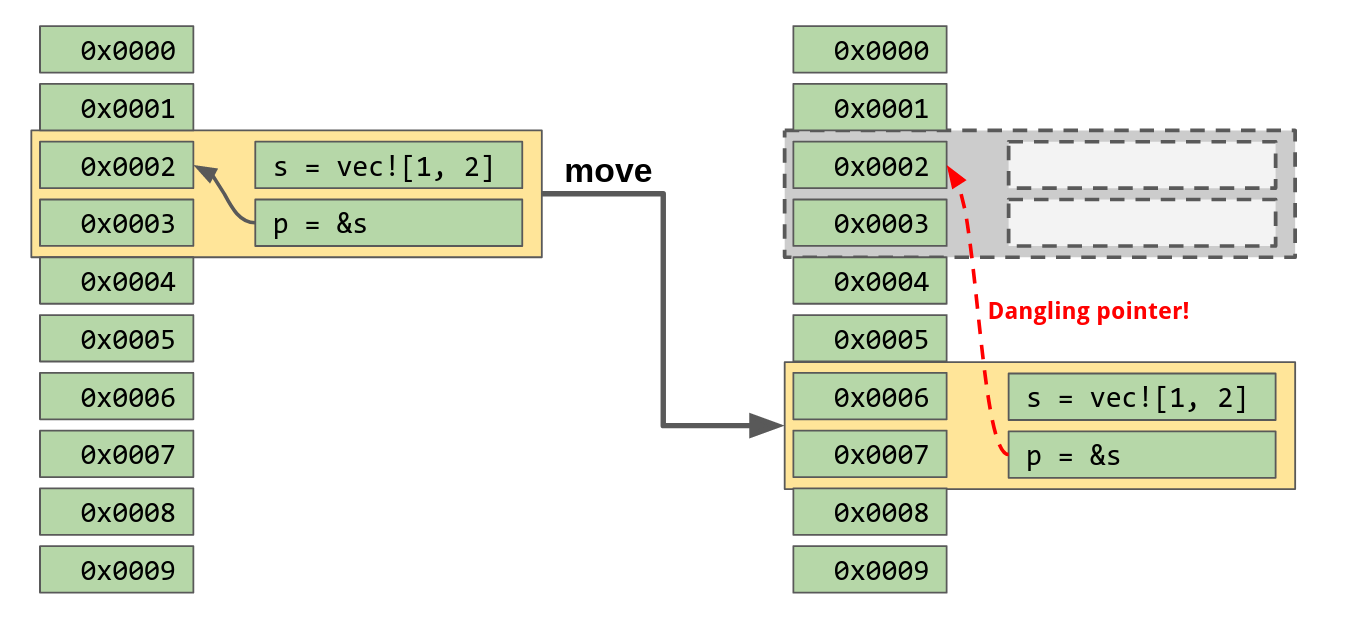
//! Then, let's assume we had a way of getting an instance of this struct. We could
//! then write the following code that creates a dangling pointer in safe rust!
//!
//! ```rust
//! let foo = Foo::magic_construct();
//!
//! let bar = foo; // move foo to a new location
//! println!("{:?}", bar.p); // access the self-reference, memory error!
//! ```
//!
//! 
//!
//! ## Almost-self-references on the stack
//!
//! While rust doesn't allow you to explicitly write out self referencial struct
//! members and initialize them it is perfectly valid to write out the values of
//! the members individually as separate stack bindings. This is because the borrow
//! checker *can* do a move analysis when the values are on the stack.
//!
//! Practically, we could convert the struct `Foo` from above to individual
//! bindings like so:
//!
//! ```rust
//! fn foo() {
//! let s = vec![1, 2, 3];
//! let p = &s;
//! }
//! ```
//!
//! Then, we could wrap both of them in a struct that only has references and use that instead:
//!
//! ```rust
//! struct AlmostFoo<'a> {
//! s: &'a Vec<u8>,
//! p: &'a Vec<u8>,
//! }
//!
//! fn make_foo() {
//! let s = vec![1, 2, 3];
//! let p = &s;
//!
//! let foo = AlmostFoo { s, p };
//!
//! do_stuff(foo); // call a function that expects an AlmostFoo
//! }
//! ```
//!
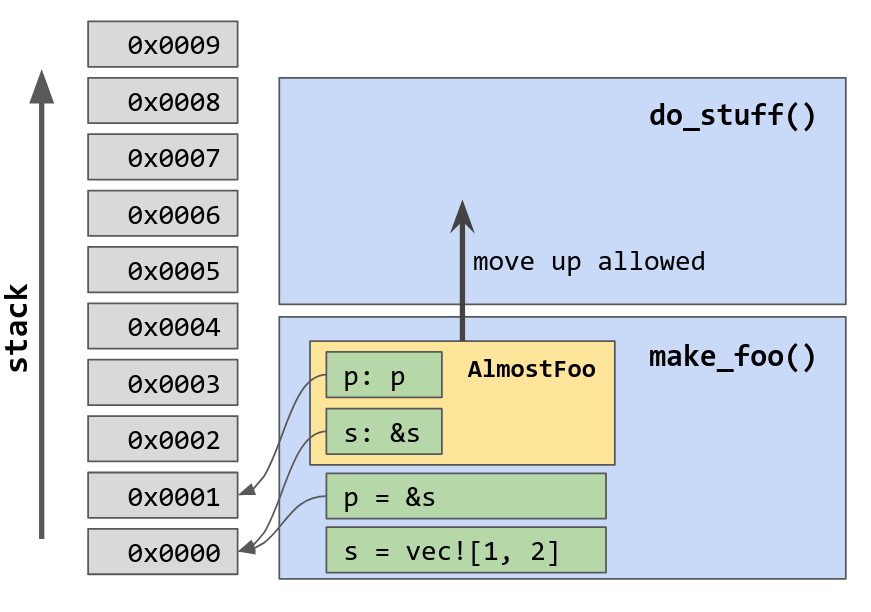
//! Of course `make_foo()` cannot return an `AlmostFoo` instance since it would be
//! referencing values from its stack, but what it can do is call other functions
//! and pass an `AlmostFoo` to them. In other words, as long as the code that wants
//! to use `AlmostFoo` is above `make_foo()` we can use this technique and work
//! with almost-self-references.
//!
//! 
//!
//! This is pretty restrictive though. Ideally we'd lke to be able return some
//! owned value and be free to move it around, put it on the heap, etc.
//!
//! ## Actually returning an `AlmostFoo`
//!
//! > **Note:** The description of async stacks bellow is not what actually happens
//! > in rustc but is enough to illustrate the point. `escher`'s API does make use
//! > that the desired values are held across an await point to force them to be
//! > included in the generated Future.
//!
//! As we saw, it is impossible to return an `AlmostFoo` instance since it
//! references values from the stack. But what if we could freeze the stack after
//! an `AlmostFoo` instance got constructed and then returned the whole stack?
//!
//! Well, there is no way for a regular function to capture its own stack and
//! return it but that is exactly what the async/await transformation does! Let's
//! make `make_foo` from above async and also make it never terminate:
//!
//! ```rust
//! async fn make_foo() {
//! let s = vec![1, 2, 3];
//! let p = &s;
//! let foo = AlmostFoo { s, p };
//! std::future::pending().await
//! }
//! ```
//!
//! Now when someone calls `make_foo()` what they get back is some struct that
//! implements Future. This struct is in fact a representation of the stack of
//! `make_foo` at its initial state, i.e in the state that the function has not be
//! called yet.
//!
//! What we need to do now is to step the execution of the returned Future until
//! the instance of `AlmostFoo` is constructed. In this case we know that there is
//! a single await point so we only need to poll the Future once. Before we do that
//! though we need to put it in a Pinned Box to ensure that as we poll the future
//! no moves will occur. This is the same restriction as with normal function but
//! with async it is enforced using the `Pin<P>` type.
//!
//! ```rust
//! let foo = make_foo(); // construct a stack that will eventually make an AlmostFoo in it
//! let mut foo = Box::pin(foo_fut); // pin it so that it never moves again
//! foo.poll(); // poll it once
//!
//! // now we know that somewhere inside `foo` there is a valid AlmostFoo instance!
//! ```
//!
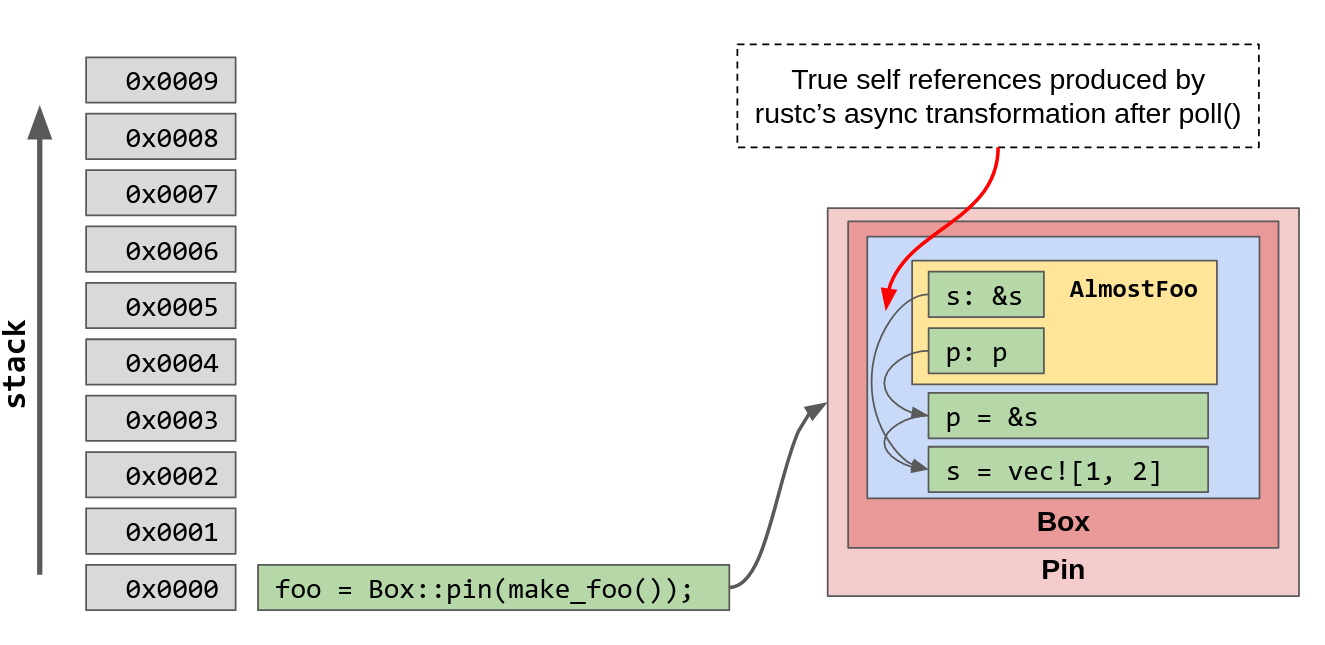
//! We're almost there! We now have an owned value, the future, that somewhere
//! inside it has an AlmostFoo instance. However we have no way of retrieving the
//! exact memory location of it or accessing it in any way. The Future is opaque.
//!
//! 
//!
//! ## Putting it all together
//!
//! `escher` builds upon the techniques described above and provides a solution for
//! getting the pointer from within the opaque future struct. Each `Escher<T>`
//! instance holds a Pinned Future and a raw pointer to T. The pointer to T is
//! computed by polling the Future just enough times for the desired T to be
//! constructed.
//!
//! As its API, it provides the `as_ref()` and `as_mut()` methods that unsafely
//! turn the raw pointer to T into a &T with its lifetime bound to the lifetime of
//! `Escher<T>` itself. This ensures that the future will outlive any usage of the
//! self-reference!
//!
//! Thank you for reading this far! If you would like to learn how escher uses the
//! above concepts in detail please take a look at the implementation.
use Future;
use Pin;
use ;
use Arc;
use Context;
use noop_waker;
/// The `Bind` trait defines a type level function that allows you convert a type that holds
/// references of lifetime `'a` to a type that holds references of lifetime `'b`.
///
/// The trait is unsafe because the implementer needs to make sure that the associated type
/// differs with the implementing type only on their lifetimes. In other words, it's meant to
/// prevent incantations like:
///
/// ```ignore
/// unsafe impl<'a> Bind<'a> for Foo<'_> {
/// type Out = Bar<'a>; // !!WRONG!!
/// }
///
/// unsafe impl<'a> Bind<'a> for Foo<'_> {
/// type Out = Foo<'a>; // CORRECT
/// }
/// ```
pub unsafe
/// Convinience alias to apply the type level function. `Rebind<'a, T>` computes a type that is
/// identical to T except for its lifetimes that are now bound to 'a.
type Rebind<'a, T> = Out;
/// Blanket implementation for any reference to owned data
unsafe
/// Safe macro that makes a type rebindable by implementing `Bind` for all lifetimes
/// A containter of a self referencial struct. The self-referencial struct is constructed with the
/// aid of the async/await machinery of rustc, see Escher::new.