# 📬 emval
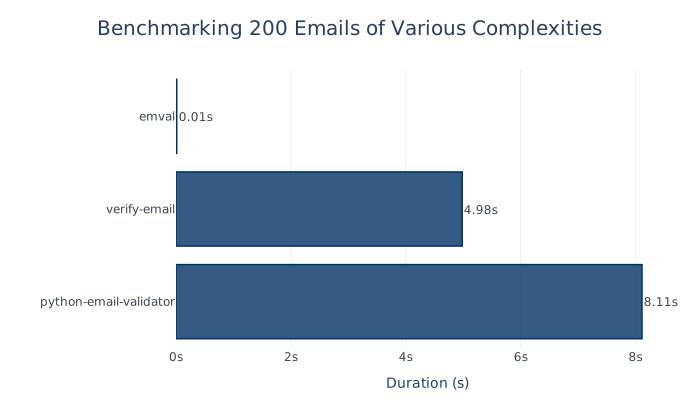
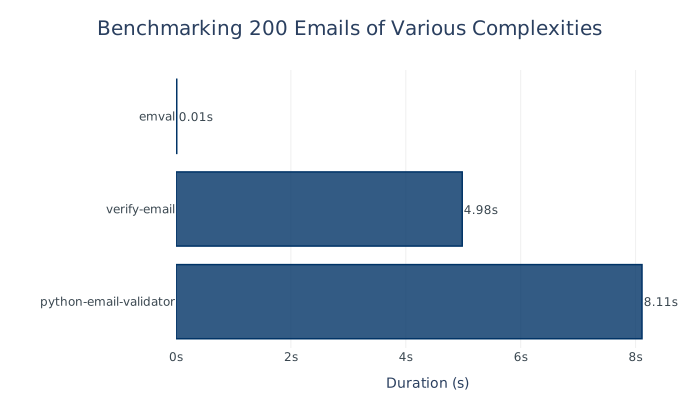
`emval` is a blazingly fast email validator written in Rust with Python bindings, offering performance improvements of 100-1000x over traditional validators.
## Features
- Drop-in replacement for popular email validators like `python-email-validator`, `verify-email`, and `pyIsEmail`.
- 100-1000x faster than [python-email-validator](https://github.com/JoshData/python-email-validator).
- Validates email address syntax according to [RFC 5322](https://www.rfc-editor.org/rfc/rfc5322.html) and [RFC 6531](https://www.rfc-editor.org/rfc/rfc6531.html).
- Checks domain deliverability (coming soon).
- Supports internationalized domain names (IDN) and local parts.
- Provides user-friendly syntax errors.
- Normalizes addresses.
- Rejects invalid and unsafe Unicode characters.
## Getting Started
Install `emval` from PyPI:
```sh
pip install emval
```
or use `emval` in a Rust project:
```sh
cargo add emval
```
## Usage
### Quick Start
To validate an email address in Python:
```python
from emval import validate_email, EmailValidator
email = "example@domain.com"
try:
# Check if the email is valid.
val_email = validate_email(email)
# Utilize the normalized form for storage.
normalized_email = val_email.normalized
except Exception as e:
# Example: "Invalid Local Part: Quoting the local part before the '@' sign is not permitted in this context."
print(str(e))
```
The same code in Rust:
```rust
use emval::{validate_email, ValidationError};
fn main() -> Result<(), ValidationError> {
let email = "example@domain.com";
let val_email = validate_email(email)?;
let normalized_email = val_email.normalized;
Ok(())
}
```
### Configurations
Customize email validation behavior using the `EmailValidator` class:
```python
from emval import EmailValidator
emval = EmailValidator(
allow_smtputf8=False,
allow_empty_local=True,
allow_quoted_local=True,
allow_domain_literal=True,
deliverable_address=False,
)
email = "user@[192.168.1.1]"
try:
validated_email = emval.validate_email(email)
print(validated_email)
except Exception as e:
print(str(e))
```
The same code in Rust:
```rust
use emval::{EmailValidator, ValidationError};
fn main() -> Result<(), ValidationError> {
let emval = EmailValidator {
allow_smtputf8: false,
allow_empty_local: true,
allow_quoted_local: true,
allow_domain_literal: true,
deliverable_address: false,
};
let email = "example@domain.com";
let validated_email = emval.validate_email(email)?;
Ok(())
}
```
### Options
- `allow_smtputf8`: Allows internationalized email addresses.
- `allow_empty_local`: Allows an empty local part (e.g., `@domain.com`).
- `allow_quoted_local`: Allows quoted local parts (e.g., `"user name"@domain.com`).
- `allow_domain_literal`: Allows domain literals (e.g., `[192.168.0.1]`).
- `deliverable_address`: Checks if the email address is deliverable by verifying the domain's MX records.
## Technical Details
### Email Address Syntax
emval adheres to the syntax rules defined in [RFC 5322](https://www.rfc-editor.org/rfc/rfc5322.html) and [RFC 6531](https://www.rfc-editor.org/rfc/rfc6531.html). It supports both ASCII and internationalized characters.
### Internationalized Email Addresses
#### Domain Names
emval converts non-ASCII domain names into their ASCII "Punycode" form according to [IDNA 2008](https://www.rfc-editor.org/rfc/rfc5891.html). This ensures compatibility with systems that do not support Unicode.
#### Local Parts
emval allows international characters in the local part of email addresses, following [RFC 6531](https://www.rfc-editor.org/rfc/rfc6531.html). It offers options to handle environments without SMTPUTF8 support.
### Unsafe Unicode Characters
emval rejects unsafe Unicode characters to enhance security, preventing display and interpretation issues.
### Normalization
emval normalizes email addresses to ensure consistency:
- **Lowercasing domains:** Domain names are standardized to lowercase.
- **Unicode NFC normalization:** Characters are transformed into their precomposed forms.
- **Removing unnecessary characters:** Quotes and backslashes in the local part are removed.
## Acknowledgements
This project draws inspiration from [python-email-validator](https://github.com/JoshData/python-email-validator). While `python-email-validator` is more comprehensive, `emval` aims to provide a faster solution.
## Getting Help
For questions and issues, please open an issue in the [GitHub issue tracker](https://github.com/bnkc/emval/issues).
## License
emval is licensed under the [MIT License](https://opensource.org/licenses/MIT). See the [LICENSE](https://github.com/bnkc/emval/blob/main/LICENSE) file for more details.