[](https://docs.rs/dryoc) [](https://crates.io/crates/dryoc) [](https://github.com/brndnmtthws/dryoc/actions/workflows/build-and-test.yml) [](https://app.codecov.io/gh/brndnmtthws/dryoc/)
[💬 Join the Matrix chat](https://matrix.to/#/#dryoc:frens.io)
# dryoc: Don't Roll Your Own Crypto™<sup></sup>
dryoc is a pure-Rust, general-purpose cryptography library that's hard to misuse. It's based on the excellent
[libsodium](https://github.com/jedisct1/libsodium) library, but in _pure_ Rust. It
also includes protected memory features throughout, which makes it dead simple
to build secure, robust, and safe cryptographic software. The original goal of this library was to provide a pure-Rust alternative to libsodium.

The purpose of this project is to provide a pure-Rust, mostly drop-in
replacement for libsodium. This library has nearly the same ergonomics as
libsodium (referred to in dryoc as the _Classic_ API), such that people
familiar with libsodium can use this library nearly interchangeably. While
the API is not 100% identical to libsodium, most functions have the same or
very similar signatures.
In addition to the Classic API, there's a _Rustaceous_ API which aims to bring
an idiomatic Rust implementation of libsodium's core features: public and
secret key authenticated cryptography and general-purpose cryptography tools.
Not all features from libsodium are implemented here, either because there
exist better implementations in other crates, or because they aren't
necessary as part of this crate.
Additionally, this crate provides exceptionally safe cryptography thanks to
Rust's safety features. The Rustaceous API is designed designed to make it
difficult to shoot yourself in the foot. It's worth noting, however, you
certainly can still shoot yourself if you choose (either by leaking private
data, using insecure hardware, OPSEC issues, etc).
For example usage, refer to the
[official docs](https://docs.rs/dryoc/latest/dryoc/) or the
[integration tests](/tests/integration_tests.rs).
## Features
* 100% pure Rust, no hidden C libraries
* mostly free of unsafe code
* Hard to misuse, helping you avoid common costly cryptography mistakes
* Many libsodium features implemented with both Classic and Rustaceous API
* Protected memory handling (`mprotect()` + `mlock()`, along with Windows
equivalents) on stable Rust for Unix and Windows targets, enabled by default
with the `protected` feature
* Password-hash string helpers enabled by default with the `base64` feature
* [Serde](https://serde.rs/) support (with `features = ["serde"]`)
* [wincode](https://crates.io/crates/wincode) support for direct binary serialization of Rustaceous box types (with `features = ["wincode"]`)
* [_Portable_ SIMD](https://doc.rust-lang.org/std/simd/index.html) implementations on nightly, with `features = ["simd_backend", "nightly"]`:
* Blake2b (used by generic hashing, password hashing, and key derivation)
* Argon2 block mixing (used by password hashing)
* Salsa20 (used by XSalsa20-Poly1305 secretbox)
* Poly1305 (used by one-time authentication and secret boxes), except on
AArch64 where dryoc keeps the soft backend because the portable-SIMD path
is slower there
* [curve25519-dalek](https://github.com/dalek-cryptography/curve25519-dalek) (used by public/private key functions) selects its own serial or x86_64 vector backend at build time
* [SHA2](https://github.com/RustCrypto/hashes/tree/master/sha2) (used by sealed boxes) includes SIMD implementation for AVX2
* [SHA3](https://github.com/RustCrypto/hashes/tree/master/sha3) (used by SHA-3 compatibility hashing)
* [ChaCha20](https://github.com/RustCrypto/stream-ciphers/tree/master/chacha20) (used by streaming interface) includes SIMD implementations for NEON, AVX2, and SSE2
## Rust version
dryoc uses the Rust 2024 edition and requires Rust 1.89 or newer, as declared
by `rust-version` in `Cargo.toml`.
Rust 2024 reserves `gen` as a keyword. Prefer generation APIs such as
`Key::generate()`. Existing `gen` APIs remain available through raw identifier
syntax, such as `Key::r#gen()`, for compatibility and are deprecated.
The `simd_backend` and `nightly` features enable dryoc's portable SIMD
backends. CPU-specific dependency backends and local benchmarking may also
benefit from target-specific `RUSTFLAGS`:
* For AVX2 set `RUSTFLAGS=-Ctarget-cpu=haswell -Ctarget-feature=+avx2`
* For SSE2 set `RUSTFLAGS=-Ctarget-feature=+sse2`
* For NEON set `RUSTFLAGS=-Ctarget-feature=+neon`
* For local Apple Silicon benchmarks, use `RUSTFLAGS=-Ctarget-cpu=native`.
NEON is part of the AArch64 macOS baseline target, so adding
`-Ctarget-feature=+neon` is not expected to change native results.
The Curve25519 backend is selected by `curve25519-dalek`, not by dryoc's
`simd_backend` feature.
Poly1305 is a special exception on AArch64: even with `simd_backend` and
`nightly` enabled, dryoc uses the soft Poly1305 backend because profiling shows
the portable-SIMD implementation is slower on that architecture.
_Note that eventually this project will converge on portable SIMD implementations
for all the core algos which will work across all platforms supported by LLVM,
rather than relying on hand-coded assembly or intrinsics, but this is a work in
progress_.
See [BENCHMARKS.md](BENCHMARKS.md) for side-by-side software and SIMD benchmark
results.
## Optional serialization
Enable `serde` to derive [`serde::Serialize`](https://docs.rs/serde/latest/serde/trait.Serialize.html)
and [`serde::Deserialize`](https://docs.rs/serde/latest/serde/trait.Deserialize.html)
for supported data structures.
Enable `wincode` to derive [`wincode::SchemaWrite`](https://docs.rs/wincode/latest/wincode/trait.SchemaWrite.html)
and [`wincode::SchemaRead`](https://docs.rs/wincode/latest/wincode/trait.SchemaRead.html)
for supported Rustaceous box types, including `DryocBox` and
`DryocSecretBox`, plus AEAD boxes and envelopes from `dryocaead`.
## Project status
The following libsodium features are currently implemented, or awaiting
implementation. This list has been reviewed against
[libsodium 1.0.22](https://github.com/jedisct1/libsodium/releases/tag/1.0.22-RELEASE):
* [x] [Public-key cryptography](https://docs.rs/dryoc/latest/dryoc/dryocbox/index.html) (`crypto_box_*`) [libsodium link](https://doc.libsodium.org/public-key_cryptography)
* [x] [Secret-key cryptography](https://docs.rs/dryoc/latest/dryoc/dryocsecretbox/index.html) (`crypto_secretbox_*`) [libsodium link](https://doc.libsodium.org/secret-key_cryptography)
* [x] [Curve25519 point*scalar multiplication](https://docs.rs/dryoc/latest/dryoc/classic/crypto_core/index.html) (`crypto_scalarmult*`) [libsodium link](https://doc.libsodium.org/advanced/scalar_multiplication)
* [x] Zeroing memory (`sodium_memzero`) with [zeroize](https://crates.io/crates/zeroize) [libsodium link](https://doc.libsodium.org/memory_management)
* [x] [Generating random data](https://docs.rs/dryoc/latest/dryoc/rng/index.html) (`randombytes_buf`) [libsodium link](https://doc.libsodium.org/generating_random_data)
* [x] [Encrypted streams](https://docs.rs/dryoc/latest/dryoc/dryocstream/index.html) (`crypto_secretstream_*`) [libsodium link](https://doc.libsodium.org/secret-key_cryptography/secretstream)
* [x] [XChaCha20-Poly1305-IETF AEAD](https://docs.rs/dryoc/latest/dryoc/dryocaead/index.html) (`crypto_aead_xchacha20poly1305_ietf_*`) [libsodium link](https://doc.libsodium.org/secret-key_cryptography/aead/chacha20-poly1305/xchacha20-poly1305_construction)
* [x] [Memory locking](https://docs.rs/dryoc/latest/dryoc/protected/index.html) (`sodium_mlock`, `sodium_munlock`, `sodium_mprotect_*`) [libsodium link](https://doc.libsodium.org/memory_management)
* [x] [Encrypting related messages](https://docs.rs/dryoc/latest/dryoc/utils/fn.increment_bytes.html) (`sodium_increment`) [libsodium link](https://doc.libsodium.org/secret-key_cryptography/encrypted-messages)
* [x] [Generic hashing](https://docs.rs/dryoc/latest/dryoc/generichash/index.html) (`crypto_generichash_*`) [libsodium link](https://doc.libsodium.org/hashing/generic_hashing)
* [x] [Secret-key authentication](https://docs.rs/dryoc/latest/dryoc/auth/index.html) (`crypto_auth*`) [libsodium link](https://doc.libsodium.org/secret-key_cryptography/secret-key_authentication)
* [x] [One-time authentication](https://docs.rs/dryoc/latest/dryoc/onetimeauth/index.html) (`crypto_onetimeauth_*`) [libsodium link](https://doc.libsodium.org/advanced/poly1305)
* [x] [Sealed boxes](https://docs.rs/dryoc/latest/dryoc/dryocbox/struct.DryocBox.html#method.seal) (`crypto_box_seal*`) [libsodium link](https://doc.libsodium.org/public-key_cryptography/sealed_boxes)
* [x] [Key derivation](https://docs.rs/dryoc/latest/dryoc/kdf/index.html) (`crypto_kdf_*`) [libsodium link](https://doc.libsodium.org/key_derivation)
* [x] [Key exchange](https://docs.rs/dryoc/latest/dryoc/kx/index.html) (`crypto_kx_*`) [libsodium link](https://doc.libsodium.org/key_exchange)
* [x] [Public-key signatures](https://docs.rs/dryoc/latest/dryoc/sign/index.html) (`crypto_sign_*`) [libsodium link](https://doc.libsodium.org/public-key_cryptography/public-key_signatures)
* [x] [Ed25519 to Curve25519](https://docs.rs/dryoc/latest/dryoc/classic/crypto_sign_ed25519/index.html) (`crypto_sign_ed25519_*`) [libsodium link](https://doc.libsodium.org/advanced/ed25519-curve25519)
* [x] [Signature secret-key extraction helpers](https://docs.rs/dryoc/latest/dryoc/classic/crypto_sign_ed25519/index.html) (`crypto_sign_ed25519_sk_to_seed`, `crypto_sign_ed25519_sk_to_pk`) [libsodium link](https://doc.libsodium.org/public-key_cryptography/public-key_signatures)
* [x] [SHA-2 hashing](https://docs.rs/dryoc/latest/dryoc/classic/crypto_hash/index.html) (`crypto_hash_sha256_*`, `crypto_hash_sha512_*`) [libsodium link](https://doc.libsodium.org/hashing/sha-2)
* [x] [SHA-3 hashing](https://docs.rs/dryoc/latest/dryoc/sha3/index.html) (`crypto_hash_sha3256_*`, `crypto_hash_sha3512_*`) [NIST FIPS 202 link](https://nvlpubs.nist.gov/nistpubs/fips/nist.fips.202.pdf)
* [x] [Short-input hashing](https://docs.rs/dryoc/latest/dryoc/classic/crypto_shorthash/index.html) (`crypto_shorthash`) [libsodium link](https://doc.libsodium.org/hashing/short-input_hashing)
* [x] [Password hashing](https://docs.rs/dryoc/latest/dryoc/pwhash/index.html) (`crypto_pwhash_*`) [libsodium link](https://doc.libsodium.org/password_hashing/default_phf)
* [x] [HKDF key derivation variants](https://docs.rs/dryoc/latest/dryoc/hkdf/index.html) (`crypto_kdf_hkdf_sha256_*`, `crypto_kdf_hkdf_sha512_*`) [libsodium link](https://doc.libsodium.org/key_derivation/hkdf)
* [x] [Direct HMAC authentication variants](https://docs.rs/dryoc/latest/dryoc/hmac/index.html) (`crypto_auth_hmacsha256_*`, `crypto_auth_hmacsha512_*`, `crypto_auth_hmacsha512256_*`) [libsodium link](https://doc.libsodium.org/secret-key_cryptography/secret-key_authentication)
The following libsodium features are either incomplete, not exposed as public
APIs, or not implemented; you may find equivalent functionality in other
crates:
* [ ] [AEAD constructions](https://doc.libsodium.org/secret-key_cryptography/aead) beyond XChaCha20-Poly1305-IETF, including AEGIS-128L/256, AES256-GCM, and ChaCha20-Poly1305
* [ ] XChaCha20-Poly1305 box and secretbox variants (`crypto_box_curve25519xchacha20poly1305_*`, `crypto_secretbox_xchacha20poly1305_*`)
* [ ] Extendable-output functions (`crypto_xof_shake*`, `crypto_xof_turboshake*`), added in libsodium 1.0.21
* [ ] [Key encapsulation](https://github.com/jedisct1/libsodium/releases/tag/1.0.22-RELEASE) (`crypto_kem_*`, `crypto_kem_mlkem768_*`, `crypto_kem_xwing_*`), added in libsodium 1.0.22
* [ ] Deterministic random data for reproducible tests (`randombytes_buf_deterministic`)
* [ ] Short-input hash variants beyond SipHash-2-4 with 64-bit output (`crypto_shorthash_siphashx24_*`)
* [ ] [IP address encryption](https://doc.libsodium.org/secret-key_cryptography/ip_address_encryption) (`crypto_ipcrypt_*`, `sodium_ip2bin`, `sodium_bin2ip`), added in libsodium 1.0.21
* [ ] [Helpers](https://doc.libsodium.org/helpers), [padding](https://doc.libsodium.org/padding), and constant-time verify utilities (`sodium_*`, `crypto_verify_*`)
* [ ] Standalone [stream cipher](https://doc.libsodium.org/advanced/stream_ciphers) APIs (`crypto_stream_*`; use the [salsa20](https://crates.io/crates/salsa20) or [chacha20](https://crates.io/crates/chacha20) crates directly instead)
* [ ] [Advanced features](https://doc.libsodium.org/advanced):
* [ ] Keccak-f[1600] core permutation (`crypto_core_keccak1600_*`)
* [ ] [Scrypt](https://doc.libsodium.org/advanced/scrypt) (`crypto_pwhash_scryptsalsa208sha256_*`; use the [scrypt](https://crates.io/crates/scrypt) crate directly instead)
* [ ] [Finite field and group arithmetic](https://doc.libsodium.org/advanced/point-arithmetic) (`crypto_core_ed25519_*`, `crypto_core_ristretto255_*`; try the [curve25519-dalek](https://crates.io/crates/curve25519-dalek) crate)
* [ ] Ed25519 and Ristretto255 scalar multiplication variants (`crypto_scalarmult_ed25519_*`, `crypto_scalarmult_ristretto255_*`)
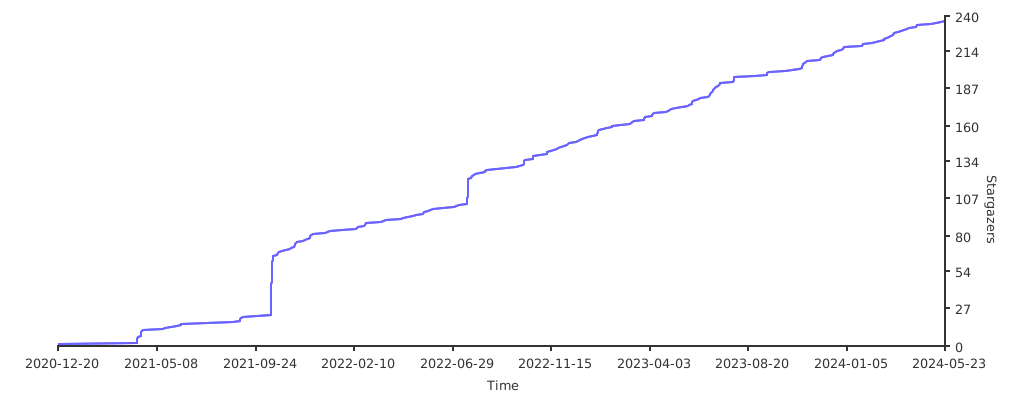
## Stargazers over time
[](https://starchart.cc/brndnmtthws/dryoc)
## Other NaCl-related Rust implementations worth mentioning
* [sodiumoxide](https://crates.io/crates/sodiumoxide)
* [crypto_box](https://crates.io/crates/crypto_box)
available on Unix and Windows targets with the default `protected` feature.
Unsupported targets do not expose the protected-memory API. These features
require custom memory allocation, system calls, and pointer arithmetic, which
are unsafe in Rust. Some optional SIMD code, including dependency-provided SIMD
implementations and small internal helpers, may contain unsafe code. In
particular, many SIMD implementations are considered "unsafe" due to their use
of assembly or intrinsics, however without SIMD-based cryptography you may be
exposed to timing attacks. The in-crate unsafe inventory includes fixed-size
byte views, optional wincode schema impls for Rustaceous boxes and AEAD
envelopes, BLAKE2b parameter byte views, protected memory guarded heap buffers
and OS protection calls, and Salsa20 SIMD unaligned in-place and
buffer-to-buffer XOR.
See the [rustdoc unsafe code summary](https://docs.rs/dryoc/latest/dryoc/#unsafe-code)
for the full non-test unsafe inventory in this crate.
