# Dracon System
**Proactive disk space monitoring and automatic cleanup.** Disk, process, guard, doctor — local machine diagnostics and watchdog. Prevents "disk full" emergencies on development machines and servers.
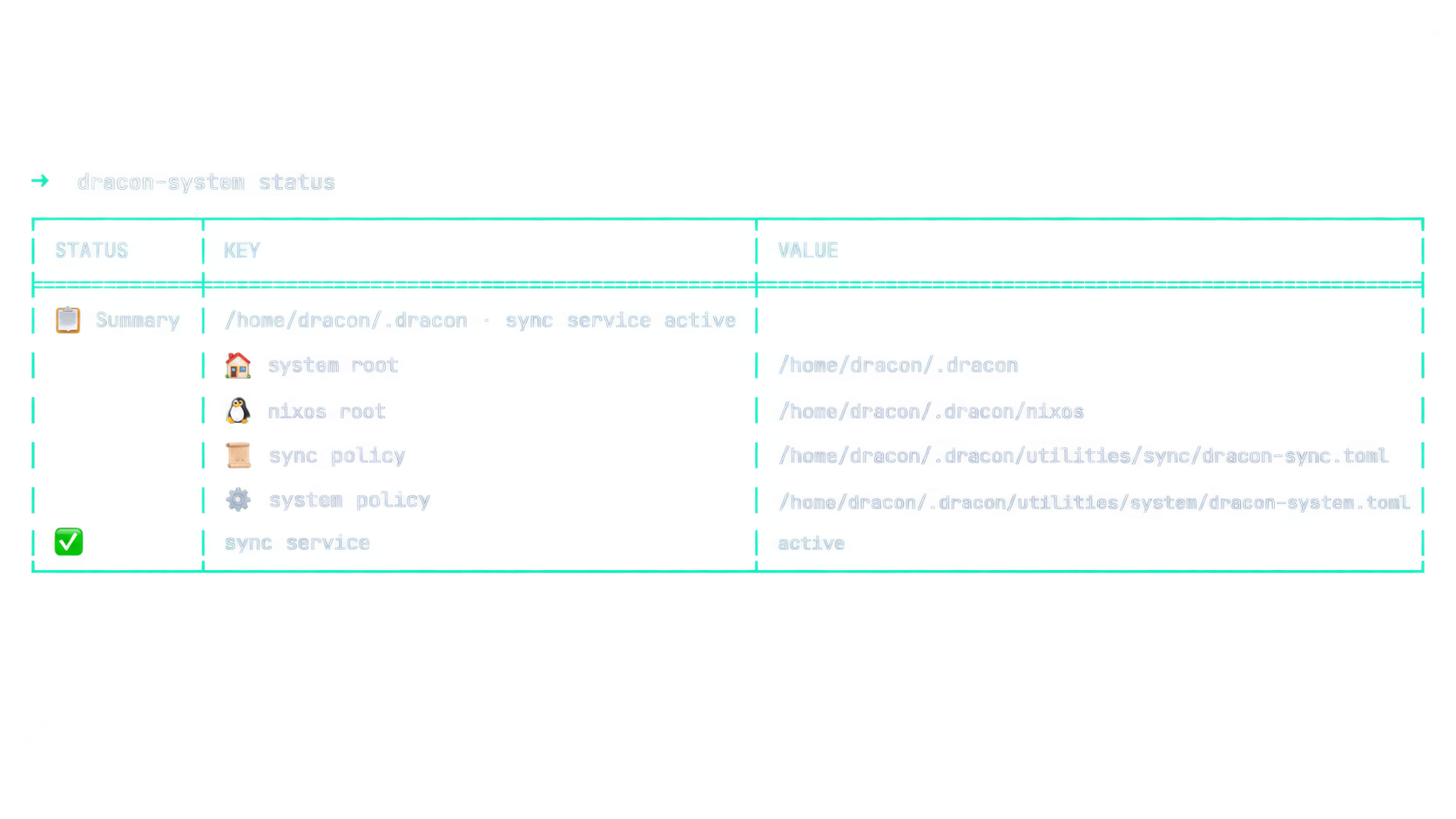
This page is the user guide for `dracon-system` (also rendered on
crates.io). This repo is the canonical, live source on `main`
(mirrored to GitLab and Codeberg). For workspace builds it is also
checked out as a nested standalone repo under `dracon-system/` in the
[`dracon-utilities`](https://github.com/DraconDev/dracon-utilities)
parent repo — a regular nested repo, not a submodule.
## Install
```bash
cargo install dracon-system
```
The binary lands at `~/.cargo/bin/dracon-system` (version 0.112.41 on
crates.io). The shipped guard unit runs `%h/.local/bin/dracon-system`, so
for service use either copy it there or install from a checkout:
```bash
# Clone the repo
git clone https://github.com/DraconDev/dracon-system-disk-process-guard-doctor.git
cd dracon-system-disk-process-guard-doctor
# Build (locked)
cargo build --release --locked
# Install where the guard unit looks
install -d "$HOME/.local/bin"
install -m 0755 target/release/dracon-system "$HOME/.local/bin/dracon-system"
```
Or, from a full `dracon-utilities` checkout, run `./install.sh` at the
parent root to install all three utilities plus services and hooks in
one pass.
## Features
### Disk Space Monitoring
- **Early Warning** — proactive notification before space becomes critical
- **Warning** — state change notification
- **Action** — automatic cleanup triggers
- **Critical** — aggressive mitigation
(Thresholds are policy; the shipped example uses 65/75/85/92, the compiled
defaults are 70/80/90/95 — see Configuration.)
### Automatic Rust Target Cleanup
- Automatically cleans `target/` directories when disk hits action level
- Smart protection for active builds:
- Detects running `cargo`, `rustc`, `clippy-driver` processes
- Protects target dirs in their working directories
- Protects recently modified target dirs (configurable)
- Configurable minimum size threshold
### Process Monitoring & Graduated Renice
- Monitors processes using excessive CPU (default: >50% for >30s) or RSS
(default: >4 GiB)
- Graduated renice based on severity:
- ≥180% CPU → nice 5 (gentle deprio)
- ≥300% CPU → nice 10 (moderate deprio)
- ≥500% CPU → nice 15 (strong deprio)
- RSS ≥4 GiB → nice 5 (memory hog deprio)
- RSS ≥8 GiB → nice 10 (heavy memory deprio)
- Targets are floors: an already nicer process is never raised to a
higher priority by a smaller tier value
- **Never directly kills processes** — mitigation can renice heavy jobs,
bias `oom_score_adj` during critical pressure, and optionally throttle
CPU with a reversible `CPUQuota`; OOM bias only influences the kernel's
last-resort choice
- Auto-releases reversible process adjustments after pressure recovers
### Build-Aware Monitoring
- Detects active Rust build processes
- Protects their target directories from cleanup
- Detects active cargo/npm/pip/go operations (including common wrappers) for
diagnostics and dry-run protection
- Refuses recursive package-cache deletion during apply because external
package managers provide no shared lock with the guard
- Fails closed when process metadata cannot be inspected
- Prevents breaking active compilation or cache writes by never deleting
package caches without lifecycle-safe coordination
### Disk Space Trend Prediction
- Tracks disk usage history over time
- Predicts when disk will fill based on usage rate
- Warns if disk predicted to fill within configurable hours
### Inode Monitoring
- Monitors inode usage on root filesystem
- Warns when inode usage exceeds threshold (default 85%)
- Critical for systems with many small files
### Zombie Process Detection
- Detects accumulated zombie processes
- Alerts when zombie count exceeds threshold (default 20)
- Helps identify parent processes not reaping children
### Large Log File Detection
- Scans configured directories for large log files
- Alerts on files exceeding size threshold (default 100 MiB)
- Helps identify runaway logging
- **No configuration needed.** Omitting `log_dirs` scans the default,
`~/.local/state/dracon` — the guard's own state directory, which always
exists where the daemon runs, is inside the unit's `ReadWritePaths` so
`auto_truncate_logs` can reclaim there, and holds the guard's own event
log. Set `log_dirs` to a comma-separated list to scan your own
directories; set `log_dirs = ""` to switch the check off. An explicitly
blank value is honoured as "off" and is *not* the same as omitting the
key.
- A configured directory that does not exist is reported on stderr rather
than skipped silently, so a wrong path cannot be mistaken for the check
being disabled.
### Reloading Configuration (SIGHUP)
`systemctl --user reload dracon-system-guard.service` (or `kill -HUP <pid>`)
re-reads the policy and applies it. The shipped unit wires this through
`ExecReload=/bin/sh -c 'kill -HUP $MAINPID'`, so the reload is reachable from
the service manager. (`/bin/sh` rather than `/bin/kill` because this unit
serves NixOS *and* plain distros, and on NixOS `/bin` holds only `sh` — a
`/bin/kill` directive fails there with 203/EXEC. `kill` is a POSIX shell
builtin, so no PATH lookup is involved.) The reload is **bounded**: it
replaces the policy and the in-memory runtime state, and does nothing else —
it performs no I/O of its own, spawns nothing, and never re-registers
signal handlers.
**Reloaded on SIGHUP** — every `[guard]` setting, including `interval_secs`,
all disk thresholds, the cleanup and quarantine toggles, the log and
notification settings, and `disk_extra_mounts`. Setting `enabled = false`
stops the guard, which is the documented way to stop it without a restart.
**Read fresh on every pass, no signal needed** — only `links` entries. The
daemon re-reads the policy file every pass to pick up link changes, but it
takes just `links` from it; `[guard]` and `[storage]` are used only from the
copy the daemon holds, so a threshold change does **not** take effect until
you reload or restart.
**Requires a restart** — the daemon lock (a process-level resource, acquired
once at startup), the signal handlers, and the one-shot startup log rotation.
**A reload that cannot complete cleanly is refused, not half-applied.** The
daemon first restores any process adjustments it still has outstanding
(renice, OOM bias, CPU caps). If that restore only partly succeeds, the new
policy is **not** adopted: the previous policy stays live, so its mitigations
remain armed and the outstanding adjustment is retried on the next pass
instead of being stranded. This matters because the two halves describe
different worlds — the leftover adjustment was made under the old policy, and
if the new policy disabled the mitigation that made it, nothing would ever
retry the restore and the process would stay reniced for the life of the
daemon. The only exception is `enabled = false`, which is always applied:
stopping is the safe direction, and the retained state is retried during
shutdown.
A reload is also refused, with the previous policy kept, if the policy file
has become corrupt or unreadable.
## Installation
### Quick Install (User Service)
Run the repository installer from the repository root:
```bash
cd dracon-utilities
./install.sh
```
This will:
1. Build the release binary
2. Install to `~/.local/bin/dracon-system`
3. Set up and start the systemd user service
The per-utility directories do not contain standalone installers; use the root `install.sh` for all utilities.
### Manual Install
```bash
# Build
cargo build --release --locked -p dracon-system
# Copy binary
cp target/release/dracon-system ~/.local/bin/
# (Optional) Install systemd service
mkdir -p ~/.config/systemd/user
cp dracon-system-guard.service ~/.config/systemd/user/
systemctl --user daemon-reload
# A unit change is not live until it is redeployed this way. After a release
# that touched the unit, `scripts/check-unit-deployment.sh` reports drift.
# It also checks the thing a file comparison cannot: that the *running* service
# can write the storage roots the policy names. A `ReadWritePaths=` entry that
# is correct on disk still grants nothing when `ProtectSystem=strict` has
# remounted the parent read-only — which is what kept the reclaim path from
# moving a single byte for four days in September 2026. See
# `docs/design/guard-namespace-contract-2026-10-01.md`.
```
### Server Deployment (System-wide)
For servers, you may want to run as a system service:
```bash
# Build
cargo build --release --locked -p dracon-system
# Copy binary
sudo cp target/release/dracon-system /usr/local/bin/
# Create dedicated user (optional but recommended)
sudo useradd -r -s /bin/false dracon-guard
# Create system service file
sudo cat > /etc/systemd/system/dracon-system-guard.service << 'EOF'
[Unit]
Description=Dracon System Guard - Proactive disk space monitoring
After=network.target
[Service]
Type=simple
ExecStart=/usr/local/bin/dracon-system guard daemon
# Do not restart clean policy disablement; restart crashes/failures.
Restart=on-failure
RestartSec=10
# 78 (EX_CONFIG) is used for malformed/unreadable startup policy.
RestartPreventExitStatus=2 78
User=root
# Or use dedicated user with appropriate permissions
# User=dracon-guard
# Group=dracon-guard
# Resource limits
MemoryMax=250M
CPUQuota=20%
[Install]
WantedBy=multi-user.target
EOF
sudo systemctl daemon-reload
sudo systemctl enable dracon-system-guard
sudo systemctl start dracon-system-guard
```
## Usage
### Commands
```bash
# Show system status
dracon-system status
# Run diagnostics
dracon-system doctor
# Analyze storage hotspots
dracon-system storage ~/Dev
# Clean up build artifacts (dry-run)
dracon-system storage ~/Dev --cleanup
# Actually clean up
dracon-system storage ~/Dev --cleanup --apply
# Run single guard check (machine-readable snapshot)
dracon-system guard once
dracon-system guard once --json
# Run as daemon (continuous monitoring)
dracon-system guard daemon
# Prune caches and Docker resources
dracon-system guard prune
# Reclaim all reclaimable space (dry-run unless --apply)
dracon-system guard clean
dracon-system guard clean --apply
# Show recent events
dracon-system events
dracon-system events -t 50
dracon-system events -s guard -s severity
# Raw JSONL (empty results emit no sentinel)
dracon-system events --json
# Manage symlinks
dracon-system link status
dracon-system link doctor
dracon-system link apply
# Relocate a cold dir to another disk, leave a symlink (dry-run unless --apply)
dracon-system relocate ~/Dev/big-archive --to /mnt/data
dracon-system relocate ~/Dev/big-archive --to /mnt/data --apply
# Quarantine: hold-then-delete staging with a TTL
dracon-system quarantine move ~/Dev/stale-stuff --apply
dracon-system quarantine list
dracon-system quarantine restore stale-stuff.1729958400000000000
dracon-system quarantine expire --apply
# Operator escape hatch for one entry the fail-safe is holding
dracon-system quarantine purge stale-stuff.1729958400000000000 --apply
# Check space-tier setup readiness (cold root, quarantine, mounts)
dracon-system setup
dracon-system setup --apply # create missing cold/quarantine dirs
# Zram stats
dracon-system zram --status
dracon-system zram --gen-config
```
Destructive flags (`storage --cleanup --apply`, `guard clean --apply`,
`link apply --force-replace`) only act when the operator opts in.
`storage --cleanup --apply` also retains all `cache` hotspots because no
shared package-manager/guard lock exists. `guard clean` with no target flags selects all six cleanup targets; target
flags select a subset. `--all` also requests Docker's aggressive mode for all
unused images, while a Docker-only selection uses Docker's dangling-resource
mode.
### Systemd Service Management
```bash
# Enable at login
systemctl --user enable dracon-system-guard
# Start now
systemctl --user start dracon-system-guard
# Check status
systemctl --user status dracon-system-guard
# Re-read the policy and apply it (every [guard] setting, including
# interval_secs and the thresholds; a partly-failed restore refuses the
# reload and keeps the previous policy — see "Reloading Configuration")
systemctl --user reload dracon-system-guard
# View logs
journalctl --user -u dracon-system-guard -f
```
The guard service uses `Restart=on-failure`: a valid `enabled = false` policy
prints `guard disabled in policy` and exits 0, so systemd leaves it stopped.
A missing, malformed, or unreadable explicit startup policy exits with status
78 (`EX_CONFIG`), which is listed in `RestartPreventExitStatus=2 78` and
therefore does not restart-loop. Crashes, abnormal signal termination, and other nonzero failures
remain restartable; deliberate SIGTERM/SIGINT shutdown is handled cleanly.
After fixing a policy, run `systemctl --user reset-failed dracon-system-guard.service`
if systemd recorded a failed unit, then restart it.
## Configuration
The live config lives at `~/.dracon/utilities/system/dracon-system.toml`
(override with `DRACON_SYSTEM_POLICY`). `dracon-system status` reports the
same effective policy path in both human and `--json` output, including
whether that path exists. The annotated template is
`dracon-system.example.toml` in this repo
(`dracon-system.example.toml` at the repo root; `dracon-system/dracon-system.example.toml` from a `dracon-utilities` checkout).
Note: the shipped example is intentionally stricter (more report-only)
than the compiled defaults — see the header comment in the template:
```toml
[guard]
# Enable the guard daemon
enabled = true
# Seconds between guard check cycles
interval_secs = 30
# Disk usage thresholds (percent) — shipped example posture
# (compiled defaults are 70/80/90/95)
disk_early_warn_percent = 65
disk_warn_percent = 75
disk_action_percent = 85
disk_critical_percent = 92
# Report disk pressure without pausing dracon-sync.
freeze_sync_at_action = false
unfreeze_below_percent = 70
# Process monitoring
process_cpu_percent = 50.0 # Alert if CPU > 50%
process_rss_mb = 4096 # Alert if RSS > 4 GiB
process_sustain_secs = 30
# Report sustained CPU-heavy processes; do not change priorities by default.
auto_renice = false
renice_value = 5
release_after_secs = 120
# Memory-pressure limiting is reversible and gated (both default true):
# acts only after multi-signal pressure persists
# memory_pressure_sustain_secs (120 s)
auto_renice_on_memory = true
bias_oom_on_pressure = true
cap_offenders_cpu_percent = 0 # hard CPU throttle, off by default
# Automatic Rust target cleanup (report-only unless auto_cleanup_apply)
auto_cleanup_rust = true
auto_cleanup_apply = false
auto_cleanup_interval_secs = 1800
cleanup_min_size_mb = 256
rust_search_roots = "~/Dev"
# Proactive cleanup scans begin at 80% disk usage
proactive_cleanup_percent = 80
# Broad cleanup kinds are report-only unless explicitly requested
# (the compiled code defaults these to true)
docker_prune = false
clean_package_caches = false
clean_trash = false
clean_nix_garbage = false
# Notifications (notify_command must be an absolute path; arguments allowed)
# e.g. "/usr/bin/notify-send -u critical" — no wrapper script needed.
notify = true
notify_command = "/usr/bin/notify-send"
notify_cooldown_secs = 300
# Persistent heavy-process events; `~` expands to the service user's home.
# Non-empty relative paths resolve from the process working directory; the
# shipped user service sets WorkingDirectory=%h for a stable relative base.
guard_log_file = "~/.local/state/dracon/dracon-system-guard.log"
guard_log_max_mb = 1
```
## How It Works
### Threshold Actions
| early-warn | 65% | Notification only |
| warn | 75% | Notification, state change alert |
| action | 85% | Auto-cleanup Rust targets (+ freeze sync only if `freeze_sync_at_action = true`) |
| critical | 92% | All above, more aggressive cleanup |
### Cleanup Logic
When disk hits action level:
1. Scan configured directories for Rust `target/` dirs
2. Skip targets touched within `rust_target_action_min_age_days` (default 7 days) — active projects are never candidates
3. Detect active `cargo`/`rustc` processes
4. Protect target dirs in active build working directories
5. Delete unprotected, lingering target dirs ≥ `cleanup_min_size_mb`
5. Detect active cargo/npm/pip/go operations and skip their corresponding cache estimates in dry-run; apply refuses package-cache deletion without a shared lock
6. Clean aged top-level entries only below the explicitly safe `/tmp` root or its descendants; invalid `tmp_search_paths` entries are refused
7. Also clean safe trash, Nix garbage, stale `node_modules/`, and Docker resources when those policy toggles are enabled
7. Send notification with cleanup summary
### Proactive Cleanup
When disk usage is above `proactive_cleanup_percent` (80% in the shipped
example) but below `disk_action_percent`, stale reclaim candidates are
removed on a bounded cadence. Active builds (running cargo/rustc) are
always protected. Since 2026-09-14 the action tier applies the same
lingering idea via `rust_target_action_min_age_days` (default 7 days),
so a target rebuilt hours ago is never deleted at any pressure level.
### Process Monitoring
The guard monitors processes using ≥`process_cpu_percent`% CPU or
≥`process_rss_mb` MiB RSS for >`process_sustain_secs` seconds:
1. All heavy processes are logged to persistent JSONL file
2. The event file is capped at a 10 MiB active segment plus one rotated segment;
oversized records are truncated and tail queries retain only bounded data
3. `--tail` is capped at 1,000 records; oversized legacy segments are discarded
on the next event write
4. When `auto_renice = true`, heavy processes are reniced with graduated values
5. Higher CPU/memory usage = higher nice value (lower priority)
6. Process still gets full CPU when nothing else needs it
7. Un-reniced after `release_after_secs` of being non-heavy
### Trend Prediction
The guard tracks disk usage over time and uses linear regression to predict when the disk will fill. If the predicted time is within `trend_warn_hours`, it sends an early warning.
### Safety Boundaries
#### Quarantine entries with an unreadable manifest
Every quarantined entry carries a `.quarantine.json` manifest recording the
directory it came from. If that manifest cannot be read, the entry **cannot
be restored** — there is no record of where it went — so `quarantine expire`
**never deletes it**, at any TTL, including with `--apply`. This is a
deliberate fail-safe, re-examined 2026-09-29: the manifest is the only thing
standing between "held, recoverable by hand" and "gone", and nothing is
gained by risking that on a timer. The quarantine root is written only by
the guard, so an unreadable manifest means corruption or outside
interference rather than a routine condition a TTL exists to bound, and a
genuinely transient read error resolves itself — after which the entry ages
and expires normally.
**The pin is never silent.** `quarantine list` marks such entries `PINNED`
and prints how many are held and how many bytes they occupy;
`quarantine expire` says so too rather than reporting "no expired entries"
while holding data. `--json` carries a `pinned` array and `pinned_bytes`.
**The escape hatch** is `quarantine purge <name>` — one entry you have
looked at, dry-run unless `--apply`, reporting what it would reclaim first.
It is deliberately never a bulk "delete everything unreadable" switch: a
manifest that is unreadable for one entry is often unreadable because
something is wrong with the whole root, and a bulk sweep would reintroduce
exactly the unaccountable timer-driven deletion the fail-safe prevents.
Purging an entry discards it permanently; there is no restore afterwards.
The purge path shares the restore path's containment checks, so it refuses
the same traversal attempts and will not operate through a symlinked entry.
The guard never directly kills processes. Process mitigation is limited to
reversible `renice`, optional `oom_score_adj` biasing, and optional CPUQuota
throttling; OOM bias can only influence which process the kernel chooses if
its last-resort OOM killer fires. Destructive cleanup paths are canonicalized
first, symlinks are rejected, and configured protected paths are honored.
`clean_tmp` accepts only canonical descendants of `/tmp`, never an arbitrary
home-root such as `~`. Log truncation uses the same safety check
before modifying files, so system-protected or user-protected log paths are
skipped.
## Guard Behavior (Observation-First)
`dracon-system guard daemon` monitors disk, memory, CPU, zombies, inodes,
logs, and cleanup candidates every `interval_secs`. Defaults are deliberately
quiet and non-destructive:
- **Report, don't act**: CPU-heavy processes are reported, not reniced
(`auto_renice = false`); cleanup is dry-run/report-first
(`auto_cleanup_apply = false`); disk pressure never pauses `dracon-sync`
(`freeze_sync_at_action = false`). No process is killed, reniced, or moved
and no file is deleted unless the operator opts in.
- **Memory-pressure limiting is reversible and gated**: `auto_renice_on_memory`
and `bias_oom_on_pressure` (both default `true`) act only after a
multi-signal pressure state persists `memory_pressure_sustain_secs`
(120 s). Swap occupancy alone is **not** pressure — low available memory
and/or PSI/swap-in thrash is required. Hard CPU caps
(`cap_offenders_cpu_percent`) are off by default.
- **Stateful, rate-limited alerts**: entry/escalation/recovery notify once;
unchanged conditions emit at most every `report_repeat_secs` (30 min).
Heavy-process alerts are keyed by pid + process start time, so a persistent
process cannot nag and a recycled PID cannot be silenced.
- **Bounded scans**: action-level cleanup scans run at most every
`auto_cleanup_interval_secs` (30 min) even in report-only mode; proactive
scans start at `proactive_cleanup_percent = 80`.
Everything is configurable in the `[guard]` table of the policy file; see
`dracon-system.example.toml`. `dracon-system guard once --json` prints a full
machine-readable snapshot (disk state, memory `observed` vs stabilized
`pressure`, zombies, offenders).
`notify_command` accepts arguments, so
`notify_command = "/usr/bin/notify-send -u critical"` works with no wrapper
script. The value is split into a program and an argv array and executed
directly by `NotifyCommand::parse` in `src/policy.rs` — **no shell is ever
invoked**, so `;`, `|`, `$(...)`, backticks and globs in either the config or
the notification text are inert characters rather than syntax, and there is no
variable or command expansion. Quoting follows shell rules (single quotes,
double quotes, backslash escapes); an unterminated quote is rejected instead
of being silently mis-parsed. The program must be an absolute path and may
not be a shell, a privilege escalator, or an argument pass-through wrapper —
`NotifyCommand::parse` refuses `sh`, `bash`, `dash`, `zsh`, `ksh`, `csh`,
`fish`, `busybox`, `sudo`, `su`, `doas`, `pkexec`, `env`, `xargs`, `nohup`,
`setsid`, `nice`, `ionice`, `timeout`, `watch` and `systemd-run`. That
restriction is not new policy: before arguments were supported the whole
string was passed as a single path, so `sh -c ...` was refused only because
that string was not a file. Argument support would have removed that
protection, so it is now explicit.
The legal range of each numeric knob is **enforced**, not just documented:
`normalize_guard_policy` in `src/policy.rs` clamps out-of-range values at the
policy load boundary, so the daemon, `doctor`, `setup`, `link`, `relocate`,
`quarantine` and `storage` all receive in-range values by construction. Each
clamp is reported on stderr as `⚠ policy: out-of-range value(s) clamped
to their legal range: <fields>` — if you see that, the guard is running on
the clamped value, not yours, so fix the file. Because the guard re-reads
the policy every pass, the report is emitted once per *distinct* set rather
than once per load, and a fix is confirmed with `✓ policy: all values now in
range (previously clamped: …)`. Knobs where `0` means
"disabled" are deliberately NOT clamped; clamping those would silently re-arm
a feature you turned off. The full rules, and the list of exempt knobs, are
at the top of `dracon-system.example.toml`.
## What Is in This Repo
- `src/` — utility source code
- `tests/` — integration tests
- `Cargo.toml` — standalone build manifest with registry dependencies
- `README.md` — this utility's user guide
- `dracon-system.example.toml` — example config
- `dracon-system-guard.service` — systemd user-service unit
- `LICENSE`, `SECURITY.md`, `.gitignore`, `.github/` — repo metadata
- Architecture + invariants: [`docs/SOURCE_OF_TRUTH.md`](https://github.com/DraconDev/dracon-system-disk-process-guard-doctor/blob/main/docs/SOURCE_OF_TRUTH.md)
- Design notes: [`BLUEPRINT.md`](https://github.com/DraconDev/dracon-system-disk-process-guard-doctor/blob/main/BLUEPRINT.md)
## Relationship to the Monorepo
| Source code | This repo (`main` branch) |
| Source of truth | This repo; mirrored to GitLab and Codeberg; nested checkout under `dracon-system/` in the `dracon-utilities` parent |
| Workspace integration | Builds standalone, or as a `dracon-utilities` workspace member when nested under `dracon-system/` |
| Shared libraries | Published `dracon-system-lib` crate from crates.io |
| Operational policy | `~/.dracon/utilities/` TOML files |
## Why This Name?
The descriptive name is a deliberate choice for Codeberg/Forgejo, where
descriptive repo names get upvotes and free attention because readers
immediately know what the project does. The full word list (no fillers, no
audience/UX claims) is documented in
[`docs/design/github-feature-repos.md`](https://github.com/DraconDev/dracon-utilities/blob/main/docs/design/github-feature-repos.md).
## Purpose
Protects machines from disk/process pressure and provides deterministic diagnostics for storage, links, zram, events, and the guard daemon.
## Runtime
- Binary: `dracon-system`
- Service: dracon-system-guard.service (`systemctl --user enable --now dracon-system-guard.service`)
- Example policy: `dracon-system.example.toml` in this repo
(`dracon-system/dracon-system.example.toml` from the `dracon-utilities` monorepo root);
the live config lives at `~/.dracon/utilities/system/dracon-system.toml`
(override with `DRACON_SYSTEM_POLICY`)
- Common commands: `dracon-system status · dracon-system doctor · dracon-system storage · dracon-system guard daemon`;
also `events`, `link` (`status`/`doctor`/`apply`), `symlinks`, `zram`,
`guard once` (one pass, `--json` for machines), `guard prune`, `guard clean`
(dry-run unless `--apply`) — full list at `dracon-system --help`.
Bare `guard clean` selects all six cleanup targets; target flags select a
subset, and `--all` additionally enables Docker's all-unused-images mode.
Destructive flags (`storage --cleanup --apply`, `guard clean --apply`,
`link apply --force-replace`) only act when the operator opts in.
## Maintenance
Changes are made here, on `main`. The GitLab/Codeberg mirrors follow
automatically, as does the nested checkout in the `dracon-utilities` parent.
## Binary Size
The release binary is approximately 3MB, making it suitable for:
- Embedded systems
- Containers
- Minimal server installs
## License
AGPL-3.0-only — see [LICENSE](LICENSE).
---
*Part of the [Dracon](https://dracon.uk) developer workspace.*