discord_hook 0.1.5

A Rust crate for sending messages to Discord via webhooks
Documentation
1
2
3
4
5
6
7
8
9
10
11
12
13
14
15
16
17
18
19
20
21
22
23
24
25
26
27
28
29
30
31
32
33
34
35
36
37
38
39
40
41
42
43
44
45
46
47
48
49
50
51
52
53
54
55
56
57
58
59
60
61
62
63
64
65
66
67
68
69
70
71
72
73
74
75
76
77
78
79
80
81
82
83
84
85
86
87
88
89
90
91
92
93
94
95
96
97
98
99
100
101
102
103
104
105
106
107
108
109
110
111
112
113
114
115
116
117
118
119
120
121
122
123
124
125
126
127
128
129
130
131
132
133
134
135
136
137
138
139
140
141
142
143
144
145
146
147
148
149
150
151
152
153
154
155
156
157
158
159
160
161
162
163
164
165
166
167
168
169
170
171
172
173
174
175
176
177
178
179
180
181
182
183
184
185
186
187
188
189
190
191
192
193
194
195
196
197
198
199
200
201
202
203
204
205
206
207
208
209
210
211
212
213
214
215
216
217
218
219
220
221
222
223
224
225
226
227
228
229
230
231
232
233
234
235
236
237
238
239
240
241
242
243
244
245
246
247
248
249
250
251
252
253
254
255
256
257
258
259
260
261
262
263
264
265
266
267
268
269
270
271
272
273
274
275
276
277
278
279
280
281
282
283
284
285
286
287
288
289
290
291
292
293
294
295
296
297
298
299
300
301
302
303
304
305
306
307
308
309
310
311
312
313
314
315
316
317
318
319
320
321
322
323
324
325
326
327
328
329
330
331
332
333
334
335
336
337
338
339
340
341
342
343
344
345
346
347
348
349
350
351
352
353
354
355
356
357
358
359
360
361
362
363
364
365
366
367
368
369
370
371
372
373
374
375
376
377
378
379
380
381
382
383
384
385
386
387
388
389
390
391
392
393
394
395
396
397
398
399
400
401
402
403
404
405
406
407
408
409
410
411
412
413
414
415
416
417
418
419
420
421
422
423
424
425
426
427
428
429
430
431
432
433
434
435
436
437
438
439
440
441
442
443
444
use reqwest::Client;
use secrecy::{ExposeSecret, SecretString};
use std::time::Duration;

use hooksmith_core::{HttpClient, RetryPolicy, WebhookSender};

use crate::{WebhookError, WebhookMessage};

/// Validate that a webhook URL is HTTPS and targets the Discord API.
///
/// This runs at construction time so misconfigured or accidentally-HTTP URLs
/// are caught before the first request is ever made.
fn validate_url(url: &str) -> Result<(), WebhookError> {
    if !url.starts_with("https://") {
        return Err(WebhookError::InvalidUrl {
            reason: "webhook URL must use HTTPS",
        });
    }
    if !url.contains("discord.com/api/webhooks/") {
        return Err(WebhookError::InvalidUrl {
            reason: "URL must target discord.com/api/webhooks/",
        });
    }
    Ok(())
}

/// Validate that a thread ID is a valid Discord snowflake (non-empty, all ASCII digits).
///
/// Thread IDs are appended to the request URL, so rejecting non-numeric characters
/// prevents URL manipulation attacks.
fn validate_thread_id(thread_id: &str) -> Result<(), WebhookError> {
    if thread_id.is_empty() || !thread_id.chars().all(|c| c.is_ascii_digit()) {
        return Err(WebhookError::InvalidThreadId);
    }
    Ok(())
}

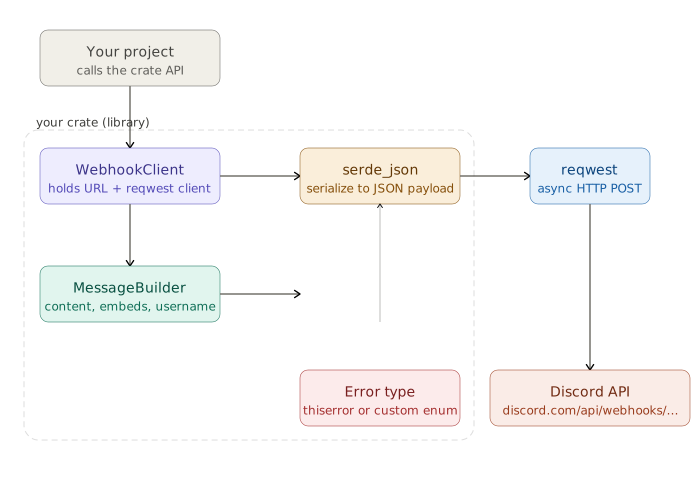
/// An async Discord webhook client.
///
/// # Example
///
/// ```rust,no_run
/// use discord_hook::{WebhookClient, WebhookMessage, Embed};
///
/// #[tokio::main]
/// async fn main() -> Result<(), discord_hook::WebhookError> {
///     let client = WebhookClient::new("https://discord.com/api/webhooks/ID/TOKEN")?;
///
///     let embed = Embed::builder()
///         .title("Hello from discord_hook!")
///         .description("A rich embed sent via webhook.")
///         .color(0x5865F2)
///         .field("Version", "0.1.0", true)
///         .build();
///
///     let message = WebhookMessage::builder()
///         .username("MyBot")
///         .embed(embed)
///         .build()?;
///
///     client.send(&message).await
/// }
/// ```
#[derive(Clone)]
pub struct WebhookClient {
    /// The full webhook URL stored as a secret so it is never accidentally
    /// logged or included in debug output.  Call `.expose_secret()` only at
    /// the point where the URL is needed for an HTTP request.
    url: SecretString,
    client: HttpClient,
}

impl WebhookClient {
    /// Create a new client with a default [`reqwest::Client`].
    ///
    /// # Errors
    ///
    /// Returns [`WebhookError::InvalidUrl`] if the URL does not use HTTPS or
    /// does not target `discord.com/api/webhooks/`.
    pub fn new(url: impl Into<String>) -> Result<Self, WebhookError> {
        let url = url.into();
        validate_url(&url)?;
        Ok(Self {
            url: SecretString::from(url),
            client: HttpClient::new(),
        })
    }

    /// Create a client that reuses a pre-configured [`reqwest::Client`].
    ///
    /// Useful when you want to share a client (connection pool, middleware, etc.)
    /// across your application.
    ///
    /// # Errors
    ///
    /// Returns [`WebhookError::InvalidUrl`] if the URL does not use HTTPS or
    /// does not target `discord.com/api/webhooks/`.
    pub fn with_client(url: impl Into<String>, client: Client) -> Result<Self, WebhookError> {
        let url = url.into();
        validate_url(&url)?;
        Ok(Self {
            url: SecretString::from(url),
            client: HttpClient::with_reqwest(client),
        })
    }

    /// Send a [`WebhookMessage`] to Discord.
    ///
    /// Uses `?wait=true` so Discord confirms the message was saved before
    /// responding — errors that would otherwise be silently dropped (e.g. bad
    /// embed structure) are surfaced as [`WebhookError::ApiError`].
    ///
    /// # Errors
    ///
    /// - [`WebhookError::Http`] – transport-level failure.
    /// - [`WebhookError::RateLimited`] – Discord returned HTTP 429; the
    ///   `retry_after_ms` field tells you how long to wait.
    /// - [`WebhookError::ApiError`] – any other non-2xx response.
    pub async fn send(&self, message: &WebhookMessage) -> Result<(), WebhookError> {
        self.execute(message, None).await
    }

    /// Send a [`WebhookMessage`] into a specific thread.
    ///
    /// Pass the thread's snowflake ID as `thread_id`.  The thread will be
    /// automatically unarchived if needed.
    pub async fn send_to_thread(
        &self,
        message: &WebhookMessage,
        thread_id: &str,
    ) -> Result<(), WebhookError> {
        validate_thread_id(thread_id)?;
        self.execute(message, Some(thread_id)).await
    }

    /// Send a [`WebhookMessage`] with automatic retries on transport failure.
    ///
    /// Uses the supplied [`RetryPolicy`] for exponential backoff. Note that
    /// Discord 429 rate-limit responses are **not** retried automatically —
    /// they are returned immediately as [`WebhookError::RateLimited`] so your
    /// application can handle the `retry_after_ms` value explicitly.
    ///
    /// # Example
    ///
    /// ```rust,no_run
    /// use discord_hook::{WebhookClient, WebhookMessage};
    /// use hooksmith_core::RetryPolicy;
    /// use std::time::Duration;
    ///
    /// # #[tokio::main]
    /// # async fn main() -> Result<(), discord_hook::WebhookError> {
    /// let client = WebhookClient::new("https://discord.com/api/webhooks/ID/TOKEN")?;
    /// let message = WebhookMessage::builder().content("hello").build()?;
    ///
    /// let policy = RetryPolicy { max_attempts: 4, base_delay: Duration::from_millis(250), jitter: true };
    /// client.send_with_retry(&message, &policy).await?;
    /// # Ok(())
    /// # }
    /// ```
    pub async fn send_with_retry(
        &self,
        message: &WebhookMessage,
        policy: &RetryPolicy,
    ) -> Result<(), WebhookError> {
        let url = format!("{}?wait=true", self.url.expose_secret());
        let response = self
            .client
            .post_json_with_retry(&url, message, policy)
            .await?;
        let status = response.status();

        if status == reqwest::StatusCode::TOO_MANY_REQUESTS {
            let retry_after_ms = response
                .headers()
                .get("retry-after")
                .and_then(|v| v.to_str().ok())
                .and_then(|s| s.parse::<f64>().ok())
                .map(|secs| (secs * 1000.0) as u64)
                .unwrap_or(1_000);
            return Err(WebhookError::RateLimited { retry_after_ms });
        }

        if !status.is_success() {
            let body = response
                .bytes()
                .await
                .map(|b| {
                    // Cap at 4 KiB — enough to describe any API error without
                    // allowing a misbehaving endpoint to exhaust memory.
                    let slice = &b[..b.len().min(4096)];
                    String::from_utf8_lossy(slice).into_owned()
                })
                .unwrap_or_else(|_| status.to_string());
            return Err(WebhookError::ApiError {
                status: status.as_u16(),
                message: body,
            });
        }

        Ok(())
    }

    async fn execute(
        &self,
        message: &WebhookMessage,
        thread_id: Option<&str>,
    ) -> Result<(), WebhookError> {
        // Always use wait=true so Discord confirms the message was saved.
        // Errors that would otherwise be silently dropped (e.g. bad embed
        // structure) are surfaced as ApiError instead.
        let mut url = format!("{}?wait=true", self.url.expose_secret());
        if let Some(tid) = thread_id {
            url.push_str("&thread_id=");
            url.push_str(tid);
        }

        let response = self.client.post_json(&url, message).await?;

        let status = response.status();

        if status == reqwest::StatusCode::TOO_MANY_REQUESTS {
            let retry_after_ms = response
                .headers()
                .get("retry-after")
                .and_then(|v| v.to_str().ok())
                .and_then(|s| s.parse::<f64>().ok())
                .map(|secs| (secs * 1000.0) as u64)
                .unwrap_or(1_000);

            return Err(WebhookError::RateLimited { retry_after_ms });
        }

        if !status.is_success() {
            let body = response
                .bytes()
                .await
                .map(|b| {
                    let slice = &b[..b.len().min(4096)];
                    String::from_utf8_lossy(slice).into_owned()
                })
                .unwrap_or_else(|_| status.to_string());
            return Err(WebhookError::ApiError {
                status: status.as_u16(),
                message: body,
            });
        }

        Ok(())
    }
}

impl std::fmt::Debug for WebhookClient {
    /// Formats `WebhookClient` for debug output **without exposing the token**.
    ///
    /// The webhook URL is `https://discord.com/api/webhooks/{id}/{token}`.
    /// This implementation shows everything up to and including the webhook ID
    /// but replaces the token segment with `<REDACTED>`, so you can identify
    /// which webhook is configured without leaking the secret.
    fn fmt(&self, f: &mut std::fmt::Formatter<'_>) -> std::fmt::Result {
        let raw = self.url.expose_secret();
        let redacted = match raw.rfind('/') {
            Some(idx) => format!("{}/", &raw[..idx]),
            None => String::new(),
        };
        f.debug_struct("WebhookClient")
            .field("url", &format_args!("{}<REDACTED>", redacted))
            .finish_non_exhaustive()
    }
}

impl WebhookSender for WebhookClient {
    type Message = WebhookMessage;
    type Error = WebhookError;

    /// Send a [`WebhookMessage`], satisfying the generic [`WebhookSender`] trait.
    ///
    /// Identical to the inherent [`WebhookClient::send`] method — use whichever
    /// is more convenient.  The trait is useful when writing code that is
    /// generic over notification backends.
    fn send(
        &self,
        message: &WebhookMessage,
    ) -> impl std::future::Future<Output = Result<(), WebhookError>> + Send {
        self.execute(message, None)
    }
}

// ---------------------------------------------------------------------------
// WebhookClientBuilder
// ---------------------------------------------------------------------------

/// Builder for [`WebhookClient`] with configurable timeout settings.
///
/// Use this instead of [`WebhookClient::new`] when you need to control connect
/// or overall request timeouts rather than accepting the 30-second default.
///
/// # Example
///
/// ```rust,no_run
/// use discord_hook::WebhookClientBuilder;
/// use std::time::Duration;
///
/// # fn main() -> Result<(), discord_hook::WebhookError> {
/// let client = WebhookClientBuilder::new("https://discord.com/api/webhooks/ID/TOKEN")
///     .connect_timeout(Duration::from_secs(5))
///     .request_timeout(Duration::from_secs(15))
///     .build()?;
/// # Ok(())
/// # }
/// ```
pub struct WebhookClientBuilder {
    url: String,
    connect_timeout: Option<Duration>,
    request_timeout: Option<Duration>,
}

impl WebhookClientBuilder {
    /// Start building a client for the given Discord webhook URL.
    pub fn new(url: impl Into<String>) -> Self {
        Self {
            url: url.into(),
            connect_timeout: None,
            // Mirror the default applied by WebhookClient::new.
            request_timeout: Some(Duration::from_secs(30)),
        }
    }

    /// Set the maximum time allowed to establish a TCP connection.
    pub fn connect_timeout(mut self, timeout: Duration) -> Self {
        self.connect_timeout = Some(timeout);
        self
    }

    /// Set the maximum time allowed for a complete request/response cycle.
    ///
    /// Defaults to 30 seconds.
    pub fn request_timeout(mut self, timeout: Duration) -> Self {
        self.request_timeout = Some(timeout);
        self
    }

    /// Validate the URL and build the [`WebhookClient`].
    ///
    /// # Errors
    ///
    /// - [`WebhookError::InvalidUrl`] — URL is not a valid Discord webhook URL.
    /// - [`WebhookError::Http`] — underlying HTTP client could not be constructed
    ///   (e.g. TLS backend unavailable).
    pub fn build(self) -> Result<WebhookClient, WebhookError> {
        validate_url(&self.url)?;
        let mut builder = Client::builder();
        if let Some(t) = self.connect_timeout {
            builder = builder.connect_timeout(t);
        }
        if let Some(t) = self.request_timeout {
            builder = builder.timeout(t);
        }
        let client = builder.build().map_err(WebhookError::Http)?;
        Ok(WebhookClient {
            url: SecretString::from(self.url),
            client: HttpClient::with_reqwest(client),
        })
    }
}

#[cfg(test)]
mod tests {
    use super::*;

    #[test]
    fn rejects_http_url() {
        let err = validate_url("http://discord.com/api/webhooks/123/abc").unwrap_err();
        assert!(matches!(err, WebhookError::InvalidUrl { .. }));
    }

    #[test]
    fn rejects_non_discord_url() {
        let err = validate_url("https://example.com/webhook").unwrap_err();
        assert!(matches!(err, WebhookError::InvalidUrl { .. }));
    }

    #[test]
    fn accepts_valid_discord_url() {
        assert!(validate_url("https://discord.com/api/webhooks/123456789/abcdef").is_ok());
    }

    #[test]
    fn client_new_propagates_invalid_url() {
        let err = WebhookClient::new("not-a-url").unwrap_err();
        assert!(matches!(err, WebhookError::InvalidUrl { .. }));
    }

    #[test]
    fn debug_output_redacts_token() {
        let client =
            WebhookClient::new("https://discord.com/api/webhooks/123456789/SECRET_TOKEN").unwrap();
        let debug = format!("{client:?}");
        assert!(
            !debug.contains("SECRET_TOKEN"),
            "token must not appear in debug output"
        );
        assert!(debug.contains("123456789"), "webhook id should be visible");
    }

    #[test]
    fn thread_id_rejects_empty() {
        assert!(matches!(
            validate_thread_id(""),
            Err(WebhookError::InvalidThreadId)
        ));
    }

    #[test]
    fn thread_id_rejects_non_numeric() {
        for bad in &["abc", "123abc", "12&34", "12/34", "12?id=1", " 123"] {
            assert!(
                matches!(validate_thread_id(bad), Err(WebhookError::InvalidThreadId)),
                "expected InvalidThreadId for {:?}",
                bad
            );
        }
    }

    #[test]
    fn thread_id_accepts_valid_snowflake() {
        assert!(validate_thread_id("1234567890123456789").is_ok());
    }

    #[test]
    fn builder_accepts_valid_url() {
        use std::time::Duration;
        let result = WebhookClientBuilder::new("https://discord.com/api/webhooks/123456789/abcdef")
            .connect_timeout(Duration::from_secs(5))
            .request_timeout(Duration::from_secs(15))
            .build();
        assert!(result.is_ok());
    }

    #[test]
    fn builder_rejects_invalid_url() {
        let result = WebhookClientBuilder::new("http://example.com/webhook").build();
        assert!(matches!(result, Err(WebhookError::InvalidUrl { .. })));
    }
}