<div align=center>
<h1 aligh="center">
DiffusionX
</h1>
<p align="center">
一个多线程高性能的 Rust 随机数生成和随机过程模拟库
</p>
<p align="center">
<a href="README.md">English</a> | 简体中文
</p>
<p align="center">
<a href="https://crates.io/crates/diffusionx"> <img alt="Crates.io Version" src="https://img.shields.io/crates/v/diffusionx?style=for-the-badge"> </a>
<a href="https://docs.rs/diffusionx"> <img alt="docs.rs" src="https://img.shields.io/docsrs/diffusionx?style=for-the-badge"> </a>
<img alt="License: MIT OR Apache-2.0" src="https://img.shields.io/crates/l/diffusionx?style=for-the-badge">
<img alt="Downloads" src="https://img.shields.io/crates/d/diffusionx?style=for-the-badge">
</p>
</div>
## 已实现功能
### 随机数生成
- [x] 正态分布
- [x] 均匀分布
- [x] 指数分布
- [x] 泊松分布
- [x] $\alpha$-稳定分布
### 随机过程模拟
- [x] 布朗运动
- [x] $\alpha$-稳定莱维过程
- [x] 柯西过程
- [x] $\alpha$-稳定 subordinator
- [x] 逆 $\alpha$-稳定 subordinator
- [x] 泊松过程
- [x] 分数布朗运动
- [x] 连续时间随机游走
- [x] Ornstein-Uhlenbeck 过程
- [x] 朗之万方程
- [x] 广义朗之万方程
- [x] 从属朗之万方程
- [x] 莱维游走
- [x] 生灭过程
- [x] 随机游走
- [x] 布朗桥
- [x] Brownian excursion
- [x] Brownian meander
- [x] 伽马过程
- [x] 几何布朗运动
- [x] 布朗非高斯过程
## 使用
### 随机数生成
```rust
use diffusionx::random::{normal, uniform, stable};
fn main() -> Result<(), Box<dyn std::error::Error>> {
// 生成一个均值为 0.0,标准差为 1.0 的正态随机数
let normal_sample = normal::rand(0.0, 1.0)?;
// 生成 1000 个标准正态随机数
let std_normal_samples = normal::standard_rands::<f64>(1000);
// 生成一个 [0, 10) 范围内的均匀随机数
let uniform_sample = uniform::range_rand(0..10)?;
// 生成 1000 个 [0, 1) 范围内的均匀随机数
let std_uniform_samples = uniform::standard_rands(1000);
// 生成 1000 个标准稳定随机数
let stable_samples = stable::standard_rands(1.5, 0.5, 1000)?;
Ok(())
}
```
### 随机过程模拟
```rust
use diffusionx::simulation::{prelude::*, continuous::Bm};
fn main() -> Result<(), Box<dyn std::error::Error>> {
// 创建标准布朗运动对象
let bm = Bm::default();
// 创建持续时间为 1.0 的轨迹
let traj = bm.duration(1.0)?;
// 使用时间步长 0.01 模拟布朗运动轨迹
let (times, positions) = traj.simulate(0.01)?;
println!("times: {:?}", times);
println!("positions: {:?}", positions);
// 计算一阶原点矩,1000 个粒子,时间步长为 0.01
let mean = traj.raw_moment(1, 1000, 0.01)?;
println!("mean: {mean}");
// 计算二阶中心矩,1000 个粒子,时间步长为 0.01
let msd = traj.central_moment(2, 1000, 0.01)?;
println!("MSD: {msd}");
// 计算 EATAMSD,100.0 的持续时间,1.0 的 delta,10000 个粒子,时间步长为 0.1,
// Gauss-Legendre 积分阶数为 10
let eatamsd = bm.eatamsd(100.0, 1.0, 10000, 0.1, 10)?;
println!("EATAMSD: {eatamsd}");
// 计算布朗运动首次通过时间,边界为 -1.0 和 1.0
let fpt = bm.fpt((-1.0, 1.0), 1000.0, 0.01)?;
println!("FPT: {fpt}");
Ok(())
}
```
### 可视化示例
```rust
use diffusionx::{
simulation::{continuous::Bm, prelude::*},
};
fn main() -> Result<(), Box<dyn std::error::Error>> {
// 创建布朗运动轨迹
let bm = Bm::default();
let traj = bm.duration(10.0)?;
// 配置并创建可视化
let config = PlotConfigBuilder::default()
.time_step(0.01)
.output_path("brownian_motion.png")
.caption("布朗运动轨迹")
.x_label("t")
.y_label("B")
.legend("bm")
.size((800, 600))
.backend(PlotterBackend::BitMap)
.build()?;
// 生成图像
traj.plot(&config)?;
Ok(())
}
```
## 架构与可扩展性
DiffusionX 采用基于 trait 的系统设计,具有高度的可扩展性和性能优化:
### 核心 Trait
- `ContinuousProcess`: 连续随机过程的基本 trait
- `PointProcess`: 点过程的基本 trait
- `DiscreteProcess`: 离散随机过程的基本 trait
- `Moment`: 统计矩计算的 trait,包括原点矩和中心矩
- `Visualize`: 绘制过程轨迹的 trait
### 扩展自定义过程
1. 添加新的连续随机过程:
```rust
#[derive(Debug, Clone)]
struct MyProcess {
}
impl ContinuousProcess for MyProcess {
fn simulate(
&self,
duration: f64,
time_step: f64
) -> XResult<(Vec<f64>, Vec<f64>)> {
todo!() }
}
```
2. 实现 `ContinuousProcess` trait 后自动实现
- 均值 `mean`
- 均方位移 `msd`
- 原点矩 `raw_moment`
- 中心矩 `central_moment`
- 首次通过时间 `fpt`
- 占据时间 `occupation_time`
- 时间平均均方位移 `tamsd`
- 可视化 `plot`
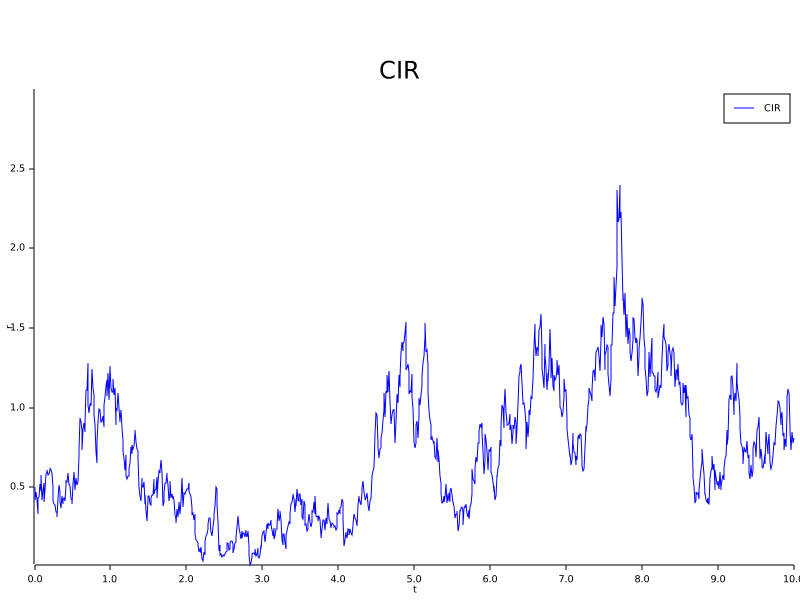
**示例:**
```rust
use diffusionx::{
XError, XResult,
random::normal,
simulation::prelude::*,
utils::{diff, linspace, write_csv},
};
/// CIR
#[allow(clippy::upper_case_acronyms)]
#[derive(Clone)]
struct CIR {
speed: f64,
mean: f64,
volatility: f64,
start_position: f64,
}
impl CIR {
fn new(
speed: impl Into<f64>,
mean: impl Into<f64>,
volatility: impl Into<f64>,
start_position: impl Into<f64>,
) -> XResult<Self> {
let speed: f64 = speed.into();
if speed <= 0.0 {
return Err(XError::InvalidParameters(format!(
"speed must be greater than 0, but got {}",
speed
)));
}
Ok(Self {
speed,
mean: mean.into(),
volatility: volatility.into(),
start_position: start_position.into(),
})
}
}
impl ContinuousProcess for CIR {
fn simulate(&self, duration: f64, time_step: f64) -> XResult<Pair> {
let t = linspace(0.0, duration, time_step);
let num_steps = t.len() - 1;
let initial_x = self.start_position.max(0.0);
let noises = normal::standard_rands::<f64>(num_steps);
let delta = diff(&t);
let x = std::iter::once(initial_x)
.chain(
noises
.iter()
.zip(delta)
.scan(initial_x, |state, (&xi, delta_t)| {
let current_x = *state;
let drift = self.speed * (self.mean - current_x);
let diffusion = self.volatility * current_x.sqrt().max(0.0);
let next_x = current_x + drift * delta_t + diffusion * xi * delta_t.sqrt();
*state = next_x.max(0.0);
Some(*state)
}),
)
.collect();
Ok((t, x))
}
}
fn main() -> XResult<()> {
let duration = 10.0;
let particles = 10_000;
let time_step = 0.01;
let cir = CIR::new(1, 1, 1, 0.5)?;
let traj = cir.duration(duration)?;
let (t, x) = cir.simulate(duration, time_step)?;
write_csv("tmp/CIR.csv", &t, &x)?;
// mean
let mean = cir.mean(duration, particles, time_step)?; // or let mean = traj.raw_moment(1, particles, time_step)?;
println!("mean: {mean}");
// msd
let msd = cir.msd(duration, particles, time_step)?; // or let msd = traj.central_moment(2, particles, time_step)?;
println!("MSD: {msd}");
// FPT
let max_duration = 1000.0;
let fpt = cir
.fpt((-1.0, 1.0), max_duration, time_step)?
.unwrap_or(-1.0);
println!("FPT: {fpt}");
// occupation time
let occupation_time = cir.occupation_time((-1.0, 1.0), duration, time_step)?;
println!("Occupation Time: {occupation_time}");
// TAMSD
let slag = 1.0;
let quad_order = 10;
let tamsd = TAMSD::new(&cir, duration, slag)?;
let eatamsd = tamsd.mean(particles, time_step, quad_order)?;
println!("EATAMSD: {eatamsd}");
// Visualization
let config = PlotConfigBuilder::default()
.time_step(time_step)
.output_path("tmp/CIR.svg")
.caption("CIR")
.show_grid(false)
.x_label("t")
.y_label("r")
.legend("CIR")
.backend(PlotterBackend::SVG)
.build()
.unwrap();
traj.plot(&config)?;
Ok(())
}
```
**结果:**
```
mean: 0.9957644815350275
MSD: 0.7441251895881059
FPT: 0.38
Occupation Time: 4.719999999999995
EATAMSD: 0.6085042089895467
```
## 基准测试
性能基准测试比较 Rust、C++、Julia 和 Python 实现的代码,请见[这里](https://github.com/tangxiangong/diffusionx-benches)。
## 许可协议
本项目采用以下任一许可协议:
* Apache License, Version 2.0, ([LICENSE-APACHE](LICENSE-APACHE) 或 https://www.apache.org/licenses/LICENSE-2.0)
* MIT license ([LICENSE-MIT](LICENSE-MIT) 或 https://opensource.org/licenses/MIT)
您可以选择其中任意一种。
### 贡献
除非您明确声明,否则根据 Apache-2.0 许可协议的定义,您有意提交的任何贡献都将按照上述双重许可协议进行许可,不附加任何额外条款或条件。