
declarative-gpui




A declarative ui! macro for building GPUI element
trees with Tailwind-style tokens, real Rust control flow, and zero runtime
overhead — every token compiles directly to GPUI builder calls, and colors are
converted to their final Hsla values at compile time (faster than typical
hand-written GPUI).
use ui;
use *;
Getting started
Add the macro to your project (published as
declarative-gpui on crates.io;
its engine, declarative-gpui-core,
is an implementation detail cargo pulls in automatically):
You also need GPUI itself — either the crates.io release or the Zed
repository (this macro's token tables are verified against zed rev
bb48a42; see GPUI compatibility):
[]
= "0.2"
= "0.2"
# or the rev this crate is verified against:
# gpui = { git = "https://github.com/zed-industries/zed", rev = "bb48a42983f2a4bb9ac9d31c63abe02497088f67" }
Then use ui! anywhere you build GPUI elements — it expands to plain
builder calls, so it drops into any Render impl (gpui::prelude::* must
be in scope, as with hand-written GPUI):
use ui;
use *;
use ;
The full element and style-token reference is below. Minimum supported Rust version: 1.88.
Code → pixels
The 47-line examples/src/dsl.rs renders the card
below — pixel-identical to the 165-line hand-written
examples/src/hand_written.rs, 72% less
code:
Both implementations run side by side in the showcase app
(cargo run -p declarative-gpui-examples --release); hover a pane's
</> view code button to see the source that renders it:
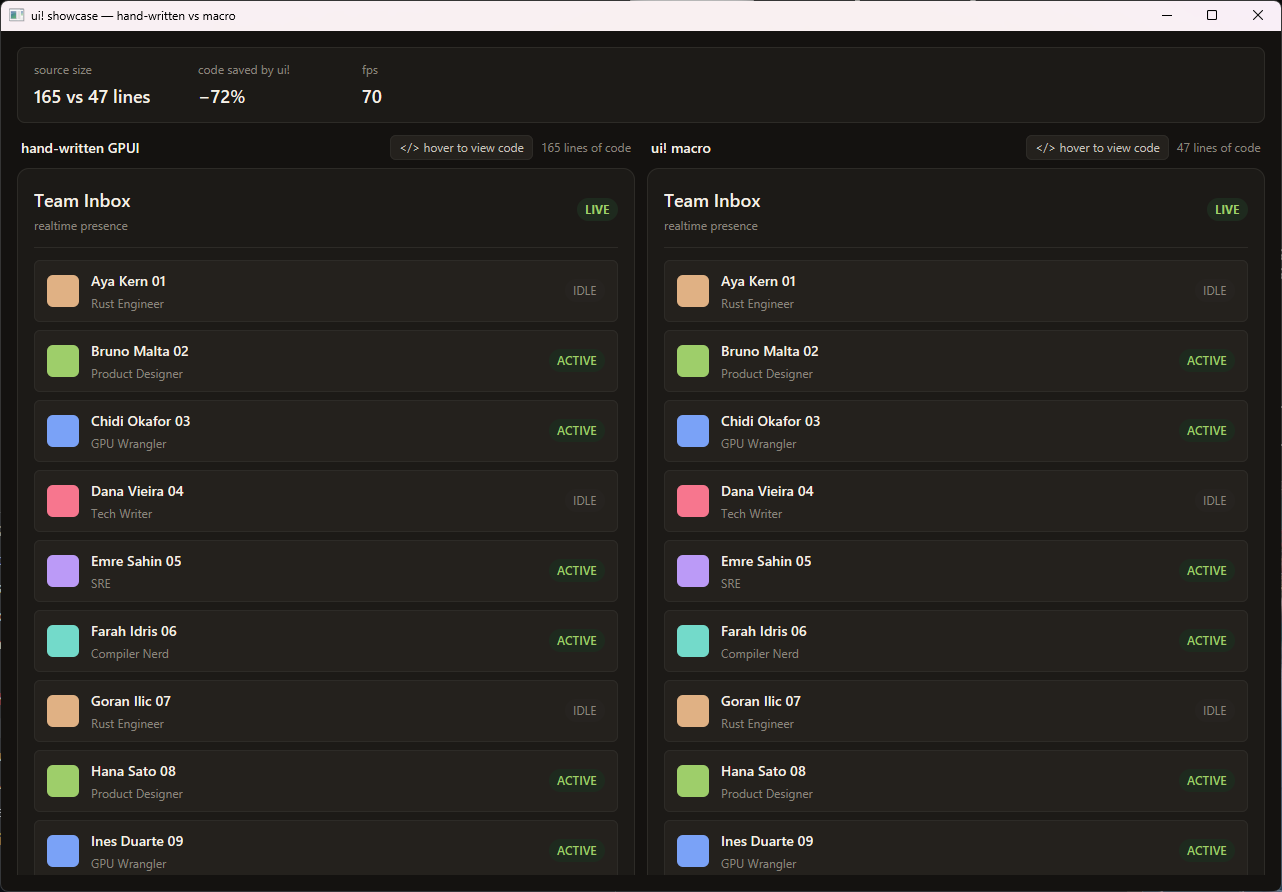
Zero runtime overhead — the macro expands to the same builder calls you'd write by hand, so there is nothing extra at runtime. Details in examples/README.md.
Elements
| Element | Expands to |
|---|---|
div(...) |
gpui::div() |
row(...) |
gpui::div().flex().flex_row() |
col(...), card(...) |
gpui::div().flex().flex_col() |
center(...) |
div().flex().flex_row().items_center().justify_center() |
scroll(...) |
stateful div with a stable auto ID + .overflow_y_scroll() |
list(id, count, render, ...) |
gpui::uniform_list(...) |
text(content, ...), text_raw, label |
the content, wrapped in a styled div only when style args are present |
| any other name | called as a constructor: badge(...) → badge() |
Children go in braces; if/else, if let, for, and match (with
guards) work anywhere a child can appear and expand to real Rust control
flow — branch bodies hold any number of nodes. { expr } escapes to an
arbitrary Rust expression, and { ..expr } spreads any
IntoIterator<Item: IntoElement> into the parent's children — an Option
(renders nothing on None), a Vec<AnyElement>, or a mapped iterator:
col
if let Some = self.modal.take
Leaf elements (text, text_raw, label, list) have no children, so a
{ ... } directly after one is parsed as the next sibling — no wrapper
container needed.
Element arguments
Three forms, in any mix (commas between args are optional but recommended — without them adjacent expression args can merge and misparse):
- Style tokens —
px_8,bg_1c1a17,rounded_lg(reference below). key = value— any builder method:id = "main",w = gpui::rems(2.0),font_family = "Zed Mono",on_click = |e, w, cx| …. Mouse handlers (on_mouse_downetc.) default toMouseButton::Left.- Call-style —
hover(|s| s.opacity(0.8)),when(cond, |el| …)become.hover(…),.when(…).
Conditional style tokens
when(cond, <args>) with style tokens (or key = value / call-style args)
after the condition expands them inside a .when() closure — conditional
styling without giving up compile-time tokens, colors included:
row
row // key = value works too
when(cond, |el| …) with a closure still passes through to GPUI's
FluentBuilder::when unchanged, and a bare path that isn't a style token
(when(cond, my_modifier)) is treated as a callback.
Stateful elements
Elements using a method that requires Stateful<Div> — on_click,
on_hover, on_drag, tooltip, hoverable_tooltip, active,
group_active, track_scroll, anchor_scroll, or the
overflow(_x/_y)_scroll tokens — automatically get a stable .id() (from
file!:line!:column!), so div(on_click = …) just works. An explicit
id = … is folded into the constructor instead. On custom constructors
(unknown element names) nothing is injected — there, put id = … before
type-changing methods yourself.
Style token reference
Numeric conventions (deliberately different from GPUI's rem scale — rem
values remain available via key = value):
| Form | Meaning | Example |
|---|---|---|
_N |
N pixels | w_240 → .w(px(240.)) |
_XpY |
decimal pixels | p_2p5 → 2.5px |
_neg_N |
negative (where GPUI allows) | m_neg_8 → −8px |
_auto, _full, _px |
GPUI's auto / 100% / 1px methods | mx_auto, min_w_full, w_px |
| fractions | relative size | w_1_2 → 50%, h_2_3, flex_basis_1_4 |
- Layout —
flexgridblockhidden,flex_row/flex_col(+_reverse), wrap variants,flex_1flex_autoflex_initialflex_none,flex_grow(_0/_1),flex_shrink(_0/_1),justify_*(incl.justify_evenly),items_*(incl.items_stretch),self_*,content_*,aspect_square. - Spacing —
p/px/py/pt/pb/pl/pr,m*(margins allow_auto/_neg_),gap/gap_x/gap_y. - Sizing —
whsizemin_wmin_hmin_sizemax_wmax_hmax_sizewith all numeric forms. - Position —
relativeabsolute,top/bottom/left/right/inset(+_auto/_neg_). - Colors —
bg_,text_,border_,text_bg_,text_decoration_+ hex (1c1a17,abc,1c1a17ccwith alpha,abcd) or a named color (black white gray red green blue yellow cyan magenta orange purple). Emitted as precomputedHslaliterals — zero color math at runtime. Precedence note: a 3/6-digit all-numeric suffix is a color (text_112=#112); anything else numeric is a size (text_16= 16px). - Typography —
text_xs…text_3xl,text_N(px size), weights (thin…black, with or withoutfont_prefix),italic,underline,line_through,text_decoration_{0,1,2,4,8,solid,wavy,none}andtext_decoration_<color>,truncate,text_ellipsis(_start/_middle),line_clamp_N,whitespace_nowrap/normal,text_left/center/right. - Borders & radius —
border(_x/_y/_t/_b/_l/_r)(bare = 1px,_N= Npx,_0p5= 0.5px),border_dashed,border_<color>; fullroundedfamily (rounded_lg,rounded_tl_2xl,rounded_8, …). - Effects & misc —
shadow(_2xs…_2xl,_none),opacity_N(0–100),cursor_*,visible/invisible,overflow_hidden(_x/_y),overflow_scroll(_x/_y)(needs a stateful element),scrollbar_width_N,debug,debug_below. - Grid —
grid_cols_N/grid_rows_N,grid_cols_min_content_N/_max_content_N,col_span_N/row_span_N(+_full),col_start/col_end/row_start/row_end(+_auto,_neg_N).
Unknown tokens are compile errors ("Unknown style token"), never silently ignored.
Themes: color! and Hsla palettes
Style-token colors are static by nature. For themed apps (light/dark), the
same compile-time conversion is available standalone via color!, which
expands to a const-constructible Hsla literal:
use ;
use Hsla;
pub const LIGHT: Theme = Theme ;
pub const DARK: Theme = Theme ;
Because the palette already stores Hsla, a themed bg = th.panel is a
plain field copy — no rgb() hex unpacking or RGB→HSL conversion per frame.
Avoid storing themes as u32 hex and converting at the call site
(bg = (rgb(th.panel))); that reintroduces the per-frame color math the
macro exists to eliminate.
Zero runtime overhead
The generated code is what a careful GPUI author would write, or better:
- style tokens are direct method calls — no runtime string matching;
- colors are compile-time
Hslaliterals — norgb()unpacking or RGB→HSL conversion per frame (andcolor!extends this to theme palettes); - unstyled
text(...)emits the bare content — no wrapper div layout node; listmoves its render closure — noArc, no per-frame allocation;- every element yields its concrete type — no
AnyElementboxing.
These guarantees are pinned by tests in core — and you can inspect any
invocation yourself with ui_expand!, which returns the pretty-printed
generated code as a &'static str (a per-invocation cargo expand, no
nightly needed):
println!;
GPUI compatibility
Token tables are verified against GPUI at zed rev bb48a42 (2026-07-02).
The integration crate compiles every DSL feature against that exact rev —
if GPUI renames or removes an API the macro targets, that crate stops
compiling. Bump the rev in integration/Cargo.toml to check newer GPUI.
Workspace layout & development
.             proc-macro shim (`ui!` entry point)
core/         declarative-gpui-core — parser, emitter, token tables, tests
integration/  compile-surface tests against real GPUI (excluded from default builds)
examples/     side-by-side showcase: hand-written GPUI vs ui! (see examples/README.md)
License
Licensed under either of Apache License, Version 2.0 or MIT license at your option.