# dagga 🌿
A crate for scheduling directed acyclic graphs.
## Features
- node `creates` resources semantics
- node `reads` resource semantics, ie borrow
- `writes` resource semantics, ie mutable/exclusive borrow
- `consumes` resource semantics, ie move
- node dependencies
* node X must run _before_ node Y
* node X must run _after_ node Y
* barriers - nodes added before a barrier will always be scheduled before the barrier and nodes added after a barrier will always be scheduled after the barrier
## Example uses
* scheduling parallel operations with dependencies, shared and exclusive resources
* scheduling steps in a render graph
* scheduling system batches in ECS
* scheduling audio nodes in an audio graph
## Example
```rust
use dagga::*;
// Create names/values for our resources.
//
// These represent the types of the resources that get created, passed through
// and consumed by each node.
let [a, b, c, d]: [usize; 4] = [0, 1, 2, 3];
// Add the nodes with their dependencies and build the schedule.
// The order they are added should not matter (it may cause differences in
// scheduling, but always result in a valid schedule).
let dag = Dag::<(), usize>::default()
.with_node({
// This node results in the creation of an `a`.
Node::new(()).with_name("create-a").with_result(a)
})
.with_node({
// This node creates a `b`.
Node::new(()).with_name("create-b").with_result(b)
})
.with_node({
// This node reads `a` and `b` and results in `c`
Node::new(())
.with_name("create-c")
.with_read(a)
.with_read(b)
.with_result(c)
})
.with_node({
// This node modifies `a`, but for reasons outside of the scope of the types
// expressed here (just as an example), it must be run before
// "create-c". There is no result of this node beside the side-effect of
// modifying `a`.
Node::new(())
.with_name("modify-a")
.with_write(a)
.with_read(b)
.run_before("create-c")
})
.with_node({
// This node consumes `a`, `b`, `c` and results in `d`.
Node::new(())
.with_name("reduce-abc-to-d")
.with_move(a)
.with_move(b)
.with_move(c)
.with_result(d)
});
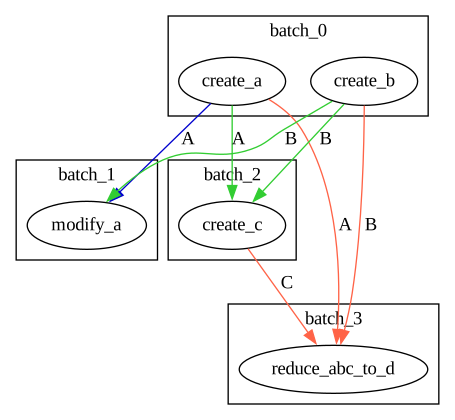
dagga::assert_batches(
&[
"create-a, create-b", /* each batch can be run in parallel w/o violating
* exclusive borrows */
"modify-a",
"create-c",
"reduce-abc-to-d",
],
dag.clone(),
);
```
You can also have `dagga` create a dot graph file to visualize the schedule (using graphiz or similar):