# csgrs
Constructive Solid Geometry (CSG) is a modeling technique that uses Boolean operations like union and intersection to combine 3D solids. This library implements CSG operations on meshes simply using BSP trees. It is meant to add CSG to the larger [Dimforge](https://www.dimforge.com/) ecosystem, bring the [OpenSCAD](https://openscad.org/) feature set into Rust, work in a wide variety of environments, and be reasonably performant.
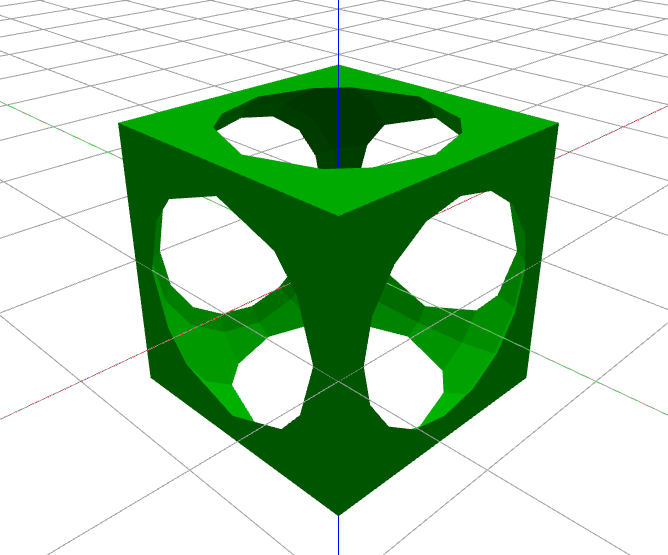
## Use the library:
use csgrs::CSG;
// Create a type alias for easy usage
type MyCSG = CSG<()>;
## Construct a 2D shape:
let square = MyCSG::square(None);
let square2 = MyCSG::square(Some(([2.0, 3.0], true)));
let circle = MyCSG::circle(None);
let circle2 = MyCSG::circle(Some((2.0, 64)));
let points = vec![[0.0, 0.0], [2.0, 0.0], [1.0, 1.5]];
let polygon2d = MyCSG::polygon_2d(&points);
## Construct a 3D shape:
let cube = MyCSG::cube(None);
let cube2 = MyCSG::cube(Some([0.0, 0.0, 0.0], [1.0, 1.0, 1.0])); // center, radius
let sphere = MyCSG::sphere(None);
let sphere2 = MyCSG::sphere(Some([0.0, 0.0, 0.0], 1.0, 16, 8)); // center, radius, slices, stacks
let cylinder = MyCSG::cylinder(None);
let cylinder2 = MyCSG::cylinder(Some([0.0, -1.0, 0.0], [0.0, 1.0, 0.0], 1.0, 16)); // start, end, radius, slices
// A simple triangular prism
let points = [
[0.0, 0.0, 0.0], // 0
[1.0, 0.0, 0.0], // 1
[0.0, 1.0, 0.0], // 2
[0.0, 0.0, 1.0], // 3
[1.0, 0.0, 1.0], // 4
[0.0, 1.0, 1.0], // 5
];
// Faces: bottom triangle, top triangle, and 3 rectangular sides
let faces = vec![
vec![0, 1, 2], // bottom
vec![3, 5, 4], // top
vec![0, 2, 5, 3], // side
vec![0, 3, 4, 1], // side
vec![1, 4, 5, 2], // side
];
let prism = MyCSG::polyhedron(&points, &faces);
## Combine shapes:
let union_result = cube.union(&sphere);
let subtraction_result = cube.subtract(&sphere);
let intersection_result = cylinder.intersect(&sphere);
## Extract polygons:
let polygons = union_result.to_polygons();
println!("Polygon count = {}", polygons.len());
## Translate:
let translation_result = cube.translate(Vector3::new(3.0, 2.0, 1.0));
## Rotate:
let rotation_result = cube.rotate(15.0, 45.0, 0.0);
## Scale:
let scale_result = cube.scale(2.0, 1.0, 3.0);
## Mirror:
let mirror_result = cube.mirror(Axis::Y);
## Convex hull:
let hull = cube.convex_hull();
## Minkowski sum:
let rounded_cube = cube.minkowski_sum(&sphere);
## Extrude a 2D shape:
let square = MyCSG::square(Some(([2.0, 2.0], true)));
let prism = square.extrude(5.0);
## Extrude along a vector:
// Extrude along the +Y direction by 5 units:
let extruded_y = my_2d_shape.extrude_along(Vector3::new(0.0, 5.0, 0.0));
// Extrude along some arbitrary vector, say (1.0, 2.0, 3.0):
let extruded_diagonal = my_2d_shape.extrude_along(Vector3::new(1.0, 2.0, 3.0));
## Rotate extrude: (bugged atm)
let polygon = MyCSG::polygon_2d(&[
[1.0, 0.0],
[1.0, 2.0],
[0.5, 2.5],
]);
let revolve_shape = polygon.rotate_extrude(360.0, 16); // degrees, steps
## [Transform](https://en.wikipedia.org/wiki/Transformation_matrix#Affine_transformations):
// Scale X, Shear X along Y, Shear X along Z, Translate X
// Shear Y along X, Scale Y, Shear Y along Z, Translate Y
// Shear Z along X, Shear Z along Y, Scale Z, Translate Z
// The last row are clamped to 0,0,0,1 in OpenSCAD
cube.transform(Matrix4x4::new(11, 12, 13, 14,
21, 22, 23, 24,
21, 22, 23, 24,
0, 0, 0, 1));
## Bounding box:
let aabb = cube.bounding_box();
println!("Axis-aligned bounding box mins: {:?}", aabb.mins);
println!("Axis-aligned bounding box maxs: {:?}", aabb.maxs);
## Grow / Shrink a 3D shape: (bugged atm)
let grown_cube = cube.grow(4.0);
let shrunk_cube = cube.shrink(4.0);
## Grow / Shrink a 2D shape:
let grown_square = square.offset_2d(4.0);
let shrunk_square = square.offset_2d(-4.0);
## Text:
let font_data = include_bytes!("my_font.ttf");
// Generate a simple "Hello" text in the XY plane
let csg_text = MyCSG::text_mesh("Hello", font_data, Some(10.0));
## Subdivide triangles:
let subdivisions = 2;
let subdivided_csg = my_csg.subdivide_triangles(subdivisions);
## Renormalize:
let renormalized_csg = my_csg.renormalize();
## Compute all ray intersections for measurement (expensive):
let cube = MyCSG::cube(None);
let ray_origin = nalgebra::Point3::new(-5.0, 0.0, 0.0);
let ray_dir = nalgebra::Vector3::new(1.0, 0.0, 0.0);
let intersections = cube.ray_intersections(&ray_origin, &ray_dir);
println!("Found {} intersections:", intersections.len());
for (point, dist) in intersections {
println!(" t = {:.4}, point = {:?}", dist, point); // distance to 4 decimal places
}
## Create a [Parry](https://parry.rs/) TriMesh:
let trimesh = my_csg.to_trimesh();
## Create a [Rapier](https://rapier.rs/) rigid body:
// 90 degrees in radians
let angle = std::f64::consts::FRAC_PI_2;
// Axis-angle: direction = Z, magnitude = angle
let axis_angle = Vector3::z() * angle;
let rigid_body = my_csg.to_rigid_body(
&mut rigid_body_set,
&mut collider_set,
Vector3::new(0.0, 0.0, 0.0), // translation
axis_angle, // 90° around Z
1.0, // density
);
## Collect mass properties of a shape:
let density = 1.0;
let (mass, center_of_mass, inertia_frame) = my_csg.mass_properties(density);
## Export an ASCII STL:
let stl_data = union_result.to_stl("cube_minus_sphere");
let filename = "output.stl";
let mut file = File::create(filename).expect("Failed to create file");
file.write_all(stl_data.as_bytes()).expect("Failed to write STL");
## Export a binary STL:
my_csg.to_stl_file("output.stl").unwrap();
## Import an STL:
let csg = MyCSG::from_stl_file("input.stl").unwrap();
## Generic shared data:
In order to allow you to store custom per-polygon metadata (colors, IDs, etc.), `csgrs` now has a generic type parameter `S: Clone` on both `CSG<S>` and `Polygon<S>`. If you don’t need custom data, you can simply use `()`, an empty type, for `S`.
// No shared data:
type MyCSG = CSG<()>;
let cube = MyCSG::cube(None);
If you do want custom data, define your own type that implements Clone:
#[derive(Clone)]
struct MyMetadata {
color: (u8, u8, u8),
layer_id: u32,
// etc.
}
// Then alias with the custom type:
type MyCSG = CSG<MyMetadata>;
// Or instantiate directly:
let mut csg = CSG::<MyMetadata>::new();
The various shape functions (`cube`, `sphere`, etc.) produce polygons whose `shared` field is `None` by default.
## Getting and setting shared data:
Once you have a `CSG<S>`, you can access its polygons (either via `csg.polygons` or `csg.to_polygons()`) and use the following helper methods on each `Polygon<S>`:
shared_data() -> Option<&S>: Returns a reference to the shared data if present.
shared_data_mut() -> Option<&mut S>: Returns a mutable reference to the shared data.
set_shared_data(value: S): Overwrites the shared data with a new value.
// Create a CSG with a single polygon that has a string shared value:
let mut poly = Polygon::new(
vec![
Vertex::new(Point3::new(0.0, 0.0, 0.0), nalgebra::Vector3::z()),
Vertex::new(Point3::new(1.0, 0.0, 0.0), nalgebra::Vector3::z()),
Vertex::new(Point3::new(0.0, 1.0, 0.0), nalgebra::Vector3::z()),
],
Some("MyTriangle".to_string()),
);
// Access the data
if let Some(data) = poly.shared_data() {
println!("Shared data is: {}", data);
}
// Mutably modify
if let Some(data_mut) = poly.shared_data_mut() {
data_mut.push_str("_extended");
}
// Or directly set
poly.set_shared_data("OverwrittenData".to_string());
// Make a CSG from polygons
let csg = CSG::from_polygons(vec![poly]);
## Implementation Details
All CSG operations are implemented in terms of two functions, `clip_to()` and `invert()`, which remove parts of a BSP tree inside another BSP tree and swap solid and empty space, respectively. To find the union of `a` and `b`, we want to remove everything in `a` inside `b` and everything in `b` inside `a`, then combine polygons from `a` and `b` into one solid:
a.clip_to(&b);
b.clip_to(&a);
a.build(&b.all_polygons());
The only tricky part is handling overlapping coplanar polygons in both trees. The code above keeps both copies, but we need to keep them in one tree and remove them in the other tree. To remove them from `b` we can clip the inverse of `b` against `a`. The code for union now looks like this:
a.clip_to(&b);
b.clip_to(&a);
b.invert();
b.clip_to(&a);
b.invert();
a.build(&b.all_polygons());
Subtraction and intersection naturally follow from set operations. If union is `A | B`, subtraction is `A - B = ~(~A | B)` and intersection is `A & B = ~(~A | ~B)` where `~` is the complement operator.
## Todo
- extrusions between two polygons
- extruding a line does not currently result in a 2D shape as it has fewer than three points
- debug revolve extrude - use vector extrusions, cap ends
- projection to 2d / cut
- dxf/svg import/export
- fragments (circle, sphere, regularize with rotate_extrude)
- polygon holes
- fill
- 32bit / 64bit feature
- parallelize clip_to and invert with rayon and par_iter
- identify more candidates for par_iter
- manifoldness tests / fixes - in stl_io library
- reimplement 3D offsetting with voxelcsgrs or https://docs.rs/parry3d/latest/parry3d/transformation/vhacd/struct.VHACD.html
- reimplement convex hull with https://docs.rs/parry3d-f64/latest/parry3d_f64/transformation/fn.convex_hull.html
- implement 2d/3d convex decomposition with https://docs.rs/parry3d-f64/latest/parry3d_f64/transformation/vhacd/struct.VHACD.html
- reimplement transformations and shapes with https://docs.rs/parry3d/latest/parry3d/transformation/utils/index.html
- adjust binary STL function to output data, not file
- evaluate https://github.com/asny/tri-mesh for useful functions
- identify blockers for no-std
- identify opportunities to use parry2d_f64 and parry3d_f64 modules and functions to simplify and enhance our own
- https://docs.rs/parry2d-f64/latest/parry2d_f64/index.html
- https://docs.rs/parry3d-f64/latest/parry3d_f64/index.html
# License
Copyright (c) 2025 Timothy Schmidt, initially based on a translation of CSG.js Copyright (c) 2011 Evan Wallace, under the [MIT license](http://www.opensource.org/licenses/mit-license.php).