# create-grafana-plugin
**One command. A production-ready Grafana plugin project.**
Scaffold panel, data source, or app plugins with the fastest modern frontend toolchain — **Rspack** for bundling, **Bun** for runtime, **Biome** for formatting and linting — and optionally add **Rust WASM** for native-speed computation, a full **Docker observability stack** (Grafana + Prometheus + Tempo + Loki), and a ready-to-run **mock telemetry generator** that produces correlated traces, logs, and metrics out of the box.
**English** · [中文](README_zh.md)
---
## Dashboard Preview
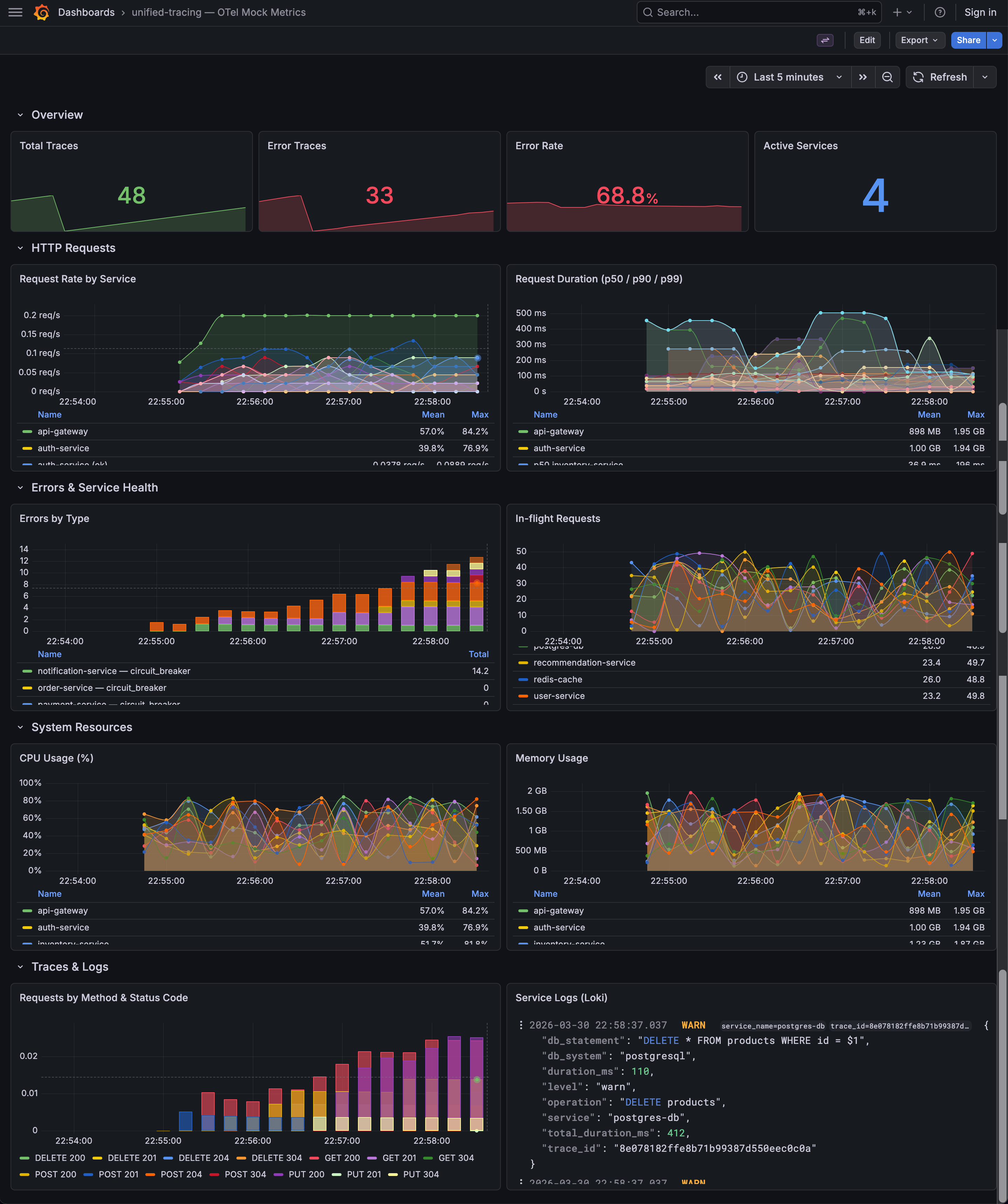
> Pre-configured Grafana dashboard with request rates, latency percentiles, error breakdown, system resource gauges, and Loki logs — auto-provisioned when you use `--mock`.
## Why create-grafana-plugin?
| Grafana's plugin SDK has no official scaffolding tool for custom stacks | Generates a complete, opinionated project in seconds |
| Setting up Rspack + AMD output for Grafana is non-trivial | Pre-configured `rspack.config.js` with JSDoc types, SWC loader, and AMD externals |
| Integrating Rust WASM into a Grafana plugin requires manual plumbing | `--wasm` adds a wasm-pack crate, TypeScript bridge, and build scripts automatically |
| Local development needs Grafana + backends running together | `--docker` provisions Grafana, Prometheus, Tempo, and Loki via Compose |
| No realistic test data for observability dashboards | `--mock` ships a Rust-based mock generator with correlated multi-service traces, logs, and metrics |
| Keeping generated boilerplate up-to-date across teams | `update` subcommand refreshes managed files while preserving custom code |
| Running multiple plugin projects on one machine causes port conflicts | `--port-offset` shifts all Docker host ports by a fixed delta |
## Highlights
- **Rust-powered CLI** — single static binary, instant startup, cross-platform (macOS, Linux, Windows).
- **Fastest-in-class toolchain** — Rspack (Rust bundler), Bun (runtime + test runner), Biome (Rust linter/formatter). No webpack, no Jest, no Prettier.
- **Three plugin types** — Panel, Data Source, App. Each gets type-specific components, types, and module entry points.
- **Optional Rust → WASM** — wasm-pack crate, TypeScript bridge (`wasm-bridge.ts`), Cargo workspace — ready for compute-heavy logic in the browser.
- **Full observability dev stack** — Docker Compose with Grafana, Prometheus, Tempo, Loki, auto-provisioned datasources, and network isolation per project.
- **Production-grade mock data** — `otel-mock` simulates 10 microservices with fixed realistic call chains, generating distributed traces (OTLP → Tempo), correlated JSON logs (→ Loki), and Prometheus-scrapable metrics (counters, gauges, histograms) with a random error rate (10–90%). A pre-configured Grafana dashboard is auto-provisioned with panels for request rates, latency percentiles, error breakdown, system resource gauges, and Loki logs.
- **Port isolation** — `--port-offset N` shifts every Docker host port by N (e.g., `--port-offset 100` → Grafana on 3100, Prometheus on 9190).
- **Config-driven** — Interactive prompts, CLI flags, or a `.grafana-plugin.toml` file. CI-friendly.
- **Smart updates** — `create-grafana-plugin update` diffs managed files against the latest template; `--dry-run` previews changes.
- **Auto-formatted output** — Biome and `cargo fmt` run automatically after scaffold, so generated code is lint-clean from the start.
- **CI included** — GitHub Actions workflow for lint, test, and build ships with every generated project.
## Quick start
```bash
npx create-grafana-plugin@latest
```
Follow the prompts — or go fully non-interactive:
```bash
npx create-grafana-plugin \
--name my-dashboard \
--type panel \
--org acme \
--author "Jane Doe" \
--wasm \
--docker \
--mock
```
Then:
```bash
cd my-dashboard
bun run setup # install deps + build WASM (if enabled)
docker compose up -d # start Grafana + backends (if --docker)
bun run dev # Rspack watch mode
bun run package # build + create dist .tar.gz archive
bun run dev:reload # build + force-recreate Grafana container
```
Open Grafana at `http://localhost:3000` — datasources, plugins, and mock data are pre-configured.
## Installation
### npm (recommended)
```bash
npx create-grafana-plugin@latest
```
Zero prerequisites beyond Node/Bun. The npm package detects your OS and pulls the right native binary.
### Cargo (Rust)
```bash
cargo install create-grafana-plugin
```
### From source
```bash
git clone https://github.com/andeya/create-grafana-plugin.git
cd create-grafana-plugin
cargo install --path cli
```
## Usage
### Interactive mode
```bash
npx create-grafana-plugin
```
Prompts: plugin name, description, author, organization, type, WASM, Docker, mock data.
### Non-interactive mode
Provide `--name`, `--type`, `--author`, and `--org` to skip all prompts:
```bash
npx create-grafana-plugin \
--name my-plugin \
--type datasource \
--org myorg \
--author "Your Name" \
--description "Real-time metrics datasource" \
--docker \
--mock \
--port-offset 200
```
### Configuration file
```bash
npx create-grafana-plugin --config .grafana-plugin.toml
```
```toml
name = "my-org-panel"
description = "My Grafana plugin"
author = "Your Name"
org = "myorg"
type = "panel"
wasm = true
docker = true
mock = true
port_offset = 100
```
CLI flags override TOML values. The generated project does **not** depend on this file at runtime.
### Update an existing project
```bash
cd my-plugin
npx create-grafana-plugin update
```
The updater discovers plugin type, org, WASM/Docker/mock layout, and port offset from your project files. Only **managed** files (those marked with `@managed`) are overwritten; your custom code is untouched.
```bash
npx create-grafana-plugin update --dry-run # preview diffs without writing
```
## Configuration reference (`.grafana-plugin.toml`)
| `name` | string | Plugin name (normalized to kebab-case) |
| `description` | string | Human-readable description |
| `author` | string | Author display name |
| `org` | string | Grafana org segment (plugin id = `org-name`) |
| `type` | string | `panel`, `datasource`, or `app` |
| `wasm` | bool | Include Rust WASM workspace and bridge |
| `docker` | bool | Include Docker Compose + provisioning |
| `mock` | bool | Include mock data generator (requires `docker`) |
| `port_offset` | integer | Global host port offset for Docker services |
## Generated project structure
A **panel plugin** with WASM + Docker + mock data:
```text
my-plugin/
├── .github/workflows/ci.yml # lint + test + build
├── .grafana-plugin-version # tracks scaffold tool version
├── biome.json # Biome config (formatter + linter)
├── bunfig.toml # Bun config
├── Cargo.toml # Rust workspace (when --wasm)
├── docker-compose.yml # Grafana + Prometheus + Tempo + Loki
├── provisioning/ # auto-provisioned datasources, dashboards & config
├── otel-mock/ # Rust mock telemetry generator
│ └── src/
│ ├── main.rs # OTLP traces + Loki logs + Prometheus metrics
│ ├── graph.rs # synthetic multi-service call graph (10 services)
│ ├── loki_push.rs # Loki push API client
│ └── openmetrics_exemplars.rs # histogram with trace_id exemplars
├── src/
│ ├── components/MainPanel.tsx # plugin UI
│ ├── module.ts # Grafana entry point
│ ├── types/index.ts # shared types
│ └── services/wasm-bridge.ts # WASM bridge (when --wasm)
├── my_plugin/src/lib.rs # Rust WASM crate (when --wasm)
├── scripts/
│ ├── bump-version.ts # semver bump utility
│ └── clean-plugin-dist.ts # dist cleaner
├── tests/ # Bun test suite
├── plugin.json # Grafana plugin manifest
├── package.json # Bun scripts
├── tsconfig.json
├── rspack.config.js # Rspack (AMD output for Grafana)
├── README.md
└── AGENTS.md # AI coding standards
```
Plugin type determines `src/` contents: panel gets `MainPanel.tsx`, datasource gets `QueryEditor.tsx` + `ConfigEditor.tsx` + `DataSource.ts`, app gets `AppRootPage.tsx` + `AppConfig.tsx`.
## CLI reference
### Scaffold (default command)
| `--name <NAME>` | Plugin name (kebab-case) |
| `--description <TEXT>` | Plugin description |
| `--author <NAME>` | Author name |
| `--org <ORG>` | Organization segment for plugin id |
| `--type <TYPE>` | `panel`, `datasource`, or `app` |
| `--wasm` | Include Rust WASM crate and bridge |
| `--docker` | Include Docker-based dev environment |
| `--mock` | Include mock data generator (requires `--docker`) |
| `--port-offset <N>` | Shift all Docker host ports by N |
| `--config <FILE>` | Load settings from a TOML file |
### `update` subcommand
| `--dry-run` | Show diffs and new files without writing |
Built-in: `-h` / `--help`, `-V` / `--version`.
## Template customization
Templates live under `templates/` using the [Tera](https://keats.github.io/tera/) engine (Jinja2-like syntax). Template stacks: `base`, `panel`, `datasource`, `app`, `wasm`, `docker`, `mock`.
- **Fork or vendor** this repo to customize defaults, dependencies, or layout.
- **Context variables**: `plugin_name`, `org`, `plugin_id`, `crate_name`, `has_wasm`, `has_docker`, `has_mock`, `port_offset`, etc. See [`TemplateContext`](cli/src/template.rs).
- **Managed markers**: Generated files contain `@managed by create-grafana-plugin — do not edit`. The `update` command uses these markers to safely merge template changes.
## Development (this repository)
```bash
bun run format # Biome format + cargo fmt
bun run lint # Biome check + clippy
bun run lint:fix # auto-fix lint issues
bun run test # cargo test --workspace
bun run verify # lint + test
```
## Versioning
Rust crate and npm packages share a single semver. Source of truth: `[workspace.package] version` in `Cargo.toml`.
```bash
bun run bump:patch # 0.1.0 → 0.1.1
bun run bump:minor # 0.1.0 → 0.2.0
bun run bump:major # 0.1.0 → 1.0.0
```
To release: commit, push tag `vX.Y.Z`, and the GitHub Actions workflow handles crates.io + npm publishing.
## Contributing
Contributions welcome.
1. Open an issue first for larger changes.
2. Use **English** for commit messages and code comments.
3. Run `bun run verify` before submitting a PR.
4. Match existing template and CLI style; update tests for behavior changes.
## License
[MIT](LICENSE)