
Cortiq Gateway
English · Русский





A universal LLM gateway with intelligent routing. One OpenAI-compatible endpoint → automatic model selection from your pool (cheap local + expensive hosted) based on the task type and complexity decided by allaigate / cortiq-router.
In your agent/SDK you only change
base_url— and you get "smart" routing across models. No model-selection logic on the client side.
┌─────────────┐   OpenAI / Anthropic / MCP    ┌──────────────────┐
│   Agent /   │ ─────────────────────────────▶│  Cortiq Gateway  │
│  developer  │   (standard protocol)          │  (this project)  │
└─────────────┘ ◀─────────────────────────────└──────────────────┘
                       response + metadata        │          │
                                                  │ /v1/route│ call LLM
                                                  ▼          ▼
                                         ┌──────────────┐  ┌─────────────────────┐
                                         │ cortiq-router│  │  Model pool         │
                                         │ (task type,  │  │  • local llama.cpp  │
                                         │  complexity) │  │  • ollama / vLLM    │
                                         └──────────────┘  │  • OpenAI / Claude  │
                                                           └─────────────────────┘
✨ Highlights
- Zero-config start.
cortiq-gatewaywith no flags: the config is created for you, a busy port is swapped for a free one, the browser opens on a setup wizard that downloads a ready-made local model and wires it into routing — no TOML, no token, no separate model server. - Fast. Rust/Tokio: sub-millisecond p99 gateway overhead — ~10× the throughput of Portkey and ~47× of LiteLLM in a like-for-like proxy benchmark (details).
- Drop-in OpenAI API + streaming. Point any OpenAI client at the gateway and send
model: "cortiq-auto";stream: trueis fully supported (SSE). - Multi-protocol. OpenAI Chat & Embeddings, Anthropic Messages (in/out, streaming), and an MCP server (
POST /mcp) exposing routing as tools for agent orchestrators. - Intelligent routing.
complexity.tier→ ordered model pool (low → local,high → cloud), with fallback and graceful degradation when the router is down. Plus per-task rules ([routing.tasks]): pin translations to a local model and code to your strongest coder — the complexity chain stays as fallback (docs). - Image & video generation. The Playground drives local text-to-image (Lumina) and text-to-video (MiniMax-H3)
.cmfmodels viacortiq imagine/animate: live progress with ETA, a generation gallery, PNG export, in-browser AVI playback — no ffmpeg anywhere. - Semantic cache. Optional embedding-based cache returns a stored answer for prompts semantically near a previous one — skipping the model call (hit-rate & savings on the dashboard).
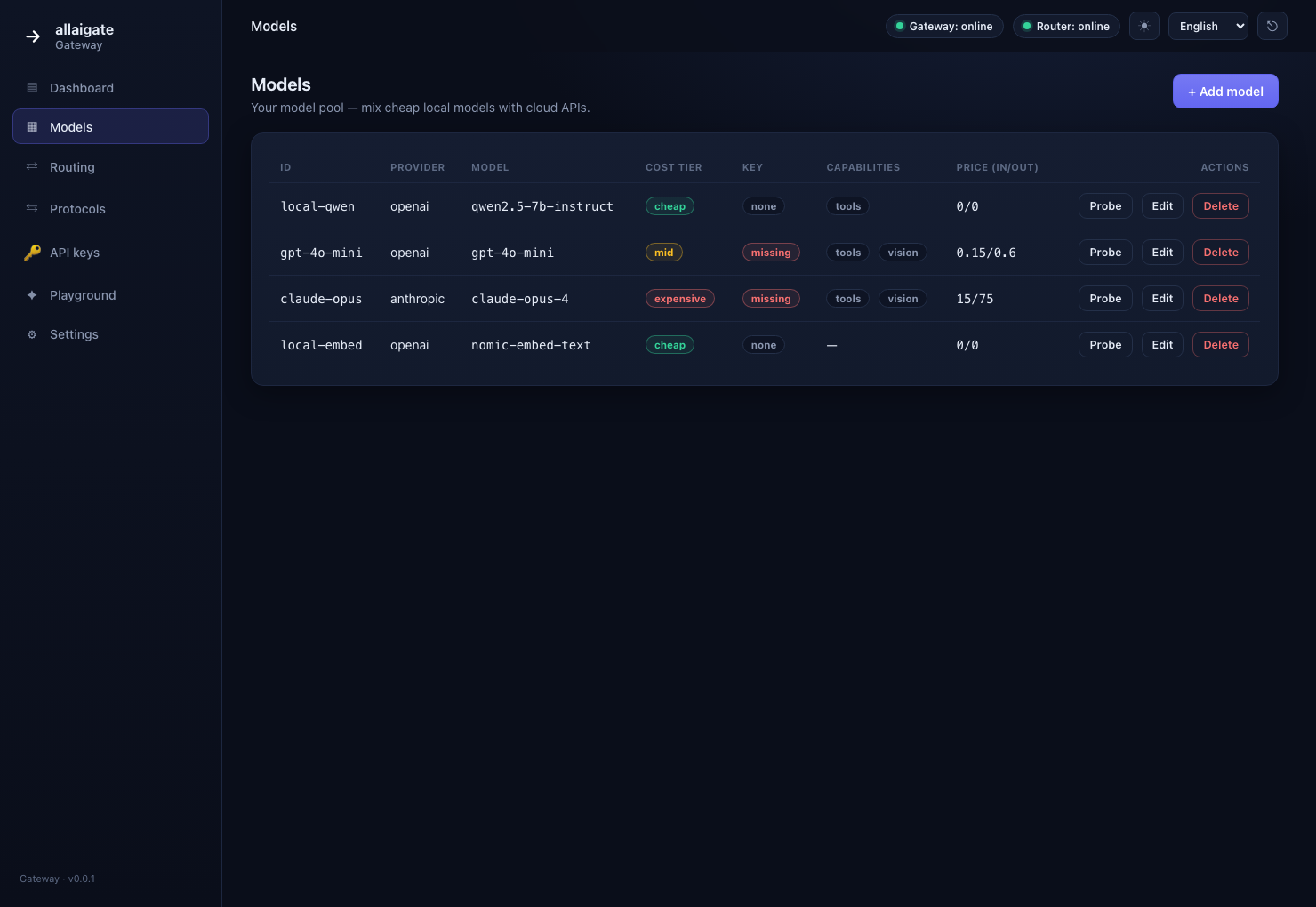
- Built-in multilingual admin console. Manage models, routing, protocols, keys and secrets from a web UI — no hand-editing TOML, no restart (changes are hot-reloaded). Available in 7 languages (en, ru, de, fr, es, zh, tr) with light/dark themes.
- Live analytics. Per-request stats (tokens, cost, latency, success rate, failovers), time-series charts, breakdowns by model/tier/task, and a Prometheus
GET /metricsendpoint. - Playground. Send a prompt through the live pipeline and inspect the routing decision.
- Single self-contained binary. The SPA is embedded into the Rust binary — nothing extra to deploy.
- Secrets stay in the gateway. Agents hold only a virtual gateway key; provider keys live in the gateway and never leak to clients.
📦 Install
# Docker (GitHub Container Registry)
# → admin console at http://localhost:9000/admin
# from crates.io
# or build from source
The image ships a default config and runs out of the box; mount /app/config (with a
gateway.toml) to use your own. Downloaded models and stats live in /app/data — mount
a volume there so they survive container recreates (a host folder works too, e.g.
-v "$PWD/models:/app/data/models"). Tags: :latest, :X.Y.Z, :edge
(linux/amd64 + arm64).
Docker Compose — gateway + a local Ollama model in one command:
# → OpenAI API at http://localhost:9000/v1 · admin at /admin (token: change-me)
See docker-compose.yml. For smart routing, set CORTIQ_ROUTER_KEY
and add a [router] (see docs/ROUTER.md).
Deploying for a team or an office (systemd/launchd/Windows service, TLS reverse proxy, API keys with rate limits and monthly budgets, backups): docs/DEPLOY.md.
🖥️ Admin console
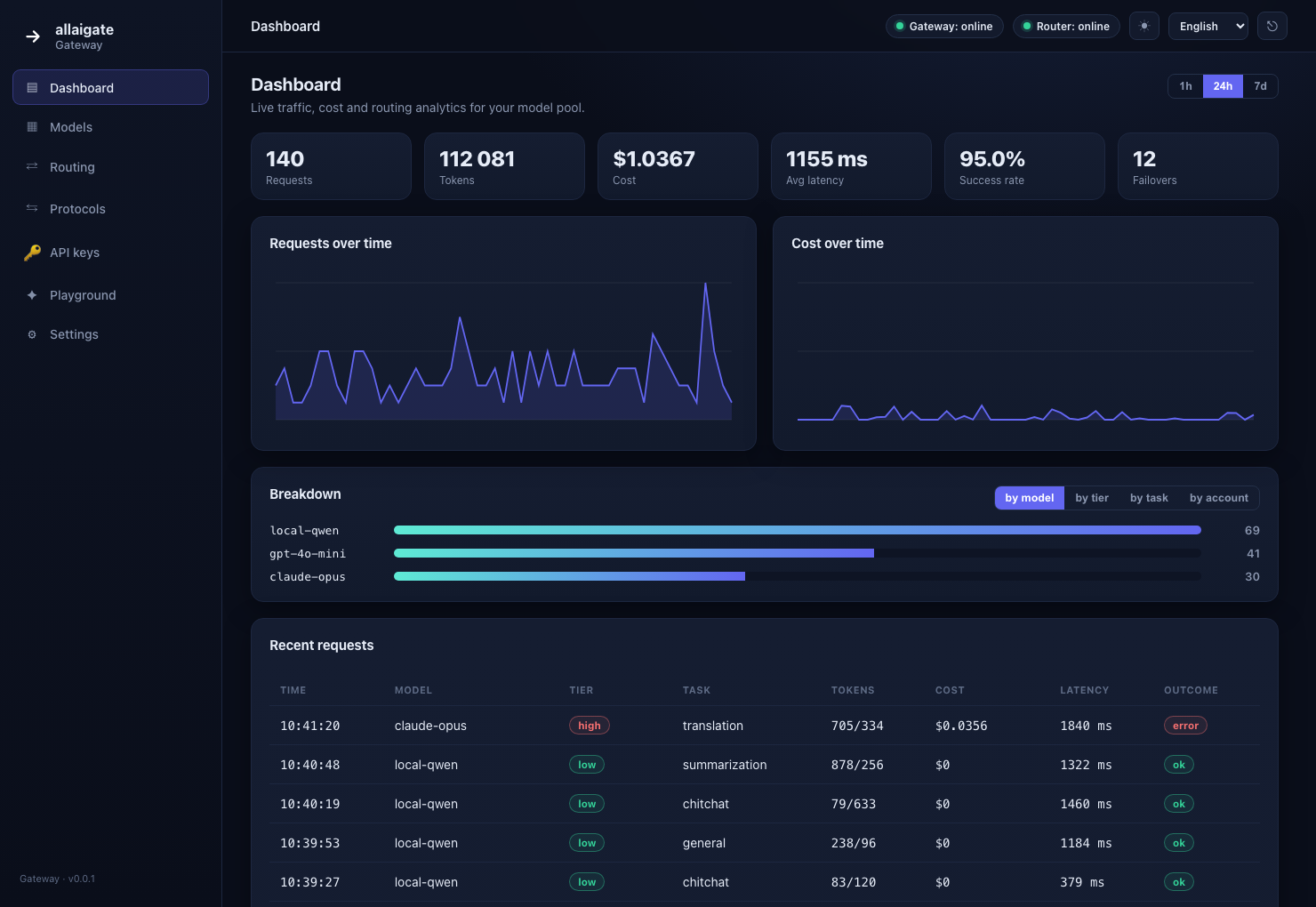
The gateway ships with an embedded web console at /admin:
| Models | Routing |
|---|---|
 |
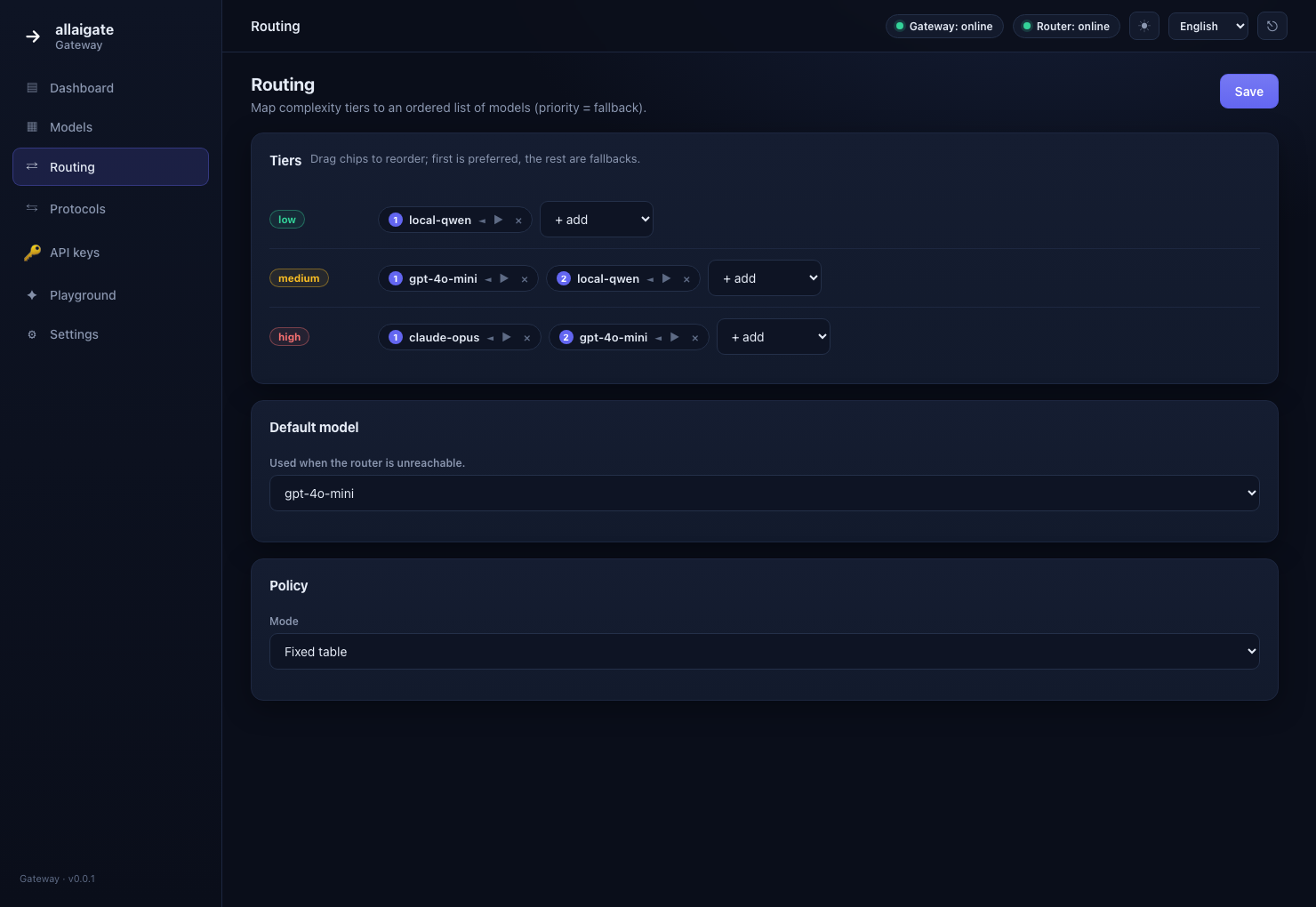 |
| add/edit/probe models, manage provider keys | visual tier editor (ordered, reorderable) |
| Playground |
|---|
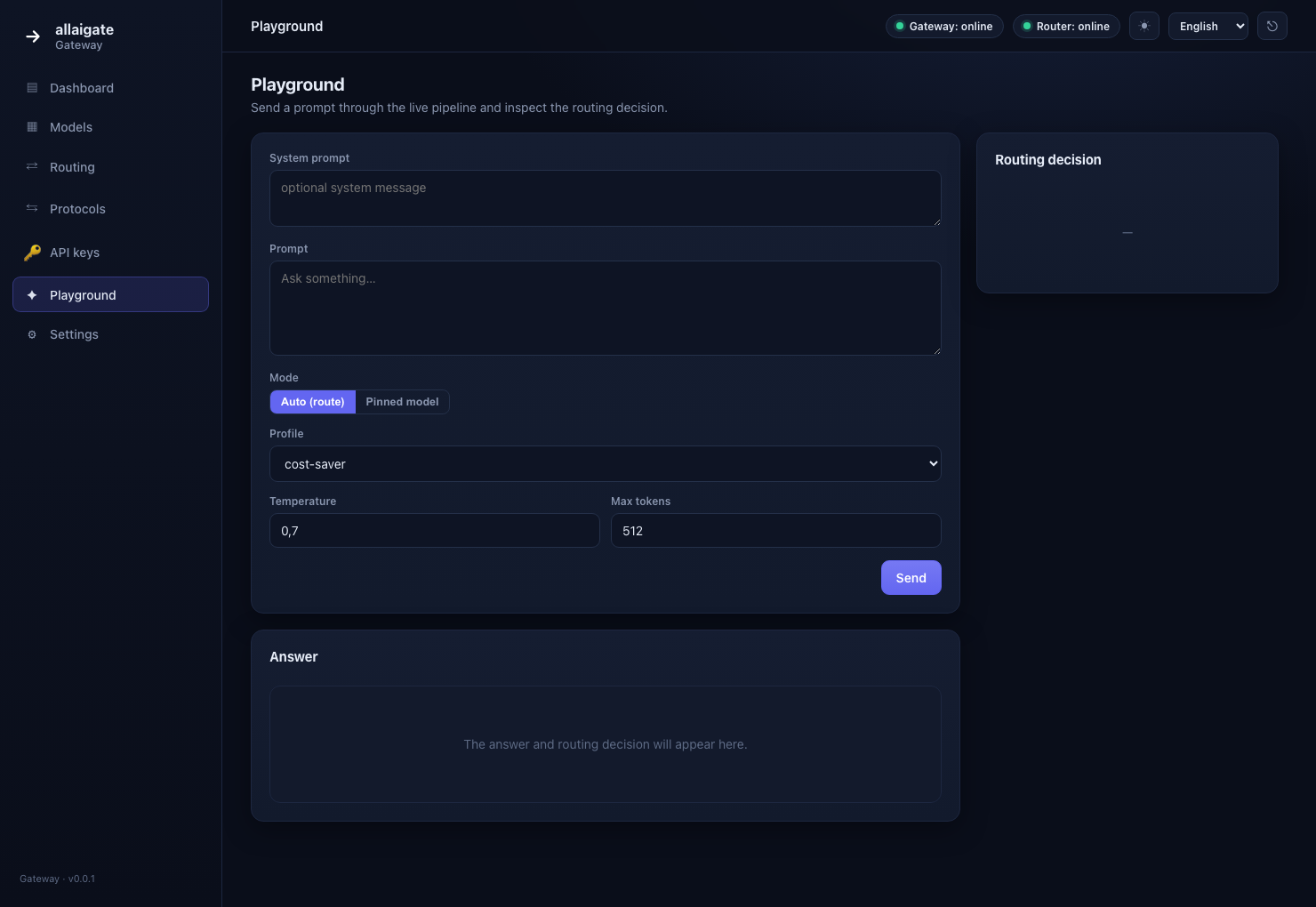 |
| test the live pipeline and see the routing decision |
The console is open by default — no token needed. To protect it, set any one of
--admin-token <TOKEN>, [admin].token, or [admin].token_env:
# open http://localhost:9000/admin?token=<YOUR_TOKEN>
Once a token is set, every /admin/api/* endpoint requires it as a Bearer token. Secret
values are never returned by the API (only their presence: store / env / missing).
🚀 Quick start
That is the whole command. On first run the gateway:
- creates its config —
config/gateway.tomlwhen started from a checkout, otherwise~/.cortiq-gateway/gateway.toml(override with$CORTIQ_GATEWAY_HOMEor--config); - picks a free port if 9000 is taken, and writes the choice back to the config;
- opens your browser on the setup wizard at
/admin#/onboarding.
The wizard takes you from nothing to a working local model:
| Step | What happens |
|---|---|
| Language | 7 languages; changeable later from the header |
| Ready-made models | the infosave .cmf models, read live from HuggingFace — pick a quantization and watch the real download progress |
| Any HF model | search HuggingFace and auto-convert to .cmf |
| Finish | every completed download is connected as a local model, its cortiq serve is started, routing.default points at it, and you land in the Playground |
No TOML editing, no separate "register" step, no manually started model server. Prefer to skip the wizard? Add models from the console (Models, Import model) or hand-write the config — both still work, and changes hot-reload without a restart.
# explicit config / port / no browser — all optional
For smart routing across a pool, point [router] at the hosted allaigate router or a local
cortiq-router (see docs/ROUTER.md). Without a router the gateway degrades
gracefully to the default model, so a local-only setup works out of the box.
Now any OpenAI client works through the gateway:
=
=
# response headers show what the gateway picked:
# X-Cortiq-Task-Label: math
# X-Cortiq-Complexity-Tier: low
# X-Cortiq-Selected-Model: local-qwen
model: "cortiq-auto" enables routing. Any real model name from the config
("gpt-4o-mini", "local-qwen") is a direct passthrough, without routing.
Using the hosted allaigate router? Set
url = "https://138.226.222.209",verify_tls = false,taxonomy_id = "data-assistant", and acortiq_…key inCORTIQ_ROUTER_KEY. On hard prompts the router escalates to an oracle (~10 s), so settimeout_ms = 12000+— otherwise the gateway gracefully degrades to the default model.
🧭 The router (allaigate)
cortiq-auto routing is powered by a semantic router — the classifier that reads a
prompt and returns its task type + complexity. Use the hosted
allaigate router (~94% accuracy on close task types,
patent-pending, privacy-first) or self-host cortiq-router. Pinned models need no router.
🎉 Launch promo: grab a $1 Starter key with code
LAUNCH1at api.allaigate.com (limited activations).
Setup, pricing, API contract and how to verify accuracy: docs/ROUTER.md.
Request flow
- Client →
POST /v1/chat/completions(or Anthropic/MCP) withmodel: "cortiq-auto". - The gateway extracts the text to route on (strategy is configurable, see docs/ROUTING.md).
- Gateway →
cortiq-router /v1/route→ getstask_label+complexity.tier. - Gateway selects a model from the pool via the routing table (with a fallback order).
- Gateway → the selected model's provider (translating the protocol if needed), returns the response.
- Gateway attaches routing metadata in headers/
usageand records cost & statistics.
Details — docs/ARCHITECTURE.md.
Supported protocols (inbound)
Each adapter is toggled in the config — take only what you need.
| Protocol | Endpoint | Status |
|---|---|---|
| OpenAI Chat Completions | POST /v1/chat/completions |
✅ implemented (+ streaming) |
| OpenAI Embeddings | POST /v1/embeddings |
✅ implemented |
| Anthropic Messages | POST /v1/messages |
✅ implemented (+ streaming) |
| MCP (Model Context Protocol) | POST /mcp (JSON-RPC) |
✅ implemented |
| OpenAI Completions (legacy) | POST /v1/completions |
✅ implemented (+ streaming) |
| OpenAI Models | GET /v1/models |
✅ implemented |
| Native passthrough | POST /route |
✅ implemented |
Supported providers (outbound)
| Provider | Covers |
|---|---|
openai (OpenAI-compatible) |
OpenAI, OpenRouter, Together, Groq, vLLM, llama.cpp server, LM Studio, Ollama (/v1) |
anthropic |
Claude Messages API (+ streaming) |
ollama |
native Ollama API |
http |
arbitrary HTTP endpoint (custom adapter) |
Most local servers already expose an OpenAI-compatible API — so the openai
adapter makes the gateway universal with almost no effort.
Configuration
= "0.0.0.0:9000"
[]
= "http://localhost:8080"
= "CORTIQ_ROUTER_KEY"
[[]]
= "local-qwen"
= "openai"
= "http://localhost:8000/v1"
= "qwen2.5-7b-instruct"
= "cheap"
[[]]
= "claude-opus"
= "anthropic"
= "https://api.anthropic.com"
= "claude-opus-4"
= "ANTHROPIC_API_KEY"
= "expensive"
[]
= ["local-qwen"]
= ["claude-opus", "local-qwen"]
= "local-qwen"
Full example — config/gateway.example.toml. Routing & cost-aware selection — docs/ROUTING.md. Everything in the config is also editable from the admin console at runtime.
Cross-standards (like grown-up APIs)
- Auth:
Authorization: Bearer sk-gw-...(virtual gateway keys). - Errors: OpenAI-compatible
{"error": {...}}envelope — parsed natively by SDKs. - Routing metadata:
X-Cortiq-*headers on every response. - Cost accounting: token usage + USD cost and the selected model.
- Observability:
GET /metrics(Prometheus),GET /healthz,GET /readyz.
Details — docs/PROTOCOLS.md.
⚡ Performance & accuracy
Latency — gateway overhead proxying the same instant backend, ab -k -r -c 20 -n 5000:
| Gateway | req/s | p50 | p99 |
|---|---|---|---|
| Cortiq Gateway (Rust) | ~57,300 | 0 ms | 1 ms |
| Portkey (Node) | ~5,800 | 3 ms | 9 ms |
| LiteLLM (Python, 4 workers) | ~1,200 | 9 ms | 59 ms |
Accuracy — task-type routing on natural-language prompts (7 task types). LiteLLM/Portkey have no semantic task router; a keyword heuristic is the DIY stand-in:
| Classifier | Accuracy |
|---|---|
| allaigate semantic router | 100% (37/37) |
| keyword heuristic (no classifier) | 32% (12/37) |
Methodology, caveats and a reproducible harness: BENCHMARKS.md
(bash bench/run.sh, python3 bench/accuracy.py). Numbers vary; the gaps are the point.
Build & test
✅ Tested
| Area | How it's verified | Status |
|---|---|---|
| Config load/save round-trip, routing validation | cargo test (unit) |
✅ |
| Build · format · lint | CI: cargo build / fmt --check / clippy -D warnings on Linux · macOS · Windows |
✅ |
| OpenAI Chat + SSE streaming | integration (mock upstream) | ✅ |
| Anthropic Messages — in/out, streaming + non-streaming | integration (mock) | ✅ |
Embeddings (POST /v1/embeddings) |
integration (mock) | ✅ |
| Semantic cache — hit / miss / savings | integration (mock) | ✅ |
MCP — initialize / tools/list / tools/call |
integration (mock) | ✅ |
Models · Completions · native POST /route |
integration (mock) | ✅ |
| Routing — auto / pinned / failover / degrade | integration (mock and live allaigate router) | ✅ |
| Hot config reload (no restart) | integration | ✅ |
| Latency benchmark vs LiteLLM / Portkey | bench/run.sh (Apache Bench) — see BENCHMARKS.md |
✅ |
| Task-type routing accuracy | bench/accuracy.py — live router 100% vs keyword heuristic 32% |
✅ |
Status
Implemented: OpenAI Chat Completions with SSE streaming, Anthropic provider +
inbound /v1/messages (streaming), embeddings, a semantic cache, MCP server,
routing with fallback & graceful degradation, cost/token accounting, the embedded
multilingual admin console with hot config reload, statistics and Prometheus
GET /metrics. Planned: per-account routing tables, router feedback loop. See the roadmap in
docs/ARCHITECTURE.md.
Contributions welcome — see CONTRIBUTING.md.
License
Apache-2.0 — see LICENSE.